Onward or Onwards: Which Is Correct?
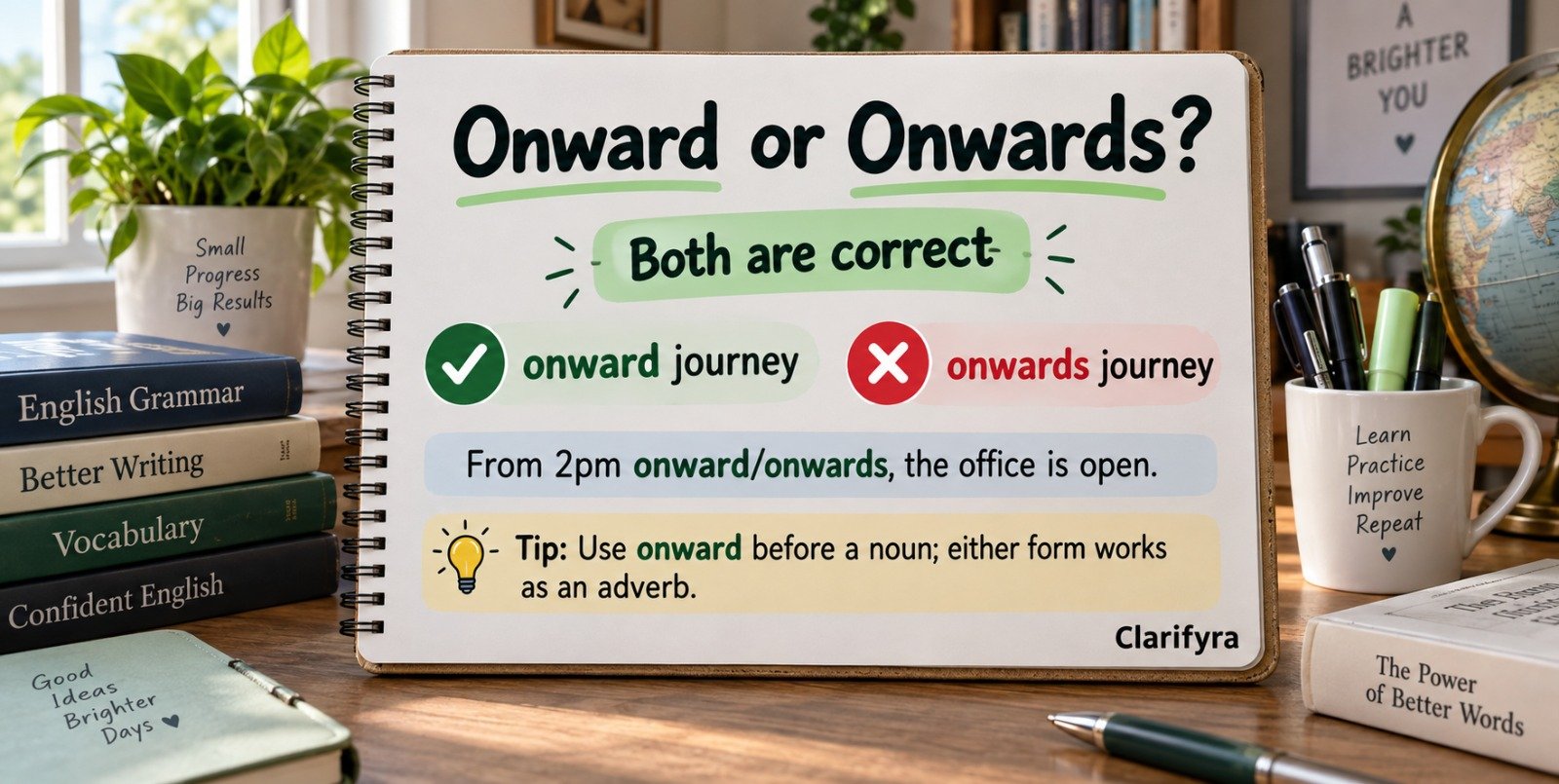
If you are deciding between onward and onwards, the good news is that both forms are correct. They share the same basic idea of moving forward or continuing from a particular point, but their usage differs slightly depending on grammar and regional preference. Onward is especially common in American English and can work as both an adjective and an adverb. Onwards is mainly used as an adverb and is more common in British English. The distinction becomes particularly useful in phrases involving time, such as “from 2pm onward” or “from 2pm onwards.”
Both onward and onwards are correct. Onward is more common in American English and can also appear before a noun, while onwards is more common as an adverb in British English. For time expressions, “from 10 am onward” and “from 10 am onwards” are both acceptable.
Onward or Onwards: What’s the Difference?
When onward and onwards are used as adverbs, their meanings are essentially the same. Both can describe movement forward or continuation after a particular time or stage.
The main differences are:
| Feature | Onward | Onwards |
|---|---|---|
| Correct English? | Yes | Yes |
| Main meaning | Forward; continuing ahead | Forward; continuing ahead |
| Used as an adverb? | Yes | Yes |
| Used as an adjective? | Yes | Normally no |
| More common in | American English | British English |
| Time example | From 10 am onward | From 10 am onwards |
| Before a noun | Onward journey | Not normally “onwards journey” |
For most everyday sentences, the choice depends on the variety of English you are using. However, when the word appears directly before a noun, onward is the appropriate form.
For example:
Correct: We booked an onward flight to Rome.
Not standard: We booked an onwards flight to Rome.
Many English learners mix up similar-looking words such as Honoured or Honored: Which Spelling Is Correct?
What Does “Onward” Mean?
Onward means moving or continuing forward, either physically or figuratively. It may refer to movement through space, progress through a process, or continuation from a point in time.
As an adverb:
- The hikers continued onward despite the rain.
- From Monday onward, the office will open earlier.
- She looked onward toward the next stage of the project.
As an adjective, it appears before a noun:
- We arranged our onward travel.
- Their onward journey took another three hours.
- Passengers should check the gate for their onward flight.
This adjective use is one of the most important differences between the two forms. Onward is more grammatically flexible because it can function as both an adjective and an adverb.
What Does “Onwards” Mean?
Onwards also means forward or continuing from a certain point. It is normally used as an adverb.
Examples include:
- The group walked onwards toward the village.
- From September onwards, the classes will begin at 8:30.
- She worked there from 2022 onwards.
- After resting for a few minutes, they moved onwards.
The word is particularly natural in British English.
Unlike onward, however, it is not normally used directly before a noun. You would therefore say:
an onward journey
rather than:
an onwards journey
Why Are the Two Forms Confusing?
The confusion is understandable because the two words have almost identical meanings when used as adverbs.
Compare:
- The soldiers moved onward.
- The soldiers moved onwards.
Both mean that they continued moving forward.
The difference becomes clearer when you consider regional style and grammatical function. American English tends to favor the shorter adverb onward, while British English frequently uses onwards.
English has several similar pairs where an -s ending can appear in adverbs, such as:
- toward / towards
- backward / backwards
- forward / forwards
Regional preferences vary, so the presence or absence of the final s does not automatically make one form incorrect.
American English vs British English
Regional preference is one of the easiest ways to decide which version to use.
American English
American writers usually prefer onward:
- From 4pm onward, parking is free.
- We continued onward to the next town.
- From this point onward, all requests must be submitted online.
British English
British writers are more likely to use onwards when it functions as an adverb:
- From 4pm onwards, parking is free.
- We continued onwards to the next town.
- From this point onwards, all requests must be submitted online.
British English still uses onward when it functions as an adjective:
- onward journey
- onward connection
- onward travel
- onward flight
If you write for an international audience, either adverbial form will normally be understood. The most important thing is to follow a consistent English style.
How to Use Onward or Onwards for Time
Both words are commonly used to mean starting at a particular time and continuing after it.
For example:
- from Monday onward
- from Monday onwards
- from July onward
- from July onwards
- from 3pm onward
- from 3pm onwards
In these expressions, the meaning is the same.
If a café says:
Open from 2pm onwards
it means the café opens at 2pm and remains open for some period after that.
The American-style equivalent is:
Open from 2pm onward
The word does not tell you exactly when the period ends. It simply establishes the point from which something continues.
Is It “10 AM Onward” or “10 AM Onwards”?
Both forms are grammatically acceptable.
In American English:
Appointments are available from 10 am onward.
In British English:
Appointments are available from 10 am onwards.
You may occasionally see the shorter construction “10 am onward” without from, especially in schedules, notices, or informal writing:
Live music: 10 am onward
That wording can work, but “from 10 am onward” or “from 10 am onwards” is usually clearer in a complete sentence.
From 2pm Onwards or Onward?
Again, both forms are correct:
American English:
The manager will be available from 2pm onward.
British English:
The manager will be available from 2pm onwards.
There is no meaningful difference in the time being described. The distinction is mainly regional.
The same rule applies to other times:
- From 1pm onward / onwards
- From 4pm onward / onwards
- From 6:30pm onward / onwards
- From tomorrow onward / onwards
So if you are wondering whether “from 2pm onwards” or “from 2pm onward” is correct, you can use either one according to your preferred variety of English.
4pm Onwards or Onward?
Both “4pm onwards” and “4pm onward” can be used, especially in shortened schedules or notices.
For example:
US style:
Food will be served from 4pm onward.
UK style:
Food will be served from 4pm onwards.
In a compact event schedule, you might also see:
Entertainment: 4pm onwards
This is especially natural in British English.
For polished prose, adding from often makes the relationship with the starting time clearer.
Examples in Sentences
The easiest way to understand the distinction is to see both forms in natural contexts.
Examples with “Onward”
- The team pushed onward despite the setback.
- From next week onward, meetings will begin at nine.
- She boarded a train for her onward journey.
- The airport provides information about onward travel.
- From that day onward, his routine changed completely.
- We drove onward until we reached the coast.
Examples with “Onwards”
- The walkers continued onwards through the valley.
- From June onwards, the museum stays open later.
- We travelled onwards after lunch.
- From 10 am onwards, visitors may enter without an appointment.
- She lived in Manchester from 2020 onwards.
- They moved onwards to the next stage of the competition.
Notice that onwards works naturally after verbs and time expressions, while onward can additionally modify nouns such as journey, travel, and flight.
Synonyms for Onward and Onwards
Depending on the sentence, useful synonyms include:
- forward
- forwards
- ahead
- further
- forth
- continuing
- advancing
For example:
They moved onwards.
→ They moved forward.
The project moved onward.
→ The project continued.
From Monday onward.
→ Starting Monday and continuing after that point.
Not every synonym works in every grammatical context, so it is better to choose one based on the meaning of the sentence rather than replace the word mechanically.
Common Mistakes to Avoid
One common mistake is assuming that the final -s makes onwards incorrect. It does not. It is a standard English adverb, particularly in British English.
Another mistake is using onwards directly before a noun.
Correct: onward journey
Incorrect in standard usage: onwards journey
The same applies to:
- onward flight
- onward travel
- onward connection
- onward progress
It is also unnecessary to use both forms together. Do not write constructions such as:
from 4pm onward onwards
Choose one according to your style.
Finally, remember that regional preference is not the same as correctness. A British writer using onwards is not making an error, and an American writer using onward is not choosing a different meaning.
An Easy Way to Remember the Difference
A simple memory rule is:
US → onward
UK → often onwards
Then remember one additional rule:
Before a noun → onward
So:
- US: from 5pm onward
- UK: from 5pm onwards
- Both: onward journey
That covers most situations in which you will need to choose between the two forms.
Final Verdict: Which One Should You Use?
Both words are standard English. Use onward if you are following American English, while onwards will often sound more natural as an adverb in British English. When the word comes before a noun, however, choose onward, as in onward journey or onward travel.
For time phrases, both “from 10 am onward” and “from 10 am onwards” mean that something starts at 10 am and continues after that point.
FAQs
Can both “onward” and “onwards” be correct?
Yes. Both are accepted English words. When used as adverbs, they generally have the same meaning. Onward is more common in American English, while onwards is more common in British English.
Is “onwards” formal English?
Yes. Onwards is a standard adverb and is perfectly acceptable in formal writing, particularly in British English. The final -s does not make the word informal or incorrect.
Should I write “from now onward” or “from now onwards”?
Both are correct. From now onward is more typical of American English, while from now onwards is especially natural in British English. Both mean “starting now and continuing into the future.”
Can I say “an onwards journey”?
Normally, no. When the word directly modifies a noun, use onward. Write “an onward journey,” “onward travel,” or “an onward flight.” Onwards is normally used as an adverb rather than an adjective.
What is the best synonym for “onward”?
Forward is usually the closest general synonym. Depending on the sentence, alternatives such as ahead, further, continuing, or advancing may also work.
Is “from 4pm onwards” grammatically correct?
Yes. From 4pm onwards is standard English and is particularly common in British usage. In American English, from 4pm onward is usually preferred. Both indicate that something begins at 4pm and continues afterward.
The distinction is easier once you remember that the two forms share the same basic meaning but differ in regional preference and grammatical flexibility. For clear writing, match the form to your audience and always use onward before a noun—a simple distinction that fits Clarifyra’s goal of helping readers find better ways to say what they mean.
You May Also Read | Minute or Minuet: Meaning, Difference, Spelling, and Examples