Fuelled or Fueled: Which Spelling Is Correct?
If you have ever paused over the extra l in fuelled, you are not alone. The good news is that fuelled and fueled are both correct spellings of the past tense and past participle of fuel. The difference is mainly regional: fuelled is the standard form in British English and is also used in Australian English, while fueled is the usual American English spelling. Canadian English can use either form, with fuelled commonly appearing alongside fueled
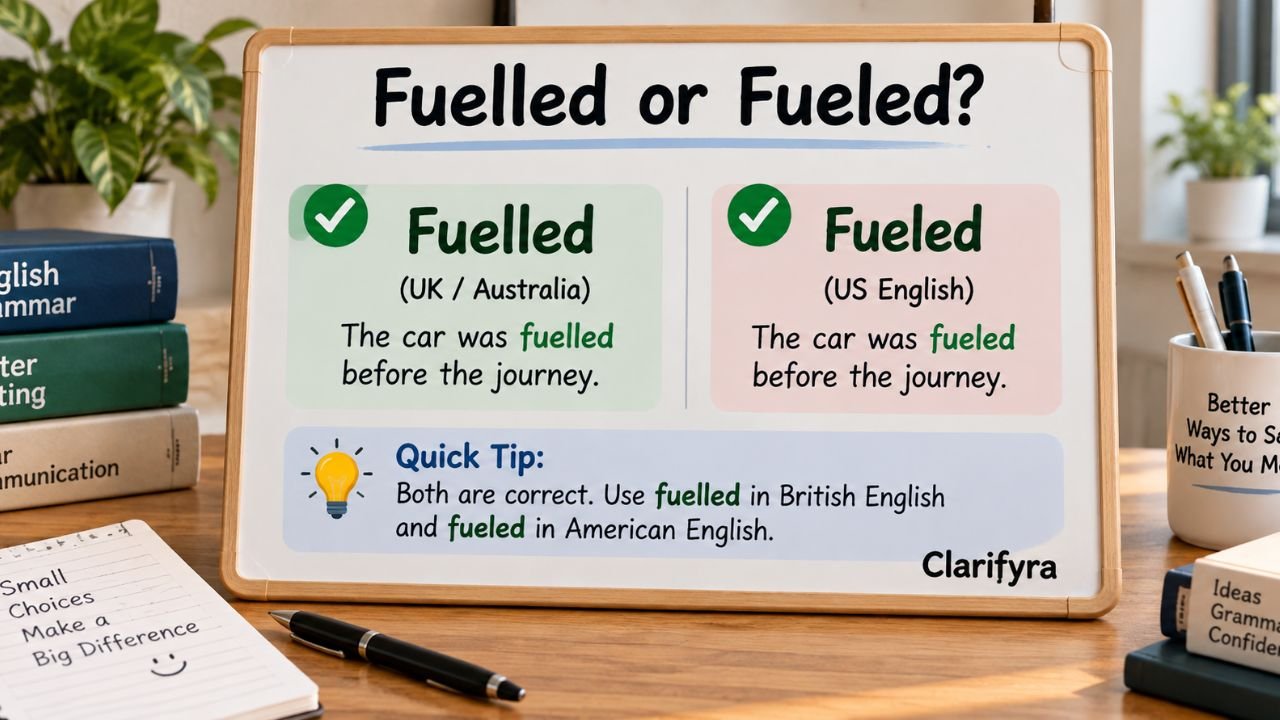
Both “fuelled” and “fueled” are correct. Use fuelled in British and Australian English, while fueled is the usual American English spelling. Canadian English uses both forms, so the best choice there depends on the style being followed.
Fuelled or Fueled: The Main Difference
There is no difference in meaning between the two spellings. Both are forms of the verb fuel.
| Feature | Fuelled | Fueled |
|---|---|---|
| Correct spelling? | Yes | Yes |
| Main association | British English | American English |
| Also used in Australia? | Yes | Less typical |
| Used in Canada? | Yes | Yes |
| Meaning | Past tense/past participle of fuel | Past tense/past participle of fuel |
| Example | The car was fuelled. | The car was fueled. |
Cambridge gives fuelled as the British form and notes that American English usually uses a single l in these verb forms. Oxford likewise lists fueled as the American form and notes that Canadian English usually uses fuelled.
So, if you are writing for a British audience, choose fuelled. If your content follows American English, choose fueled.
What Does “Fuelled” or “Fueled” Mean?
Both forms have exactly the same basic meanings.
As a verb, fuel can mean to provide something with fuel or energy. It can also mean to make something stronger or more intense, particularly a feeling, reaction, trend, or situation.
For example:
- The aircraft was fuelled before take-off.
- The aircraft was fueled before takeoff.
- The report fuelled public concern.
- The report fueled public concern.
- Her success fuelled her ambition.
- Her success fueled her ambition.
Cambridge defines fuel both in its literal sense of supplying power and in its figurative sense of increasing or strengthening something such as a feeling or behaviour.
The spelling changes according to the variety of English, but the meaning and grammatical function remain the same.
Is “Fuelled” British English?
Yes. Fuelled is the usual British English spelling.
British English generally retains the double l in this form:
fuel → fuelled
Examples:
The car was fuelled before the journey.
The heating system is fuelled by gas.
The announcement fuelled speculation about the company’s future.
Cambridge’s British English entry uses fuelled in examples such as “fuelled by” and identifies the American pattern as usually using a single l.
Therefore, if your website follows UK English, fuelled is the appropriate choice.
Fuelled or Fueled UK: Which Should You Use?
For UK writing, use:
✅ fuelled
For example:
The vehicle was fuelled before the long journey.
The American form fueled is understandable to British readers, but fuelled is the conventional British spelling.
Is “Fueled” American English?
Yes. Fueled is the standard American English spelling.
American English normally writes:
fuel → fueled
For example:
The plane was fueled before departure.
Higher demand fueled price increases.
The new discovery fueled interest in the project.
Oxford’s American English dictionary gives fueled as the past simple and fueling as the -ing form.
This is why you will commonly see fueled in American newspapers, books, websites, and other US-focused writing.
Fuelled or Fueled in Australia
Australian English generally follows British spelling conventions for this particular form.
The Australian Broadcasting Corporation’s English-learning guidance explicitly gives:
British and Australian: fuelled
American: fueled
So Australian writers would normally use fuelled:
The car was fuelled before the trip.
The controversy was fuelled by inaccurate information.
The machine is fuelled by diesel.
This is a useful example of why it is important to consider the intended audience rather than treating one spelling as universally correct.
Fuelled or Fueled in Canada
Canadian English is a little less straightforward.
Both fuelled and fueled can be found in Canadian English. Oxford specifically notes that Canadian English usually uses fuelled and fuelling, while other references also document both forms in Canadian usage.
For Canadian writing, therefore, neither spelling should automatically be treated as an error.
If you are writing for a Canadian publication, employer, school, or organization, follow its established style guide. If no specific style is required, consistency is more important than switching between forms.
For example:
The campaign was fuelled by public enthusiasm.
or:
The campaign was fueled by public enthusiasm.
Both spellings can be encountered in Canadian English.
What About “Fuelling” and “Fueling”?
The same regional distinction appears in the present participle or gerund form.
British and Australian English
fuelling
The company is fuelling the vehicle.
American English
fueling
The company is fueling the vehicle.
Oxford lists fueling as the American form and fuelling as the form usually used in Canadian English.
This gives you a useful pattern:
| Base verb | British/Australian | American |
|---|---|---|
| fuel | fuel | fuel |
| past tense | fuelled | fueled |
| past participle | fuelled | fueled |
| -ing form | fuelling | fueling |
The distinction is especially useful if you are trying to keep an entire article consistent with either British or American English.
Why Do the Spellings Differ?
The difference is part of a broader pattern of spelling variation between British and American English.
For example:
- colour — British/Australian
- color — American
- centre — British/Australian
- center — American
- theatre — British/Australian
- theater — American
ABC Education identifies fuelled as an exception within its discussion of double-l spelling patterns: British and Australian English use fuelled, while American English uses fueled.
It is better to learn this as a specific spelling distinction rather than assuming that every English word ending in l will follow exactly the same pattern. English spelling contains many individual conventions and exceptions.
Fuelled vs Fueled in Sentences
Seeing the two forms side by side makes the difference easier to understand.
British English
The car was fuelled before the journey.
The fire was fuelled by strong winds.
The announcement fuelled further debate.
Her determination was fuelled by years of experience.
American English
The car was fueled before the trip.
The fire was fueled by strong winds.
The announcement fueled further debate.
Her determination was fueled by years of experience.
Notice that the meaning of each pair is unchanged. Only the spelling differs.
Common Mistakes to Avoid
1. Treating “fueled” as universally incorrect
It is not incorrect. It is the normal American spelling.
2. Treating “fuelled” as a misspelling
It is not a misspelling. It is the standard British form and is also used in Australian English.
3. Mixing styles unnecessarily
If an article is written in British English, using fuelled alongside American spellings such as color and center can make the writing inconsistent.
The same applies to American English.
4. Assuming Canada follows only one system
Canadian spelling has influences from both British and American English, and fuelled and fueled can both occur. Oxford specifically records fuelled as the usual Canadian form in its American English entry.
Easy Way to Remember the Difference
A simple rule is:
UK/Australia → fuelled
US → fueled
Think of the extra l as part of the British-style spelling:
British: fuelled
American: fueled
The same distinction carries over to the related forms:
British: fuelling
American: fueling
If you are writing for an international audience, choose one variety of English and use it consistently throughout the article.
Which Form Should You Use?
The best spelling depends on your intended audience.
If you are writing British English, use fuelled.
If you are writing American English, use fueled.
If you are writing Australian English, fuelled is the conventional choice.
For Canadian English, either form may be encountered, but fuelled is commonly recognized as the Canadian preference in major learner-dictionary guidance.
The important thing is not to change the spelling randomly. Consistent regional spelling makes your writing look more polished and deliberate.
FAQ
Is “fuelled” or “fueled” correct?
Both are correct. Fuelled is the usual British and Australian spelling, while fueled is the standard American spelling. Canadian English can use both, with fuelled commonly preferred in dictionary guidance.
Is “fuelled” British or American?
Fuelled is primarily associated with British English. It is also the conventional Australian spelling and is used in Canadian English. American English normally uses fueled.
Is “fueled” a British spelling?
It can be understood in British English, but fuelled is the standard British spelling. Fueled is primarily the American form.
Is “fuelled” used in Australia?
Yes. Australian English generally follows British spelling for this word, so fuelled is the normal Australian form. ABC Education specifically lists fuelled as the British and Australian spelling.
Which is correct in Canada: fuelled or fueled?
Both can be found in Canadian English. Oxford lists fuelled as the form usually used in Canadian English, although fueled also occurs.
Does “fuelled” have a different meaning from “fueled”?
No. They have the same meaning and grammatical function. The difference is primarily regional spelling, not vocabulary or definition.
The Bottom Line
Fuelled and fueled are both correct forms of fuel. Choose fuelled for British and Australian English, and fueled for American English. In Canada, both forms occur, with fuelled commonly recognized as the Canadian preference. The key is to match your spelling to your audience and remain consistent. For more clear explanations of confusing English choices, Clarifyra helps you find better ways to say what you mean.