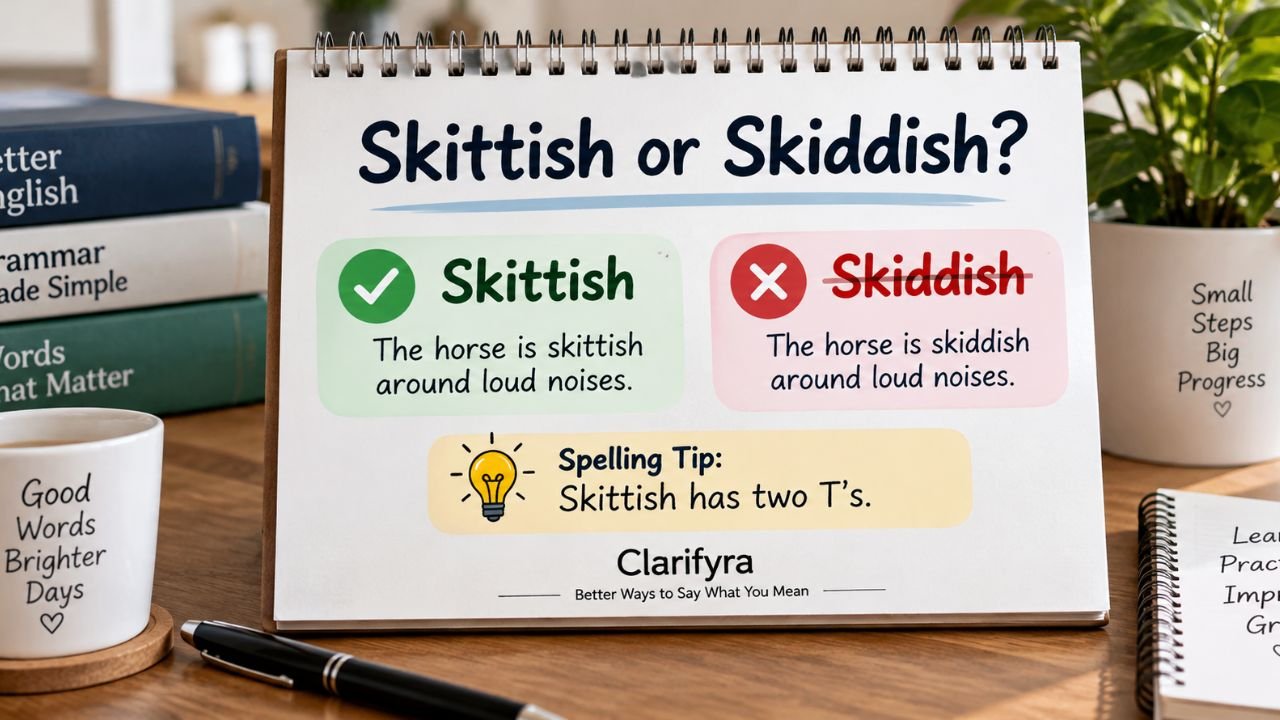
Skittish or Skiddish: Which Is Correct?
Have you ever written “skiddish” and then wondered whether it should actually be “skittish”? The two forms look and sound similar, so the confusion is understandable. However, when you mean someone or something that is nervous, easily frightened, or quick to react, standard English uses skittish. The spelling skiddish is generally treated as a misspelling or nonstandard form rather than an alternative spelling. Dictionaries such as Cambridge and Collins recognize skittish and give it several related meanings.
Skittish is the correct standard spelling. Skiddish is generally a misspelling or nonstandard form when it is intended to mean nervous, easily frightened, or easily startled. There is also no standard British-versus-American spelling difference: both British and American English use skittish.
Skittish or Skiddish: Which Is Correct?
If you are deciding which form to use in your writing, choose skittish.
| Feature | Skittish | Skiddish |
|---|---|---|
| Standard spelling | ✅ Yes | ❌ No |
| Part of speech | Adjective | Not standard in this sense |
| Meaning | Nervous, easily frightened, jumpy, or unpredictable | Usually intended as a misspelling of skittish |
| British English | ✅ Used | ❌ Not standard |
| American English | ✅ Used | ❌ Not standard |
| Example | The horse is skittish. | The horse is skiddish. ❌ |
Cambridge lists skittish as an adjective in both its UK and US dictionary entries, while Wiktionary specifically records skiddish as a misspelling of skittish.
So if you’re writing an email, article, essay, school assignment, or professional document, skittish is the form to use.
What Does “Skittish” Mean?
Skittish is an adjective used when someone or something is nervous, easily frightened, easily startled, or prone to reacting quickly.
It is especially common when describing animals.
For example:
- The skittish horse backed away when the gate opened.
- The cat is skittish around unfamiliar people.
- The deer became skittish after hearing the sudden noise.
- She seemed skittish before the interview.
Cambridge defines the word as describing people and animals that are nervous or easily frightened. It also gives a figurative use for investors who are uncertain or nervous about economic conditions.
The word can therefore describe both physical reactions to fear and uncertainty or nervousness in a broader sense.
Skittish can describe people, too
Although animals are a familiar context, skittish is not restricted to animals.
For example:
He became skittish when the conversation turned toward money.
Here, skittish suggests that he became nervous or uncomfortable and perhaps reacted cautiously.
It can also describe someone whose mood, ideas, or opinions change unpredictably. Cambridge records this additional sense, while Collins also includes meanings related to lively, changeable, or difficult-to-predict behavior.
Is “Skiddish” a Real Word?
When skiddish is used as an alternative spelling of skittish, it is generally considered a misspelling or nonstandard form.
Wiktionary explicitly labels skiddish as a misspelling of skittish. Several English usage guides likewise distinguish the standard spelling skittish from the frequently encountered incorrect form skiddish.
That means you should not write:
❌ The puppy was skiddish around strangers.
Instead, write:
✅ The puppy was skittish around strangers.
The same applies when describing people or figurative situations:
❌ Investors became skiddish after the announcement.
✅ Investors became skittish after the announcement.
The important point is that skiddish should not be treated as a separate word with a different standard meaning in ordinary English writing.
Why Do People Confuse the Two Spellings?
The confusion is understandable because skittish is not spelled exactly as it might sound when spoken quickly.
One likely source of the mistake is the familiar word skid. Someone who knows the word skid may naturally imagine a form such as skiddish. The resulting spelling looks plausible even though it is not the standard form.
Pronunciation can also contribute. Cambridge gives the UK pronunciation as approximately /ˈskɪt.ɪʃ/ and the US pronunciation as approximately /ˈskɪt̬.ɪʃ/.
If someone has heard the word without seeing it written, they may remember its sound but substitute d for tt.
This is a common type of spelling error: a person writes what they think they heard rather than the established spelling.
Correct Usage Examples
Seeing the word in context makes the difference easier to remember.
Animals
Correct: The skittish horse moved away from the noisy crowd.
Incorrect: The skiddish horse moved away from the noisy crowd.
People
Correct: She became skittish when she realized everyone was watching her.
Incorrect: She became skiddish when she realized everyone was watching her.
Pets
Correct: Our new kitten is still skittish around visitors.
Incorrect: Our new kitten is still skiddish around visitors.
Markets and investors
Correct: Investors remained skittish because of the uncertain economic outlook.
Incorrect: Investors remained skiddish because of the uncertain economic outlook.
The figurative use is well established. Cambridge, for example, uses skittish in relation to investors, showing that the word can describe uncertainty and caution rather than literal fear.
Skittish vs. Shy: Are They the Same?
Not exactly.
Shy usually describes someone who is uncomfortable with attention, social interaction, or unfamiliar people.
Skittish suggests nervousness, jumpiness, or a tendency to react suddenly to something unexpected.
For example:
The child is shy around strangers.
This focuses on social reserve.
The horse is skittish around loud noises.
This focuses on being easily startled.
The two words can overlap, but they are not interchangeable in every sentence.
Other words that may fit the context include nervous, jumpy, wary, uneasy, excitable, restless, and easily frightened. Collins lists nervous, lively, excitable, and jumpy among related words for skittish.
Skittish or Skiddish UK: Is There a British Spelling?
If you are wondering about skittish or skiddish in UK English, the answer is straightforward: British English uses skittish.
There is no standard British spelling skiddish corresponding to the American spelling skittish.
Cambridge identifies the UK pronunciation separately from the US pronunciation, but the written form remains skittish in both varieties.
| Variety | Standard spelling |
|---|---|
| British English | skittish |
| American English | skittish |
| Canadian English | skittish |
| Australian English | skittish |
This makes it different from pairs such as colour/color and centre/center, where British and American spelling conventions genuinely differ.
With skittish, there is no need to choose between a British and American spelling.
Grammar and Related Forms
Skittish is an adjective.
It normally comes before a noun or after a linking verb.
Before a noun
a skittish horse
a skittish cat
a skittish investor
After a linking verb
The horse became skittish.
The dog seems skittish.
Investors remain skittish.
There are also related forms such as skittishly, an adverb, and skittishness, a noun.
For example:
The horse moved skittishly across the field.
Cambridge lists skittishly as an adverb meaning in a nervous or easily frightened way.
You would not normally use skittish as a verb.
❌ The noise skittished the birds.
A natural alternative would be:
✅ The noise made the birds skittish.
A Simple Way to Remember the Spelling
The easiest rule is:
Skittish has two T’s.
Think of the spelling this way:
S-K-I-T-T-I-S-H
The middle contains TT, not DD.
A quick memory cue is:
Skittish = two T’s
If you are unsure while writing, pause and remember that the standard spelling is skittish, not skiddish.
Common Mistakes to Avoid
1. Using “skiddish”
❌ The dog is skiddish.
✅ The dog is skittish.
2. Using only one T
Another possible spelling mistake is skitish.
❌ The cat is skitish.
✅ The cat is skittish.
Remember the double T.
3. Assuming it is an American spelling
Skittish is not an American-only form. It is used in both British and American English.
4. Thinking the word only applies to animals
You can describe people, investors, markets, and other situations as skittish when the meaning fits.
5. Using it to mean “angry”
Skittish generally suggests nervousness, jumpiness, or uncertainty—not anger.
For example:
The horse was skittish after hearing the thunder.
The horse was frightened or easily startled; it was not necessarily angry.
How to Choose the Right Word
When you mean nervous, easily frightened, easily startled, or unpredictable, use:
skittish ✅
When you see skiddish used with that intended meaning, treat it as a nonstandard spelling and replace it with skittish in polished writing.
A useful check is to ask yourself:
Am I describing something that is nervous or easily startled?
If yes, the spelling you want is skittish.
FAQs
Which is correct, skittish or skiddish?
Skittish is the standard spelling. Skiddish is generally a misspelling or nonstandard form when it is intended to mean nervous, easily frightened, or easily startled.
What is the meaning of skittish?
Skittish is an adjective meaning nervous, easily frightened, easily startled, or jumpy. It can also describe something unpredictable or, in some contexts, a person whose opinions or behavior change readily.
Is “skiddish” an American spelling?
No. Skiddish is not a standard American spelling of skittish. The standard spelling is skittish in both American and British English.
Is skittish a British word?
Yes. Skittish is used in British English as well as American English. Cambridge provides both UK and US pronunciations for the word, while keeping the spelling the same.
Is skittish an adjective?
Yes. Skittish is an adjective. You can say a skittish horse, a skittish dog, or the horse became skittish.
How can I remember how to spell skittish?
Remember: skittish has two T’s. Write it as SKI + TT + ISH. If you are choosing between skittish and skiddish, choose the form with TT.
Final Verdict
The standard choice is skittish, with two T’s. It is an adjective used for people or animals that are nervous or easily frightened and can also describe uncertain, changeable, or unpredictable situations.
Skiddish is generally a misspelling rather than a separate standard English word. There is no British-versus-American spelling distinction here, so skittish is the form to use for both UK and US audiences. For clear, accurate English, that’s the spelling worth remembering—and that is exactly the kind of distinction Clarifyra aims to make easier to understand.