65 Other Ways to Say “Good Luck” for Every Situation
“Good luck” is a perfectly natural way to encourage someone before an exam, interview, competition, presentation, journey, or important life event. Still, those two words can sometimes feel too brief, too familiar, or not quite right for the relationship or situation.
There are many other ways to say “good luck” that can sound more supportive, professional, affectionate, funny, or motivating. You might tell a nervous friend, “You’ve got this,” wish a colleague “every success,” or say “Bring it home!” before a big game. The best phrase depends less on finding a perfect synonym and more on matching your words to the moment.
A Quick Comparison of Good Luck Alternatives
| Alternative | Tone | Best Used For |
|---|---|---|
| Best of luck | Friendly, neutral | Exams, interviews, everyday situations |
| All the best | Warm, versatile | Work, life changes, messages |
| You’ve got this | Encouraging, casual | Friends, coworkers, exams |
| Wishing you success | Professional | Projects, academic and business settings |
| I’m rooting for you | Warm, supportive | Friends, family, partners |
| Fingers crossed | Casual | Results, applications, uncertain outcomes |
| Go crush it | Energetic | Sports, presentations, interviews |
| Break a leg | Playful, traditional | Performances, auditions |
| I hope it goes well | Neutral, sincere | Almost any everyday situation |
| I believe in you | Personal, emotional | Loved ones and close relationships |
These expressions are not completely interchangeable. “Wishing you success” fits a professional email much better than “Go crush it,” while “Break a leg” has a specific association with performances and auditions rather than everyday situations. Modern English-language guides similarly distinguish professional, motivational, conversational, and situation-specific alternatives.
You May Also Read | Cute Ways to Say Goodnight: Sweet, Romantic and Flirty Ideas
What Does “Good Luck” Really Mean?
When you tell someone “good luck,” you are expressing the hope that things turn out well for them.
For example:
“Good luck with your interview tomorrow.”
“Good luck in the final!”
“Good luck with your new job.”
The phrase does not necessarily suggest that success depends entirely on chance. In normal conversation, it often functions as a simple expression of encouragement and support.
That distinction matters because some alternatives focus on luck, while others focus on ability, preparation, confidence, or success.
“Fingers crossed” focuses on hoping for a favorable outcome.
“You’ve got this” focuses on confidence.
“I believe in you” focuses on emotional support.
“Wishing you every success” focuses on the desired result.
Understanding these differences helps you choose language that sounds natural rather than simply swapping one phrase for another.
Best Alternatives to “Good Luck”
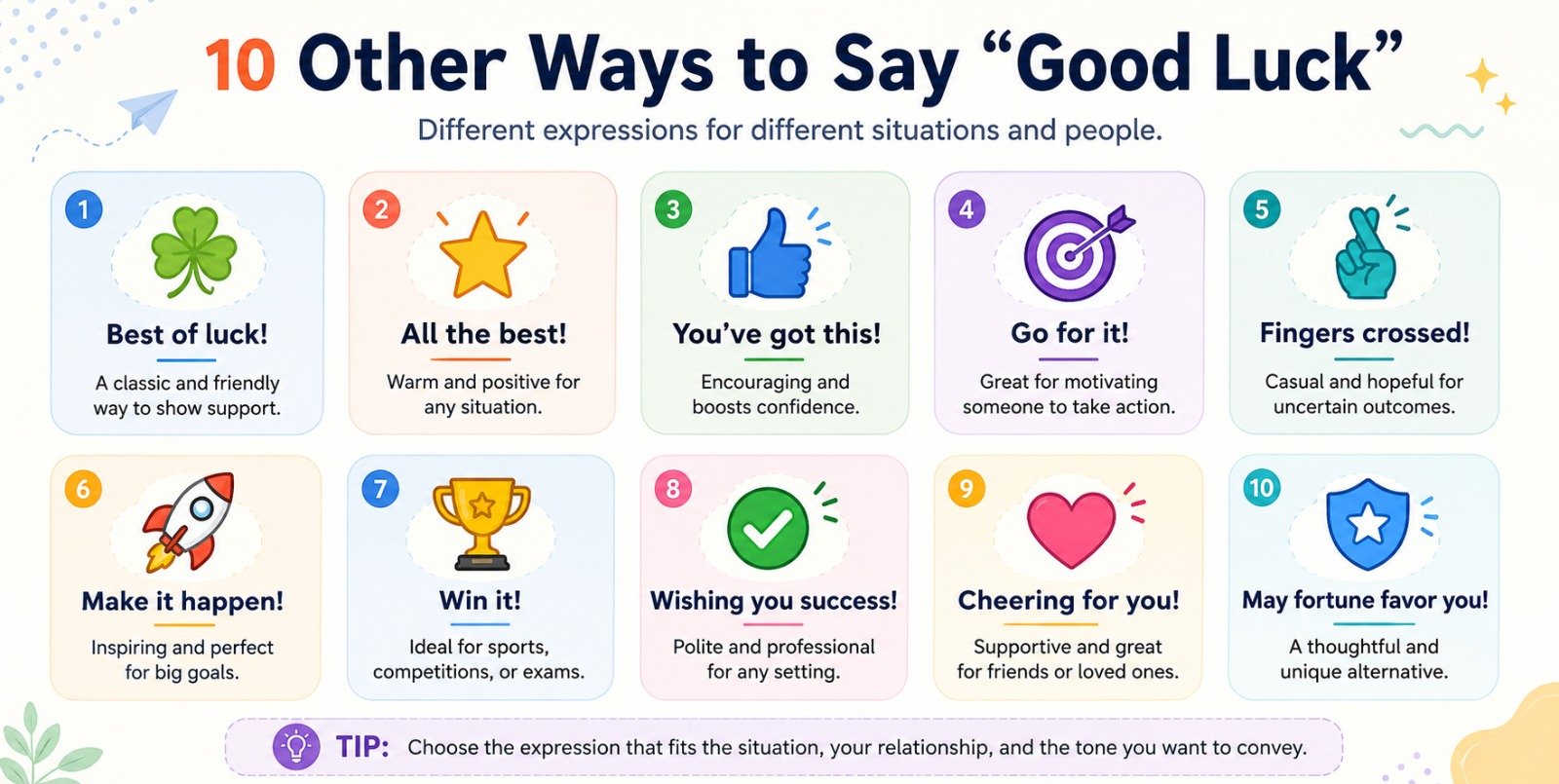
If you need a versatile phrase that works in many situations, start with these:
- Best of luck
- All the best
- Wishing you the best
- You’ve got this
- I hope it goes well
- Fingers crossed
- I’m rooting for you
- Wishing you success
- I believe in you
- You’ll do great
- Give it your best shot
- Go for it
- Make it happen
- Go get ’em
- Sending good vibes your way
Some of these are close substitutes for “good luck,” while others change the emphasis. For example, “You’ll do great” shows confidence in the person, whereas “Fingers crossed” acknowledges that the outcome may still depend on circumstances.
Other Ways to Say “Good Luck” Professionally
Professional communication usually benefits from wording that feels positive without sounding overly casual.
Good options include:
1. Wishing You Every Success
This is polished and slightly formal, making it useful for new positions, projects, presentations, and career changes.
Example:
“Wishing you every success in your new role.”
2. Wishing You All the Best
Warm without being too personal, this works well with colleagues, clients, and professional contacts.
Example:
“Wishing you all the best with tomorrow’s presentation.”
3. I Hope Everything Goes Well
This is natural, neutral, and suitable for most workplace situations.
Example:
“I hope everything goes well during your meeting with the client.”
4. Best Wishes
“Best wishes” is particularly natural when someone is starting a new chapter or moving on professionally.
Example:
“Best wishes as you begin your new position.”
5. Wishing You Success
This option focuses directly on achievement and suits business or academic communication.
Example:
“Wishing you success with the upcoming launch.”
6. I’m Confident You’ll Do Well
This goes beyond wishing for luck and shows confidence in the person’s preparation or ability.
Example:
“You’ve prepared thoroughly, and I’m confident you’ll do well.”
7. I Wish You Continued Success
This is useful when the person has already achieved something and you are wishing that success continues.
Example:
“I wish you continued success in the next stage of your career.”
In professional settings, “good luck” itself is not incorrect or unprofessional. More polished alternatives simply allow you to adjust the warmth and formality of the message.
Other Ways to Say “Good Luck” Casually
With friends, siblings, classmates, or coworkers you know well, your wording can be much more relaxed.
Try:
- You’ve got this!
- Go for it!
- Go get ’em!
- You’ll nail it!
- Go crush it!
- You’re going to do great.
- Give it your best shot.
- Show them what you’ve got.
- I’m rooting for you.
- Fingers crossed!
- Sending good vibes.
- Make it happen!
- You can do this.
- Go smash it!
- Time to shine!
Examples:
“You’ve practiced all week. You’ve got this!”
“Big interview today? Go crush it!”
“I’ll be rooting for you from here.”
“You’re ready. Go show them what you can do.”
Expressions such as “You’ve got this” and “I’m rooting for you” can feel more personal than “good luck” because they communicate confidence and support.
Other Ways to Say “Good Luck” Without Saying Good Luck
Sometimes the most meaningful encouragement does not mention luck at all.
You can focus instead on the person’s effort, preparation, or ability:
- I believe in you.
- You’re ready for this.
- Trust yourself.
- You’ve prepared well.
- I know you can do it.
- Give it everything you’ve got.
- I’m cheering for you.
- Show them what you can do.
- Stay confident.
- You’re more than ready.
- Do your best.
- Make yourself proud.
- Trust your training.
- You know what you’re doing.
- I know you’ll do great.
Compare these two messages:
“Good luck on your exam.”
“You’ve studied hard for this. Trust yourself.”
Both are supportive, but the second message reinforces the person’s preparation rather than leaving the emphasis on chance.
That makes confidence-based wording especially useful before exams, interviews, presentations, competitions, and other situations where someone has worked hard to prepare.
Other Ways to Say “Good Luck” to Someone You Care About
When the person is close to you, a warmer message often feels more sincere than a generic wish.
Try:
- I believe in you.
- I’ll be thinking of you.
- I’m rooting for you all the way.
- You’re going to be amazing.
- I know you can do this.
- I’m so proud of you already.
- Go make yourself proud.
- I’m cheering you on.
- Whatever happens, I’m behind you.
- You’ve worked so hard for this.
- I can’t wait to hear how it goes.
- I know you’ll give it your best.
For example:
“You’ve worked incredibly hard for this. I believe in you.”
“I’ll be thinking of you today. You’re going to do great.”
“Whatever happens, I’m proud of how far you’ve come.”
These phrases communicate emotional support, which may matter more than luck when someone is nervous or under pressure.
Cute Ways to Say “Good Luck” to Your Boyfriend
A message to your boyfriend can be affectionate, playful, or reassuring depending on your relationship.
Natural options include:
- You’ve got this, handsome.
- I believe in you, babe.
- Go make me proud!
- You’re going to be amazing.
- I’m your biggest cheerleader.
- Go show them how good you are.
- I’m rooting for you, love.
- Sending you lucky kisses.
- I’ll be thinking about you.
- You’ve worked hard for this.
- Go shine, babe.
- I know you can do it.
- I can’t wait to hear how well it went.
- You’re already a winner to me.
- Sending you all my positive energy.
Example:
“You’ve prepared so hard for this, babe. Trust yourself and go show them what you can do.”
For a shorter text:
“You’ve got this ❤️ Go make yourself proud!”
Cute wording works best when it sounds like something you would naturally say to your partner. Overly romantic language can feel awkward if that is not how you normally communicate.
Funny Ways to Say “Good Luck”
A little humor can make someone relax before a stressful moment.
Try these with people who understand your sense of humor:
- Don’t mess it up!
- Try not to panic.
- May luck finally remember your address.
- Go make questionable decisions successfully.
- No pressure. Only your entire future depends on this.
- Return victorious!
- Try not to become famous without me.
- Go pretend you’re not nervous.
- May your coffee be strong and your problems be small.
- Go make everyone jealous.
- Try not to break anything.
- May the universe cooperate for once.
- Go do something impressive.
- Don’t forget me when you win.
- Fake confidence until real confidence shows up.
Example:
“Big interview today? Try not to become CEO before lunch.”
Or:
“Go crush it. And if that fails, pretend it was part of the plan.”
Humorous wishes are highly relationship-dependent. A phrase like “Don’t mess it up” can be funny between close friends but dismissive or rude when said to a colleague, manager, or someone who is genuinely anxious. Lists of modern alternatives often include playful expressions, but their appropriateness depends strongly on context.
Other Ways to Say “Good Luck” for Sports
Sports usually calls for energetic, action-focused encouragement rather than formal well-wishes.
Good options include:
- Bring it home!
- Go crush it!
- Give it everything!
- Play your heart out!
- Show them what you’ve got!
- Go get that win!
- Leave it all on the field.
- Trust your training.
- Play your game.
- Go dominate!
- Make us proud!
- Stay focused.
- Go get ’em!
- Time to shine.
- Finish strong.
- Give it your all.
- Go make it happen.
- You’re ready for this.
- Own the moment.
- Make every second count.
Example:
“You’ve trained hard for this. Trust your training and bring it home.”
For a team:
“Play your game, stay focused, and give it everything.”
“Break a leg” would sound strange before most sporting events, while “Bring it home” or “Go crush it” matches the competitive energy better. Current language guides also recommend more energetic expressions in sports and competition contexts.
Other Ways to Say “Good Luck” Before an Exam
Students often need reassurance more than a reminder about luck.
Useful phrases include:
- You’ve got this.
- Trust what you know.
- You’re well prepared.
- Go ace it!
- Stay calm and focused.
- Believe in yourself.
- You know more than you think.
- Give it your best shot.
- You’re ready.
- Take your time and trust yourself.
- I know you’ll do great.
- Show what you know.
- Keep a clear head.
- You’ve done the work.
- Go smash that exam.
Example:
“You’ve studied hard. Stay calm, trust yourself, and show what you know.”
This sounds more encouraging than simply saying “good luck” because it reminds the student that preparation matters.
Other Ways to Say “Good Luck” for a Job Interview
A job interview is another situation where confidence-based language works particularly well.
Try:
- You’re going to do great.
- Go show them what you can do.
- You’re ready for this.
- Be yourself and stay confident.
- I’m rooting for you.
- You’ve prepared well.
- Go impress them.
- Trust yourself.
- They’d be lucky to have you.
- I hope the interview goes smoothly.
- Wishing you every success.
- Show them why you’re the right person.
- You know your stuff.
- Walk in with confidence.
- You’ve got this.
Examples:
“You’ve prepared well. Walk in confidently and be yourself.”
Or, for a partner or friend:
“They’d be lucky to have you. Go show them what you can do.”
Other Ways to Say “Good Luck” Before a Performance
Some expressions have specific cultural associations with performances.
The most famous is:
Break a leg!
Despite its literal wording, “break a leg” is traditionally used to wish performers success before going on stage.
Other possibilities include:
- Knock ’em dead!
- Own the stage!
- Steal the show!
- Blow them away!
- Go shine!
- Dazzle them!
- You’re going to be amazing.
- The stage is yours.
- Give them a show to remember.
- Go make some magic.
Example:
“Opening night tonight? Break a leg!”
Here, “break a leg” sounds natural. Before a formal business meeting, however, “I hope everything goes smoothly” would usually be a safer choice.
Not Every Alternative Means Exactly the Same Thing
This is where choosing the right phrase becomes important.
“Best of luck” is very close to “good luck” and can replace it in most situations.
“You’ve got this” is different. It expresses confidence in the person’s ability rather than hoping luck helps them.
“Fingers crossed” suggests that the outcome is uncertain and may depend partly on circumstances.
“I’m rooting for you” emphasizes personal support.
“Wishing you success” sounds more deliberate and professional.
“Break a leg” is culturally associated with performances and should not automatically replace “good luck” everywhere.
“Go crush it” adds high energy and confidence, so it works better in casual or motivational contexts.
That is why the best alternative should be chosen by meaning and tone, not simply because it appears on a synonym list.
How to Choose the Right Way to Say “Good Luck”
A quick way to choose is to consider three things: who the person is, what they are doing, and how you normally speak to them.
For a manager or client:
“Wishing you every success with the presentation.”
For a coworker you know well:
“You’ve got this!”
For your best friend:
“Go crush it!”
For your partner:
“I believe in you. You’re going to be amazing.”
For an athlete:
“Trust your training and bring it home.”
For a performer:
“Break a leg!”
For someone waiting for uncertain results:
“Fingers crossed for you.”
Specific encouragement usually sounds more thoughtful than a generic phrase. Instead of simply writing “Good luck,” adding the event can make your message feel more personal:
“Best of luck with your interview tomorrow.”
“I’m rooting for you in the final.”
“Wishing you every success in your new role.”
Frequently Asked Questions
What is another way to say “good luck”?
Some natural alternatives are “best of luck,” “all the best,” “you’ve got this,” “I’m rooting for you,” “fingers crossed,” and “wishing you success.” The best choice depends on the situation and your relationship with the person.
What can I say instead of “good luck” without mentioning luck?
Try “I believe in you,” “You’re ready for this,” “Trust yourself,” “I’m rooting for you,” or “Go show them what you can do.” These expressions focus on confidence, preparation, and support.
What is a professional way to say “good luck”?
“Wishing you every success,” “Wishing you all the best,” “Best wishes,” and “I hope everything goes well” are natural professional choices. “Good luck” itself is also acceptable in many workplaces; alternatives simply let you adjust the level of formality.
What is a heartfelt way to wish someone good luck?
“I believe in you,” “I’m rooting for you,” and “Whatever happens, I’m proud of you” feel more personal because they offer emotional support rather than only wishing for a favorable outcome.
What are some funny ways to say “good luck”?
With close friends, you might say “Don’t mess it up,” “Return victorious,” “May the universe cooperate for once,” or “Go pretend you’re not nervous.” Humor should match the relationship and should be avoided if the person is seriously stressed.
What should I say instead of “good luck” before a sports game?
“Bring it home,” “Trust your training,” “Give it everything,” “Go crush it,” and “Leave it all on the field” are stronger choices for sports because they sound energetic and action-focused.
What can I say to my boyfriend instead of “good luck”?
You could say “I believe in you, babe,” “You’ve got this, handsome,” “I’m rooting for you,” or “Go make yourself proud.” A personalized sentence about what he is actually doing will usually feel more meaningful.
Is “best of luck” better than “good luck”?
Neither is inherently better. “Good luck” is simple and neutral, while “best of luck” can sound slightly warmer or more emphatic. Both are natural in everyday English.
Is “break a leg” another way to say “good luck”?
Yes, particularly before a performance, audition, or stage appearance. It is a traditional expression of encouragement and should not be interpreted literally. It is less suitable as a universal replacement for “good luck.”
Conclusion
There is no single alternative to “good luck” that works perfectly everywhere. “Wishing you every success” may suit a formal email, “You’ve got this” works naturally between friends, “Bring it home” fits a sports match, and “I believe in you” adds warmth when the person matters to you.
The best wording comes from considering the situation, your relationship with the person, the emotion you want to express, and how formal or casual the moment is. Clarifyra is built around those small but meaningful differences, helping you choose words that sound natural for the person and moment rather than simply replacing one phrase with another.
You May Also Read | Other Ways to Say “Have a Good Rest of Your Day”: Meaning, Usage and Better Alternatives