Ways to Say You Died Train Lyrics: “50 Ways to Say Goodbye” Meaning Explained
The phrase “ways to say you died” comes from Train’s song “50 Ways to Say Goodbye.” It’s part of a humorous breakup story in which the narrator would rather invent ridiculous explanations for his ex-girlfriend’s disappearance than admit to his friends that she left him.
So, despite the dramatic wording, the song isn’t really about death. It’s about rejection, wounded pride, bad excuses, and someone who admits he’s “no good at goodbyes.”
What Song Has the Lyrics “Ways to Say You Died”?
The song is “50 Ways to Say Goodbye” by Train, from the band’s 2012 album California 37. It was written by Pat Monahan, Espen Lind, and Amund Bjørklund.
The phrase people remember as “ways to say you died” appears as part of the narrator’s running joke. He keeps inventing exaggerated explanations for his girlfriend’s absence because admitting that she simply ended the relationship would hurt his pride.
That detail matters if you’re looking for a song called Ways to Say You Died. There isn’t a well-known Train song by that title. The title you’re probably trying to remember is “50 Ways to Say Goodbye.”
| What You May Remember | What It Actually Refers To | Meaning |
|---|---|---|
| “Ways to say you died” | A phrase from the song | The narrator’s made-up explanations |
| “Ways to Say Goodbye Lyrics” | 50 Ways to Say Goodbye | Train’s breakup song |
| “Train ways to say you died lyrics” | The same Train song | A lyric-identification search |
| “50 Ways to Say Goodbye meaning” | The story behind the song | Hiding rejection through ridiculous excuses |
| “50 ways” | An exaggerated title idea | Not a literal list of 50 normal farewells |
What Do the “Ways to Say You Died” Lyrics Mean?
The simplest interpretation is that the narrator has been dumped and doesn’t want his friends to know.
Instead of saying something straightforward such as:
“My girlfriend left me.”
he imagines increasingly unbelievable reasons why she isn’t around anymore.
The humor comes from the contrast. A normal breakup requires a normal explanation, but the narrator turns it into a collection of outrageous disasters.
The song therefore mixes heartbreak with dark comedy.
The narrator clearly still cares about the relationship, but his pride makes him uncomfortable with telling the truth. His imaginary explanations become a comic defense mechanism against admitting that he was rejected. This interpretation is also reflected in discussions of the song’s heartbreak-and-humor theme.
Other Ways to Say “She Left Me”
This is essentially the truth the narrator is avoiding throughout the song.
Depending on the situation, someone describing a breakup might naturally say:
- She broke up with me.
- She ended the relationship.
- We broke up.
- We went our separate ways.
- Things didn’t work out between us.
- Our relationship ended.
- We decided to move on separately.
- We’re not together anymore.
- She decided to move on.
- We called it quits.
These aren’t completely interchangeable.
“She broke up with me” directly says who ended the relationship, while “we broke up” sounds more neutral. “We went our separate ways” is softer and may suggest a mutual separation. “We called it quits” is much more conversational.
That difference helps explain the joke in Train’s song: there were plenty of simple ways the narrator could describe what happened, but he chooses ridiculous fictional explanations instead.
What Are “50 Ways to Say Goodbye” Lyrics About?
At its core, “50 Ways to Say Goodbye” is a breakup song.
The narrator’s partner tells him the relationship is over. Although he tries to sound accepting, his reaction shows that the breakup has bruised his ego.
Instead of openly telling other people what happened, he invents bizarre stories involving accidents and impossible or unlikely situations.
The point isn’t for listeners to believe those stories. Their absurdity is what makes the song funny.
The narrator is effectively saying:
“I don’t know how to explain that you left me, so I’m going to make something ridiculous up.”
That gives the song two emotional layers.
On the surface, it’s playful and exaggerated.
Underneath, it’s about someone who is embarrassed, hurt, and still struggling to accept that a relationship he valued has ended.
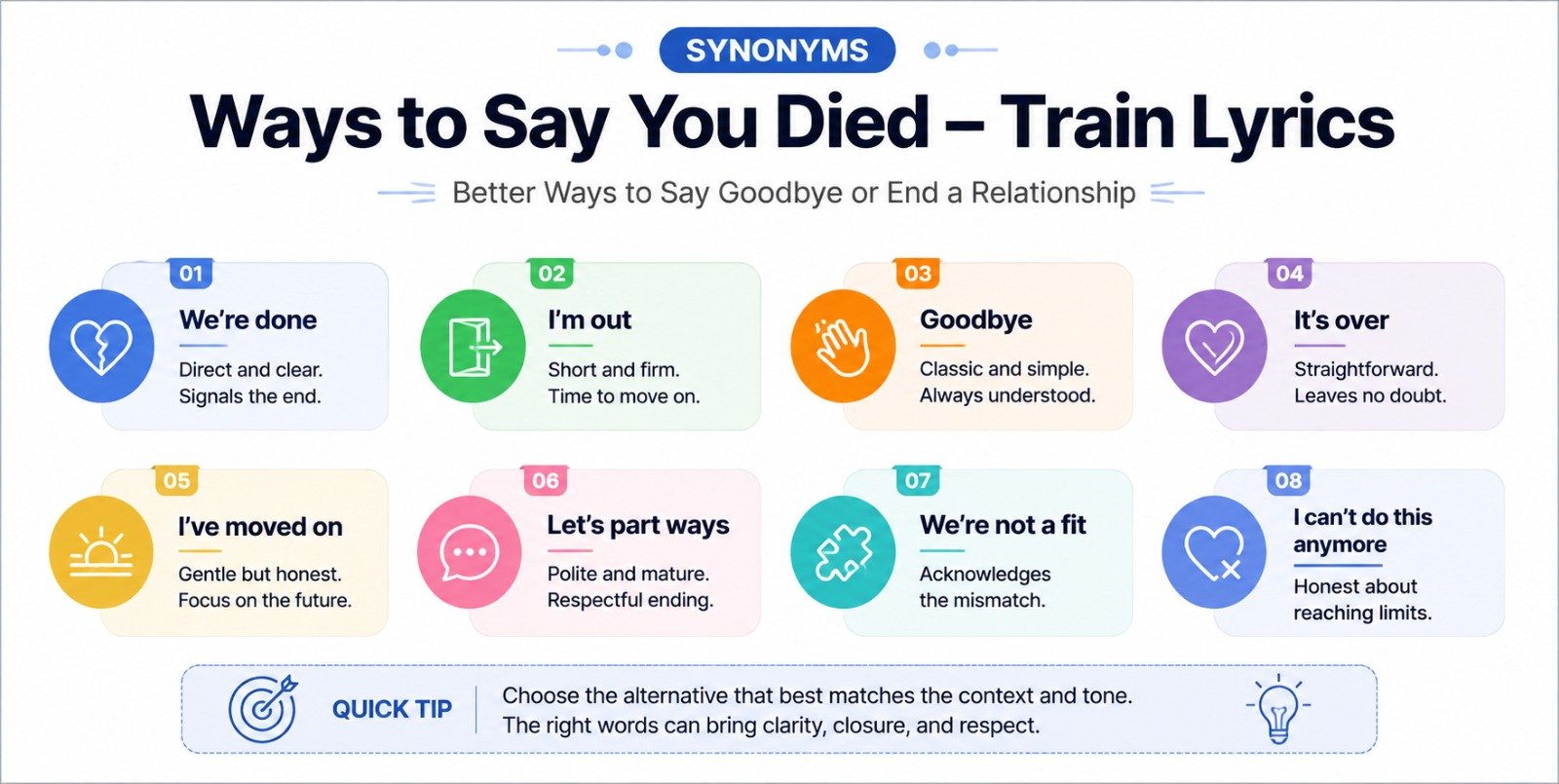
Other Ways to Say “Goodbye” After a Breakup
The title also creates an interesting language question: what are some natural ways to describe saying goodbye when a relationship ends?
You might use:
- Farewell
- Take care
- I wish you the best
- It’s time for us to move on
- I think we need to go our separate ways
- Good luck with everything
- I hope things work out for you
- Maybe this is where we part ways
- It’s time to let each other go
- I think this is the end for us
The emotional weight varies considerably.
“Take care” can sound calm and neutral. “I wish you the best” is warmer. “It’s time to let each other go” sounds more emotional and final.
In a real breakup, the most natural choice depends on whether the relationship is ending amicably, painfully, or somewhere in between.
Why Does the Narrator Pretend His Girlfriend Died?
Pride is the clearest explanation.
When people experience rejection, telling friends and family can sometimes feel almost as uncomfortable as the breakup itself. The narrator takes that recognizable emotion and pushes it to a comic extreme.
Rather than say that his girlfriend chose to leave, he invents circumstances in which he had no control over losing her.
That distinction protects his ego.
“She left me” means she made a choice.
“She disappeared because of some bizarre disaster” removes rejection from the story completely.
Of course, Train takes the idea so far that the excuses become obviously ridiculous. That’s what turns an uncomfortable breakup into comedy.
Other Ways to Say “I’m Embarrassed She Left”
If someone wanted to express that emotion honestly rather than inventing excuses, natural wording could include:
- I’m embarrassed that the relationship didn’t work out.
- It’s difficult for me to talk about the breakup.
- I’m still trying to process what happened.
- My pride is a little hurt.
- I didn’t expect things to end this way.
- I’m not ready to talk about it yet.
- I’m having a hard time admitting that it’s over.
These phrases communicate very different things from the fictional stories in the song. They acknowledge the emotional reality instead of hiding it.
Why Is It Called “50 Ways to Say Goodbye”?
The title shouldn’t be read as a promise of 50 ordinary farewell phrases.
The song revolves around the narrator’s attempts to come up with alternative explanations for why his former partner has disappeared from his life.
That is also why searches for Train 50 Ways to Say Goodbye lyrics and ways to say you died Train lyrics lead to the same song.
The number “50” works as part of the song’s exaggerated concept rather than as a numbered language lesson.
You shouldn’t expect the lyrics to contain a literal list such as:
- Goodbye
- Farewell
- See you later
- Take care
That’s not what the title means in context.
Does Train Actually Give 50 Ways to Say Goodbye?
No. The song doesn’t present 50 distinct farewell expressions.
Instead, it cycles through a much smaller collection of absurd stories about what supposedly happened to the narrator’s former girlfriend.
Those imagined situations involve things such as aircraft, animals, natural disasters, vehicles, water, and other exaggerated accidents. The lyrics repeat several of these ideas later in the song rather than introducing 50 unique ones.
The number is therefore better understood as part of the song’s comic exaggeration.
Is “50 Ways to Say Goodbye” Really About Death?
Not in the literal sense.
Death appears in the narrator’s invented stories, but the central event is a breakup.
The song is better understood as being about:
- rejection
- embarrassment
- wounded pride
- difficulty accepting a breakup
- making excuses
- using humor to cope with disappointment
This distinction is important because the dramatic imagery can make the song sound much darker when individual lines are read without context.
Within the full story, the scenarios are deliberately unbelievable.
Other Ways to Say “Died” in Respectful English
Outside the humorous context of the Train song, talking about a real person’s death requires much more sensitivity.
Depending on the situation, respectful alternatives include:
Passed away
This is one of the most common gentle alternatives.
“Her grandfather passed away last year.”
Passed on
A softer expression that some speakers prefer, although its use can depend on personal or cultural preference.
“We were sorry to hear that he passed on.”
Lost his/her life
Common when describing an accident, disaster, war, or other tragic event.
“Several people lost their lives in the accident.”
Is no longer with us
A very gentle and indirect expression, often used when speaking emotionally about someone who has died.
“Although she is no longer with us, her work continues to inspire people.”
Died itself isn’t disrespectful. In factual, medical, journalistic, or direct communication, it is often the clearest word.
The alternatives above aren’t exact synonyms in every setting. For example, “lost her life” usually suggests an external event or tragedy, while “passed away” is broader and softer.
Why Does the Song Sound Happy If It’s About a Breakup?
That contrast is part of the song’s appeal.
Instead of sounding like a slow, mournful breakup ballad, “50 Ways to Say Goodbye” uses an energetic pop arrangement with prominent horn instrumentation. The lively sound works against the narrator’s heartbreak and makes his increasingly ridiculous explanations feel even more comic.
In other words, the music helps tell the joke.
The situation hurts the narrator, but the song invites the listener to laugh at the exaggerated way he handles it.
“Ways to Say You Died” vs. “Ways to Say Goodbye”
These phrases sound related, but they aren’t equivalent.
“Ways to say goodbye” normally means different expressions used when leaving someone:
- Goodbye
- Farewell
- See you later
- Take care
- Until next time
“Ways to say you died,” in the Train song, refers to the narrator coming up with different fictional explanations for what happened to his former girlfriend.
So if you’re simply looking for alternatives to “goodbye,” the lyric isn’t intended as a normal list of expressions.
Other Ways to Say “Goodbye” in Everyday English
For actual everyday conversation, these are much more useful:
| Expression | Tone | Best Used For |
|---|---|---|
| See you later | Casual | Friends and coworkers |
| Take care | Warm, neutral | Most everyday situations |
| See you soon | Friendly | When you expect to meet again |
| Catch you later | Very casual | Friends |
| Have a good one | Casual | Everyday departures |
| Until next time | Warm | Friendly or written farewells |
| Farewell | Formal/dramatic | Ceremonial or literary situations |
| All the best | Warm/polite | Messages and emails |
| Talk soon | Casual | Texts and online conversations |
| Safe travels | Friendly | Someone leaving for a trip |
“Farewell” sounds noticeably more formal and final than “see you later,” while “talk soon” only works when future communication is expected.
That is why choosing a goodbye expression should depend on the relationship and situation rather than treating every option as interchangeable.
Who Wrote “50 Ways to Say Goodbye”?
The songwriting credits go to:
- Pat Monahan
- Espen Lind
- Amund Bjørklund
The track appears on Train’s California 37, released in 2012. Shazam also credits Espionage as producer and Butch Walker as co-producer.
Pat Monahan performs the lead vocals.
Why the Phrase Is Easy to Misremember
Song lyrics often become search phrases when listeners remember one memorable line but forget the actual title.
That’s especially easy with this song because “ways to say you died” sounds enough like a possible song title to stand on its own.
But the distinction is simple:
Remembered phrase: “ways to say you died”
Song title: 50 Ways to Say Goodbye
Artist: Train
Once you know the title, the strange wording makes more sense because it connects directly to the song’s breakup joke.
Frequently Asked Questions
What Train song says “ways to say you died”?
The phrase comes from “50 Ways to Say Goodbye” by Train. The song appears on the band’s 2012 album California 37.
Is the Train song called “Ways to Say You Died”?
No. “Ways to Say You Died” isn’t the song title. The song is called “50 Ways to Say Goodbye.” The similar phrase appears within the song.
What does “ways to say you died” mean in the song?
It refers to the narrator’s made-up explanations for why his former girlfriend isn’t around. He is embarrassed about being dumped, so he jokingly imagines increasingly absurd alternatives to telling his friends that she left him.
What is the meaning of Train’s “50 Ways to Say Goodbye”?
It’s a humorous breakup song about rejection and wounded pride. The narrator has trouble accepting and explaining the breakup, so he invents ridiculous stories about his former girlfriend’s disappearance.
Are there actually 50 ways to say goodbye in the song?
No. The lyrics don’t provide 50 unique goodbye expressions. The title works as exaggeration, while the song uses a smaller set of fictional scenarios that are repeated.
Are “ways to say you died” and “ways to say goodbye” the same thing?
No. In normal English, ways to say goodbye means alternatives such as “take care,” “see you later,” or “farewell.” Within the Train song, ways to say you died refers to fictional stories explaining why the narrator’s ex is gone.
Is “50 Ways to Say Goodbye” supposed to be funny?
Yes. Although the underlying subject is heartbreak, the exaggerated explanations and upbeat presentation give the song a deliberately comic tone.
Is it okay to say “passed away” instead of “died”?
Yes, particularly when you want gentler wording. “Passed away” is common in condolences and sensitive conversation. However, “died” remains clear and appropriate in many factual contexts, so the best choice depends on tone and audience.
Final Thoughts
The memorable “ways to say you died” Train lyrics make more sense once you know the story behind them. The song is “50 Ways to Say Goodbye,” and its outrageous explanations aren’t meant as literal ways of talking about death. They’re part of a joke about a heartbroken narrator who would rather invent impossible stories than simply admit that his girlfriend left him.
In real conversation, wording such as “we broke up,” “we went our separate ways,” “take care,” or “passed away” carries its own tone and should be chosen according to the situation. That’s the kind of distinction Clarifyra aims to make clearer, so the words you choose match what you actually mean.
You May Also Read | 50 Ways to Say Goodbye Lyrics: Meaning, Spanish and Other Goodbye Phrases