Eatting or Eating: Which Is Correct?
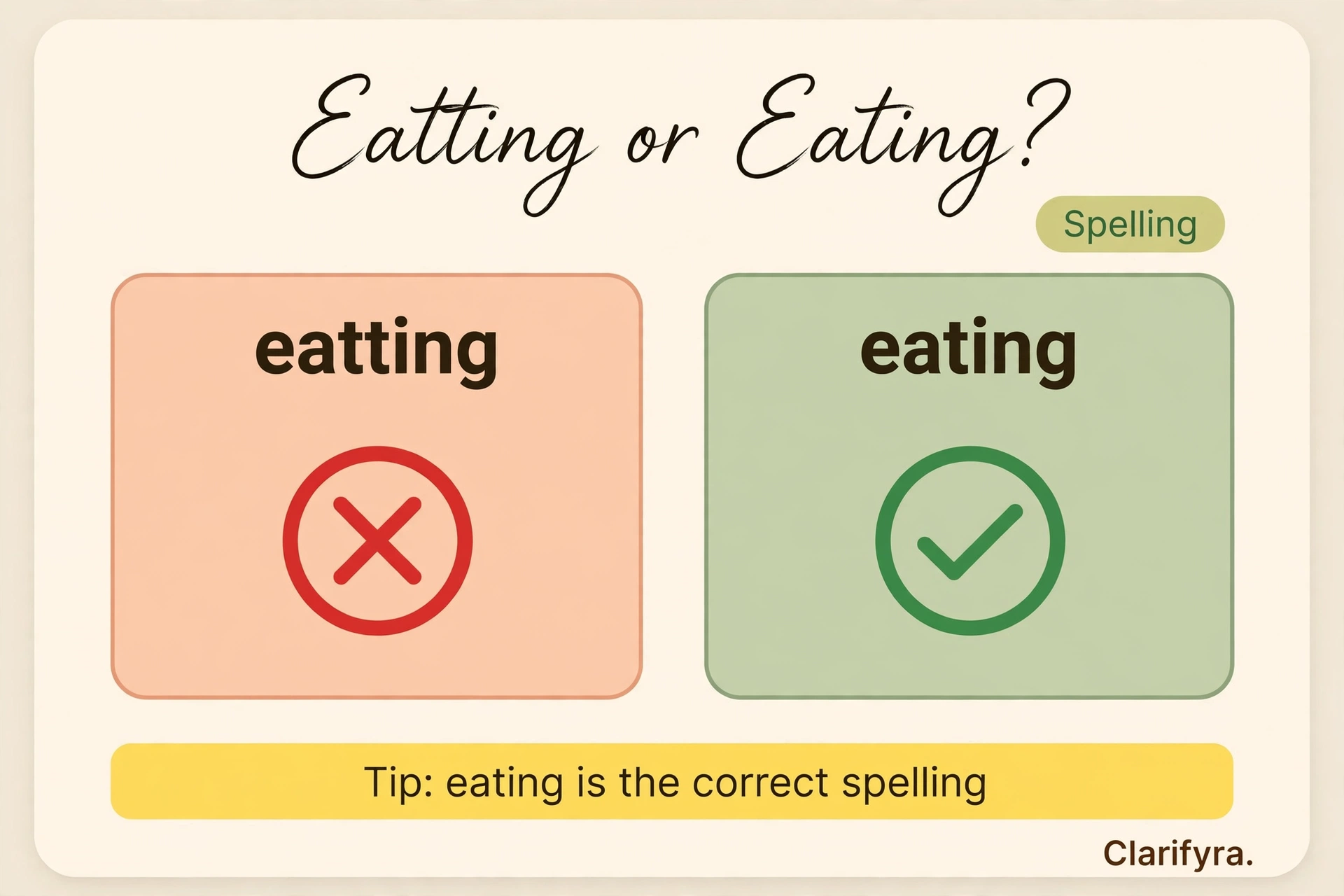
The correct spelling is eating — one t. Eatting, with a double t, is a common misspelling that comes from a real English spelling rule applied in the wrong place. The verb is eat, and its -ing form is simply eat + ing: eating. The doubled t in words like sitting and getting follows a pattern that eat doesn’t meet, because eat has two vowel letters — ea — before its final consonant.
Quick Answer
Eating is the only correct spelling of the -ing form of eat. Oxford Learner’s Dictionaries lists the verb forms of eat as: eats, ate, eaten, and -ing form eating (/ˈiːtɪŋ/) — one t. Eatting is not a standard form; it double-counts a rule that only applies when a short word ends in one vowel letter plus one consonant letter, as in sit → sitting or get → getting. Because eat ends in two vowel letters (ea) plus t, the t stays single: eat → eating, exactly like read → reading and beat → beating.
What “Eat” Actually Does
Eat is an irregular verb, and its principal parts are worth fixing in memory because the -ing form sits inside a small, stable set. Merriam-Webster defines the transitive verb as “to take in through the mouth as food: ingest, chew, and swallow in turn,” with the noun eater derived from it. Oxford Learner’s gives the forms plainly: present eat, third person eats, past ate, past participle eaten, and -ing form eating, pronounced /ˈiːtɪŋ/.
The pronunciation is the first clue to the spelling. Eating begins with the long vowel /iː/ — the “ee” in see — held across the ea digraph. In English spelling, a doubled consonant after a vowel usually signals that the vowel before it is short: compare sitting /ˈsɪtɪŋ/ (short i) with siting /ˈsaɪtɪŋ/. A spelling like eatting would predict a short vowel and a completely different word — something like “atting” — which is one reason the double-t form looks wrong to fluent readers even before they can name the rule.
The verb’s other forms reinforce the pattern. The past tense ate and the past participle eaten both keep a single t, and the derived noun eater and adjective eatable (both recorded by Oxford near the verb entry) do the same. At no point in the verb’s paradigm does a double t appear. Eating isn’t an exception carved out of the system; it’s exactly what the system produces.
The Doubling Rule — and Why “Eat” Misses It
English doubles a final consonant before a vowel-initial suffix like -ing or -ed in a specific, narrow set of circumstances. The classic classroom version runs like this: if a one-syllable word ends in one vowel letter followed by one consonant letter, and that consonant is not w, x, or y, double the consonant. Hence sit → sitting, run → running, get → getting, stop → stopped. The doubling protects the short vowel: without it, siting and hoping would be misread with long vowels.
Two common situations fall outside the rule. First, words ending in a silent e drop the e instead of doubling anything: hope → hoping, write → writing. Second — and this is eat‘s situation — words with two vowel letters before the final consonant never double it: eat → eating, read → reading, beat → beating, rain → raining, feel → feeling. The ea in eat already tells the reader the vowel is long, so no doubling is needed and none is standard.
Seen this way, eatting is an overgeneralisation. A writer has learned — correctly — that sitting and getting double their final consonant, and has extended the pattern to a word whose vowel structure doesn’t trigger it. It’s the same family of error as writting (from the silent-e pattern) or begining (a multisyllable word where the stress rule actually requires beginning). Each mistake comes from one true rule applied one word too far.
Words That Behave Like “Eat”
| Base verb | -ing form | Why no doubling |
|---|---|---|
| eat | eating | ea = two vowel letters before t |
| beat | beating | ea before t |
| read | reading | ea before d |
| heat | heating | ea before t |
| rain | raining | ai before n |
| feel | feeling | ee before l |
| sit | sitting | One vowel + one consonant → doubling does apply |
| get | getting | One vowel + one consonant → doubling does apply |
The bottom two rows are the contrast that makes the rule memorable. Sit and get each have a single short vowel letter before a single final consonant, so they double. Eat and its neighbours have a two-letter vowel team doing the work, so they don’t. If you can see ea, ai, ee, oo, or ou immediately before the last consonant, the consonant stays single.
Correct vs. Incorrect
- ✓ “We are eating dinner at seven.”
- ✗ “We are eatting dinner at seven.” → ✓ “We are eating dinner at seven.”
- ✓ “She has been eating more vegetables lately.”
- ✗ “She enjoys eatting out.” → ✓ “She enjoys eating out.”
- ✓ “The children were eating quietly.”
- ✗ “Healthy eatting habits matter.” → ✓ “Healthy eating habits matter.”
- ✓ “He stopped eating and listened.”
- ✗ “An eatting disorder clinic.” → ✓ “An eating disorder clinic.”
Common Mistakes
1. Doubling after a vowel team. The root error: seeing a final t and doubling it the way sitting does, without noticing the ea in front of it. The fix is visual, not memorised — check the two letters before the final consonant. Two vowel letters means stop.
2. Treating “eating” as a noun and changing the spelling. Eating doubles as a gerund and noun (“healthy eating,” “comfort eating”) without changing form. The noun use sometimes tempts writers into eatting by analogy with nouns like setting. The analogy fails for the same reason: set has one vowel letter, eat has two.
3. Carrying the error into other forms. Writers who produce eatting occasionally also produce eatten for eaten or eatter for eater. Oxford’s paradigm — eats, ate, eaten, eating — contains no double t anywhere, so any form with tt can be corrected on sight.
4. Confusing -ing spelling with pronunciation spelling. Because the t in eating is often pronounced as a quick flap in American English (something like “eeding”), writers sometimes guess at the spelling from the sound. The written form follows the base word, not the casual pronunciation: eat + ing, always.
5. Assuming every short verb doubles. The doubling rule is conditional, not universal. Short verbs ending in two consonants (help → helping), in w/x/y (fix → fixing, play → playing), or in a vowel team (eat → eating) all keep a single final consonant. Only the one-vowel-plus-one-consonant shape doubles.
Frequently Asked Questions
Is “eatting” ever correct?
Not in standard English. The standard -ing form recorded by Oxford Learner’s Dictionaries is eating, and the double-t spelling appears in none of the verb’s forms. It survives as a frequent typo because the doubling rule for sitting and getting is so familiar.
Why does “sitting” double its t but “eating” doesn’t?
Because of the vowel letters. Sit ends in one vowel letter (i) plus one consonant (t), which triggers doubling to protect the short vowel. Eat ends in two vowel letters (ea) plus t; the vowel is already long, so the t stays single.
What are the full forms of “eat”?
Base eat, third-person eats, past ate, past participle eaten, and -ing form eating — the set listed by Oxford Learner’s Dictionaries, with eating pronounced /ˈiːtɪŋ/.
Does the same rule explain “beating” and “reading”?
Yes. Beat → beating and read → reading work exactly like eat → eating: a two-letter vowel (ea) before the final consonant, so no doubling. The same pattern gives heating, raining, and feeling.
How can I check an -ing spelling quickly?
Look at the three letters before -ing would attach. If the base ends in vowel-team + consonant (ea+t), write one consonant. If it ends in single vowel + single consonant (i+t), write two. Then sanity-check against the base: eat is visibly sitting inside eating, letter for letter.
The Takeaway
The -ing form of eat is eating, with a single t — the form Oxford Learner’s Dictionaries records and the only spelling that matches the rest of the verb’s paradigm (eats, ate, eaten). Eatting borrows the doubling from sitting and getting, but that rule needs one vowel letter before the final consonant; eat has two. When two vowel letters stand before the last consonant, the consonant stays single: eating, beating, reading, every time.