Upon vs Apon: Which Spelling Is Correct?
The difference between upon and apon is mainly a matter of correct modern spelling. The two forms can look and sound similar, especially because the first syllable of upon is usually unstressed in normal speech. However, they are not equally acceptable in standard English today. Upon is the established modern word, while apon is an old or nonstandard spelling that should generally be avoided in contemporary writing.
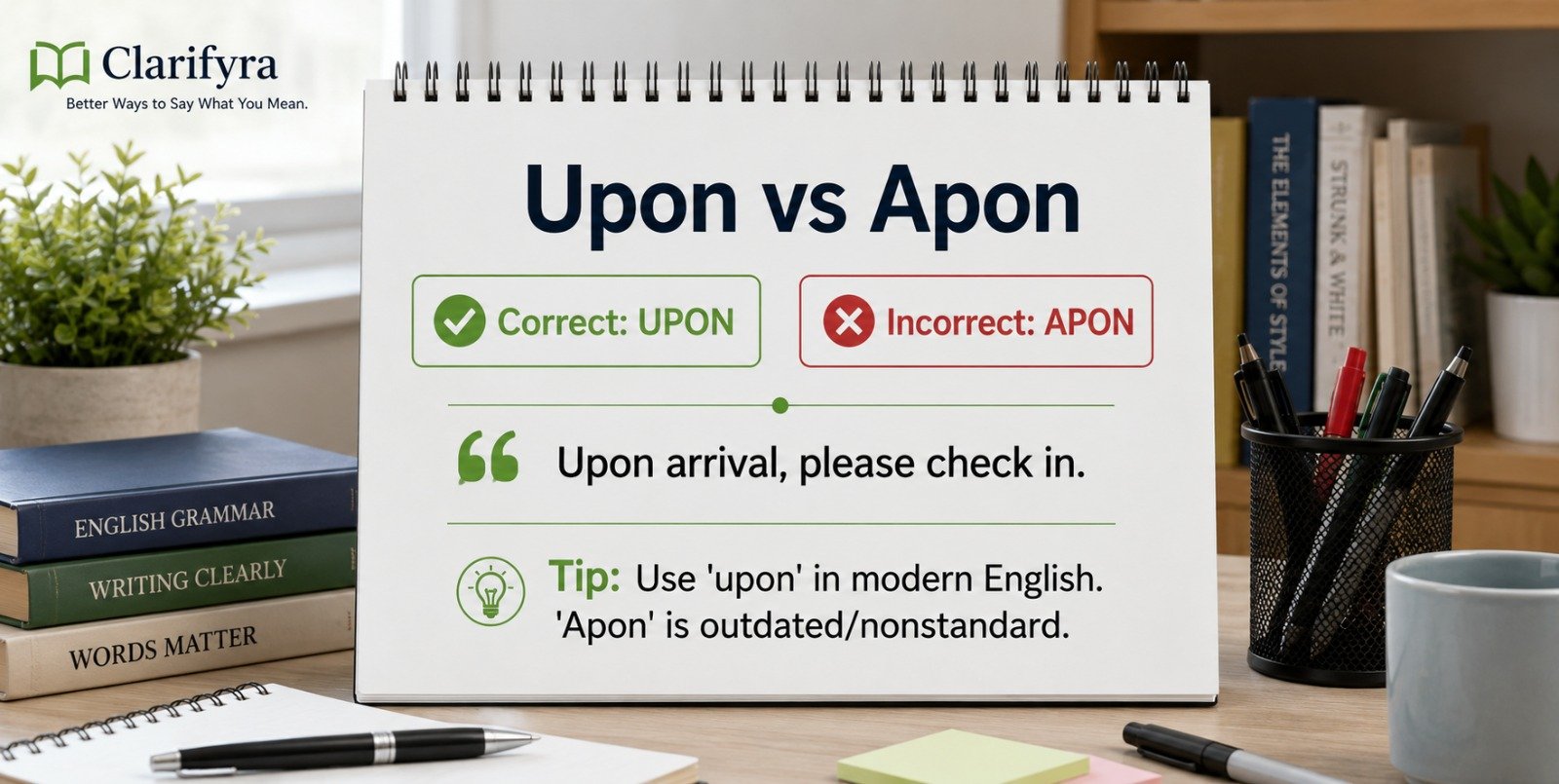
Upon is the correct spelling in modern standard English. Apon is an archaic or nonstandard form and is usually treated as a misspelling today. Write upon arrival, upon request, and once upon a time.
Upon or Apon: Which Is Correct?
In present-day English, upon is the form you should use.
Apon has appeared in older forms of English, so it is not completely invented. However, that historical background does not make it a normal alternative spelling today.
For modern writing:
Correct: Upon receiving the message, she replied.
Incorrect in standard modern English: Apon receiving the message, she replied.
The same rule applies in formal writing, schoolwork, articles, emails, and ordinary communication.
Quick Comparison
| Feature | Upon | Apon |
|---|---|---|
| Correct in modern standard English? | Yes | Generally no |
| Word type | Preposition | Archaic/nonstandard spelling |
| Common meaning | On, immediately after, when | Historically related to upon |
| Modern use | Common and accepted | Avoid in normal writing |
| Example | Upon arrival, call reception. | Apon arrival, call reception. ✗ |
The important point is that these are not two modern words with separate meanings. In most present-day contexts, the choice is simply between a standard spelling and an outdated or incorrect one.
You May Also Read | Columbia vs Colombia: Which Spelling Is Correct?
What Is Upon?
Upon is primarily a preposition. Its meaning changes slightly depending on the sentence, but it is closely related to on.
It can refer to position:
- The documents were placed upon the desk.
- Snow rested upon the roof.
It can also refer to something happening immediately after another event:
- Upon hearing the news, he called his family.
- Upon completion of the form, submit it online.
In other situations, it can mean roughly when or as soon as:
- Upon arrival, guests should check in.
- Payment is due upon delivery.
The word often sounds slightly more formal or literary than on, although it remains completely standard English.
Is “Apon” a Real Word?
This question needs a little nuance.
Apon can be found in historical English texts as an older spelling related to upon. That means it has existed in the language historically.
In contemporary standard English, however, apon is not normally accepted as an alternative spelling of upon.
If you are writing a modern sentence such as:
Apon approval, the funds will be released.
you should change it to:
Upon approval, the funds will be released.
So when asking what is apon, the most useful modern answer is that it is an obsolete or nonstandard form rather than a separate word with a different present-day meaning.
Upon vs Apon Meaning
The upon vs apon meaning distinction is simpler than comparisons such as affect vs effect because there are not two separate modern definitions to learn.
Upon can mean:
- on
- on top of
- immediately after
- when
- as soon as
- depending on, in certain expressions
For example:
- The decision depends upon the final report.
- Upon seeing the damage, he contacted the insurer.
- The responsibility rests upon the manager.
Apon does not carry a separate modern meaning. When it appears as a substitute for upon in contemporary writing, it is usually simply the wrong spelling.
Why Do People Confuse Upon and Apon?
The main reason is pronunciation.
In natural speech, upon is commonly pronounced with a weak first syllable. It sounds roughly like:
uh-PON
Because the initial vowel is not strongly emphasized, someone writing the word from sound alone may assume it begins with a- rather than u-.
Historical spellings can also contribute to the confusion. A reader may encounter apon in an old text and assume that it remains an accepted modern variant.
For everyday English, though, the spelling rule is straightforward:
Use upon.
Apon vs Upon Arrival
The correct expression is:
Upon arrival
It means when you arrive or as soon as you arrive.
Examples:
- Upon arrival, please report to the front desk.
- Visitors will receive their passes upon arrival.
- She called her parents upon arrival at the hotel.
- Payment will be collected upon arrival.
Writing apon arrival is not standard modern English.
You may also see on arrival, which is correct:
- Please check in on arrival.
Both on arrival and upon arrival can work, but upon arrival tends to sound slightly more formal.
Upon vs Apon Examples
Seeing the two forms side by side makes the rule easier to remember.
Correct Examples
- Once upon a time, there was a small village.
- Upon hearing the alarm, everyone left the building.
- The offer is available upon request.
- Payment is required upon delivery.
- He came upon an old photograph in the drawer.
- Upon arrival, guests should show identification.
- The final choice depends upon several factors.
Incorrect Examples
- Once apon a time, there was a small village.
- Apon hearing the alarm, everyone left.
- Payment is required apon delivery.
- Apon arrival, guests should check in.
In each incorrect sentence, replacing apon with upon fixes the spelling.
Upon vs Apon Pronunciation
Upon is generally pronounced approximately:
uh-PON
The stress falls on the second syllable.
The first vowel is reduced in normal speech, which explains why the word may sound different from its written form.
That pronunciation does not justify changing the spelling to apon.
A helpful way to think about it is:
Spelling: upon
Approximate pronunciation: uh-PON
Pronunciation and spelling do not always match perfectly in English, so it is better to remember the established written form.
What Does “Upon You” Mean?
The upon you meaning depends on the full sentence.
For example:
The responsibility is upon you.
This means that the responsibility rests with you.
Another example:
A difficult decision is upon you.
Here, the phrase suggests that you are facing or are about to face a difficult decision.
You may also hear expressions such as:
The holiday season is upon us.
This means the holiday season has arrived or is very close.
So upon you does not have one fixed definition. It generally conveys the idea that something rests on you, affects you, approaches you, or is something you must deal with.
Synonyms for Upon
The most direct synonym for upon is often on.
For example:
- The bag was upon the chair.
- The bag was on the chair.
However, different alternatives work depending on the meaning.
When “upon” means “immediately after”
Possible alternatives include:
- after
- when
- as soon as
Example:
Upon hearing the news, she smiled.
Can become:
After hearing the news, she smiled.
When “upon” means “on”
Example:
The papers lay upon the table.
Can become:
The papers lay on the table.
There is therefore no single upon vs apon synonym that fits every sentence. The best replacement depends on how upon is being used.
Easy Way to Remember the Correct Spelling
A simple memory trick is to see upon as:
UP + ON = UPON
Both up and on are familiar English words, and together they visually lead you to the correct spelling.
You can also remember one of the best-known English phrases:
Once upon a time
Most people have seen that expression since childhood, and it always uses upon, never apon.
Other useful phrases include:
- upon arrival
- upon request
- upon completion
- upon reflection
- upon approval
- depend upon
If you remember even one or two of these expressions, the spelling becomes much easier.
Common Mistakes to Avoid
One common mistake is writing apon arrival because the word sounds like it begins with an “a.” The standard phrase is upon arrival.
Another is assuming that upon must always be replaced with on because it sounds formal. In many cases, either word works, but upon is still perfectly correct.
Writers may also mistakenly assume that apon is the British spelling and upon is American. That is not the case. Upon is the standard spelling in both British and American English.
Finally, seeing apon in an old source does not mean it should be copied into normal contemporary writing. Historical spelling and modern standard spelling are not always the same.
Final Verdict: Upon or Apon?
Use upon in modern English. It is the standard spelling and works in expressions such as upon arrival, upon request, and once upon a time. Although apon has historical roots, it is outdated and should generally not be used as a modern alternative. When you need a clear answer to confusing spelling choices like this one, Clarifyra helps you choose the form that fits standard English.
Frequently Asked Questions
Is it upon or apon?
Upon is the correct spelling in modern standard English. Apon is an old or nonstandard form and should normally be avoided in present-day writing.
Is “apon” an American or British spelling?
No. Apon is not the standard British alternative to upon. Modern British and American English both use upon.
Is “upon arrival” grammatically correct?
Yes. Upon arrival is a standard expression meaning when you arrive or as soon as you arrive. For example: “Upon arrival, please check in at reception.”
Can I use “on” instead of “upon”?
Often, yes. On is usually more conversational, while upon can sound more formal or literary. For example, “on arrival” and “upon arrival” can both be correct.
What part of speech is “upon”?
Upon is mainly a preposition. It can express position, timing, dependency, or the idea of something happening immediately after another event.
Why is “apon” sometimes found in old writing?
Older English had spelling forms that differed from modern standardized spelling. Apon appeared historically, but contemporary standard English settled on upon as the accepted form.
You May Also Read | Is It Wiff or Whiff? Meaning and Spelling Explained