Champaign or Champagne: Which Is Correct?
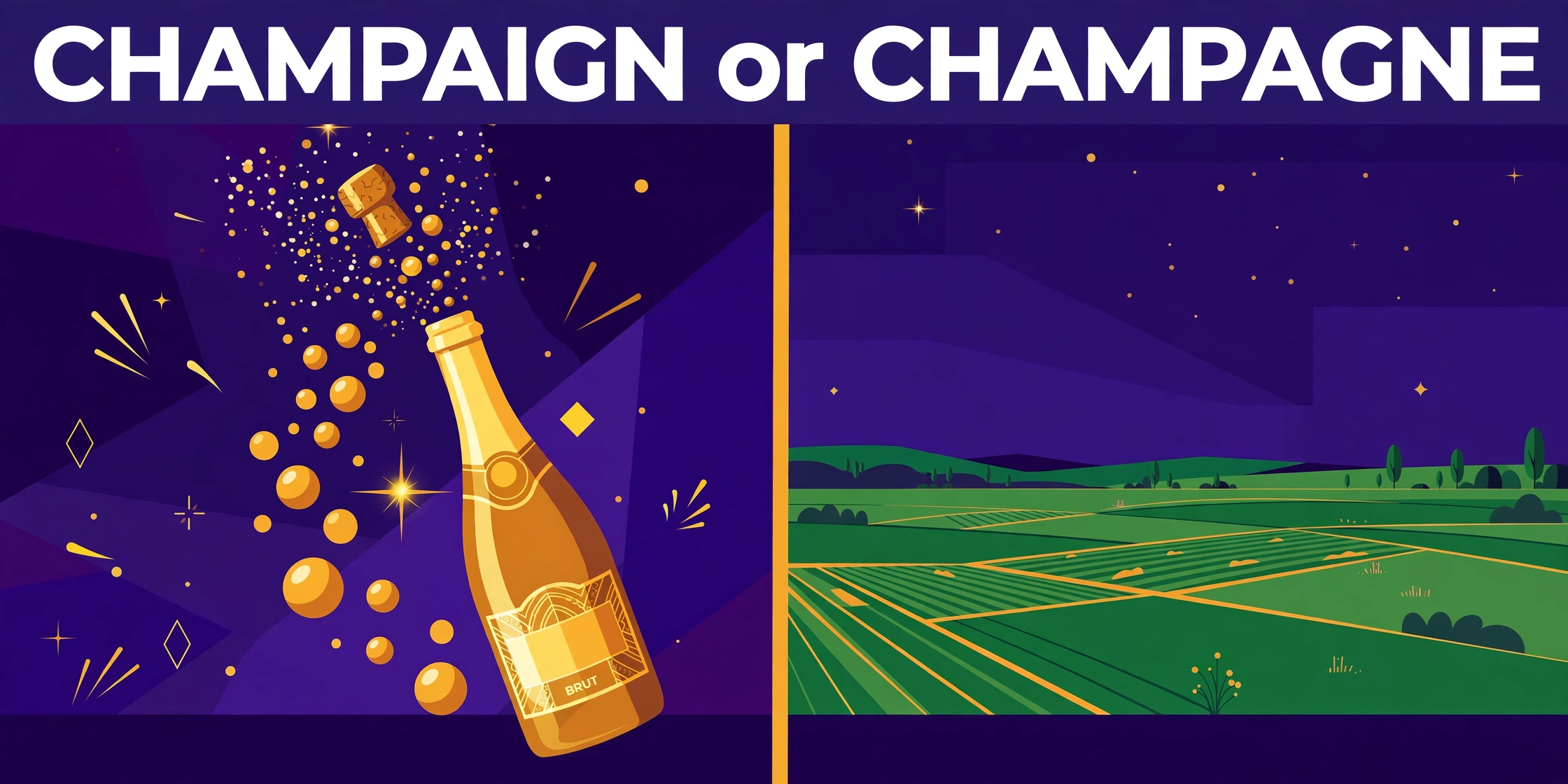
Champagne is a sparkling white wine from the Champagne region of France, and champaign is an old word for open, flat countryside. They are pronounced exactly the same way — /ʃæmˈpeɪn/, “sham-PAYN” — and they share the same Latin root, which is why the confusion is so persistent. But they are not interchangeable: one belongs in a wine glass, the other belongs in a geography book or a place name. If you are writing about a celebration, the word is champagne; if you are writing about the city in Illinois, the word is Champaign; and if you are writing about a wide open plain, the archaic word is champaign.
Quick Answer: Use champagne for the sparkling wine — “We opened a bottle of champagne to celebrate.” Use Champaign (capital C) for the city in Illinois and other place names. Use champaign (lowercase) only for open, flat countryside, and only in historical or literary writing, since the word is archaic in modern English. The two words are homophones: both are pronounced /ʃæmˈpeɪn/.
What the Dictionaries Say
Cambridge Dictionary defines champagne as a noun: “a white sparkling wine made in the Champagne area of France,” and notes the looser use for any sparkling white wine. Dictionary.com gives the American pronunciation /ʃæmˈpeɪn/ and the British /ʃæmˈpeɪn/, and records the word as first used in English in 1655–65, short for French vin de Champagne, “wine of Champagne.” Collins adds two further senses: a pale orange-yellow to greyish-yellow colour, and, as a modifier, something luxurious — “a champagne carpet,” “a champagne capitalist.” The wine itself is traditionally made from a blend of Chardonnay, Pinot Noir, and Pinot Meunier grapes, and it gains its bubbles from a second fermentation in the bottle, the méthode champenoise.
Champaign is a different entry, and a much older one. The Oxford English Dictionary and Wiktionary record it as a noun meaning open countryside, or an area of open countryside, marked as archaic in geography. Wiktionary also records an obsolete sense, “a battlefield,” and an adjective sense, “pertaining to open countryside; unforested, flat.” The word entered English around 1400, from Old French champaigne, from Late Latin campānia, “level country,” from Latin campus, “level ground, field, plain.” The same root gives us campaign and the Italian campagna: all three words began life as descriptions of open fields. Samuel Johnson’s dictionary defined champaign simply as “a flat open country,” and that is still the best definition.
Champagne: The Wine, the Colour, and the Lifestyle
Champagne is, first and foremost, a drink. In its strict sense it is a sparkling white wine produced in the Champagne region around Reims and Épernay in north-east France, made by the traditional method of a second fermentation inside the bottle. The name is legally protected in the European Union and in many other countries: a sparkling wine made anywhere else cannot be sold as champagne, however similar the method. In the United States the rules are looser, and some American producers still use the word for sparkling wine made elsewhere, but in careful writing the distinction matters. If the bottle did not come from Champagne, the accurate term is sparkling wine.
In everyday speech the word is used more loosely, and the dictionaries record that too. Collins lists “any effervescent white wine” as a second sense, and Dictionary.com the same: “a similar sparkling wine produced elsewhere.” That looseness is fine in conversation, but it is worth knowing where the boundary lies, because in a wine list, a legal document, or a piece of food writing, the strict sense is the one that counts.
Champagne has two figurative senses that are easy to miss. As a noun it names a colour: a very pale brownish-gold, the colour of the wine itself — “a champagne carpet,” “a champagne dress.” As an adjective it suggests luxury or expense: “champagne tastes,” “a champagne lifestyle.” Both senses come from the wine’s association with celebration and wealth, and both are standard English, recorded by Collins and Dictionary.com.
Champaign: Open Country, and a City in Illinois
Champaign, spelled with an a after the m and no final e, is the older word, and in modern English it survives in two places: old books and place names. As a common noun it means a wide stretch of flat, open country, without trees or hills. You will find it in Malory’s Le Morte d’Arthur from the fifteenth century, where knights ride “over a champaign unto a wood,” and in the poetry and prose of the seventeenth and eighteenth centuries, where a “champaign country” is a landscape of open fields. The adjective sense survives in the same way: a “champaign” landscape is flat and open.
Nobody uses the word this way in ordinary modern writing, and that is the point. If you write “the champaign stretched to the horizon” in a contemporary essay, most readers will assume you have misspelled champagne. The word is archaic, and the dictionaries mark it as such. Use plain, open country, or open fields instead, and keep champaign for quotations, historical writing, and discussions of the word itself.
Where the spelling is alive and correct is in place names. The best known is Champaign, Illinois, a city in east-central Illinois with a population of 88,302 at the 2020 census. It was founded in 1855 as West Urbana, when the Illinois Central Railroad laid its track two miles west of Urbana, and it was renamed Champaign when it received its city charter in 1860. The city and the county were named after Champaign County, Ohio, which took its name from the French word for “open, level country.” There is also a Champaign County in Ohio, and the spelling appears in smaller place names and surnames across the United States.
The capital letter matters here. Champaign the city is always capitalised, and it is always spelled with an a. “Champagne, Illinois” is wrong, and so is “a bottle of champaign.” The spelling tells you which word you mean, even though the ear cannot: the wine ends in -agne, the place and the old landscape word end in -aign.
Pronunciation: Identical, in Both Varieties of English
Both words are pronounced /ʃæmˈpeɪn/ — “sham-PAYN” — in British and American English alike. Wiktionary gives the same transcription, /ˈʃæmpeɪn/, for both entries, and Dictionary.com gives /ʃæmˈpeɪn/ for the wine in both its American and British listings. There is no pronunciation difference to learn, which is exactly why the pair is confusing: spelling is the only thing that separates them.
Correct vs Incorrect
| Incorrect | Correct | Why |
|---|---|---|
| We toasted with a bottle of champaign. | We toasted with a bottle of champagne. | The wine is always spelled champagne. |
| She lives in Champagne, Illinois. | She lives in Champaign, Illinois. | The city is spelled Champaign, with an a. |
| The champagne stretched to the horizon. (meaning open fields) | The champaign stretched to the horizon. | Open countryside is champaign, though the word is archaic — “open country” is clearer today. |
| He ordered a glass of champaign at the bar. | He ordered a glass of champagne at the bar. | A drink is always champagne, whatever the bar. |
| The University of Illinois is in Champagne‑Urbana. | The University of Illinois is in Champaign‑Urbana. | The twin-city name uses the place spelling, Champaign. |
| Her dress was champaign in colour. | Her dress was champagne in colour. | The pale gold colour is named after the wine, so it keeps the wine’s spelling. |
Common Mistakes to Avoid
1. Spelling the wine “champaign”
This is the most common error with the pair, and it usually comes from the city name. People who live near Champaign, Illinois, or who have seen the name on a map, carry the -aign spelling into the wine. Spellcheckers sometimes miss it, because champaign is a real word. The fix is a simple association: the wine ends in -agne, like the French region it comes from. If you are writing about something you can drink, the last four letters are pagne.
2. Spelling the city “Champagne”
The mirror-image error is just as common, especially in writing about the University of Illinois. The city is Champaign, named for open country, not for wine. A useful memory aid is the landscape itself: central Illinois is famously flat, open farmland — a champaign in the old sense of the word. The city’s name describes the land it stands on.
3. Using “champaign” for open country in modern writing
This is not a spelling error but a register error. Champaign as a common noun is archaic, and using it in a modern sentence will confuse most readers, who will read it as a misspelling of champagne. The dictionaries are clear about its status: Wiktionary marks the noun “geography, archaic,” and the battlefield sense “obsolete.” If you mean open country, write “open country” or “plain.” Reserve champaign for quotations from older texts, place names, and discussions of the word itself.
4. Calling any sparkling wine “champagne”
In conversation this is harmless, and the dictionaries record the loose sense. But in careful writing — a wine list, a restaurant review, a legal document — it is wrong. True champagne comes from the Champagne region of France and is made by the traditional method. Sparkling wine from elsewhere has its own names: prosecco from Italy, cava from Spain, crémant from other parts of France. Using the right name is a matter of accuracy, and in the European Union it is a matter of law as well.
Frequently Asked Questions
Is “champaign” a real word?
Yes. It is an old English word meaning open, flat countryside, recorded in dictionaries since the fifteenth century and still listed by Wiktionary and the Oxford English Dictionary. It is archaic as a common noun, but it is alive and correct in place names such as Champaign, Illinois, and Champaign County, Ohio. It is not, however, a spelling of the wine: for the drink, the only correct spelling is champagne.
Are “champaign” and “champagne” pronounced the same?
Yes. Both are pronounced /ʃæmˈpeɪn/, “sham-PAYN,” with the stress on the second syllable, in both British and American English. They are homophones: the spelling is the only difference, and the context — wine, landscape, or place name — is what tells the reader which one is meant.
Where does the word “champagne” come from?
From the Champagne region of north-east France, whose name comes from Late Latin campānia, “level country,” from Latin campus, “field, plain.” The English word is short for French vin de Champagne, “wine of Champagne,” and it entered English in the mid-seventeenth century. The same root gives us champaign, campaign, and the Italian campagna.
The Takeaway
Champagne is the wine, the pale gold colour, and the luxurious lifestyle — always spelled with a g and an e, and pronounced “sham-PAYN.” Champaign is the old word for open, flat country, and the name of a city in Illinois — spelled with an a and no final e, and pronounced exactly the same way. The two words share a root and a sound, but they do different jobs: one you drink, the other you drive through. When in doubt, ask what the sentence is about. A celebration needs champagne; a place in Illinois needs Champaign; and a stretch of open fields needs champaign — or, in modern writing, simply “open country.”
Sources: Cambridge Dictionary (champagne); Collins English Dictionary (champagne); Dictionary.com (champagne); Merriam-Webster (champagne); Wiktionary (champaign; champagne); Etymonline (champaign; campaign); Encyclopaedia Britannica and Wikipedia (Champaign, Illinois).