Trick or Trunk: Which Phrase Is Correct?
If you have ever typed “trick or trunk” into a search box, you have probably heard two Halloween phrases and wondered which one is real. The short answer is that the phrase itself does not exist. There is no standard English expression called “trick or trunk.” What exist are two separate, real phrases that sound alike and both belong to Halloween: trick or treat and trunk or treat. One is the old door-to-door custom; the other is a newer parking-lot version of it. Once you can tell them apart, the confusion disappears.
What the Dictionaries Actually Say
The dictionaries settle the question quickly, because they list both real phrases and say nothing at all about “trick or trunk.” That silence is itself the finding: a phrase that appears in no major dictionary is not a standard phrase, however often it is typed into a search box.
| Term | Dictionary | What it says |
|---|---|---|
| Trick or treat! | Cambridge Learner’s Dictionary | Something children say on Halloween, when they dress to look frightening and visit people’s houses to ask for sweets. Also listed as the verb phrase “go trick or treating.” |
| Trick or treat | Merriam-Webster | A Halloween practice in which children in costume go from door to door saying “trick or treat” when a door is opened, to ask for treats with the implied threat of playing tricks on those who refuse. First known use: 1927. |
| Trunk or treat | Merriam-Webster | A Halloween event or practice, usually in a parking lot, in which children in costume collect sweets from the often decorated trunks of participating vehicles. First known use: 1989. |
| Trunk | Cambridge Learner’s Dictionary | The thick main stem of a tree; the main part of a person’s body; the storage space at the back of a car (American English; British English calls it the boot); an elephant’s long nose; a large strong box. |
Two dates in that table do most of the work. “Trick or treat” is the older phrase by more than sixty years: Merriam-Webster dates its first known use to 1927, tracing early examples to Canadian newspapers of the 1920s. “Trunk or treat” is a late-twentieth-century invention, first known in 1989, that borrows the older phrase’s rhythm and swaps in a new word. The newer phrase was built to sound like the old one — which is exactly why the two get tangled.
“Trick or Treat”: What It Means
“Trick or treat” is both a phrase children shout and the name of the custom itself. The bargain it states is deliberately playful and slightly threatening: give us a treat — sweets, or in some places money — or we will play a trick on you. In practice the trick is almost always an idle threat. The children get the sweets, the householder gets a visit from small ghosts and superheroes, and nobody’s windows get soaped.
The word “trick” here means a mischievous prank, not a magic trick and not a clever technique. Cambridge defines trick as “an action that is intended to deceive, either as a way of cheating someone or as a joke or form of entertainment,” and the Halloween sense is the joke half of that definition. The phrase has also become a verb: Merriam-Webster lists “trick-or-treat” as an intransitive verb, and Cambridge lists “go trick or treating,” so “the children went trick-or-treating” is as natural as “the children said ‘trick or treat.’”
“Trunk or Treat”: What It Means
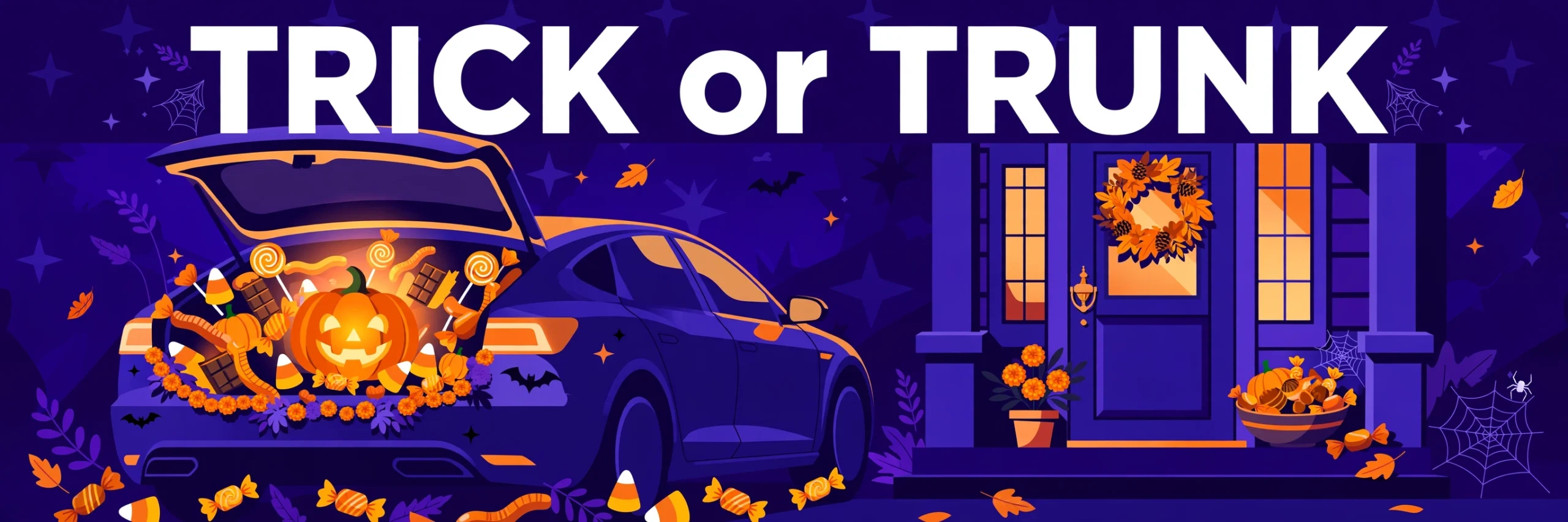
“Trunk or treat” is a different event that deliberately copies the older phrase. Instead of children walking from door to door, families park their cars in a lot — often at a church, a school, or a community centre — decorate the open trunks, and hand out sweets from them. Children in costume walk from car to car instead of from house to house.
The event began in the United States in the 1990s as a supervised, contained alternative to door-to-door trick-or-treating. Parents who worried about their children walking dark streets at night could bring them to a single well-lit parking lot instead, and churches were early adopters. Merriam-Webster’s first known use of 1989 fits that history: the phrase is a product of the late 1980s and the 1990s, not of the older Halloween tradition. Like its older cousin, it has become a verb — Merriam-Webster lists “trunk-or-treat” with the forms “trunk-or-treated” and “trunk-or-treating,” and the noun “trunk-or-treater” for a person taking part.
Notice what the word “trunk” contributes. It names the actual place the sweets come from: the car trunk. A trunk-or-treat event is, literally, treating from trunks. And note the British–American split: in British English the back of a car is the boot, not the trunk, so “trunk or treat” is an American phrase first.
Why the Two Phrases Get Mixed Up
The confusion has two causes. First, the sound: “trick” and “trunk” share their opening tr- cluster and their single syllable, and “treat” and “trunk” share the same opening too. In fast speech the two phrases are near-rhymes, and a child hearing the newer phrase for the first time can easily mishear one for the other.
Second, the calendar. Both phrases belong to the same night, the same costumes, and the same sweets, so the two names blur together in memory. The older name of the night itself, All Hallows’ Eve, is a reminder of how many names one evening can carry.
Correct vs Incorrect
| Sentence | Verdict | Why |
|---|---|---|
| “The children shouted ‘trick or treat!’ at every door.” | Correct | The standard phrase for the door-to-door custom. |
| “The church is holding a trunk or treat in the car park on Saturday.” | Correct | The standard phrase for the parking-lot event; the sweets come from car trunks. |
| “We went trick or trunk last night.” | Incorrect | There is no such phrase. You mean “trick or treating” or “trunk or treating.” |
| “She loaded the pumpkins into the trunk of the car.” | Correct | “Trunk” on its own, in the American car sense. |
| “He played a trick on his sister by hiding her shoes.” | Correct | “Trick” on its own, in the prank sense — the sense used in “trick or treat.” |
| “We trunk-or-treated at the school last year.” | Correct | The hyphenated verb form of “trunk or treat.” |
Examples in Real Sentences
Trick or treat: “The twins dressed as pirates and went trick or treating down our street.” “‘Trick or treat!’ the children chorused, holding out their buckets.” “She bought three bags of sweets for the trick-or-treaters.”
Trunk or treat: “The primary school runs a trunk or treat in its car park every October.” “We decorated our car trunk with cobwebs for the trunk or treat.” “Families who prefer a supervised event often choose trunk-or-treating over door-to-door visits.”
Trunk on its own: “He opened the trunk and took out the spare tyre.” (American English; in British English, “the boot.”) “The elephant’s trunk curled around the branch.” “Lightning split the trunk of the old beech.”
Common Mistakes
1. Writing “trick or trunk” as if it were a phrase. This is the central error, and it comes from blending the two real phrases. If you catch yourself writing it, stop and ask which event you mean: doors or car park. Doors means “trick or treat”; car park means “trunk or treat.”
2. Using “trunk or treat” for the door-to-door custom. The two events look similar — costumes, sweets, October — but they are different events with different names. Calling the door-to-door round “trunk or treat” confuses anyone who knows the parking-lot version. The reverse error is just as common: if the sweets come from car trunks in a car park, the event is a trunk or treat, even though the children will probably still shout “trick or treat!” at each car.
3. Forgetting the British–American split on “trunk.” In British English, the back of a car is the boot, so “trunk or treat” can sound nonsensical to a British reader at first hearing. If you are writing for a British audience, a short gloss — “sweets handed out from decorated car boots (called trunks in American English)” — saves a paragraph of confusion.
4. Hyphenating the quoted phrase. “Trick or treat!” as shouted speech takes no hyphens. The hyphens appear when the phrase becomes a verb or an adjective: “trick-or-treating,” “a trick-or-treat bucket.” The same rule holds for “trunk or treat” and “trunk-or-treating.”
Frequently Asked Questions
Is “trick or trunk” ever correct?
No. It is not listed in Cambridge, Merriam-Webster, Oxford Learner’s Dictionaries, or Collins as a phrase, and it has no established meaning. It is a blend of “trick or treat” and “trunk or treat.” If you see it written, the writer almost certainly means one of those two.
What is the difference between trick or treat and trunk or treat?
Trick or treat is the traditional custom: children in costume go from door to door, say “trick or treat!”, and receive sweets. Trunk or treat is a newer, organised event in a car park, where volunteers hand out sweets from decorated car trunks. The first is older (first recorded 1927); the second dates from 1989 and was designed as a supervised alternative.
Do British people say “trunk or treat”?
Rarely, and the phrase can confuse British readers because in British English a car’s storage compartment is the boot, not the trunk. The door-to-door custom is widely known in Britain as trick or treating. Trunk-or-treat events exist in Britain too, but they are much less common than in the United States.
How do you pronounce “trick or treat”?
UK /ˌtrɪk ɔː ˈtriːt/, US /ˌtrɪk ɔːr ˈtriːt/ — “TRIK or TREET,” with the stress on “treat.” “Trunk or treat” is UK /ˌtrʌŋk ɔː ˈtriːt/, US /ˌtrʌŋk ɔːr ˈtriːt/ — “TRUNK or TREET.” The pronunciations follow from the ordinary pronunciations of the three words.
The Short Version
Trick or trunk is not a phrase. The choice is between trick or treat, the door-to-door Halloween custom first recorded in 1927, and trunk or treat, the parking-lot event first recorded in 1989 in which sweets are handed out from decorated car trunks. Both are standard; the blend of the two is not. Remember the test: doors mean trick or treat, car park means trunk or treat.
Sources: Cambridge Learner’s Dictionary, “Trick or treat!” and “Trunk”; Merriam-Webster, “trick or treat” (first known use 1927) and “trunk-or-treated” (first known use 1989). External links: Cambridge — Trick or treat!; Merriam-Webster — trunk-or-treated.