All Hallows’ Eve Meaning: Definition, Origin and Examples
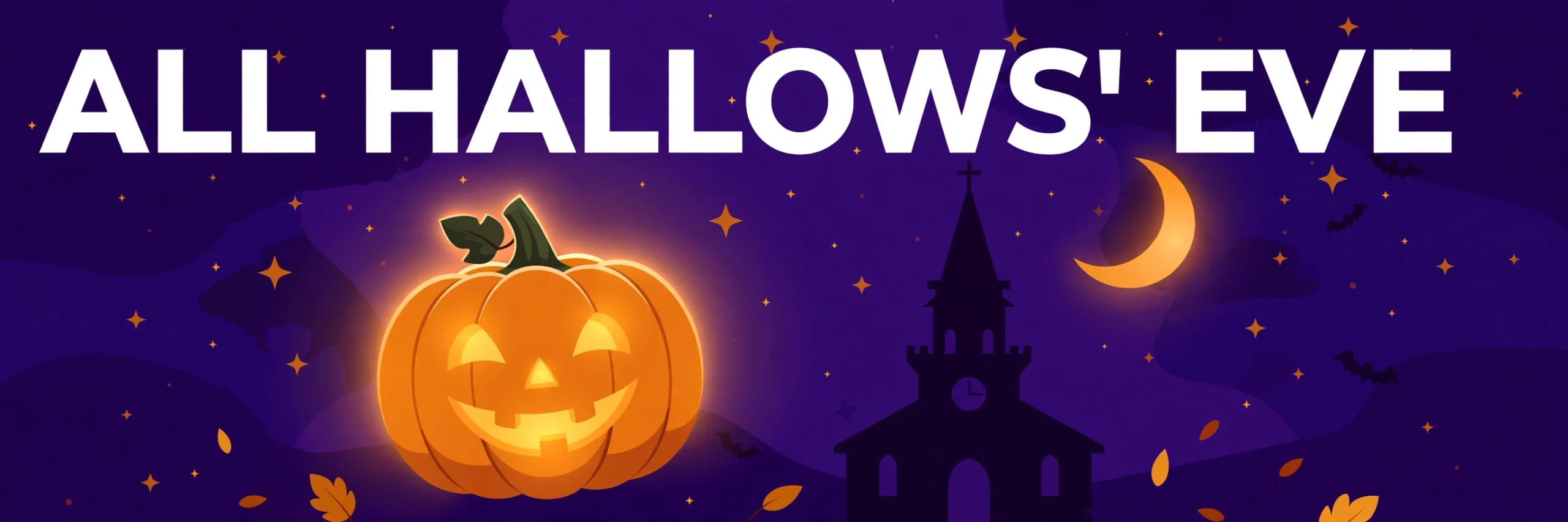
Every October, the word Halloween is everywhere — on shop windows, party invitations, and children’s costumes. Far less often, you will see the older, fuller name it came from: All Hallows’ Eve. It sounds formal, almost ceremonial, and that is exactly what it is: the original name of the evening before All Saints’ Day, and the phrase that explains where Halloween comes from.
The phrase is easy to get wrong: the apostrophe sits where most people would not put it, and the word hallow means something most people have forgotten. This article gives the definition, the correct spelling, the pronunciation, the history, and the difference between All Hallows’ Eve, Halloween, All Saints’ Day, and Samhain.
What Does “All Hallows’ Eve” Mean?
The meaning is plain once the three words are taken apart. All means every one of them. Hallows means holy people — saints. Eve means the evening, or the day, before a festival. Put together, the phrase means the evening before the day of all the saints. It is a name for a date, 31 October, defined by what follows it: All Saints’ Day on 1 November.
That is the whole meaning — and it corrects the commonest misunderstanding. All Hallows’ Eve is not a separate festival with its own subject: it takes its meaning from the day after it, as Christmas Eve takes its meaning from Christmas Day. The evening is the vigil, the night of preparation before the feast.
| Dictionary / source | What it says |
|---|---|
| Cambridge Dictionary — Halloween | “The night of 31 October when children dress in special clothes and people try to frighten each other.” Cambridge also lists the spelling Hallowe’en, which preserves the link to the older phrase. |
| Dictionary.com — “What Does the Word ‘Halloween’ Mean?” | “Halloween is sometimes spelled Hallowe’en, reflecting the fact that its name comes from a shortening of Allhallows Even. Allhallows is another name for the Christian holiday known as All Saints’ Day. In Allhallows Even, even means the same thing as eve — the evening or day before a holiday (as in Christmas Eve). The word hallow is used in reference to the saints — hallowed means ‘holy.'” |
| Oxford Learner’s Dictionaries — Halloween | Oxford gives the pronunciation UK /ˌhæləʊˈiːn/, US /ˌhæləˈwiːn/, and defines it as the night of 31 October. The spelling and sound both descend from All Hallows’ Even. |
How to Spell “All Hallows’ Eve” — and Where the Apostrophe Goes
The spelling is the part people get wrong most often, and the apostrophe is the reason. The correct form is:
All Hallows’ Eve — with the apostrophe after the s in Hallows’.
The apostrophe sits there because the phrase is a plural possessive. It is the eve of all the hallows — of all the saints, taken together. The same rule that gives us the girls’ school (the school of the girls) gives us All Hallows’ Eve (the eve of all the hallows). The apostrophe after the s is doing real grammatical work, not decorating the word.
| Spelling | Verdict |
|---|---|
| All Hallows’ Eve | Correct. Plural possessive: the eve of all the saints. |
| All Hallows Eve | Seen often, and understandable, but the apostrophe is missing. Acceptable in casual writing; not the full correct form. |
| All Hallow’s Eve | Wrong. This would mean the eve of one single hallow, which makes no sense — the phrase is about all the saints. |
| All Hallow Eve | Wrong. Hallow on its own is a verb or a singular noun; the phrase needs the plural Hallows. |
| All Hallows Eve’s | Wrong. The possessive belongs to Hallows, not to Eve. |
Hallowe’en, with an apostrophe before the en, is the older contracted spelling of Halloween; it shows where letters were dropped from All Hallows’ Even. It is correct but old-fashioned, and modern dictionaries list plain Halloween first.
How to Pronounce “All Hallows’ Eve”
The phrase is pronounced exactly as its parts suggest, with the stress on the first syllable of Hallows:
- UK: /ɔːl ˈhæləʊz iːv/ — awl HAL-ohz EEV
- US: /ɔːl ˈhæloʊz iːv/ — awl HAL-ohz EEV
Three points matter. First, All rhymes with call and hall. Second, Hallows has two syllables — HAL-ohz — with a clear z at the end, because the word ends in a possessive s after a vowel sound; dropping the z drops the possessive. Third, Eve is one long syllable, EEV, as in Christmas Eve. No dictionary consulted lists a separate pronunciation entry for the full phrase; the one above follows from the standard pronunciations of its three component words.
Where the Phrase Comes From
The history runs in the opposite direction from what most people assume: the long phrase came first, and the short word is the abbreviation.
Hallow is an Old English word for a holy person, a saint. It survives today in the Lord’s Prayer — “hallowed be thy name” — and in this phrase. The festival of All Saints was called All Hallows’ Day in Old English, from ealra hālgena mæssedæg, “the mass day of all saints,” and the evening before it was All Hallows’ Eve.
The phrase itself is first recorded in 1556. The shorter form followed a well-worn path. In Scots, the word for eve was even, which could be shortened to e’en. So All Hallows’ Even became Hallowe’en, and then Halloween — first recorded in that form in the 1550s, with the modern spelling established by about 1745. Every step is a small, ordinary contraction of the one before it. There is no mystery in the etymology once the steps are laid out; there is only a chain of shortenings, each one dropping a syllable that speakers no longer needed.
The date follows from the feast. All Saints’ Day has been celebrated on 1 November since the eighth century, when Pope Gregory III fixed it on that date in Rome — so the evening before, 31 October, became All Hallows’ Eve by definition. The day after, 2 November, is All Souls’ Day, for prayer for all the departed. Together the three days are sometimes called Allhallowtide, a season for remembering the dead.
All Hallows’ Eve vs Halloween vs All Saints’ Day
These terms overlap, and that is why they get confused. The table separates them:
| Term | Date | What it is |
|---|---|---|
| All Hallows’ Eve | 31 October | The evening before All Saints’ Day; the older, formal name for the night. |
| Halloween | 31 October | The same night, under the shortened modern name; today mostly a secular celebration of costumes, parties, and trick-or-treating. |
| All Saints’ Day (All Hallows’ Day) | 1 November | The Christian feast honouring all the saints. |
| All Souls’ Day | 2 November | The day of prayer for all the faithful departed. |
| Allhallowtide | 31 October – 2 November | The three-day season containing all of the above. |
The practical rule: for the modern celebration — costumes, pumpkins, trick-or-treating — say Halloween. For the night in its historical or religious sense, or when writing about the origin of the word, say All Hallows’ Eve.
Is All Hallows’ Eve the Same as Samhain?
Not exactly, and the difference is worth stating carefully. Samhain (pronounced SOW-in) was an ancient Gaelic seasonal festival marking the end of the harvest and the beginning of winter. It fell around the same time of year, and many historians believe some of its customs fed into the way Halloween came to be celebrated — the sense of a night when the boundary between the living and the dead felt thin is older than Christianity in these islands.
But the name is Christian, not Celtic: it comes from the feast of All Saints, through Old English and Scots. And the origins of individual Halloween customs remain a subject of historical discussion — it would be misleading to claim that every modern custom came from Samhain, or that the Church created All Saints’ Day simply to replace a pagan festival. The honest summary: the name is Christian, the date is the eve of a Christian feast, and some of the night’s customs have older roots that historians still debate.
How to Use “All Hallows’ Eve” in a Sentence
- “On All Hallows’ Eve, the church holds a vigil service before the feast of All Saints.”
- “The word Halloween is a shortened form of All Hallows’ Eve.”
- “In the sixteenth century, All Hallows’ Eve was a night for remembering the dead, not for fancy dress.”
- “The three days of Allhallowtide begin with All Hallows’ Eve on 31 October.”
- “She preferred the old name, All Hallows’ Eve, to the modern Halloween.”
Common Mistakes
Putting the apostrophe before the s. All Hallow’s Eve is the single most common error, and it changes the meaning: it would be the eve of one saint. The apostrophe goes after the s because the eve belongs to all the saints.
Treating it as a different night from Halloween. The two are the same night under two names — the older formal name and the modern contracted one.
Calling it a pagan festival. The phrase and the feast it names are Christian in origin. Older seasonal customs influenced how the night was celebrated, but the name itself comes from All Saints’ Day.
Writing “All Hallows Eve” without the apostrophe in formal writing. In a text message it hardly matters. In an article, an essay, or anything edited, include the apostrophe: it is part of the correct spelling.
Frequently Asked Questions
What is the meaning of All Hallows’ Eve?
It means “the evening of all the saints” — the night of 31 October, before All Saints’ Day on 1 November. Hallow is an old word for a saint; eve means the evening before a holy day.
Is All Hallows’ Eve the same as Halloween?
Yes. Halloween is a shortened form of All Hallows’ Even. They name the same night, 31 October. Halloween is the everyday modern word; All Hallows’ Eve is the older, formal name.
Why is the apostrophe after the s in Hallows’?
Because it is a plural possessive: the eve of all the hallows (all the saints). The apostrophe after the s marks that possession, just as in the students’ books.
When was the phrase first used?
All Hallows’ Eve is first recorded in 1556, and Halloween in the 1550s. All Saints’ Day itself had been fixed on 1 November since the eighth century.
What is Allhallowtide?
The three-day season from 31 October to 2 November: All Hallows’ Eve, All Saints’ Day, and All Souls’ Day — a season for remembering the saints and the departed.
How do you pronounce All Hallows’ Eve?
Awl HAL-ohz EEV — UK /ɔːl ˈhæləʊz iːv/, US /ɔːl ˈhæloʊz iːv/. Stress the first syllable of Hallows, and keep the z sound at the end of it.
The Short Version
All Hallows’ Eve is the evening of 31 October, the night before All Saints’ Day — the older, fuller name of what we now call Halloween. Spell it with the apostrophe after the s (Hallows’), because it is the eve of all the saints. Say it awl HAL-ohz EEV. The name is Christian in origin even though some of the night’s customs are older: hallow means a saint, and eve means the night before a feast.