Diffidence Meaning: Definition, Examples and How to Use It
Diffidence Meaning: Definition, Examples and How to Use It
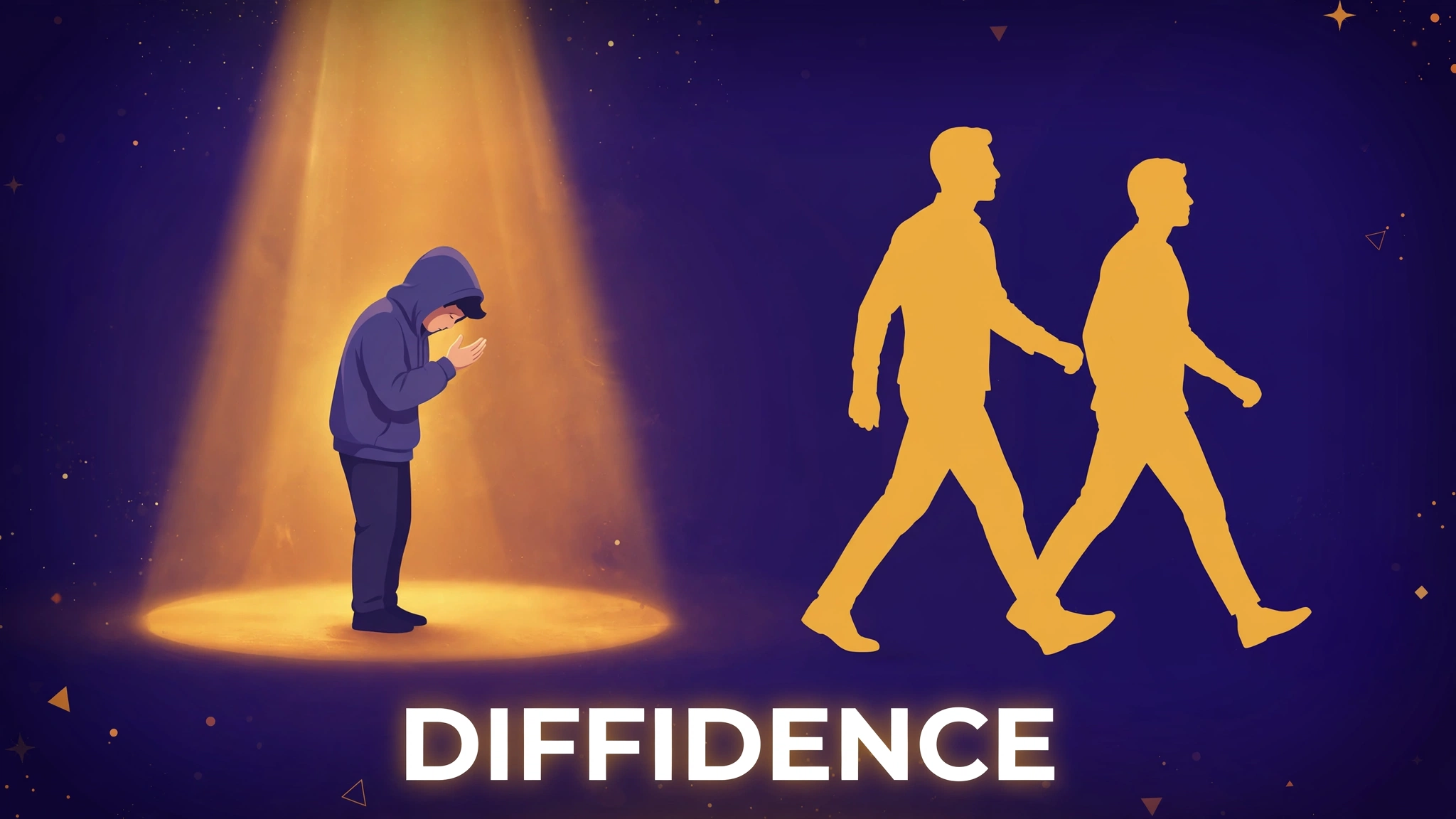
Everyone knows someone who has good ideas but never raises their hand. The idea is there, the knowledge is there — what is missing is the confidence to push it forward. That missing confidence has a precise name: diffidence. It is a formal noun for the state of being shy, hesitant, or unwilling to assert yourself, and though it sounds old-fashioned, it describes something almost everyone has felt: holding back not because you have nothing to say, but because you doubt whether saying it will go well.
What the Dictionaries Say
Merriam-Webster defines diffidence as “the quality or state of being unassertive or bashful: the quality or state of being diffident.” Its thesaurus entry glosses the word “as in timidity: the quality or state of lacking confidence or assertiveness,” and offers a quietly vivid example sentence: He met the girl’s gaze with awkward diffidence. Synonyms it groups under the word include timidity, quietness, submissiveness, reserve, submission, and shyness.
Collins, which gives the pronunciation [ˈdɪfɪdəns], captures the word’s tone through its example sentences: “He entered the room with a certain diffidence.” “He spoke with a certain diffidence.” “The trouble seems to be a kind of diffidence, a sense of embarrassment.” And perhaps most tellingly: “What women mistake as thoughtlessness is often just diffidence.” That last line points at something real — diffidence is easily misread. The quiet person in the corner is not necessarily aloof or disinterested; they may simply doubt themselves. Collins’ thesaurus maps the word onto several neighbouring ideas — doubt (a lack of confidence), humility, insecurity, meekness, modesty, and reserve — which shows how the word sits at the crossroads of shyness and self-doubt.
Cambridge’s entry confirms diffidence is a noun and supplies the pronunciation for both British and American English (more on that below). Its examples for the adjective diffident show the word’s typical company: “We are diffident about making arrangements which appear to benefit us”, “too diffident to discuss birth control with their husbands”, “I am also in a most diffident state.” The pattern is consistent: diffidence shows up where someone holds back from acting, speaking, or claiming something — through lack of confidence, not lack of interest.
How to Pronounce Diffidence (UK and US)
The pronunciation is the same on both sides of the Atlantic:
- UK: /ˈdɪfɪdəns/ — “DIF-i-dəns”
- US: /ˈdɪfɪdəns/ — “DIF-i-dəns”
Cambridge gives /ˈdɪfɪdəns/ for both UK and US audio, and Collins shows [ˈdɪfɪdəns]. Stress falls firmly on the first syllable: DIF-i-dence. The related adjective diffident is /ˈdɪfɪdənt/ (“DIF-i-dənt”) — same stress, same first vowel. The common mistake is shifting the stress to the middle (“dif-FI-dence”) or pronouncing the first vowel long (“DIE-fidence”). Keep it short and punchy at the start: DIF-i-dəns.
Where the Word Comes From
Diffidence has one of the most transparent etymologies in English — and it is shared with a word you would never guess. Merriam-Webster traces it to Middle English dyffidence, borrowed from Latin diffīdentia, built from diffīdent-, diffīdens — “distrustful, diffident” — plus -ia, with first known use in the 15th century. Dictionary.com refines this: first recorded 1425–75, from Latin diffīdent-, the stem of diffīdēns (“mistrusting, despairing,” the present participle of diffīdere), equivalent to dif- + fīd- (“trust”) + -ent.
That fīd- is the giveaway. It is the same root as Latin fidere, “to trust” — the root of confident, confidence, and fidelity. So diffident is, quite literally, the mirror image of confident: con- (“with”) + trust versus dis-/dif- (“apart, away”) + trust. A confident person trusts themselves; a diffident person does not. When you remember that pair, you will never mix the meaning up again.
There is a wrinkle worth knowing. In Latin, diffīdens meant “mistrusting” in a general sense — it could describe distrust of others as well as of oneself. Dictionary.com notes that the “distrustful” sense of diffident is now marked archaic. So while the word once covered suspicion of others, modern English has narrowed it almost entirely to self-distrust: lack of confidence in your own ability, worth, or fitness. If you meet “diffident” meaning “suspicious” in a very old book, that is the archaic sense — do not carry it into modern writing.
Diffidence vs Diffident: The Word Family
The two words belong together but are not interchangeable:
- Diffidence is the noun: the state or quality itself. Her diffidence held her back from applying.
- Diffident is the adjective: describing a person or manner. He gave a diffident smile. A diffident manner.
- Diffidently is the adverb: She raised her hand diffidently.
You will also occasionally see diffidentness listed as a noun, but it is rare and most dictionaries treat diffidence as the standard noun. “Self-diffidence” appears in older writing as an emphatic form. As a rule, pair the noun with verbs of possessing or overcoming — overcame her diffidence, showed a certain diffidence, spoke with diffidence — and use the adjective directly before nouns or after linking verbs: a diffident student, he seemed diffident.
Diffidence vs Shyness, Modesty, and Humility
These four words overlap, and choosing between them is where real precision lives.
- Shyness is the broadest: nervousness or discomfort around other people, often social. You can be shy without doubting your abilities — many shy people are extremely competent.
- Diffidence is narrower: it is specifically self-doubt. A diffident person hesitates because they question their own judgement, not merely because social situations feel awkward. This is why diffidence also appears in non-social contexts — “diffident about making arrangements” is about doubting a decision, not about being nervous at parties.
- Modesty is about not boasting — understating your achievements. A modest person may be perfectly confident inside.
- Humility is about having a low view of your own importance. It is often presented as a virtue; diffidence rarely is.
The practical test: if the person’s problem is that they think their idea might be wrong, write diffidence. If their problem is that strangers make them nervous, write shyness. If they simply don’t brag about being right, write modesty.
Correct vs Incorrect Usage
- Correct: Despite her talent, diffidence stopped her from auditioning. (self-doubt holding someone back)
- Correct: He entered the room with a certain diffidence. (Collins’ example — hesitant, unassertive manner)
- Correct: I approach the committee’s figures with a certain diffidence. (doubting one’s own grasp of the subject)
- Incorrect: His diffidence towards strangers made him suspicious of everyone. — That is the archaic “distrust” sense. For modern mistrust of others, use “suspicion” or “distrust.”
- Incorrect: She showed great diffidence by donating anonymously. — Anonymous donation is modesty or humility, not self-doubt. Use “modesty.”
Common Mistakes Learners Make
Treating it as “shyness” in every case. Shyness is the closest synonym, but diffidence carries the specific note of self-doubt. In exam essays and formal writing, markers reward the distinction: diffidence for hesitation rooted in lack of confidence, shyness for social nervousness.
Using it for lack of confidence in others. “I have diffidence in his promises” sounds wrong to modern ears — that is the archaic Latin sense (“mistrusting”). Say “I distrust his promises” or “I doubt his promises” instead.
Overusing a formal word. Diffidence is a formal, slightly literary word. In casual conversation, “she’s shy” or “he lacks confidence” usually lands better. Reserve diffidence for writing where its precision earns its formality — essays, literature, careful character description.
Spelling it “difidence.” The word has a double f: D-I-F-F-I-D-E-N-C-E. It follows the dif- prefix of the Latin root, the same double-f you see in “difference” and “difficult.”
A false-friend warning for Italian speakers. Collins explicitly notes that diffidence “is not translated by the Italian word diffidenza” — which means distrust or suspicion. The two are deceptive cognates; the Italian word points at others, the English word points at oneself.
Frequently Asked Questions
What is the difference between “diffidence” and “diffident”?
Diffidence is the noun (the state of lacking self-confidence); diffident is the adjective (describing someone who lacks it). Her diffidence was obvious versus she was diffident about volunteering. The adverb is diffidently.
Is “diffidence” the same as “shyness”?
Not exactly. Shyness is nervousness or discomfort around people; diffidence is specifically hesitation caused by doubting your own ability or judgement. A person can be socially confident yet diffident about their expertise — or shy in crowds while entirely sure of their work.
Is “diffidence” a positive or negative quality?
Mostly negative in effect, though not in character. Dictionaries define it neutrally — “the quality or state of being unassertive or bashful” — but in usage it almost always describes something holding a person back: “diffidence prevented him from applying,” “she overcame her diffidence.” It is a flaw to be worked through, not a virtue to be praised (that would be modesty or humility).
How is “diffidence” related to “confidence”?
They are etymological mirror images. Both come from Latin fidere, “to trust.” Confident is con- (“with”) + trust — trusting yourself. Diffident is dis-/dif- (“apart, away”) + trust — not trusting yourself. Diffidence is simply the noun form of that lack of self-trust.
Can “diffidence” be used about a group or organisation?
Yes, and journalists do it often. Merriam-Webster’s recent examples include “our pro bono military operations have been conducted with noticeable diffidence” and a play “caught between an exploration of comic diffidence and simply an expression of it.” When applied to organisations, it means hesitant, unassertive conduct — a reluctance to act decisively.
Takeaway
Diffidence names one of the quietest obstacles in human life: the gap between what you know and what you dare to say. It is a noun for self-doubt made visible — the hesitation before the raised hand, the qualified opinion, the application never sent. Pronounced /ˈdɪfɪdəns/ with the stress on DIF, built from the same Latin root as “confidence” but pointing the opposite way, it rewards precise use. Deploy it where the issue is genuinely doubt in oneself, not mere shyness and not humility — and you will have said, in one formal word, what might otherwise take a paragraph.