Wreath Meaning: Definition, Examples and How to Use It
A wreath is a ring-shaped arrangement of flowers, leaves, or other materials — laid on a grave in remembrance, hung on a door at Christmas, or awarded as a mark of honour. The word’s power lies in that simple circle: unbroken, with no beginning or end, which is why wreaths have symbolised eternity, victory, and memory across cultures for thousands of years.
English also stretches the word to anything with that coiled, circular shape — wreaths of smoke, a wreath of mist — and it hides two pronunciation traps (the silent a, and a plural that voices its final consonant) plus a lookalike verb, wreathe, that writers constantly mix up.
What the Dictionaries Say About “Wreath”
| Dictionary | Definition of wreath |
|---|---|
| Collins COBUILD | “An arrangement of flowers and leaves, usually in the shape of a circle, which you put on a grave or by a statue to show that you remember a person who has died or people who have died.” |
| Webster’s New World (via Collins) | “A twisted band or ring of leaves, flowers, etc.” … also “something suggesting this in shape; twisted or circular band” — as in “wreaths of smoke.” |
| Merriam-Webster (Kids) | “Something twisted or woven into a circular shape” — “a wreath of flowers.” |
Notice how every definition returns to the same image: something twisted into a ring. That is the word’s oldest sense, and everything else — the funeral custom, the Christmas door, the victor’s laurel — is built on it.
How to Pronounce “Wreath”: UK and US (and the Plural)
The spelling misleads almost everyone at first: the a is silent, and the word rhymes with teeth.
- UK: /riːθ/ — reeth, with the long “ee” of teeth
- US: /riθ/ — reeth, slightly shorter vowel
The plural is where it gets interesting. Collins records two plural pronunciations: /riːðz/ (reethz, with the th voiced like the th in breathe) and /riθs/ (reeths, voiceless). The voiced version is the traditional one and follows the same pattern as breath/breathe and sheath/sheathe — English has a habit of voicing the th when the word gains a syllable-like plural ending. Either is understood; reethz sounds more natural to most native ears.
Where Does “Wreath” Come From?
Collins traces wreath to Old English writha, related to the verb writhe — “to twist.” Merriam-Webster dates its first known use to before the 12th century. So the word has meant “something twisted into a ring” for over a thousand years, and the connection to writhe (as in “writhing in pain”) is genuine: both describe twisting.
That etymology also explains the figurative uses. A wreath of smoke or a wreath of mist is smoke or mist that curls and twists into rings — the shape, not the flowers, is the point.
The Main Kinds of Wreath
Funeral and memorial wreaths
The most solemn use. Wreaths of lilies, roses, or chrysanthemums are laid on coffins, graves, and war memorials as a public act of remembrance — Collins’s COBUILD definition leads with exactly this. “To lay a wreath” is the fixed collocation: we lay wreaths at the Cenotaph on Remembrance Sunday, at the Tomb of the Unknown Soldier, at a state funeral.
Christmas wreaths
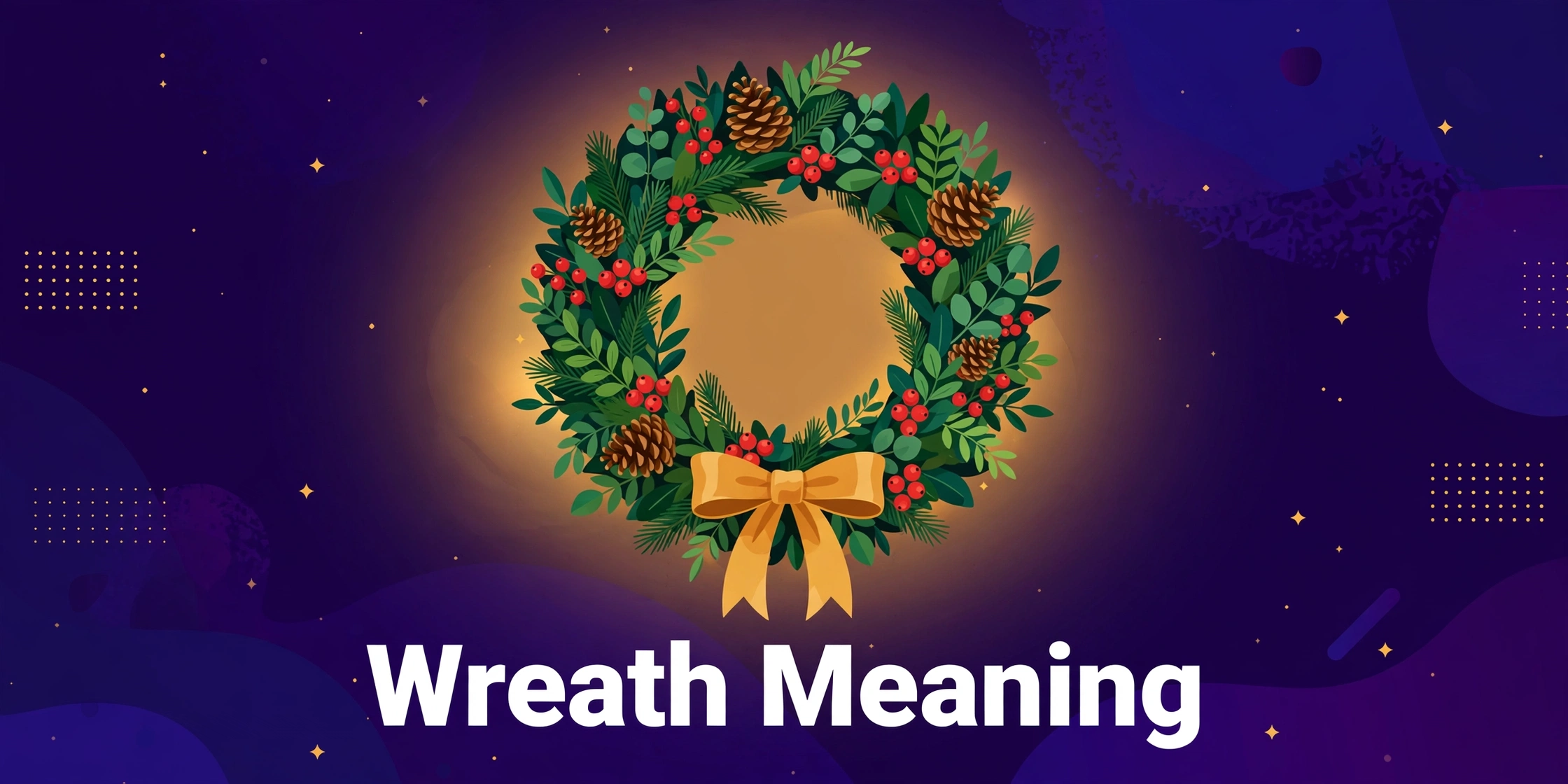
The festive use: an evergreen ring hung on a front door, often decorated with berries, pinecones, and ribbon. The Advent wreath is a specific Christian tradition — a ring of evergreen holding four candles, one lit on each Sunday of Advent. The evergreen circle symbolises eternal life, which is why the shape suits both mourning and celebration.
Laurel wreaths
The ancient honour. In classical Greece and Rome, a wreath of laurel leaves crowned victors — athletes, generals, poets. The image survives in “resting on one’s laurels” (relying on past achievements) and in the word laureate (as in Poet Laureate): literally, “crowned with laurel.” A laurel wreath in a logo or emblem still signals victory and distinction.
Decorative and heraldic wreaths
Door wreaths for autumn (dried wheat, berries) and spring (blossom) have become a year-round home-décor staple. In heraldry, a wreath (also called a torse) is the twisted band of fabric shown between a helmet and its crest on a coat of arms — a direct descendant of the word’s “twisted band” sense.
Wreath vs Wreathe: Don’t Mix Them Up
This is the single most common error with the word:
| Wreath | Wreathe | |
|---|---|---|
| Part of speech | Noun | Verb |
| Pronunciation | /riːθ/ — voiceless th, like teeth | /riːð/ — voiced th, like breathe |
| Meaning | The circular arrangement itself | To encircle or envelop; to twist into a wreath |
| Example | “a wreath of holly” | “Mist wreathed the hilltops.” |
The pair follows the breath/breathe pattern exactly: noun with a hard th, verb with a soft one. “The mountains were wreathed in fog” is correct; “the mountains were wreathed” with the noun spelling is a mistake, though an extremely common one.
Examples of “Wreath” in Sentences
- The Queen laid a wreath at the Cenotaph.
- A wreath of holly and ivy hung on every door in the street.
- The marathon winner was crowned with a laurel wreath, just like in ancient Olympia.
- Wreaths of smoke curled up from the campfire into the cold air.
- She placed a single white rose wreath on her grandmother’s grave.
- Morning mist lay in wreaths across the valley.
Common Mistakes with “Wreath”
- Pronouncing the a. It is reeth, not reeth-ah or wrayth. The a has been silent for centuries.
- Writing wreath for the verb. “Smoke wreathed the chimney” (verb, soft th) vs “a wreath of smoke” (noun, hard th).
- “Wreath laying” word order. The ceremony is the laying of a wreath or a wreath-laying ceremony — “lay a wreath” is the verb phrase to learn.
- Assuming it is only about Christmas. The funeral, memorial, and victory senses are older and, in formal writing, more prominent.
FAQs About “Wreath”
What is the plural of wreath?
Wreaths — and Collins records it pronounced either /riːðz/ (reethz, voiced th) or /riθs/ (reeths, voiceless). The spelling is always wreaths, never wreathes (that spelling belongs to the verb wreathe).
Why are wreaths circular?
The circle has no beginning or end, so across cultures it has symbolised eternity, continuity, and victory — eternal life at Christmas and funerals, unbroken triumph in the laurel crown. The shape is the meaning.
What does “lay a wreath” mean?
It means to place a wreath ceremonially, usually at a grave, memorial, or statue, as a formal act of remembrance or respect. Heads of state lay wreaths on official visits; it is one of the most recognisable rituals of public mourning.
Is a wreath only made of flowers?
No. Traditional wreaths use flowers and foliage, but modern ones use pinecones, berries, dried wheat, fabric, grapevine, even seashells. The defining feature is the ring shape, not the material.
Takeaway
A wreath is a ring — of flowers for remembrance, of evergreen for Christmas, of laurel for victory, of smoke for atmosphere. Pronounce it reeth, voice the th in the plural (reethz), and keep the verb wreathe (wreeth, soft th) strictly separate. Get those three things right and the word will never trip you up.
Source for the dictionary senses quoted above: Collins English Dictionary’s entry for “wreath”.