Lever Meaning: Definition, Examples and How to Use It
Lever Meaning: Definition, Examples and How to Use It
Lever is a small word doing a lot of work. Most people meet it first as a handle — the thing you pull on a machine — but it is also one of physics’ six simple machines, a verb meaning to pry or force something with a bar, and a figurative phrase for a means to an end. All four uses are standard, all are listed in the major dictionaries, and they all trace back to the same idea: a bar used to lift.
This article covers every sense of lever as a noun and a verb, how the pronunciation differs between British and American English (and why some Americans say it a second way), and how to use it correctly — including its close cousin leverage, which is not quite the same word.
Lever as a noun: three senses
1. The handle you pull on a machine
The everyday sense of lever is a handle or bar attached to a piece of machinery that you push or pull to operate it. The gear lever in a car, the lever that flushes a toilet, the little lever on a lock, the lever on a mixer tap controlling hot and cold water — all of these are levers in this sense. The motion is what defines it: you push or pull it, and the machine responds.
Examples:
- Push the tiny lever on the lock and the door locks itself.
- She pulled the lever and the train doors slid shut.
- The coffee machine has a single lever for steam.
This is the sense most people reach for first, and it is fully standard in both British and American English.
2. The physics sense: a rigid bar on a fulcrum
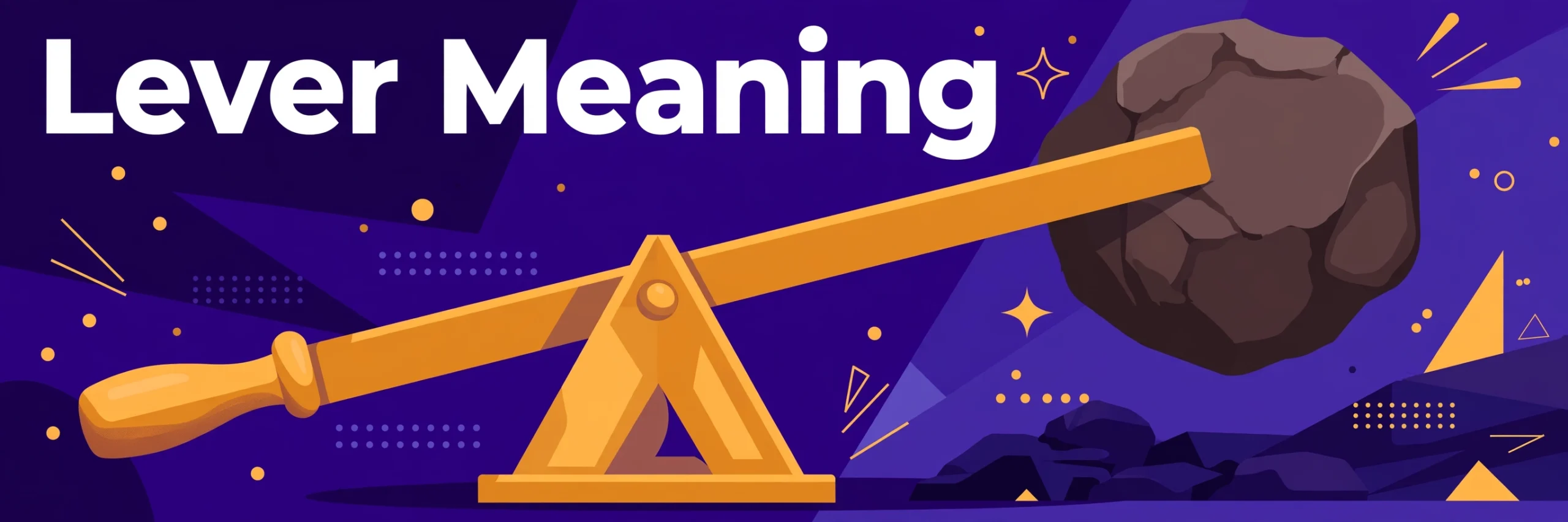
In mechanics, a lever is a rigid bar that pivots about one fixed point — the fulcrum — so that a force applied at one point moves a load at another. It is one of the six classical simple machines, alongside the wheel and axle, the pulley, the inclined plane, the wedge, and the screw. A crowbar prising up a floorboard, a seesaw, a pair of scissors, and a wheelbarrow are all levers at work.
The point of the definition is mechanical advantage: a small effort over a long distance moves a large load over a short distance. When dictionaries give this as the first sense, they are not being technical for the sake of it — this is the sense that explains the word’s history and all its figurative uses.
- The volunteers used a wooden lever to shift the fallen boulder.
- A wheelbarrow is a lever: the wheel is the fulcrum, the load sits in the middle, and you lift the handles.
3. The figurative sense: a means to an end
Because a lever multiplies force, the word has a well-established figurative sense: a lever is anything you use to gain an advantage or bring something about — a means to an end. This sense is listed by Webster’s New World and used naturally in serious prose.
- He used the threat of resignation as a lever to force the board’s hand.
- Good exam results can be a powerful lever for social mobility.
The phrasing to watch for is “use something as a lever” or “a lever for” + a goal. Note the tone: it implies strategy and pressure, not just a tool. Using someone’s loyalty “as a lever” carries a slightly manipulative edge, so use it deliberately.
Lever as a verb
Lever is also a verb, and a common one: to lever something is to move, lift, or force it with or as if with a lever. The verb forms are regular — levers, levering, levered — and it is usually transitive (it takes an object), often followed by open, up, off, or out.
- Neighbours eventually levered the door open with a crowbar.
- She levered herself up from the sofa.
- He levered the lid off the paint tin with a screwdriver.
Correct vs incorrect:
- ✓ “They levered the rock out of the soil.” — standard verb use.
- ✓ “The nurse levered the patient upright.” — the “as if with a lever” extension, moving a person with steady force.
- ✗ “He lever the box yesterday.” — the past tense is levered, not “lever.”
- ✗ “She was levering on the handle.” — “levering on” is unidiomatic; the verb takes the thing being moved: “levering the handle down.”
Intransitive use (“he levered mightily, to no avail”) exists in dictionaries but is rare in modern writing; the transitive pattern is the safe default.
Pronunciation: UK vs US
This is where lever quietly splits the English-speaking world:
- British English: /ˈliːvə/ — rhymes with “clever” without the c (“LEE-vuh”).
- American English: /ˈlevər/ — “LEV-ur,” with the same vowel as “let.”
There is a genuine second American pronunciation, /ˈlivər/ (“LIV-ur”), also listed by Webster’s New World and Collins. So an American saying “LIV-er” is not wrong — but “LEV-ur” is the most widely recognised US form, and “LEE-vuh” marks you as British. The spelling never changes; only the first vowel sound shifts.
One more sound-alike to know: lever is a homophone of leaver (someone who leaves, as in “school leaver”) in British English, where both are /ˈliːvə/. Context almost always disambiguates them in writing, but in speech — “the leaver/lever was broken” — ask for clarification if it matters.
Lever vs leverage: don’t confuse them
Leverage is the related noun meaning the mechanical advantage a lever gives — and, by extension, influence or power used to achieve something (“financial leverage,” “negotiating leverage”). In business writing it has also become a verb (“to leverage our assets”), a usage many style guides still dislike.
The distinction that matters:
- Lever = the physical thing (or the verb for using one). Concrete.
- Leverage = the advantage or force it produces. Abstract.
Correct vs incorrect:
- ✓ “The scandal gave the press leverage over the minister.” — abstract influence.
- ✗ “He used the scandal as a leverage.” — use lever here (“as a lever”), since the construction “use X as ___” takes the concrete noun.
- ? “We need to leverage our data.” — business jargon; “use” or “exploit” is usually clearer and less grating.
Common mistakes with lever
- Mixing it up with “leaver.” A leaver is a person who leaves; a lever is the bar or handle. “School leavers” vs “pull the lever” — different words, same sound (in British English).
- Wrong past tense. The verb is regular: levered, never “levere” or “leverred.”
- “Lever” as an adjective. There is no standard adjective “lever” — the derived form is lever-like (rare). Don’t write “leverish.”
- Overusing the figurative sense. “A lever for change” is vivid once; in a paragraph already full of tools and machinery metaphors, it turns into clutter. One lever per article is plenty.
Examples of lever in sentences
- The old printing press still works with a single iron lever.
- Archimedes claimed that with a long enough lever and a place to stand, he could move the Earth.
- She levered the window open after it had been painted shut.
- The union used the strike threat as a lever in negotiations.
- Pull the lever towards you to recline the seat.
- Reporters levered the documents out of the archive with freedom-of-information requests.
FAQs
Is lever a noun or a verb?
Both. As a noun it names the bar or handle (and, figuratively, a means to an end); as a verb it means to move or force something with a lever. The noun is far more common, but the verb (“levered open”) is standard and useful.
How do you pronounce lever in American English?
/ˈlevər/ (“LEV-ur”) is the most common American pronunciation; /ˈlivər/ (“LIV-ur”) is also listed by American dictionaries. British English uses /ˈliːvə/ (“LEE-vuh”).
What is a lever in physics?
One of the six simple machines: a rigid bar that pivots on a fixed point called a fulcrum, converting a small force applied over a long distance into a larger force over a short distance. Seesaws, crowbars, and wheelbarrows are everyday examples.
What does “use something as a lever” mean?
To use it as a means to an end — as a source of advantage or pressure to bring about a result, e.g. “She used the deadline as a lever to get the report finished.” It implies strategy, sometimes with a hint of manipulation.
What is the past tense of the verb lever?
Levered — the verb is regular: lever, levers, levering, levered.
The takeaway
Lever (UK /ˈliːvə/, US /ˈlevər/) is a noun for a handle, a bar on a fulcrum, or a means to an end — and a verb for forcing something with one. Keep it distinct from leaver (the person) and leverage (the advantage), mind the regular past tense levered, and you will use one of English’s hardest-working little words correctly.