Waste or Waist: What’s the Difference?
Waste is about what you throw away or use badly. Waist is the middle of your body. They sound exactly alike — the Oxford Advanced Learner’s Dictionary lists them as homophones, giving both the same pronunciation, UK and US: /weɪst/. The confusion is almost always in writing: one letter sits between them, and that one letter decides whether you’re talking about rubbish or the body part you wrap a belt around.
Quick Answer
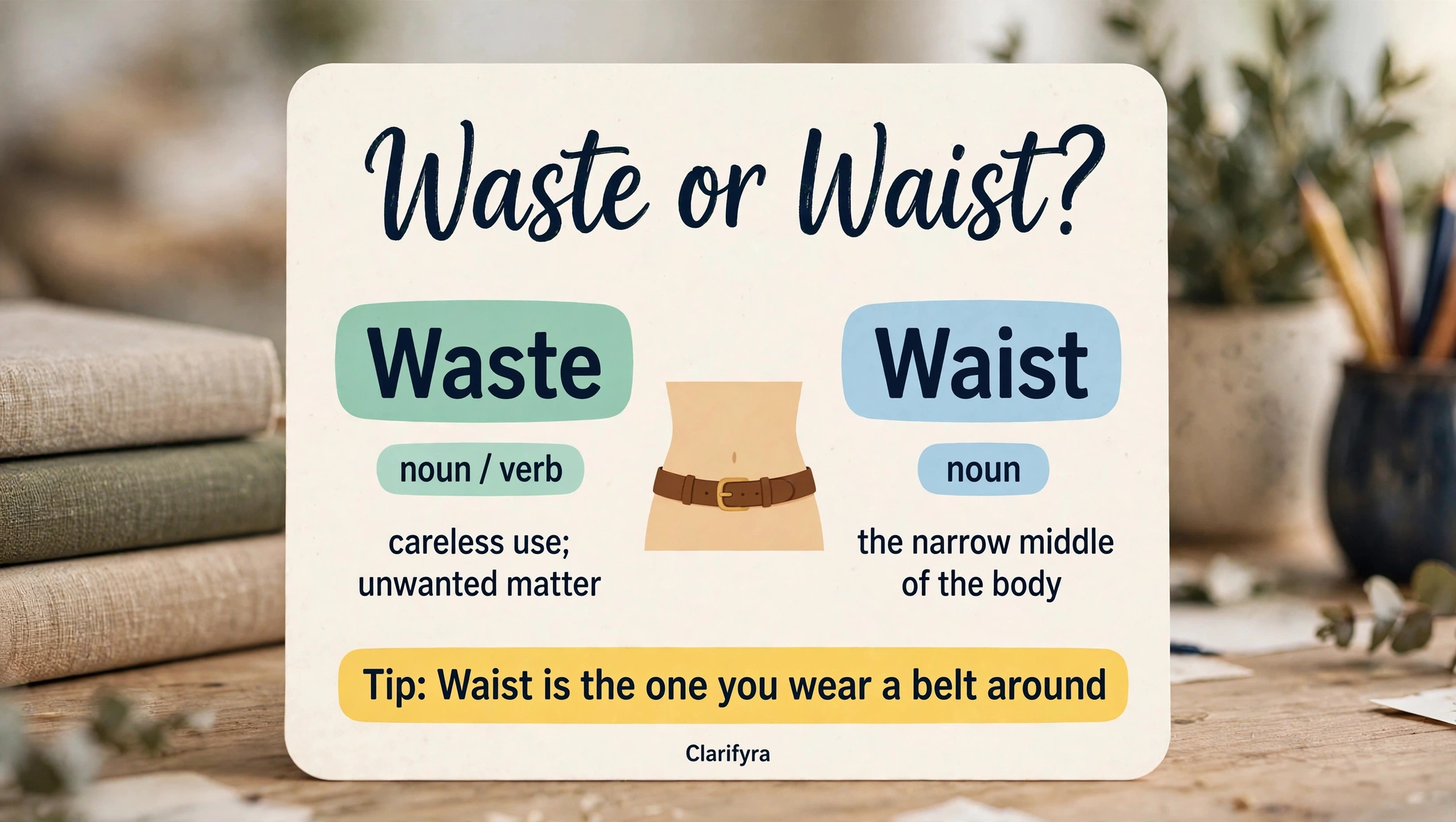
Waste (w-a-s-t-e) = using something badly, or unwanted matter: “a waste of time,” “toxic waste,” “don’t waste water.” Waist (w-a-i-s-t) = the narrow middle part of the body: “her waist,” “from the waist up,” “waist-high.” Pronunciation: both are /weɪst/ in British and American English — context is the only way to tell them apart in speech.
Waste: The “What You Throw Away” Word
Waste is the busier of the two words, working as a noun, a verb, and an adjective. All of its senses circle the same idea: something used badly, or something left over that nobody wants.
As a noun: bad use, and unwanted matter
Cambridge lists two main noun senses. The first is bad use — using something valuable carelessly, often in the phrase “a waste of…”:
“That meeting was a complete waste of time.”
“Buying that sports car was a sinful waste of money.”
“It’s such a waste of her talents.”
The second is unwanted matter — what gets thrown out: household waste, industrial waste, toxic waste. Related idiom: “go to waste,” meaning not to be used at all: “All this food will go to waste if nobody comes.”
There’s also a formal plural use, wastes, meaning large empty areas of land — “the frozen wastes of Siberia” — but you will meet this mainly in literary writing.
As a verb: to use badly
As a verb, waste means to use something carelessly or to spend it badly:
“Don’t waste water by taking a bath instead of a shower.”
“She’s wasting her time on that project.”
“He wasted his money on useless gadgets.”
The phrasal verb “waste away” is a separate, common sense: to lose weight or strength gradually — “He was wasting away from illness.”
As an adjective: left over or unwanted
In phrases like “waste material,” “waste products,” and “waste disposal,” waste works as an adjective describing things that are discarded or no longer useful.
Waist: The Body Word
Waist has one job, and it’s a simple one. Oxford Learner’s defines it as “the area around the middle of the body between the ribs and the hips, often narrower than the areas above and below”:
“He put his arm around her waist.”
“She was paralysed from the waist down.”
“The workmen were stripped to the waist.”
It also names the part of clothing that covers the waist — “a skirt with an elasticated waist,” “these jeans have a 32-inch waist” — and shows up in compounds and measurements: waistline, waist-high, high-waisted. Note that “waist” in the clothing sense often appears in measurements and sizes — a spot worth proofreading carefully, since a stray “waste” there is hard to catch at a glance.
At a Glance
| Word | Spelling | Part of Speech | Meaning | Example |
|---|---|---|---|---|
| waste | w-a-s-t-e | noun / verb / adjective | bad use; unwanted matter | “a waste of time”; “don’t waste money” |
| waist | w-a-i-s-t | noun | the narrow middle of the body | “from the waist up”; “a narrow waist“ |
Common Mistakes
1. Writing “waist” when you mean “waste.” ✗ “What a waist of money.” → ✓ “What a waste of money.” If the sentence is about time, money, food, or effort being lost or misused, it is always waste with no i. The same goes for “waist of space” — the idiom (a person who is not useful) is “a waste of space.”
2. Writing “waste” when you mean “waist.” ✗ “She has a tiny waste.” → ✓ “She has a tiny waist.” ✗ “The water was waste-high.” → ✓ “The water was waist-high.” Anything about bodies, belts, trouser sizes, or height measured against the body is waist with an i.
3. Misspelling “waistline” and “waistband.” ✗ “wasteline” / “wasteband” → ✓ “waistline” / “waistband.” These compounds are built on the body word, not the rubbish word — the belt test applies: it’s the band a waistband wraps.
4. Assuming pronunciation will tell them apart. Because they’re homophones (/weɪst/ in both UK and US), sounding the words out in your head won’t help you pick the right spelling. This is a spelling-memory pair, not a pronunciation pair — like “their/there” or “write/right.”
5. Overgeneralizing “waste” to people as an insult. “You’re a waste of space” is a recorded idiom (Oxford lists it as informal), but calling someone “a waste” outside that set phrase usually reads as a mistake rather than an idiom. Be careful with it — and never “a waist of space.”
6. Confusing “waste away” with “wasting.” “He was wasting away from illness” (losing strength) is very different from “she was wasting time” (misusing it). Both are correct waste — the i never enters this word family in any of its senses.
Why They’re Homophones (and Why the Spellings Differ)
The two words come from completely different roots, which is why their spellings diverged while their sounds converged. Merriam-Webster traces waste back through Middle English waste to Anglo-French wast and Latin vastus — a word meaning “desolate, empty,” which also gives us “vast” and “devastate.” Waist, by contrast, comes from Middle English wast, related to Old English wæstm (growth) and the verb weaxan, “to grow” — the same root that survives in “wax” (as in “wax poetic”). So the body word is connected to growing, and the rubbish word is connected to emptiness — a genuinely different ancestry behind a single shared sound.
How to Remember It
Waist has an i — and you measure your waist in inches, wrap a belt around it, and carry it in the middle of your body. One image covers the whole word: the belt test. If a belt goes around it, it’s waist. For waste, think of the final e sitting next to “thrown away” — the word for garbage, and garbage is what you end, not what you keep. And because the pair is a true homophone, never trust your ear: trust the sentence.
Frequently Asked Questions
Are “waste” and “waist” pronounced the same?
Yes. The Oxford Advanced Learner’s Dictionary explicitly marks them as homophones, giving both the same pronunciation — UK /weɪst/ and US /weɪst/. In speech, only the sentence around them tells you which one is meant.
Is it “a waist of money” or “a waste of money”?
“A waste of money” — with no i. The phrase is about money being misused, and misuse is waste‘s territory. “Waist of money,” meanwhile, is a misspelling worth eliminating from your own writing.
Is it “waistline” or “wasteline”?
Waistline — it’s built from waist, the body word, referring to the line around the middle of the body (or the measurement of it). The same applies to waistband, waist-high, and high-waisted.
Can “waste” be used as a verb?
Yes — it’s a regular verb meaning to use something carelessly or squander it: “don’t waste electricity,” “she wasted the opportunity.” Its forms are wastes, wasting, wasted. The body word waist is never a verb.
What does “waste away” mean?
It’s a phrasal verb meaning to lose weight, strength, or vitality gradually, usually through illness or neglect: “He was wasting away in hospital.” It has nothing to do with the body-part word waist, despite looking like it might.
Is “waste” a countable noun?
Both. In the “bad use” sense it’s usually singular (“a waste of time”), while in the “unwanted matter” sense it’s often uncountable (“household waste“) but can be plural (“toxic wastes“). Cambridge and Oxford both record the plural for materials and for the formal “empty land” sense.
Is “waist of time” ever correct?
No. The phrase about time being misused is always “a waste of time” — the “bad use” sense of waste with no i. “Waist” with an i only ever relates to the body, so “waist of time” is always a misspelling.
Final Takeaway
Waste (no i) is what you throw away or use badly; waist (with an i) is the middle of your body — the one you’d wear a belt around. They sound identical (/weɪst/ in both British and American English), so your ear can’t settle the question; your meaning has to. When in doubt, run the belt test.