Blankey or Blankie: Which Is Correct?
If you are typing a bedtime story, a baby-shower card, or a product listing for a child’s comfort blanket, you have probably paused over one small spelling choice: blankey or blankie? Both look plausible, both sound exactly the same, and spellcheckers do not always settle it. The short answer is to choose blankie as your default. It is the main headword form in the Cambridge Dictionary, with blankey recorded alongside it as an “also” variant. In other words, blankey is not an error that dictionaries reject outright, but blankie is the form a reader is most likely to expect, and the one editors favour when they need a single consistent spelling.
Quick Answer
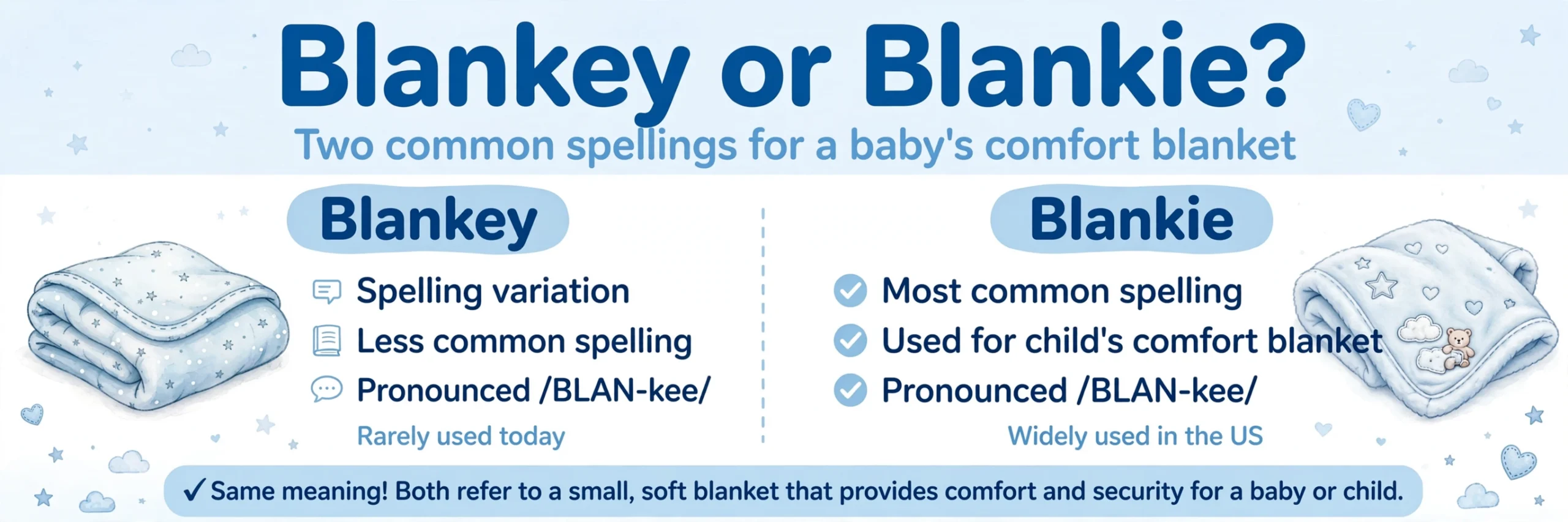
Use blankie in normal writing. It is the dictionary headword: Cambridge lists “blankie — informal, mainly US (also blankey)”, pronounced /ˈblæŋ.ki/ in both British and American English, meaning a blanket, especially a small one or a piece of one that a young child uses to feel safe and happy. Blankey is an acceptable recorded variant with the same meaning and pronunciation, and you will also see blanky in informal use. For a title, a shop listing, or any text you want to look polished, stick to one spelling throughout — and make it blankie unless you are quoting someone who wrote blankey.
What the dictionaries actually record
Cambridge Dictionary gives the entry under blankie, labelled “informal, mainly US” and adds “(also blankey)” in the same line. The pronunciation is given as /ˈblæŋ.ki/ for both the UK and US audio. That detail is worth pausing on: the dictionary does not present blankie and blankey as different words, different registers, or a British-versus-American pair. They are two spellings of one noun, with a plural listed for the headword as blankies.
Other reference works show the same pattern from slightly different angles. Wiktionary, which tracks variants closely, treats blankie as the main form (plural blankies), formed from blanket plus the diminutive ending -ie, and cross-references blanky. Collins does not give the word the same prominent headword treatment — a useful reminder that this is a warm, informal item of vocabulary rather than a core formal noun — but the absence of a separate “wrong” label is itself informative. No major dictionary marks blankey as incorrect. The hierarchy is softer than that: blankie first, blankey also seen, blanky also seen.
Why does this hierarchy exist? English diminutives are unstable in writing. We shorten blanket and add the affectionate /i/ ending heard in doggie, auntie, and blankie. When a word lives mainly in speech, writers guess how to write that final sound — -ie, -ey, or -y — which is why all three forms occur. Dictionaries reflect the balance of evidence, and blankie carries the most weight.
Meaning: more than just a small blanket
Cambridge defines blankie as “a blanket (= a flat cover made of wool or similar warm material), especially a small one or a piece of one that a young child uses to make them feel safe and happy”. The “especially” clause does the real work. A blankie is not defined by size alone; it is defined by attachment. A large bed blanket that no one is emotionally attached to is simply a blanket. A threadbare square of fabric that a toddler insists on carrying to nursery, to the car, and to bed is a blankie even if it started life as part of a full-size blanket.
That is why the word so often appears alongside security blanket. In child-development writing, a security or comfort object helps a child self-soothe during separations. Adults borrow the phrase metaphorically — “his phone is his security blanket” — but the literal blankie stays a nursery word: informal and tender. A formal report would choose blanket or comfort blanket; a parent captioning a photograph chooses blankie.
Cambridge’s “mainly US” label deserves honest handling. The word is well understood in Britain, and British parents use it, but British English also makes frequent use of comfort blanket and simply blanket in retail and childcare contexts. Do not turn the label into a false rule that blankie is “American” and blankey is “British” — dictionaries do not support that split. Both spellings occur on both sides of the Atlantic, pronounced identically.
Pronunciation and plural forms
All three written forms — blankie, blankey, and blanky — are pronounced the same: /ˈblæŋ.ki/, with stress on the first syllable, a short “a” as in cat, the “ng” sound of sing, and a final “ee” sound. There is no pronunciation difference to help you choose, and a listener cannot tell which spelling a speaker has in mind. That is precisely why the confusion exists only in writing.
For the plural, the dictionary form is straightforward: blankies. Write “She packed two blankies in the changing bag” or “The blankies are in the wash.” If you adopt the blankey spelling for a particular text, general English spelling patterns would give you blankeys (compare monkey → monkeys, where the -ey is kept before -s). In practice, because blankie is the commonest singular, blankies is the plural readers see most. The practical lesson is to keep singular and plural consistent within one piece of writing: blankie/blankies or blankey/blankeys, not a mixture of the two systems.
How to choose: a practical guide
Choose blankie when you are writing anything you expect strangers to read: a blog post, a product title on a marketplace, a children’s book manuscript, a nursery newsletter, or a social-media caption for a business account. It matches the dictionary headword, it is the spelling most autocorrect dictionaries and style checkers are trained on, and it will look intentional rather than accidental.
Blankey can stay when you are preserving someone else’s voice. If a grandmother has always written “Blankey” as the blanket’s name — almost a proper noun, as many families treat it — changing her spelling in a family history or a quoted note would erase character for no benefit. The same applies to brand names, book titles, and established nicknames: reproduce them exactly. Outside quotation and naming, though, blankey offers no advantage in meaning, warmth, or correctness that blankie does not also offer.
Blanky, the third variant, is worth recognising so that it does not confuse you when you meet it. It follows the pattern of hanky (from handkerchief) and appears in informal writing and older texts. For your own new writing, there is no strong reason to prefer it over blankie, but it would be wrong to call it illiterate: variant-tracking references record it, and readers understand it instantly.
Blankie, blankey, and blanky compared
| Form | Dictionary status | Pronunciation | Plural | Best use |
|---|---|---|---|---|
| blankie | Main headword in Cambridge (“also blankey” noted under it); plural listed | /ˈblæŋ.ki/ (UK and US) | blankies | Default for publishing, retail, education, and general writing |
| blankey | Recorded by Cambridge as an “also” variant of blankie | /ˈblæŋ.ki/ — identical | blankeys (by the regular -ey pattern) | Names, quotations, family usage you are preserving |
| blanky | Recorded as a variant in variant-tracking references; less prominent as a headword | /ˈblæŋ.ki/ — identical | blankies | Recognise it in informal and older writing; rarely the best choice for new text |
Correct vs. incorrect examples
The examples below are about consistency and context, because neither spelling changes the grammar of the sentence around it.
Correct: “Every time two-year-old Tommy goes anywhere, he has to bring along his blankie.” (This mirrors Cambridge’s own example pattern: singular, informal, child-focused.)
Correct: “She asked for her blankie, which she doesn’t usually take to school.”
Correct: “We sell a soft fleece blankie in three colours.” Here blankie works in a retail context because the product is a child’s comfort blanket, not an adult bed covering.
Correct when quoting a name: “The twins would not sleep without Blankey.” If Blankey is the family’s name for the object, the capital letter and the -ey spelling belong to the name.
Avoid: “He has to bring along his blankey, and both blankies are in his bag.” The problem is not that blankey is forbidden; it is that the text switches systems mid-sentence. Pick one.
Avoid in formal writing: “The defendant was wrapped in a blankie by paramedics.” A news or medical report should say blanket. The issue is register, not spelling.
Avoid: “Two blankies’ corners were frayed, so we washed both blankeys.” Possessives and plurals become confusing when the base spelling keeps changing.
Common mistakes
Assuming one spelling must be “wrong”
The commonest mistake is to announce that blankey “is not a word”. Cambridge explicitly records it as an also-form, so that claim fails a basic dictionary check. The accurate statement is narrower: blankie is the preferred headword, and blankey is a less prominent variant. Precision like this protects your credibility when a reader checks.
Inventing a UK-versus-US rule
Because Clarifyra often covers genuine British-American pairs (such as spiralled and spiraled), it is tempting to file blankey under “British” and blankie under “American”. The evidence does not support it. Cambridge gives one pronunciation for UK and US and labels the word “mainly US” as a whole, whichever spelling is used. Do not manufacture a regional rule where dictionaries record none.
Mixing spellings in one document
A gift guide that says “every baby needs a blankey” in the heading and “our blankies are organic cotton” in the body looks careless even though each sentence is individually defensible. Search your document for all three forms before you publish, choose the headword, and standardise.
Using the word where “blanket” is required
Blankie is informal and child-centred. In instructions (“wrap the pipes in a thermal blankie”), technical writing, or adult bedding retail, the diminutive undermines clarity and tone. The fitting word there is blanket.
FAQs
Is blankey wrong?
No. Cambridge Dictionary records blankey as an “also” form under the headword blankie. It is better described as a less common variant than as an error. If you are choosing a spelling for new, public-facing writing, choose blankie.
Is blankie American?
Cambridge labels it “informal, mainly US”, which means the word is especially associated with American usage, not that British speakers do not use or understand it. British parents use it colloquially, while comfort blanket is also common in British childcare and retail language.
What about blanky?
Blanky is another recorded variant with the same meaning and pronunciation /ˈblæŋ.ki/. You will meet it in informal writing. For your own writing, blankie remains the safest default because it is the dictionary citation form.
What is the plural of blankie?
Blankies: “one blankie, two blankies”. Keep the plural matched to your singular spelling throughout a document.
Should I write blankie or blanket in a product listing?
Use blankie when the product is a small child’s comfort or security blanket, because that is the word searching parents use. Use blanket for full-size bed coverings, throws, and any adult or technical product, where blankie would sound inaccurate.
Takeaway
Write blankie. It is the dictionary headword, it takes the regular plural blankies, and it is pronounced /ˈblæŋ.ki/ in both British and American English. Keep blankey — and the further variant blanky — for names and quotations, recognise them without alarm when other people use them, and never mix the spellings in one piece of text. When the context is formal or the blanket belongs to an adult, step up to the full word: blanket.