Analog or Analogue: Which Spelling Is Correct?
“An analogue watch,” “an analog signal,” “a meat analogue such as tofu” — the word for something similar to something else exists in two spellings, and the choice between them is mostly a matter of which side of the Atlantic your readers sit on. Analogue is the chiefly British spelling; analog is the usual American spelling, and the standard form worldwide in electronics and computing. Both are pronounced the same — UK /ˈæn.ə.lɒɡ/, US /ˈæn.ə.lɑːɡ/ — both form the same plural with -s, and neither is ever “wrong,” though each looks foreign in the other’s home territory. This article sets out what the dictionaries say, where the one genuine usage wrinkle lies (the adjective in technical writing), and how to keep related words like catalogue and analogy out of trouble.
Quick Answer
Write analogue in British English and analog in American English. Merriam-Webster labels analogue “chiefly British spelling of analog,” and Collins notes: “The spelling analog is used in American English, and also in British English for [the technology] sense.” That exception matters: for the electronics sense — signals, circuits, recording, the opposite of digital — analog is the preferred spelling even in much British technical writing, while the noun meaning “something analogous” keeps analogue in the UK (“a historical analogue“). Pronunciation never changes: /ˈæn.ə.lɒɡ/ (UK), /ˈæn.ə.lɑːɡ/ (US). Plurals: analogues (UK noun), analogs (US).
What the Dictionaries Actually Say
Merriam-Webster’s entry for analogue runs the two spellings as one word with two costumes. Its senses: something similar or comparable to something else (“historical analogues to the current situation”; “an aspirin analogue“); in biology, an organ similar in function but different in origin (“the gill of a fish is the analogue of the lung of a cat”); in chemistry, usually spelled analog, a structurally similar compound; and a food product imitating a costlier one. Its spelling note is the one every writer should memorise: the nouns analogue and analog “differ only in spelling,” the -ogue form being more common except in chemistry, while as adjectives the shorter analog is preferred — except by British English users, who keep analogue in both jobs. The entry closes the matter by calling analogue the “chiefly British spelling of analog.”
Collins approaches from the British side. Its COBUILD entry runs under analogue /ˈænəlɒɡ/, plural analogues, with the language note: “The spelling analog is used in American English, and also in British English for meaning [sense 2]” — sense 2 being the technology adjective of “analogue signals” and “analogue technology,” measuring or recording by continuously variable physical quantities. Its British English section adds “or sometimes US analog” and the examples “analogue watch” and “analogue recording.” Britannica’s learner’s dictionary splits the label geographically: headword analogue, “or US analog,” plural “analogues or US analogs.” Cambridge gives the shared pronunciation — UK /ˈæn.ə.lɒɡ/, US /ˈæn.ə.lɑːɡ/ — identical for both spellings. No source marks either form incorrect; the dictionaries unanimously present a dialect choice with a technical-writing tilt.
Both spellings descend from Greek analogon, the neuter of analogos (“proportionate”), through French analogue — which is why the British form keeps the French-style -gue ending it shares with catalogue, dialogue and monologue. American spelling, following the nineteenth-century reforming instinct associated with Noah Webster’s dictionaries, trimmed the unpronounced -ue in analog and catalog — though even American English balked at trimming dialogue and monologue all the way, and both forms of those words remain acceptable in the US today.
The One Real Wrinkle: The Technical Adjective
If the story ended at “UK analogue, US analog,” this article would be a paragraph long. The wrinkle is that the word lives a double life. As the general noun — a counterpart, a parallel, an equivalent (“the president’s situation has no historical analogue“) — geography rules exactly as described. But as the technical adjective meaning “representing data by continuously variable quantities, not by discrete digital values,” the spelling analog has become the international default of the electronics industry: analog signal, analog circuit, analog-to-digital converter, analog recording. Collins’ note encodes precisely this: American spelling everywhere, plus British spelling rights reserved for the general noun, plus analog admitted in British English for the technology sense.
British practice reflects the split honestly. British newspapers and broadcasters write “analogue television” and “analogue radio” natively — the -ue form is thoroughly at home in UK general prose — while British engineering documentation, datasheets and software overwhelmingly use analog, matching the American-originated technical literature the field runs on. Neither British camp is making an error; they are writing for different shelves of the same library. The working rule for a writer is therefore two questions, in order: Where is my audience? then Am I writing technology or general prose? UK + general prose → analogue; US + anything → analog; technology + anywhere → analog is safe, analogue acceptable in UK-facing text.
The Forms at a Glance
| Use | British English | American English | Example |
|---|---|---|---|
| Noun: counterpart, parallel | analogue | analog (also analogue) | “Tofu is a meat analogue.” (MW) |
| Noun: chemistry compound | analog / analogue | analog (usually) | “a synthetic analog of the hormone” |
| Adjective: not digital | analogue (general prose); analog (technical) | analog | “an analog signal”; UK: “analogue TV” |
| Plural of the noun | analogues | analogs | “historical analogues/analogs“ |
| Pronunciation | UK /ˈæn.ə.lɒɡ/ · US /ˈæn.ə.lɑːɡ/ (same for both spellings) | “AN-ə-log” | |
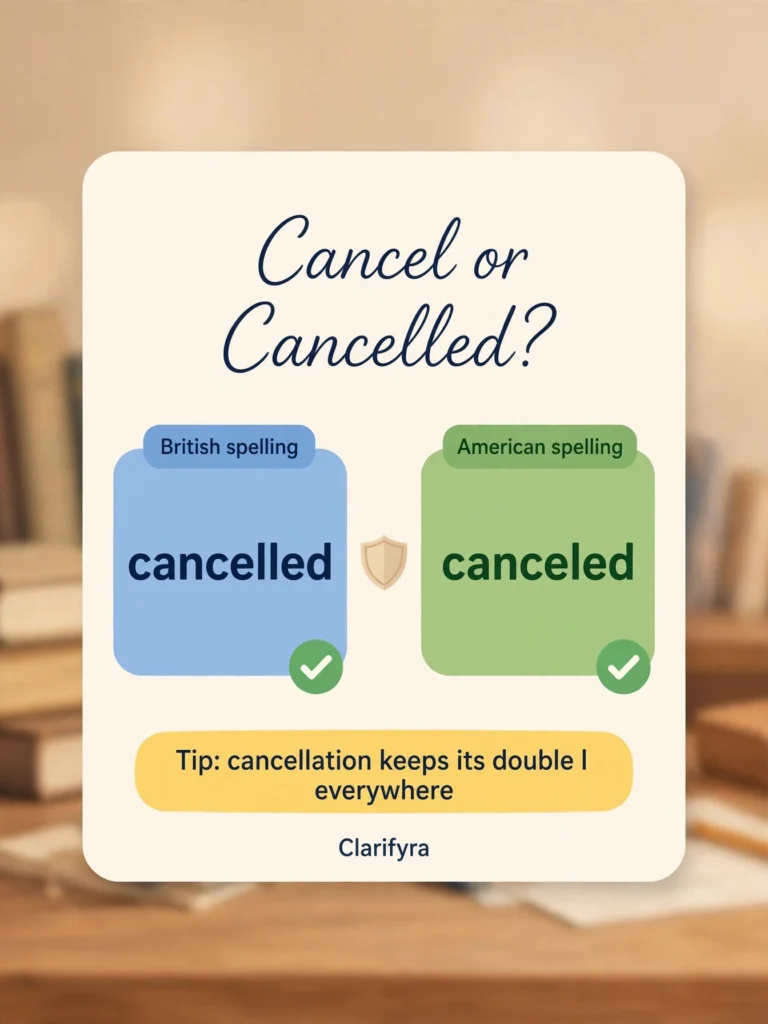
The wider family keeps its own spelling discipline, and it does not follow the headword off a cliff. Analogy and analogous never take -ue in any variety — there is no “analogie” and no “analogueous” — and the discipline extends sideways: catalogue/catalog splits along the same Atlantic line as analogue/analog, while dialogue keeps -ue on both sides in edited prose (American dialog survives mainly in computing’s “dialog box” and in some journalism). Knowing the family pattern prevents the two characteristic errors: exporting -ue where it never belongs, and stripping it where your dialect requires it.
Correct vs. Incorrect
- ✓ “She wears an analogue watch with a leather strap.” (British general prose)
- ✓ “The analog signal degrades over long cable runs.” (technical, worldwide)
- ✓ “There is no modern analog for this crisis.” (American noun)
- ✓ “There is no modern analogue for this crisis.” (British noun)
- ✗ (US text) “The committee sought an analogue in Roman history and checked the catalogue.” → ✓ “…an analog… the catalog.” (one dialect per text)
- ✗ “The two situations are analogueous.” → ✓ “The two situations are analogous.” (the adjective analogous never takes -ue)
- ✗ “An analogy between the systems…” misspelled “analogie” → ✓ “analogy” in all varieties.
- ✓ “The lab synthesised a new insulin analog.” (chemistry prefers the short form per Merriam-Webster)
Common Mistakes
1. Mixing spellings within one document. The commonest fault: analogue in the introduction, analog in the conclusion, catalogue in a caption. Neither spelling is wrong; the alternation is. Pick the form your audience’s dictionary headlines and apply it to the whole -ogue/-og family throughout the text.
2. Writing the general noun as “analog” in formal British prose. British readers register “a close analog of the original” as an Americanism — acceptable in technical writing, slightly off in a British essay or broadsheet. In UK general prose the noun is analogue.
3. Writing “analogue” in American technical documentation. The mirror error. US engineering, software and standards writing standardised on analog generations ago; analogue there looks like a British import and may be “corrected” by editors who do not know it is legitimate. Match the house dialect.
4. Extending -ue to the relatives. “Analogueous,” “analoguous,” and “analogie” are not words in any variety. The family is: analogue/analog (noun and adjective), analogy, analogous, analogously. Only the headword pair carries the optional -ue.
5. Assuming a pronunciation difference. There is none — /ˈæn.ə.lɒɡ/ in the UK, /ˈæn.ə.lɑːɡ/ in the US, whichever spelling is on the page. Writers who “correct” a colleague’s analogue aloud are correcting ink, not sound.
Frequently Asked Questions
Is “analogue” just the British spelling of “analog”?
Essentially, yes — Merriam-Webster defines it exactly that way (“chiefly British spelling of analog“), with one refinement: within British English, analog is also admitted, and often preferred, for the technology sense. So analogue is the British spelling everywhere in general prose, and analog is the American spelling everywhere plus the technical spelling almost everywhere.
Which spelling should I use for “analog watch”?
It follows your dialect, not the object. British publications write “analogue watch” (Collins’ own example); American publications write “analog watch,” and Merriam-Webster notes the shorter form is preferred for the adjective outside British English. Write for your reader.
Why does chemistry prefer “analog”?
Merriam-Webster records the chemical sense — a compound structurally similar to another — as “usually analog.” Scientific nomenclature prizes the shorter international form, and the convention stuck: journals write “insulin analog,” “a nucleic acid analog,” regardless of the journal’s home dialect. It is a field convention, not a rule of English at large.
Do “analogs” and “analogues” mean different things?
No. They are the regular plurals of the same noun in its two spellings — analogues in British texts, analogs in American ones (Britannica: “plural analogues or US analogs”). Choose the plural that matches the singular you have been using.
What about “catalogue,” “dialogue,” and “programme”?
They are cousins, not clones. Catalogue/catalog splits almost exactly like analogue/analog. Dialogue keeps -ue in edited prose on both sides of the Atlantic, with dialog confined mostly to computing and some US journalism. Programme is a separate pattern (British for schedules and broadcasts; program for computing in every dialect, British included). Treat each word’s convention on its own evidence rather than by blanket rule.
The Takeaway
Analogue is the British spelling, analog the American one, and the two are identical in meaning and sound. Keep analogue for the general noun and adjective in British writing, use analog for American audiences and for technical writing anywhere near electronics, and never let the -ue leak into analogy or analogous. One document, one dialect, one spelling — that consistency, not the choice itself, is what marks the writing as edited.