Missus or Misses: Which Spelling Is Correct?
If you have heard someone say “the missus” or “my missus,” you may wonder whether the word should actually be spelled misses. The confusion is understandable because missus and misses can sound very similar in spoken English. However, they have different meanings and grammatical roles. Missus is an informal noun traditionally meaning “wife,” while misses is normally a form of the verb miss. In this guide, we’ll look at the difference, explain phrases such as “the missus” and “my missus,” and show when each form is appropriate.
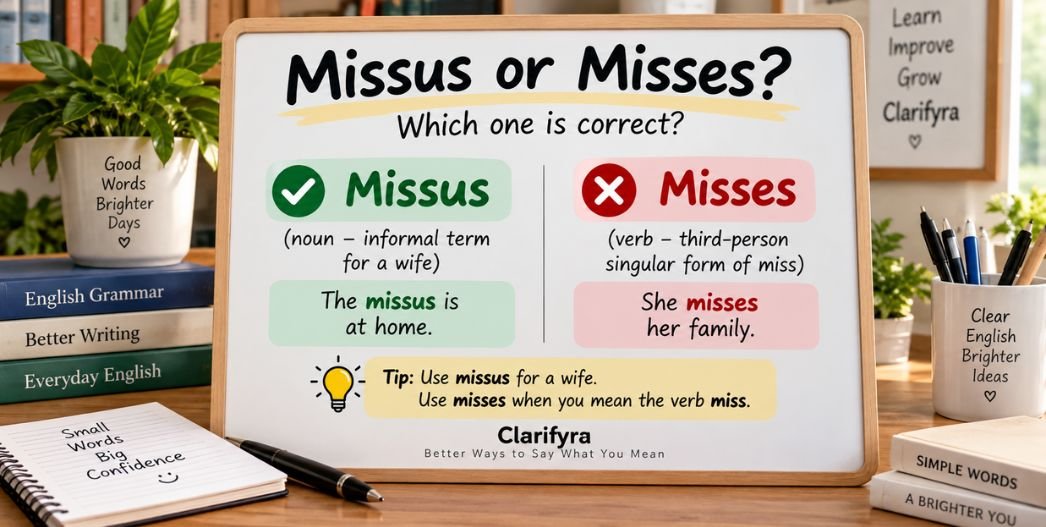
Missus is the correct spelling when you mean an informal term for a wife or, in some contexts, a girlfriend or female partner. Misses is normally the third-person singular form of the verb miss, as in “She misses her family.” So, write “the missus” or “my missus” when referring to a wife, not “the misses” or “my misses.”
Missus or Misses: What’s the Difference?
The two forms have different meanings:
| Feature | Missus | Misses |
|---|---|---|
| Word type | Noun | Verb form |
| Main meaning | Informal term for a wife | Third-person singular form of miss |
| Example | The missus is at home. | She misses her family. |
| Typical context | Informal speech | Everyday grammar |
| Standard spelling for “wife” | Yes | No |
Oxford describes missus as a usually singular noun used informally, particularly in British English, for a man’s wife. It also records informal use for a girlfriend. Cambridge likewise defines missus as an informal term for a wife or someone’s girlfriend.
By contrast, misses belongs to the verb miss. For example:
She misses her children.
Here, misses means that she feels the absence of her children.
Therefore, the choice depends on what you mean.
What Does “Missus” Mean?
Missus is an informal noun meaning wife. It is especially associated with British English and informal speech. Oxford labels this use as informal and notes that it is becoming old-fashioned; Cambridge also identifies it as an informal word for a wife.
For example:
- The missus is waiting for me.
- I need to ask my missus first.
- Have you met John’s missus?
- His missus is coming to dinner.
The word can also be used informally to mean girlfriend in some contexts. Oxford and Cambridge both record this usage.
Because missus is informal, it is not normally the word you would choose in a formal document. In formal writing, wife, spouse, or partner may be more appropriate depending on the relationship and context.
Is “Missus” Always About a Wife?
No. Although “wife” is a central meaning, dictionaries also recognize informal use for a girlfriend. Cambridge gives missus as an informal word for someone’s girlfriend, while Oxford similarly records this sense.
So:
My missus is my wife.
can be understood as a casual statement.
And in an appropriate context:
Who’s your missus, Ben?
can refer to someone’s girlfriend.
What Does “Misses” Mean?
Misses is normally the third-person singular present-tense form of the verb miss.
The verb miss has several meanings, including failing to catch or reach something, failing to attend something, or feeling the absence of someone or something.
Examples include:
- She misses her parents.
- He misses the train every morning.
- Maria misses her old school.
- James misses the target.
In each sentence, misses is a verb.
It is not the standard spelling to use when you mean wife.
Compare:
My missus is cooking dinner. ✅
Here, missus is a noun meaning wife or partner.
My misses is cooking dinner. ❌
This does not use the standard spelling for that meaning.
“The Missus” or “The Misses”?
When you mean the wife, the standard informal expression is:
the missus ✅
For example:
I need to ask the missus before we book the holiday.
Here, the missus means the speaker’s wife.
Oxford specifically gives missus as a noun used after words such as the, my, your, and his, with the example “How’s the missus?”
Cambridge also uses the missus in the sense of “my wife.”
So if you’re writing the expression referring to someone’s wife, choose the missus, not the misses.
Why Does “The Misses” Sound Possible?
The confusion mainly comes from pronunciation. Missus is pronounced /ˈmɪsɪz/ in the Oxford and Cambridge entries, which can sound very similar to the spoken form of misses.
When people hear the expression rather than see it written, they may naturally guess the spelling misses.
But spelling depends on meaning:
- missus = informal wife/partner
- misses = verb form of miss
“My Missus” or “My Misses”?
If you are talking about your wife or partner, write:
my missus ✅
For example:
My missus is coming with me.
This is an informal expression meaning that the speaker’s wife or, depending on context, girlfriend/partner is coming.
Oxford specifically notes that missus can occur after my, giving examples such as “My missus doesn’t like computer games.”
My misses does not normally have this meaning.
However, misses can correctly follow my when it is a verb in a different grammatical construction:
My daughter misses her grandmother.
Here, misses is the verb, and my belongs to the noun phrase my daughter. It is not a spelling variant of missus.
Missus, Missis, and Mrs.: Are They the Same?
There are a few related forms that can cause additional confusion.
Missus is an informal noun meaning a wife, while missis is another spelling recorded by Oxford with the same basic informal sense.
Mrs., on the other hand, is a title used before a woman’s name.
For example:
Mrs. Patel will speak at the meeting.
This is a formal title.
Compare:
I’m going to ask the missus.
This is an informal reference to a wife.
The forms are historically related. Oxford notes that missus represents an informal pronunciation of mistress and compares it with Mrs.
That connection helps explain why the words can sound alike, but they should not be treated as interchangeable in ordinary writing.
Is “Missus” American or British English?
Missus is used in both British and American English, but its status differs somewhat between varieties.
Oxford’s main learner’s entry labels the wife sense British English, while its American English entry describes the word as old-fashioned and informal.
Cambridge also records the word in both UK and US English, with additional American informal and old-fashioned senses.
Therefore, it would be misleading to say that missus is simply “wrong in American English.” It exists in American English too, although it can sound more old-fashioned or informal there.
For formal international writing, wife, spouse, or partner will usually be clearer.
Correct Usage Examples
Here are some examples showing the distinction in context.
Using “missus”
- The missus is waiting outside.
- I asked my missus about the trip.
- Have you met his missus?
- My missus loves gardening.
In these sentences, missus is a noun referring informally to a wife or, depending on context, a girlfriend.
Using “misses”
- She misses her children.
- He misses the bus every morning.
- Tom misses his old job.
- Anna misses her friends when she travels.
Here, misses is the third-person singular form of miss.
Compare the two
My missus is at work.
= My wife/partner is at work.
My wife misses her old job.
= My wife feels sad because she no longer has her old job.
The two words may sound similar, but their grammatical functions are completely different.
Common Mistakes to Avoid
1. Writing “the misses” for “the wife”
Incorrect for the intended meaning:
I’m going to ask the misses.
Standard informal form:
I’m going to ask the missus.
2. Treating “missus” as a formal title
Missus is not simply another written form of Mrs. In ordinary formal writing, use the appropriate title and name, such as Mrs. Khan, rather than Missus Khan.
3. Assuming “misses” is the plural of “missus”
Misses is normally a verb form, not the regular plural of missus. If you’re referring to multiple wives, the ordinary noun wives is the standard plural of wife. Oxford lists wives as the plural of wife.
4. Using an informal expression in a formal context
Even when missus is grammatically appropriate, it is informal. In a business letter, legal document, academic paper, or other formal setting, wife, spouse, or another precise term is generally more suitable.
An Easy Way to Remember the Difference
Use this simple rule:
Missus = a person
Misses = an action
If you can replace the word with wife or partner, you probably need missus:
The missus is at home.
→ The wife is at home.
If you can replace the word with doesn’t feel the absence of / fails to catch / fails to attend, you probably need misses:
She misses her husband.
→ She feels the absence of her husband.
This distinction makes the spelling much easier to choose.
Is “Missus” Appropriate in Formal Writing?
Usually, no if you are referring to a wife in a formal context. Missus is explicitly described by major dictionaries as informal, and Oxford also notes that this sense is becoming old-fashioned.
For example, in a formal report, write:
Mr. Ahmed attended with his wife.
rather than:
Mr. Ahmed attended with his missus.
The second sentence is understandable, but it has a distinctly casual tone.
In conversation, informal writing, dialogue, or a context where a relaxed style is intended, missus can be perfectly appropriate.
FAQ
Is “missus” or “misses” correct for a wife?
Missus is the standard informal spelling when you mean a wife. For example, “the missus” means “the wife.” Misses is normally a form of the verb miss, as in “She misses her family.”
Is “the missus” correct?
Yes. The missus is an established informal expression meaning someone’s wife. It is particularly associated with British English and is also recognized in American English, where it may sound old-fashioned or informal.
Is “my missus” correct?
Yes. My missus is a standard informal expression meaning “my wife” and can also refer to a girlfriend or partner in some contexts.
Is “missus” a formal word?
No. It is an informal noun. Oxford also describes the wife sense as becoming old-fashioned, so it is better suited to casual conversation than formal writing.
Is “misses” ever correct?
Absolutely. Misses is a correct English word when it is the third-person singular form of miss: “She misses her friends.” It simply does not normally mean “wife.”
Is “missus” the same as “Mrs.”?
Not exactly. Mrs. is a title used before a woman’s name, while missus is an informal noun referring to a wife and, in some contexts, a girlfriend. They are historically related and can have similar pronunciations.
The Bottom Line
When you mean wife in informal English, use missus: the missus or my missus. When you mean an action involving the verb miss, use misses: She misses her family. The pronunciation can make these words confusing, but their meanings and grammatical roles are different. For formal writing, wife, spouse, or partner is usually a better choice than missus. For clear explanations of confusing English words and everyday usage, Clarifyra helps you choose the form that best expresses what you mean.