Baring or Barring: What’s the Difference?
Baring or barring are both correct English words, but they mean very different things. The confusion usually comes from their nearly identical spelling and pronunciation. There is also a third word, bearing, which creates confusion in expressions such as “bearing in mind” and “has no bearing on.”
The simplest way to distinguish them is to look at the verbs they come from: baring comes from bare, barring comes from bar, and bearing comes from bear. Once you connect each form to its base verb, the difference becomes much easier to remember.
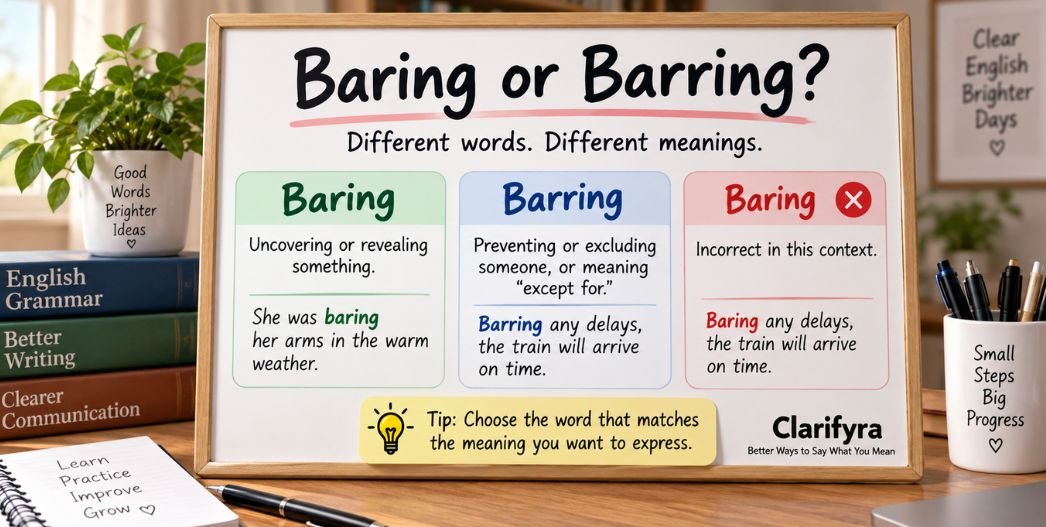
Baring means uncovering, exposing, or revealing something. Barring means preventing, blocking, or excluding someone or something, and it can also mean “except for” or “unless.” Bearing is different again and appears in expressions such as “bearing in mind” and “has no bearing on.”
Baring, Barring, and Bearing at a Glance
| Word | Base verb | Main meaning | Example |
|---|---|---|---|
| baring | bare | uncovering or revealing | She was baring her shoulders. |
| barring | bar | preventing or excluding | They are barring him from entering. |
| bearing | bear | carrying, supporting, or relating to | This has no bearing on the decision. |
All three forms are real English words. The correct choice depends entirely on what you mean. Writer’s Digest likewise identifies them as the present participles of bear, bare, and bar, respectively.
What Does “Baring” Mean?
Baring is the -ing form of bare. As a verb, bare means to uncover, expose, or reveal something.
So, when someone is baring something, they are making it visible or revealing something that was previously covered or hidden.
Examples of baring
- She was baring her arms in the warm weather.
- The dog was baring its teeth.
- He was baring his soul during the conversation.
- The workers were baring the old brick beneath the plaster.
The word can describe both physical exposure and figurative revelation. For example, baring your soul means revealing your deepest thoughts or feelings.
A useful connection is:
bare → baring
If the idea is uncovering or revealing, baring is usually the form you need.
What Does “Barring” Mean?
Barring is the -ing form of bar.
As a verb, bar can mean to block, prevent, prohibit, or stop someone from entering or doing something. Oxford lists uses including physically blocking a path and preventing someone from doing something.
Examples of barring as a verb
- The guard was barring the entrance.
- The new rules are barring visitors from entering after 9 p.m.
- The court order is barring him from contacting the witness.
- A fallen tree was barring the road.
Here, barring has the idea of creating a barrier or preventing access.
“Barring someone” meaning
When you say that someone is barring someone from a place or activity, you mean they are preventing or prohibiting that person from entering, participating, or doing something.
For example:
The club is barring him from entering the building.
This means the club is preventing him from entering.
The grammatical pattern is often:
bar + someone + from + something/doing something
For example:
The school barred the student from participating in the competition.
The continuous form would be:
The school is barring the student from participating in the competition.
Oxford specifically gives the construction bar somebody from something/from doing something for the meaning “ban or prevent.”
“Barring” Can Also Mean “Except for”
There is another important use of barring. It can function as a preposition meaning except for, unless, or in the absence of something.
For example:
Barring unexpected delays, the train should arrive on time.
This means:
Unless there are unexpected delays, the train should arrive on time.
Other examples include:
- Barring bad weather, the event will take place outdoors.
- Barring any major problems, we should finish tomorrow.
- Barring accidents, they should arrive safely.
- Barring a last-minute change, the meeting will begin at noon.
Collins defines this use as indicating that a person, thing, or event is an exception to the statement being made.
This is why barring can appear at the beginning of a sentence without referring to someone physically blocking something.
What Does “Bearing” Mean?
Bearing comes from the verb bear. The verb bear has several meanings, including carrying, supporting, enduring, and producing.
For this topic, however, two expressions are particularly important:
- bearing in mind
- has no bearing on
This is where people sometimes accidentally write baring instead.
Bearing in mind
The correct expression is:
bearing in mind
It means remembering, considering, or taking something into account.
Examples:
- Bearing in mind the weather, we decided to leave early.
- Bearing in mind the cost, we chose the cheaper option.
- Bearing in mind his experience, he was given additional responsibility.
The related expression bear in mind means to remember or consider something. The -ing form naturally becomes bearing in mind.
So:
Correct: Bearing in mind the circumstances, we decided to wait.
Incorrect: Baring in mind the circumstances, we decided to wait.
The spelling baring in mind is incorrect when the intended meaning is “considering” or “remembering.”
“Has No Bearing” or “Has No Baring”?
The correct expression is:
has no bearing on
It means has no connection with, relevance to, or influence on something.
Examples:
- That mistake has no bearing on the final result.
- His personal opinion has no bearing on the decision.
- The evidence has no bearing on the case.
- Your age has no bearing on your ability to learn a new language.
Here, bearing is related to the idea of a connection or influence.
Therefore:
Correct: This information has no bearing on the issue.
Incorrect: This information has no baring on the issue.
The same distinction applies to phrases such as “bearing on the matter” or “bearing on the outcome.”
Baring or Barring: How Do You Choose?
The easiest method is to replace the -ing form with its base verb.
If you mean “uncover” → use baring
She was baring her arms.
Think:
She was baring her arms → She was baring them → bare.
If you mean “prevent” or “block” → use barring
The security guard was barring the entrance.
Think:
The guard was barring the entrance → The guard was blocking it → bar.
If you mean “consider” → use bearing
Bearing in mind the circumstances, we waited.
Think:
Bear something in mind → bearing something in mind.
This base-verb test is more reliable than trying to remember the spelling by appearance alone.
Baring or Barring in a Sentence
Compare these examples:
Baring:
The athlete was baring his arms before the race.
The meaning is exposing or uncovering.
Barring:
The officials were barring spectators from entering the restricted area.
The meaning is preventing or excluding.
Barring as “except for”:
Barring heavy rain, the match will continue.
The meaning is “unless there is heavy rain.”
Bearing:
The new information has no bearing on our decision.
The meaning is “has no relevance or influence.”
These examples show why simply choosing the spelling that looks familiar can produce a completely different meaning.
Baring vs. Barring vs. Bearing: Common Mistakes
1. “Baring someone from entering”
When the meaning is preventing someone from entering, the correct word is barring.
Correct:
The guard was barring visitors from entering.
Not:
The guard was baring visitors from entering.
2. “Baring in mind”
The established expression is bearing in mind.
Correct:
Bearing in mind the distance, we left early.
Incorrect:
Baring in mind the distance, we left early.
3. “No baring on the decision”
When you mean “no relevance or influence,” use bearing.
Correct:
The comment has no bearing on the decision.
Incorrect:
The comment has no baring on the decision.
4. “Barring your soul”
If someone is revealing their deepest feelings, the correct expression is baring your soul.
Correct:
She was baring her soul to her closest friend.
Here, the person is exposing or revealing something figuratively.
Why Are These Words So Easy to Confuse?
The words share several letters and are all formed with the -ing ending. In addition, baring and bearing have the same pronunciation in standard English varieties, making their difference especially difficult to identify when you hear them rather than see them in writing.
Barring has a different vowel sound and is therefore easier to distinguish when spoken.
The spelling difference becomes particularly important because all three forms are legitimate words. A spellchecker may not identify a contextually wrong choice if you type a real word that simply does not fit the sentence. Writer’s Digest also emphasizes that context determines which of the three forms is appropriate.
How to Remember the Difference
Use this simple three-word rule:
BARE → BARING → uncovering
BAR → BARRING → blocking
BEAR → BEARING → carrying, considering, or relating
You can also remember the extra r in barring as a visual barrier:
bar + ring = barring
The extra r helps separate barring from baring, but always let the meaning decide.
Quick Practice
Choose baring, barring, or bearing in each sentence:
- ________ any unexpected delays, we should arrive by noon.
- The dog was ________ its teeth.
- The new evidence has no ________ on the outcome.
- The security guard was ________ the protesters from entering.
- ________ in mind the cost, we decided not to buy it.
Answers
- Barring — means “unless” or “except for.”
- Baring — means exposing or showing.
- Bearing — means having relevance or influence.
- Barring — means preventing or excluding.
- Bearing — part of the expression “bearing in mind.”
FAQ
Is “baring” a correct word?
Yes. Baring is a correct word and is the present participle of bare. It means uncovering, exposing, or revealing something. For example, “He was baring his arms” means he was exposing his arms.
Is “barring” a correct word?
Yes. Barring is the present participle of bar. It can mean preventing or blocking someone or something. It can also mean “except for” or “unless,” as in “Barring bad weather, the event will continue.”
What does “barring someone” mean?
Barring someone means preventing or excluding them from entering, participating, or doing something. For example, “The club is barring him from entering” means the club is preventing him from entering.
Is it “bearing or baring in mind”?
The correct expression is bearing in mind. It means considering or remembering something. Baring in mind is incorrect when used with this meaning.
Is it “has no bearing” or “has no baring”?
The correct expression is has no bearing on. It means something has no relevance, connection, or influence. For example, “That detail has no bearing on the decision.”
How do you pronounce “barring”?
Barring is pronounced with the vowel sound associated with bar, followed by the -ing ending. Collins gives British pronunciation as /ˈbɑːrɪŋ/ and American pronunciation as /ˈbɑrɪŋ/.
Final Verdict
Both baring and barring are correct, but they describe different actions. Baring means uncovering or revealing, while barring means preventing, blocking, or excluding; as a preposition, it can also mean “except for” or “unless.” When the meaning is “considering,” use bearing in mind, and when something has no relevance or influence, say it has no bearing on the matter. Remembering the three base verbs—bare, bar, and bear—makes the distinction much easier. For more clear explanations of confusing English words and better ways to express your meaning, Clarifyra helps make these distinctions easier to understand.