Steeling or Stealing: Which Is Correct?
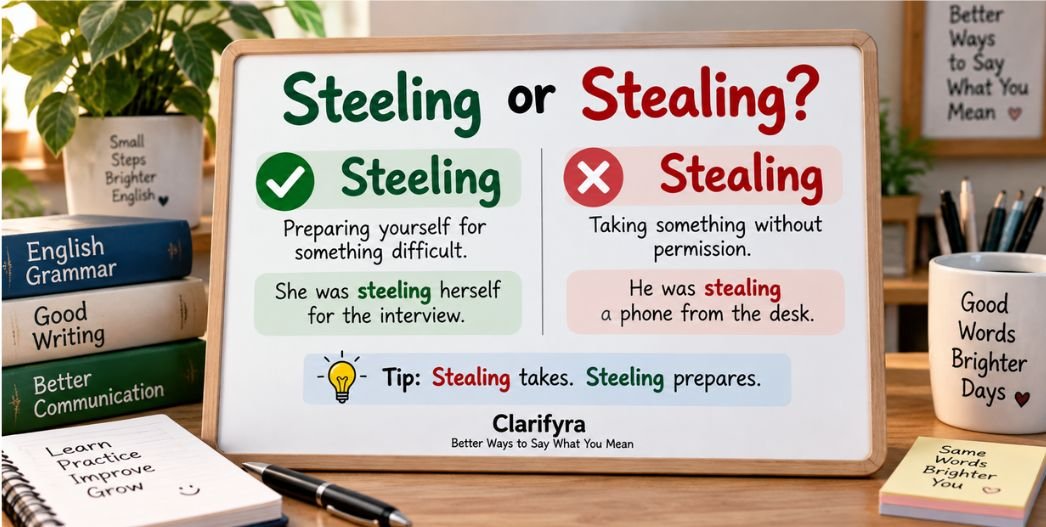
“Steeling” and “stealing” look and sound almost identical, so it is easy to mix them up in writing. However, they come from two different verbs and have different meanings. Stealing is the -ing form of steal, usually meaning to take something without permission. Steeling is the -ing form of steel, and in the expression steel yourself, it means preparing yourself mentally for something difficult or unpleasant.
The difference becomes especially important in phrases such as “steeling himself” and “steeling myself.” If you mean getting mentally ready for a difficult situation, steeling is the correct spelling.
Both “steeling” and “stealing” are correct words, but they have different meanings. “Stealing” comes from steal and usually means taking something without permission. “Steeling” comes from steel and means mentally preparing yourself for something difficult, especially in the phrase “steeling yourself.”
Steeling vs. Stealing: The Key Difference
The simplest way to distinguish the two words is to look at their base verbs:
| Word | Base verb | Meaning | Example |
|---|---|---|---|
| stealing | steal | Taking something without permission | He was stealing money. |
| steeling | steel | Preparing yourself mentally for something difficult | She was steeling herself for the news. |
Both forms are grammatically valid. The choice depends entirely on what you are trying to say.
Stealing is related to taking, while steeling is related to preparing or strengthening yourself.
The two verbs are also homophones: steal and steel have the same pronunciation but different spellings and meanings. Oxford identifies them as homophones.
What Does “Stealing” Mean?
Stealing is the present participle or gerund form of steal.
The verb steal generally means to take something without the owner’s permission or knowledge and keep it. Its main forms are:
- Base form: steal
- Present form: steals
- Past tense: stole
- Past participle: stolen
- -ing form: stealing
Cambridge gives stole and stolen as the irregular past forms of steal and defines the verb as taking something without the owner’s permission or knowledge.
Examples of “stealing”
- Someone was stealing packages from the building.
- He admitted stealing the money.
- The security camera showed them stealing a bicycle.
- Stealing another person’s work is unethical.
The word can also be used in expressions where steal means doing something quickly or secretly. For example, steal a glance means to look quickly without being noticed.
She was stealing a glance at the clock during the meeting.
So stealing does not always refer literally to taking property, although that is its most familiar meaning.
What Does “Steeling” Mean?
Steeling is the -ing form of the verb steel.
In everyday English, one important use is the expression steel yourself, meaning to prepare yourself mentally or emotionally for something difficult, unpleasant, or frightening.
Oxford gives steeling as the -ing form of steel and provides constructions such as steel yourself for something and steel yourself to do something.
Cambridge similarly defines steel yourself as preparing yourself to do something difficult or unpleasant.
Examples of “steeling”
- She was steeling herself for the difficult conversation.
- I am steeling myself for the interview.
- He steeled himself to deliver the bad news.
- They were steeling themselves against criticism.
In these sentences, nobody is taking anything. The person is mentally preparing for something challenging.
Steeling Himself or Stealing Himself?
If you mean preparing himself for something difficult, the correct expression is:
steeling himself
For example:
He was steeling himself for the difficult conversation.
Here, steeling comes from steel.
The expression stealing himself does not normally mean “preparing himself.” It would involve the verb steal, which has a different meaning.
Compare:
Correct for mental preparation:
He was steeling himself for the interview.
Different meaning:
He was stealing a phone from the desk.
The distinction is therefore not simply a spelling preference. The two forms belong to different verbs.
Steeling Myself or Stealing Myself?
When you mean getting mentally ready for something difficult, use:
steeling myself
For example:
- I am steeling myself for the results.
- I was steeling myself to have the conversation.
- She saw me steeling myself before the presentation.
The phrase steeling myself follows the same pattern as steeling himself, steeling herself, and steeling themselves.
Common patterns
steel myself for something
I am steeling myself for the criticism.
steel myself to do something
I am steeling myself to tell him the truth.
steel myself against something
She steeled herself against further disappointment.
These constructions are established uses of steel as a verb.
What Does “Steal” Mean in English Class?
In an English class, steal is usually introduced as an irregular verb meaning to take something that belongs to another person without permission.
For example:
Someone stole my phone.
The important verb forms are:
| Verb form | Word | Example |
|---|---|---|
| Base form | steal | Do not steal. |
| Third-person singular | steals | He steals things. |
| Past tense | stole | She stole my pen. |
| Past participle | stolen | My phone was stolen. |
| -ing form | stealing | He was stealing a phone. |
Because steal is irregular, the past tense is stole, not stealed, and the past participle is stolen, not stole. Cambridge confirms these forms.
The verb can also have other meanings. For example, steal a glance means to look quickly or secretly, while steal away can mean to leave quietly without being noticed.
Where Do You Use “Steeling”?
The most useful everyday use of steeling is when someone is mentally preparing for something challenging.
It commonly appears with yourself or a reflexive pronoun:
- steeling myself
- steeling yourself
- steeling himself
- steeling herself
- steeling ourselves
- steeling themselves
Examples
I was steeling myself for the doctor’s decision.
She was steeling herself to speak in front of the audience.
He is steeling himself against the possibility of rejection.
They were steeling themselves for a difficult meeting.
The verb steel can also have a literal connection with the noun steel, a strong metal. But for the confusion discussed here, the mental-preparation meaning is the one that matters most.
Where Do You Use “Stealing”?
Use stealing when the verb is steal.
The most common use is taking something without permission:
The thief was stealing jewelry.
Someone has been stealing food from the kitchen.
He was arrested for stealing a car.
But stealing can also occur in expressions involving secrecy or quick action:
She was stealing a quick glance at her notes.
He was stealing away before anyone noticed.
Cambridge lists both the “take without permission” meaning and the “do something quickly or without being noticed” meaning.
Why Are These Words So Easy to Confuse?
The main reason is pronunciation.
Steal and steel are pronounced alike, but they are spelled differently and have different meanings. Oxford explicitly lists steal and steel as homophones.
Their -ing forms therefore also sound alike:
- stealing
- steeling
When speaking, the listener cannot hear the extra e in steeling. The difference becomes visible when the word is written.
This makes context especially important.
Compare:
He was stealing the documents.
Here, he was taking the documents.
He was steeling himself for the meeting.
Here, he was preparing himself mentally.
Correct and Incorrect Examples
Seeing the words side by side makes the distinction easier.
When you mean “taking something”
Correct:
The employee was stealing money from the company.
Incorrect for this meaning:
The employee was steeling money from the company.
When you mean “preparing yourself”
Correct:
She was steeling herself for the difficult conversation.
Incorrect for this meaning:
She was stealing herself for the difficult conversation.
Another comparison
Correct:
I am steeling myself to hear the results.
Correct in a different context:
Someone was stealing my results.
The first sentence describes mental preparation. The second describes taking something.
A Simple Way to Remember the Difference
Use this quick association:
STEAL → TAKE
Think of stealing as taking something that is not yours.
STEEL → PREPARE
Think of steeling yourself as making yourself mentally strong enough to face something difficult.
You can remember it as:
Stealing takes. Steeling prepares.
This is not a grammar rule, but it is a useful shortcut when you are deciding which spelling belongs in a sentence.
Common Mistakes to Avoid
1. Writing “stealing” when you mean mental preparation
❌ She was stealing herself for the interview.
✅ She was steeling herself for the interview.
2. Writing “steeling” when you mean taking something
❌ He was steeling my wallet.
✅ He was stealing my wallet.
3. Using “stealed” as the past tense of “steal”
❌ He stealed my phone.
✅ He stole my phone.
The verb steal is irregular, so its past tense is stole.
4. Confusing “steeled” and “stole”
She steeled herself for the news.
She stole the letter.
Steeled comes from steel, while stole is the past tense of steal.
Steeling or Stealing: Which One Should You Use?
Ask yourself what the sentence is describing.
If someone is taking something, use stealing:
The boy was stealing a bicycle.
If someone is mentally preparing for something difficult, use steeling:
The boy was steeling himself for the difficult conversation.
If you can replace the word with taking, choose stealing.
If you can replace it with preparing yourself, choose steeling.
That simple test works for most situations involving these two words.
FAQ
Is “steeling” a correct word?
Yes. Steeling is the -ing form of the verb steel. In phrases such as steeling yourself, it means preparing yourself mentally for something difficult or unpleasant.
Is “stealing” a correct word?
Yes. Stealing is the -ing form of steal. It usually means taking something without permission, although steal has other meanings, such as steal a glance.
Is it “steeling himself” or “stealing himself”?
Use steeling himself when you mean that a person is mentally preparing for something difficult. For example: He was steeling himself for the criticism.
Is it “steeling myself” or “stealing myself”?
Use steeling myself when you mean mentally preparing yourself. For example: I am steeling myself for the conversation. Stealing myself does not normally express that meaning.
Are “steeling” and “stealing” pronounced the same?
Yes. They are pronounced alike because steel and steal are homophones. Their spelling and meanings are different.
What does “steal” mean in English?
The most common meaning of steal is to take something without the owner’s permission or knowledge and keep it. Its past tense is stole, its past participle is stolen, and its -ing form is stealing.
Final Verdict
Both steeling and stealing are correct, but they belong to different verbs. Use stealing for taking something without permission, and use steeling when someone is mentally preparing themselves for something difficult. So, if you are writing “___ himself for the bad news,” the correct choice is steeling himself. For more clear explanations of confusing English words and expressions, Clarifyra helps you choose the wording that best fits your meaning.