Fith or Fifth: Which Is Correct?
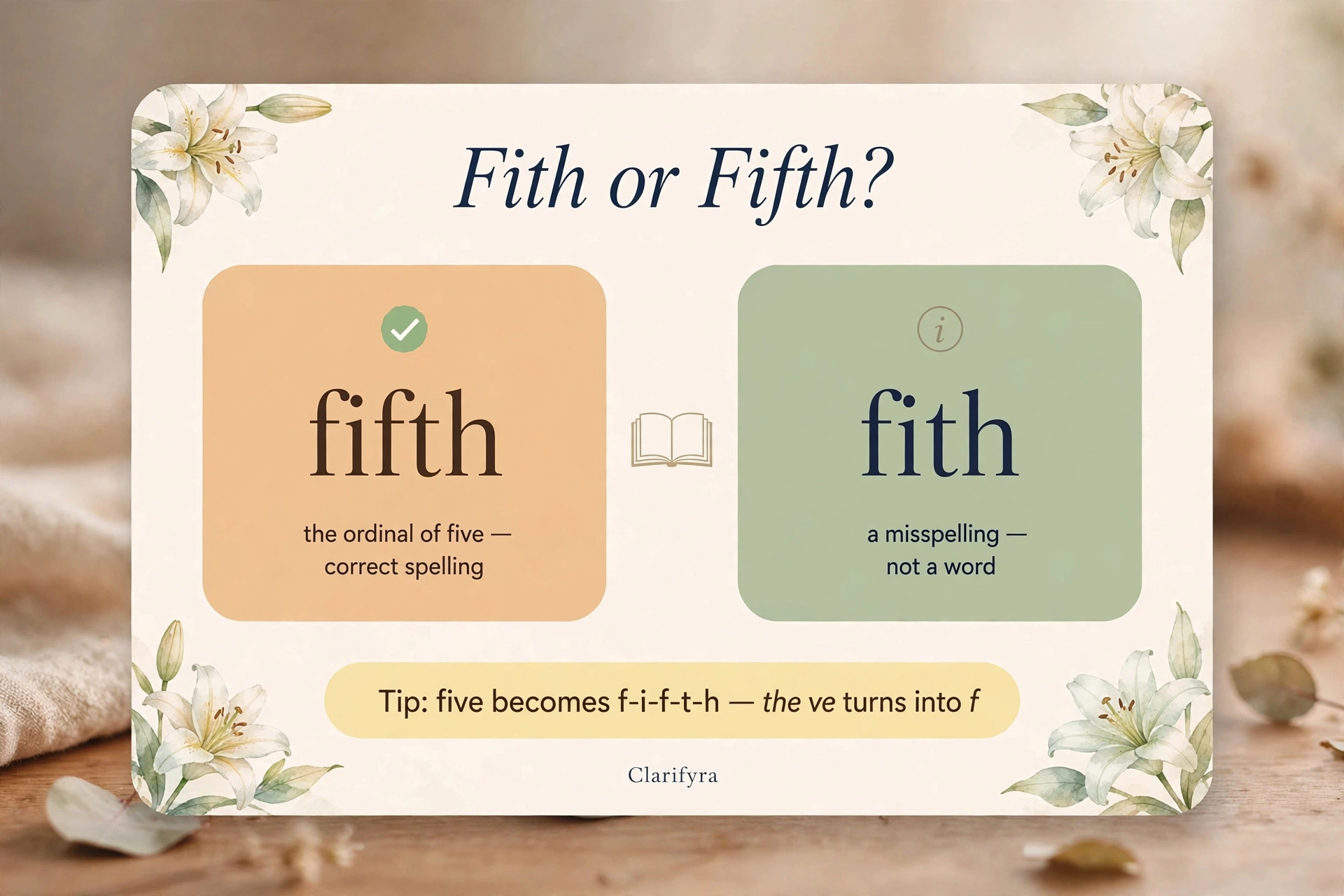
If you’ve ever hesitated between fith and fifth, here’s the short answer: fifth, with the f before the th, is the correct spelling of the ordinal of five. Fith is not a recognized English word in any major dictionary — it’s a misspelling, pure and simple. The fifth of May, the fifth floor, she finished fifth: in every one of these, the spelling keeps the f that replaced the v in five.
Quick Answer
Fifth is the ordinal of five — the word for “number five in a series.” Fith is a misspelling, not a variant: none of the major dictionaries (Cambridge, Oxford Learner’s, Merriam-Webster, Collins) lists it as a headword. The trap is that the v in five changes to f when you add -th — so the correct form is f-i-f-t-h, exactly like twelfth keeps the f from twelve.
What the Dictionaries Say: “Fifth,” Not “Fith”
The dictionary record on this question is unusually clean. Fifth is listed everywhere; fith is listed nowhere I could find it.
Merriam-Webster defines fifth as “one that is number five in a series” (“Payment is due on the fifth of the month”) and notes its etymology: Middle English fifte, fifthe, from Old English fīfta, from fīf (five). That Old English root is worth noticing, because it shows the v-to-f change is not some modern quirk — it has been there for over a thousand years. Cambridge’s Learner’s Dictionary keeps it even simpler: “5th written as a word.” Oxford’s Advanced Learner’s Dictionary lists fifth as an ordinal number (“Today is the fifth of May,” “the fifth century BC,” “It’s her fifth birthday”) and separately as a noun: “each of five equal parts of something” — “She cut the cake into fifths.”
Fifth also carries several established non-ordinal senses, all recorded by Merriam-Webster and Oxford:
- A fraction. One of five equal parts: “spent a fifth of their income on rent.” The plural fifths follows the regular pattern — “four-fifths of the expense,” in Cambridge’s corpus examples.
- A musical interval. “The musical interval embracing five diatonic degrees” (Merriam-Webster) — as in a perfect fifth.
- A liquor measure. “A unit of measure for liquor equal to one fifth of a U.S. gallon (0.757 liter)” (Merriam-Webster) — “a fifth of whiskey.”
- The Fifth Amendment. Both dictionaries record the Fifth and the idiom take/plead the fifth: making use of the right to refuse to answer questions in court (Oxford).
And fith? I checked Cambridge, Oxford Learner’s Dictionaries, Merriam-Webster, and Collins — none lists fith as a headword at all. Merriam-Webster’s etymology notes give the Middle English forms as fifte, fifthe; fith is not among them. So the honest position is the same one Clarifyra takes on invented spellings everywhere else: lowercase fith used for the ordinal is a misspelling, not a recognized variant. (The string does turn up in slang and abbreviation resources as unrelated acronyms — but nothing to do with numbers.)
Why the F Is There: Five → Fifth
The misspelling survives because fith genuinely looks like the “regular” answer. Look at the ordinals around it: four becomes fourth, six becomes sixth, seven becomes seventh. In each case you just bolt -th onto the end and nothing else changes. A writer applying that pattern to five gets five-th → and then has to decide what to do with the awkward v-th cluster. Dropping the v down to nothing gives “fith,” which looks tidy — and it’s wrong.
The actual rule, confirmed by Merriam-Webster’s etymology, is that the v in five hardens to f before the -th suffix. This happened back in Old English (fīf → fīfta), long before anyone was writing “5th” on a calendar. You don’t need the phonology lesson — you just need to know five → fifth the way you know foot → feet: it’s an old, settled change, not something you get to vote on each time you write it.
The same hardening is the reason “fiveth” — the other spelling people sometimes attempt — is also wrong. There is no *five-th* in standard English. The only correct form is fifth.
Pronunciation
| Variety | Pronunciation |
|---|---|
| British English | /fɪfθ/ — FIFTH, one syllable |
| American English | /fɪfθ/ — FIFTH, one syllable |
Both Cambridge and Oxford give the identical transcription /fɪfθ/ on both sides of the Atlantic — there is no UK/US split here. The ending is the tricky bit: /fθ/, an f immediately followed by a th. That cluster is genuinely hard to pronounce, and in fast speech it can get blurred so that the word sounds like “fith” — which is one big reason people spell it that way. If you slow down and pronounce both sounds — fif-th — the spelling starts to feel inevitable.
The “Twelfth” Parallel
Fifth is not alone in this pattern. Its closest relative is twelfth, the ordinal of twelve — and the parallels are exact. Twelve ends in -ve, just like five; add -th, and the v hardens to f: twelve → twelfth. Collins defines twelfth as “the twelfth item in a series is the one that you count as number twelve,” and gives its pronunciation as /twɛlfθ/ — the same kind of tricky f-th cluster at the end.
This makes twelfth the best memory hook available: if you know how to spell twelfth, you know the pattern for fifth. The two words are the only ordinals up through twelve that change a consonant this way.
Ordinals at a Glance
Here’s the full set from first to twentieth so you can see where the irregularities actually sit:
| # | Cardinal | Ordinal | What changed |
|---|---|---|---|
| 1st | one | first | Irregular |
| 2nd | two | second | Irregular |
| 3rd | three | third | Irregular |
| 4th | four | fourth | Added -th only |
| 5th | five | fifth | v → f, added -th |
| 6th | six | sixth | Added -th only |
| 7th | seven | seventh | Added -th only |
| 8th | eight | eighth | Dropped the t |
| 9th | nine | ninth | Dropped the e |
| 10th | ten | tenth | Added -th only |
| 11th | eleven | eleventh | Added -th only |
| 12th | twelve | twelfth | v → f, added -th |
| 13th | thirteen | thirteenth | Added -th only |
| 14th | fourteen | fourteenth | Added -th only |
| 15th | fifteen | fifteenth | Mirrors fifth — kept the f |
| 16th | sixteen | sixteenth | Added -th only |
| 17th | seventeen | seventeenth | Added -th only |
| 18th | eighteen | eighteenth | Dropped the t |
| 19th | nineteen | nineteenth | Dropped the e |
| 20th | twenty | twentieth | y → ie, added -th |
Notice how much company fifth has: only the plain “just add -th” ones behave perfectly. Irregulars first, second, third, the v-to-f shift in fifth and twelfth, the dropped letters in eighth and ninth — English ordinals are a small field full of exceptions, which is precisely why “fith” keeps looking plausible to a writer in a hurry. Also notice fifteenth: it keeps the f it shares with fifth, never “fivteenth.” Once you internalize that five’s family runs on f, both spellings protect each other.
Correct vs. Incorrect
| Incorrect ✗ | Correct ✓ | Note |
|---|---|---|
| She was born on the fith of May. | She was born on the fifth of May. | Dates: keep the f. |
| Our office is on the fith floor. | Our office is on the fifth floor. | Rank in a series. |
| He finished fith in the race. | He finished fifth in the race. | Oxford’s example usage. |
| It’s the fith time I’ve told you. | It’s the fifth time I’ve told you. | Sequence of events. |
| a fiveth of the total amount | a fifth of the total amount | The fraction sense; fiveth is not standard either. |
| He spoke fithly and finally. | He spoke fifthly and finally. | The adverb exists — fifthly — and keeps the f. |
✓ Tomorrow is the fifth (of September). — Cambridge’s example.
✗ Tomorrow is the fith (of September).
✓ Twelfth Night, Beethoven’s Fifth.
✗ Never fith — not in a date, a ranking, a fraction, or a title.
Common Mistakes
1. Writing “fith” — the main error. ✗ “the fith of May” → ✓ “the fifth of May.” The cause is the pattern from fourth/sixth/seventh: writers treat -th as a suffix you simply stick on the end, and five + th apparently gives “fith” once the awkward v is dropped. The correction is mechanical: five → fifth, with the v becoming f, every time.
2. Writing “fiveth.” ✗ “a fiveth of the cake” → ✓ “a fifth of the cake.” This is the mirror-image error — keeping the v and forcing the th on anyway. It’s no more standard than “fith”; there is no *five-th* in the dictionaries checked here.
3. Inventing “fithly.” The adverb meaning “in the fifth place” does exist — Merriam-Webster lists fifthly — and it keeps the f, same as the ordinal. (It’s mostly found in formal enumerations: “Firstly…, secondly…, …, fifthly…”.) If you’ve spelled the ordinal right, the adverb follows automatically.
4. Spelling what you hear. Because /fɪfθ/ blurs into something like “fith” in fast speech, writers — especially learners — transcribe the sound and drop the f. Say it slowly — fif-th — when you proofread, and the spelling announces itself.
5. Letting the spellchecker decide. This one is actually in your favor for once: unlike some misspellings, fith isn’t listed in the major dictionaries, so most spellcheckers will flag it. But autocorrect on phones can guess wrong in the other direction when you type fast, and it won’t catch “fith” inside a document where context might make it look intentional. A manual once-over is still worth it.
Frequently Asked Questions
Is “fith” ever correct?
Not as the ordinal of five, and not as any standard English word I could find. None of the four dictionaries I checked — Cambridge, Oxford Learner’s, Merriam-Webster, Collins — lists fith as a headword. Merriam-Webster’s etymology notes the Middle English forms as fifte, fifthe (from Old English fīfta), and fith isn’t among those either. The string appears in slang and abbreviation resources as unrelated acronyms, but nothing to do with numbers.
Why does the v in “five” change to f in “fifth”?
Why does the v in “five” change to f in “fifth”?
Merriam-Webster traces fifth through Middle English fifte, fifthe to Old English fīfta, from fīf (five). You see the identical change in twelve → twelfth (Collins). It’s not a rule you apply; it’s a form you memorize.
How do you pronounce “fifth”?
/fɪfθ/ — one syllable, “FIFTH” — in both British and American English. Cambridge and Oxford give the identical transcription on both sides of the Atlantic, so there’s no transatlantic split to learn. The ending is an f immediately followed by a th, which is why the word is harder to say than to spell. Pronounce it slowly as fif-th when you’re learning it.
Should I write “fifth” or “5th”?
Both are correct — they’re the same word in different clothes. In running prose, most style guides spell out ordinals below ten (the fifth floor, she finished fifth), which is how the dictionaries’ own examples write it (“It’s her fifth birthday,” Oxford; “Tomorrow is the fifth of September,” Cambridge). The numeral form 5th is normal in dates, addresses, and lists.
What’s the difference between “fifth” the ordinal and “fifth” the fraction?
They’re the same word wearing two hats. As an ordinal, fifth means “number five in a series” (Merriam-Webster): the fifth of May, she came fifth. As a noun/fraction, it means “one of five equal parts” (Merriam-Webster; Oxford: “She cut the cake into fifths”). The fraction sense pluralizes regularly — fifths — as in Cambridge’s corpus examples (“four-fifths of the expense”). Both senses are spelled with the f.
What other ordinals have tricky spellings like “fifth”?
The same v-to-f shift gives you twelfth (from twelve); then there’s eighth (from eight, dropping the t), ninth (from nine, dropping the e), and the three full irregulars first, second, third. Everything else from fourth to twentieth just adds -th — the table above shows the whole picture.
The Takeaway
One word, one rule, one memory hook. The ordinal of five is fifth — spelled f-i-f-t-h — in every sense: dates (the fifth of May), rankings (she finished fifth), fractions (a fifth of the rent). The v hardens to f before the -th, a change English has kept since Old English, and twelfth works the same way — so if you can spell twelfth, you already know the pattern. Fith is not a variant and not a British spelling: none of the four dictionaries I checked lists it as a word at all. Say it slowly — fif-th — and write what you hear.