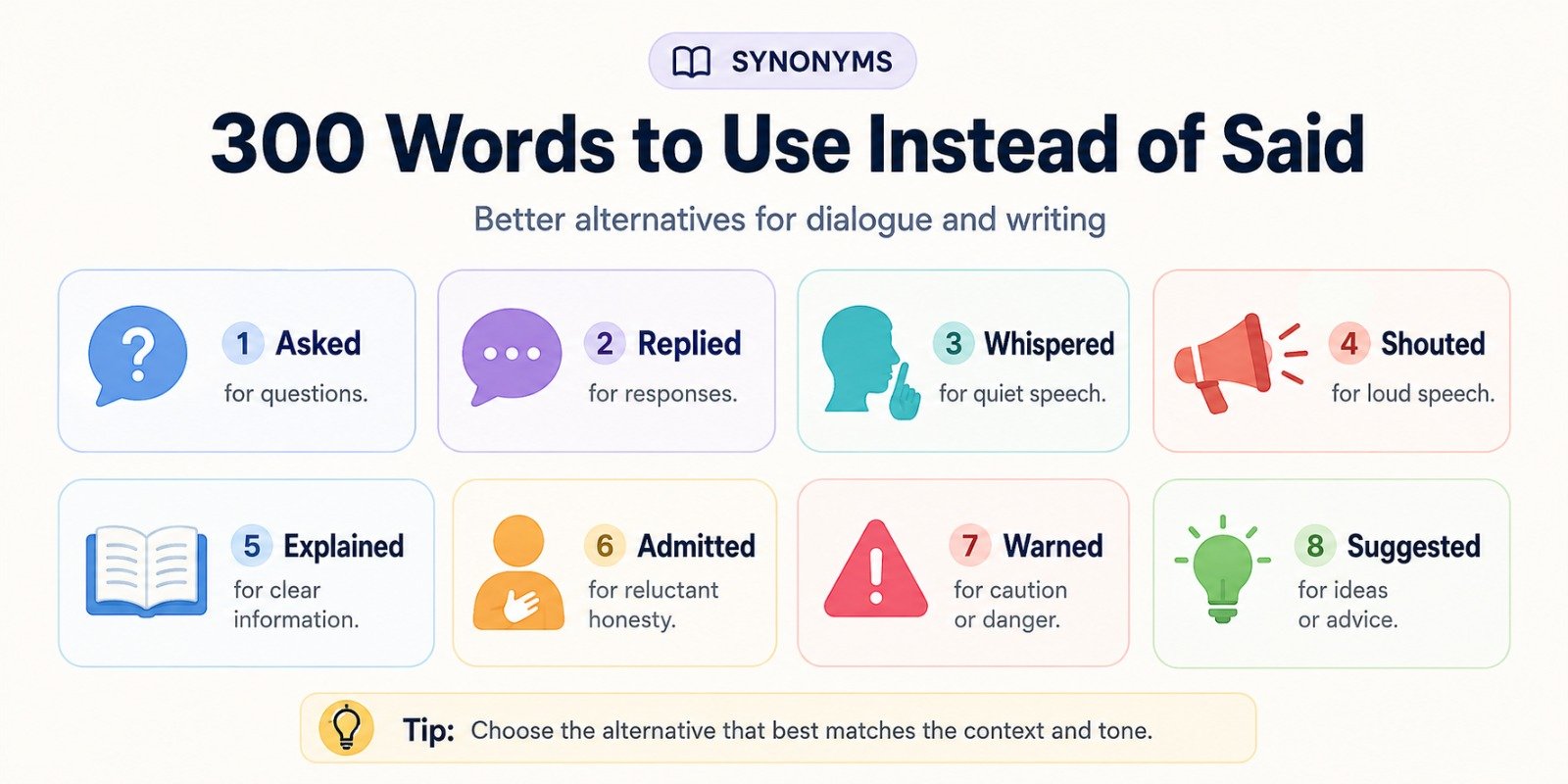
300 Words to Use Instead of Said: Better Alternatives for Dialogue and Writing
“Said” is clear, natural, and often exactly the right dialogue tag. But sometimes you need a more precise word to show whether someone whispered, argued, admitted, warned, joked, demanded, or pleaded. Choosing the right words to use instead of said can add emotion, clarify a speaker’s intention, and make dialogue or formal writing more expressive.
Below, you’ll find 300 words to use instead of said, organized by purpose and tone rather than thrown into one giant synonym list. You’ll also see which alternatives work well in dialogue, stories, essays, and other types of writing—and why not every option is an interchangeable replacement for said.
A Quick Guide to Choosing a Word Instead of Said
The best alternative tells the reader something useful that said alone does not.
| Alternative | What It Suggests | Best Used For | Example |
|---|---|---|---|
| Replied | An answer | Dialogue and conversation | “I’ll be there at six,” Maya replied. |
| Explained | Clarification | Dialogue, essays, reports | “The road is closed,” he explained. |
| Whispered | Very quiet speech | Stories and dialogue | “Don’t wake her,” Nina whispered. |
| Shouted | Loud speech | Action and emotional scenes | “Get down!” he shouted. |
| Admitted | Reluctant acknowledgment | Dialogue and formal writing | “I made a mistake,” she admitted. |
| Warned | Caution or threat | Dialogue and stories | “Stay away from the edge,” Dad warned. |
| Argued | A reasoned disagreement | Essays and debates | The author argued that the rule was outdated. |
| Suggested | An idea or recommendation | Professional and academic writing | Lee suggested a different approach. |
| Insisted | Strong determination | Dialogue and argument | “I’m paying for dinner,” she insisted. |
| Declared | Confidence or formality | Speeches, stories, announcements | “The contest is officially open,” he declared. |
| Muttered | Low, unclear speech | Fiction and dialogue | “This is ridiculous,” Ben muttered. |
| Pleaded | Emotional request | Dramatic dialogue | “Please give me another chance,” she pleaded. |
Not Every Alternative Is Interchangeable With “Said”
A list of synonyms can be helpful, but these words do not all mean exactly the same thing.
Compare:
“I didn’t take it,” Liam said.
“I didn’t take it,” Liam insisted.
“I didn’t take it,” Liam whispered.
“I didn’t take it,” Liam confessed.
The first sentence is neutral. Insisted suggests that Liam is strongly defending his statement. Whispered describes volume. Confessed changes the meaning considerably because it normally suggests an admission.
The goal isn’t to replace said every time. It’s to choose a stronger verb when the new word communicates something the reader needs to know.
300 Words to Use Instead of Said
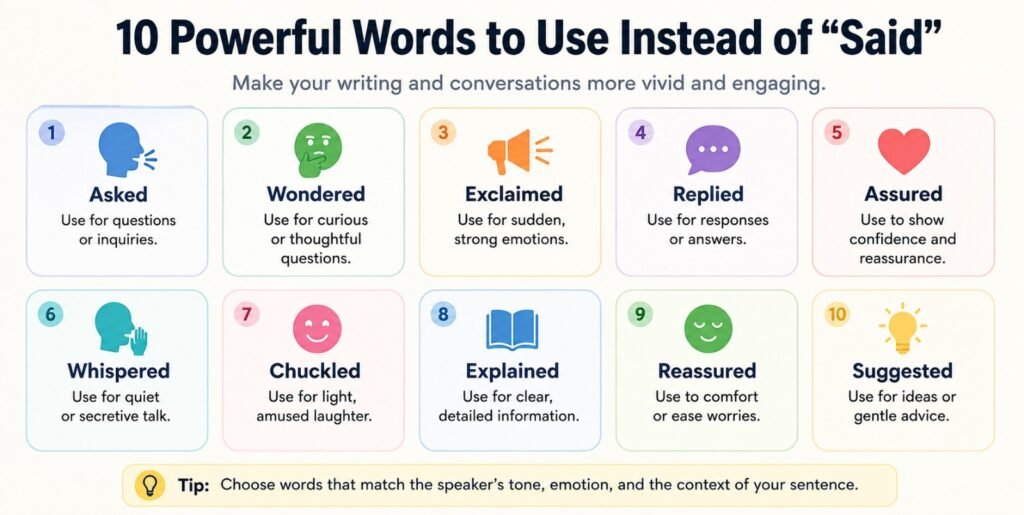
The following alternatives are grouped by meaning, emotion, and purpose so you can find a word that actually fits the sentence.
Other Ways to Say “Said” in Neutral Conversation
Use these when you need a relatively neutral dialogue tag or a verb describing straightforward communication.
- Added
- Answered
- Commented
- Continued
- Expressed
- Mentioned
- Noted
- Observed
- Remarked
- Replied
- Responded
- Shared
- Spoke
- Stated
- Uttered
- Voiced
- Related
- Reported
- Addressed
- Communicated
- Conveyed
- Imparted
- Informed
- Told
- Articulated
Replied and responded are especially useful when one speaker is answering another.
Example:
“I already checked the schedule,” Noah replied.
Stated is more formal and often sounds better in reports or informational writing than casual conversation.
Example:
The spokesperson stated that the office would reopen Monday.
Other Ways to Say “Said” When Answering
These words describe different kinds of responses.
- Acknowledged
- Affirmed
- Agreed
- Assented
- Confirmed
- Countered
- Denied
- Rejoined
- Retorted
- Returned
- Reassured
- Clarified
- Corrected
- Conceded
- Acquiesced
- Accepted
- Verified
- Maintained
- Reiterated
- Elaborated
- Explained
- Refuted
- Objected
- Contradicted
- Disputed
These alternatives reveal what kind of answer is being given.
Example:
“Yes, the reservation is still active,” the receptionist confirmed.
Example:
“That isn’t what happened,” Marcus countered.
Other Ways to Say “Said” When Asking a Question
When a character wants information, asked is often the simplest choice, but these alternatives add useful distinctions.
- Asked
- Inquired
- Queried
- Questioned
- Quizzed
- Interrogated
- Probed
- Pressed
- Wondered
- Pondered
- Requested
- Petitioned
- Implored
- Begged
- Pleaded
- Entreated
- Prompted
- Challenged
- Speculated
- Proposed
- Solicited
- Appealed
- Urged
- Invited
- Requested
Inquired sounds more formal than asked.
Example:
“Is the manager available?” she inquired.
Interrogated, on the other hand, suggests intense or aggressive questioning. It would sound exaggerated in an ordinary conversation.
Other Ways to Say “Said” Quietly
These alternatives are useful when volume, secrecy, uncertainty, or restraint matters.
- Whispered
- Murmured
- Muttered
- Mumbled
- Breathed
- Hissed
- Croaked
- Drawled
- Faltered
- Stammered
- Stuttered
- Quavered
- Sighed
- Confided
- Grumbled
- Mused
- Mumbled
- Muttered
- Whispered
- Murmured
- Intoned
- Droned
- Trailed off
- Hesitated
- Faltered
Some of these describe more than volume. Muttered can suggest annoyance, while confided suggests private or personal information.
Example:
“I never told anyone else,” Priya confided.
Other Ways to Say “Said” Loudly
Use these for strong volume, urgency, excitement, or dramatic situations.
- Shouted
- Yelled
- Screamed
- Bellowed
- Roared
- Hollered
- Boomed
- Thundered
- Shrieked
- Screeched
- Cried
- Called
- Exclaimed
- Barked
- Howled
- Wailed
- Whooped
- Yelped
- Blurted
- Proclaimed
- Announced
- Trumpeted
- Cried out
- Erupted
- Blared
Bellowed and roared are much more dramatic than shouted, so save them for scenes that justify the intensity.
Example:
“Everyone out of the building!” the firefighter shouted.
Other Ways to Say “Said” Angrily
Angry dialogue can express irritation, accusation, hostility, or open confrontation.
- Snapped
- Growled
- Snarled
- Raged
- Fumed
- Scolded
- Accused
- Rebuked
- Reprimanded
- Berated
- Cursed
- Swore
- Taunted
- Mocked
- Jeered
- Scoffed
- Sneered
- Protested
- Demanded
- Retorted
- Chided
- Admonished
- Condemned
- Criticized
- Complained
Snapped works well for brief irritation.
Example:
“I already told you I’m busy,” Ava snapped.
Berated is much stronger. It means criticizing someone harshly and at length, so it shouldn’t replace said in a minor disagreement.
Other Ways to Say “Said” With Happiness or Excitement
These alternatives fit celebrations, good news, playful conversations, and enthusiastic reactions.
- Cheered
- Exclaimed
- Gushed
- Rejoiced
- Crowed
- Chortled
- Chuckled
- Giggled
- Joked
- Quipped
- Raved
- Praised
- Congratulated
- Celebrated
- Enthused
- Beamed
- Sang
- Whooped
- Chimed
- Chirped
- Marveled
- Applauded
- Delighted
- Rhapsodized
- Bantered
Gushed suggests enthusiastic praise or excitement.
Example:
“The garden looks absolutely beautiful,” Mia gushed.
Quipped works when the speaker makes a short, clever, or witty remark.
Other Ways to Say “Said” Sadly
Use these carefully because many carry strong emotional meanings.
- Sobbed
- Wept
- Lamented
- Mourned
- Cried
- Wailed
- Whimpered
- Moaned
- Groaned
- Sniffled
- Grieved
- Bawled
- Blubbered
- Mewled
- Sniveled
- Regretted
- Sighed
- Pleaded
- Confessed
- Admitted
- Mourned
- Lamented
- Despaired
- Fretted
- Complained
The actual dialogue often does most of the emotional work, so you don’t need a dramatic tag on every sad sentence.
Example:
“I thought I’d have more time with him,” she whispered.
Sometimes the restrained whispered feels more natural than an intensely emotional verb such as wailed.
Other Ways to Say “Said” With Fear or Nervousness
- Gasped
- Trembled
- Quaked
- Quavered
- Stammered
- Stuttered
- Faltered
- Squeaked
- Squealed
- Whimpered
- Panicked
- Warned
- Cautioned
- Fretted
- Worried
- Gulped
- Sputtered
- Spluttered
- Hesitated
- Babbled
- Blurted
- Cried
- Pleaded
- Implored
- Whispered
Some words describe speech naturally, while others are better handled as action beats.
Instead of:
“Is someone outside?” Ella gulped.
A more natural construction is:
Ella gulped. “Is someone outside?”
That distinction matters because not every sound or physical action functions naturally as a dialogue tag.
Other Ways to Say “Said” During an Argument or Debate
These verbs work particularly well when a speaker is defending, opposing, or developing a position.
- Argued
- Asserted
- Contended
- Debated
- Disputed
- Countered
- Objected
- Protested
- Challenged
- Contradicted
- Insisted
- Maintained
- Defended
- Reasoned
- Refuted
- Rebutted
- Claimed
- Alleged
- Emphasized
- Stressed
- Interjected
- Interrupted
- Rejoined
- Retorted
- Contested
Argued is especially useful in essays because it describes a position rather than simply reporting speech.
Example:
The author argued that the existing policy placed too much responsibility on local councils.
Other Ways to Say “Said” When Persuading or Advising
These verbs reveal the speaker’s purpose.
- Advised
- Suggested
- Recommended
- Encouraged
- Urged
- Persuaded
- Coaxed
- Cajoled
- Appealed
- Implored
- Begged
- Pleaded
- Proposed
- Prompted
- Reminded
- Counseled
- Instructed
- Guided
- Warned
- Cautioned
- Assured
- Reassured
- Invited
- Requested
- Directed
Compare:
“You should get some rest,” Maya suggested.
with:
“You need to leave immediately,” Maya warned.
Both communicate advice of a kind, but the second carries urgency and possible danger.
Other Ways to Say “Said” With Confidence, Authority, or Purpose
These are useful for declarations, commands, promises, and firm statements.
- Declared
- Announced
- Asserted
- Proclaimed
- Commanded
- Ordered
- Instructed
- Directed
- Demanded
- Insisted
- Emphasized
- Stressed
- Affirmed
- Confirmed
- Pronounced
- Vowed
- Promised
- Swore
- Testified
- Assured
- Concluded
- Ruled
- Decreed
- Dictated
- Pronounced
Declared has a stronger, often more formal quality than said.
Example:
“This discussion is over,” the chairperson declared.
Commanded should be reserved for an actual command.
Example:
“Return to your stations,” the captain commanded.
Words to Use Instead of Said in Dialogue
Dialogue is where writers are most tempted to replace said constantly. That isn’t always necessary.
Consider:
“Did you bring the tickets?” Emma asked.
“They’re in my bag,” Ryan replied.
“You nearly gave me a heart attack,” she muttered.
“Relax. I remembered them,” he joked.
Each dialogue tag contributes something different. Asked marks a question, replied marks an answer, muttered suggests low or irritated speech, and joked tells us the final line isn’t completely serious.
A page full of unusually dramatic dialogue tags, however, can draw attention away from the characters’ actual words.
Other Ways to Say “Said” in Everyday Dialogue
For ordinary conversations, some of the most natural choices are:
- Asked
- Replied
- Answered
- Added
- Explained
- Remarked
- Commented
- Noted
- Continued
- Mentioned
- Suggested
- Admitted
- Agreed
- Insisted
- Whispered
- Muttered
- Shouted
- Joked
- Warned
- Confessed
These are versatile because readers generally understand the distinction without having to stop and interpret an unusual verb.
Words to Use Instead of Said in a Story
Storytelling benefits from precise dialogue tags when they reveal character, emotion, or tension.
Consider this scene:
“You went into my room?” Lena demanded.
“I was looking for the charger,” Max admitted.
“You could have asked me,” she snapped.
“I know. I’m sorry,” he murmured.
The verbs tell us much more than a sequence of said, said, said. Lena is angry, Max acknowledges what he did, Lena responds sharply, and Max’s quieter response suggests regret.
Other Ways to Say “Said” in a Story Without Overwriting
Good story dialogue usually mixes three techniques:
1. Simple dialogue tags
“I’ll call tomorrow,” James said.
2. Descriptive speech verbs
“Don’t touch that,” James warned.
3. Action beats
James pulled the box away from the edge. “Don’t touch that.”
Using all three creates variety without forcing elaborate synonyms into every exchange.
Use Action Beats When You Don’t Need a Synonym
An action beat describes what the character does before, during, or after speaking.
Instead of:
“I don’t believe you,” Grace said angrily.
You might write:
Grace folded her arms. “I don’t believe you.”
The action already suggests resistance or frustration. There’s no need to explain the emotion twice.
Another example:
Marcus checked the clock for the third time. “We should have left ten minutes ago.”
The action identifies Marcus as the speaker and shows his impatience without any dialogue tag.
Be Careful With Actions Used as Dialogue Tags
Not every action can replace said grammatically.
For example:
“That’s ridiculous,” Sarah smiled.
A smile isn’t a way of speaking. A cleaner version is:
Sarah smiled. “That’s ridiculous.”
Similarly:
“You scared me,” Noah laughed.
is usually clearer as:
Noah laughed. “You scared me.”
The distinction seems small, but it helps dialogue sound polished and natural.
Words to Use Instead of Said in Writing
Outside fiction, said can refer to what an author, expert, organization, report, or source communicates.
In these situations, precision matters more than dramatic variety.
Other Ways to Say “Said” in General Writing
Useful alternatives include:
Stated
Best for presenting information neutrally.
The company stated that the change would take effect in May.
Explained
Use when a person or source clarifies how or why something happened.
Dr. Patel explained that the procedure normally takes less than an hour.
Noted
Useful when drawing attention to a relevant observation.
The report noted several differences between the two groups.
Mentioned
Works when something is referred to briefly rather than discussed in depth.
Rivera mentioned the issue during the final interview.
Reported
Appropriate when communicating findings, events, or data.
Researchers reported an improvement after six weeks.
Suggested
Use when the source proposes an idea or when evidence points toward a possibility rather than certainty.
The results suggested that additional testing was needed.
Claimed
Useful when reporting an assertion without necessarily endorsing it as proven fact.
The manufacturer claimed that the new process reduced waste.
Words to Use Instead of Said in an Essay
Academic and formal writing needs a different group of reporting verbs than fiction.
You probably won’t write that a researcher growled or whispered an argument. Instead, choose a verb that accurately represents what the source does.
Other Ways to Say “Said” in an Essay
Useful essay alternatives include:
- Argued
- Asserted
- Claimed
- Concluded
- Demonstrated
- Described
- Discussed
- Emphasized
- Explained
- Found
- Identified
- Illustrated
- Maintained
- Noted
- Observed
- Proposed
- Reported
- Stated
- Suggested
- Acknowledged
Here are the distinctions that matter most.
Argued means the writer supports a position with reasoning.
Chen argued that early intervention could reduce long-term costs.
Suggested is more cautious.
The results suggested that sleep may influence memory performance.
Concluded signals a judgment reached after analysis.
The authors concluded that further research was necessary.
Acknowledged shows recognition of a fact, limitation, or opposing point.
Harris acknowledged that the sample size was relatively small.
Demonstrated is stronger than suggested and should be used only when the evidence genuinely supports that level of certainty.
Choosing the wrong reporting verb can accidentally exaggerate or weaken a source’s position.
When “Said” Is Actually the Better Word
Writers sometimes treat said as though repeating it is automatically bad. It isn’t.
In dialogue, said is useful because it’s neutral and familiar. The reader can quickly identify the speaker and move on.
Consider:
“What time does the train leave?” Carla said.
The sentence is perfectly understandable, although asked would be more precise.
Now compare:
“I’ll see you tomorrow,” Carla vocalized.
The unusual verb draws unnecessary attention to itself.
A simple said often sounds better than a rare synonym chosen only to avoid repetition.
How to Choose the Best Alternative
Before replacing said, ask what the new word contributes.
Use whispered if volume matters.
Use warned if the line communicates danger or caution.
Use admitted if the speaker reluctantly acknowledges something.
Use argued if a writer or speaker presents a reasoned position.
Use pleaded if the request is emotional and urgent.
Use announced if information is being made publicly known.
Use insisted if the speaker refuses to back down.
Use said if no extra meaning is needed.
The strongest choice is usually the most accurate one, not the most unusual one.
Common Mistakes When Replacing “Said”
Choosing a Word That Doesn’t Match the Dialogue
“I suppose that’s fine,” he roared.
Unless the character is deliberately roaring a mild statement, the verb and dialogue clash.
Using Too Many Dramatic Tags
A scene where characters constantly shriek, thunder, proclaim, hiss, and bellow can quickly feel exaggerated.
Let the dialogue carry some of the emotion itself.
Adding an Unnecessary Adverb
“Get out!” she shouted loudly.
Because shouted already means speaking loudly, the adverb adds little.
A cleaner version is:
“Get out!” she shouted.
Using an Overly Formal Word in Casual Dialogue
“Want some pizza?” Jake inquired.
This is grammatically possible, but asked sounds much more natural in an ordinary conversation.
Changing the Meaning Just to Avoid Repetition
Confessed, admitted, claimed, warned, and promised all describe specific kinds of communication. Don’t use them merely because said appeared in the previous paragraph.
Frequently Asked Questions
What are the best words to use instead of said?
Some of the most versatile alternatives are asked, replied, answered, explained, stated, remarked, whispered, shouted, admitted, warned, argued, suggested, insisted, announced, and declared. The best option depends on what the speaker is doing and how the sentence is delivered.
What are other words to use instead of said in dialogue?
Good dialogue alternatives include replied, asked, whispered, muttered, shouted, exclaimed, admitted, joked, warned, demanded, pleaded, snapped, confessed, and insisted. You can also use action beats instead of adding a speech verb to every line.
What words can I use instead of said in an essay?
Use reporting verbs such as argued, stated, explained, suggested, noted, observed, reported, claimed, concluded, acknowledged, maintained, and emphasized. Choose the verb based on what the source actually does rather than simply looking for a synonym.
Is it bad to use the word “said” repeatedly?
No. Said is a standard dialogue tag and is often less distracting than an unusual alternative. Repetition becomes a problem mainly when every line requires attribution or when the sentence structure itself becomes monotonous.
Should I replace every instance of “said”?
No. Replace it when another verb provides meaningful information about tone, emotion, intention, or volume. If the speaker is simply talking, said may be the most natural choice.
What are strong words to use instead of said?
Depending on the context, stronger alternatives include demanded, declared, insisted, commanded, warned, accused, protested, roared, pleaded, and asserted. These words carry specific meanings, so they shouldn’t be treated as neutral replacements.
What can I use instead of “said” when someone is angry?
Try snapped, growled, demanded, protested, retorted, accused, scolded, rebuked, or berated. Choose according to the intensity of the anger: snapped may show brief irritation, while berated suggests harsh, extended criticism.
What can I use instead of “said” when someone is sad?
Possible options include sobbed, whispered, lamented, cried, whimpered, pleaded, sighed, and murmured. Some are very dramatic, so match them to the actual emotional intensity of the scene.
Can “laughed” be used instead of “said”?
Usually, it’s clearer to treat laughter as an action rather than a dialogue tag. Instead of writing “That was funny,” Maya laughed, write Maya laughed. “That was funny.” This separates the physical reaction from the act of speaking.
Is “asked” better than “said” for a question?
Usually, yes. If a character is directly asking a question, asked is simple and precise. You can choose a more specific option such as inquired, questioned, pressed, or begged when the context requires it.
Conclusion
There are plenty of words to use instead of said, but effective writing isn’t about replacing said wherever it appears. Choose a different verb when it adds useful information about the speaker’s tone, purpose, emotion, volume, or attitude. In dialogue and stories, natural speech verbs and action beats create variety; in essays and formal writing, accurate reporting verbs matter more than creativity.
The right choice ultimately depends on context, audience, tone, relationship, and level of formality. Clarifyra focuses on those small but important differences so you can choose wording that sounds natural and communicates exactly what you intend.
You May Also Read | Other Ways to Say “The Pleasure Is All Mine”: Meaning, Synonyms and Replies