Cafe or Café: Which Spelling Is Correct?
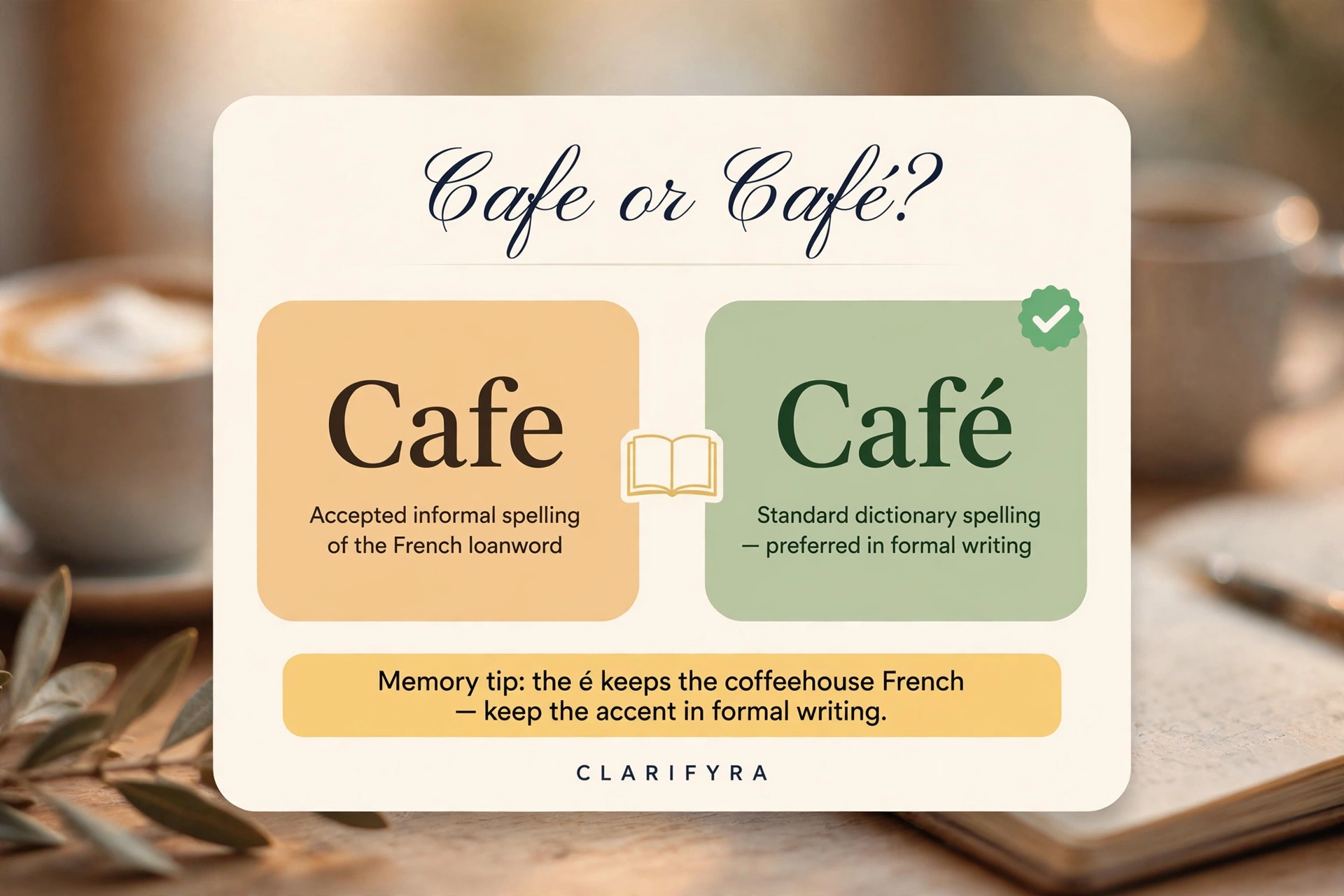
If you’ve ever hesitated between cafe and café, here’s the short answer: both are correct. Every major dictionary checked for this article — Cambridge, Oxford Learner’s, Collins, and Merriam-Webster — lists both spellings. The only thing the dictionaries can’t agree on is which one goes first: Cambridge and Merriam-Webster headword café and note cafe as the variant, while Oxford Learner’s headwords cafe and notes café as the variant. Collins keeps separate headword entries for both. The accent is a leftover from the French source word, and whether you keep it is a matter of house style, audience, and consistency — not correctness.
Quick Answer
Café (with the acute accent) is the dictionary headword in Cambridge, Collins, and Merriam-Webster; cafe (without it) is the headword in Oxford Learner’s — and every one of them accepts the other spelling as a variant. They sound identical within each variety of English. American news style tends to drop the accent (an AP Stylebook supplement puts it bluntly: cafe, not café), while British publishers more often keep it. Either choice is defensible; just use it consistently within one document. The plural is cafés (or cafes to match the base spelling).
What the Dictionaries Actually List
The dictionary evidence is unambiguous in one direction: no reference work treats cafe as a misspelling of café, or vice versa. But the order in which the dictionaries present the two forms is revealing:
| Dictionary | Headword | Variant noted | Pronunciation given |
|---|---|---|---|
| Cambridge | café, noun [C], A1 | “(also cafe)” | UK /ˈkæf.eɪ/, US /kæfˈeɪ/ |
| Oxford Learner’s | cafe, noun | “(also café)” | BrE /ˈkæfeɪ/, NAmE /kæˈfeɪ/ |
| Collins | Separate headword entries for both cafe and café (British); American entry reads “cafe … or café” | COBUILD usage note: “Café is sometimes spelled cafe” | American: (kæˈfeɪ, kəˈfeɪ) |
| Merriam-Webster | café, /kɑˈfeɪ/ (“ka-ˈFĀ”), “a usually small and informal establishment serving various refreshments (such as coffee)” | Unaccented cafe appears throughout its quoted real-world examples | /kɑˈfeɪ/, stress on the second syllable |
In other words, editorial practice runs slightly ahead of the headwords: the unaccented form is doing a lot of the real-world work.
What the Accent Is Doing There
The é carries an acute accent (the accent aigu), the stroke that rises from lower left to upper right — ╱ — like the mark in café itself and in French-derived words such as fiancé or sauté. English borrowed the word whole from French, where café means “coffee,” and kept the accent it arrived with. Oxford dates the borrowing to the early 19th century (“from French café, ‘coffee or coffee house’”), Collins says 19th century (“from French: coffee”), and Merriam-Webster traces it further back through French to Turkish kahve, with the first known English use in 1802.
In French, the acute accent over a final e is a pronunciation instruction: it says the vowel is pronounced /e/, roughly “ay,” rather than being silent as French final es usually are. English doesn’t need that instruction anymore — every English speaker already says “ka-FAY” — but the accent survives as a signal of the word’s French origin. Dropping it changes nothing about the meaning or the sound; it just removes a diacritic English orthography never fully needed.
There is one pronunciation point the accent sometimes gets credit for, and it’s worth getting right. In British English the stress falls on the first syllable — /ˈkæfeɪ/, “KAF-ay” — while in American English it falls on the second — /kæˈfeɪ/, “ka-FAY” — and that split appears in Cambridge’s and Oxford’s transcriptions whichever spelling is used. The accent doesn’t cause it; it’s a genuine UK/US difference sitting on top of a spelling both varieties share.
The American Habit of Dropping It
There isn’t a clean rule that says Americans write cafe and Britons write café — the dictionary split above is the proof. But the publishing habit does lean that way in the US. The clearest evidence comes from newsroom style. The Associated Press approach, as summarized in a university journalism supplement to the AP Stylebook, is categorical about diacritics: “Never use letters with tildes, accent marks or other diacritics in words common to in the English language (e.g., cafe NOT café, and resume NOT resumé).” The only exception the supplement names is people’s names, where the person’s own preference wins.
If your writing follows AP style or appears in American media, cafe without the accent is the natural default, and nobody will read it as an error. British publishers lean the other way but not uniformly: Cambridge’s entry and examples keep the accent, while Oxford Learner’s headwords and exemplifies the unaccented form. So even within British English, both spellings are in active, reputable use.
The Plural: Cafés, Cafes, and One Trap
The plural follows whichever base spelling you’ve chosen: cafés if you keep the accent, cafes if you don’t (Collins lists “plural cafés”; Merriam-Webster cross-references “cafés — plural of café”). Don’t mix — café in the singular and cafes in the plural looks sloppy — and café’s with an apostrophe is possessive, not plural (“the café’s menu”).
How to Type the Accent (When You Want It)
A surprising amount of accent-dropping is really keyboard avoidance. The é is easy to produce on every major platform:
- Windows: hold Alt and type 0233 on the numeric keypad, then release. (In many programs, Ctrl + ’ followed by e also works.)
- Mac: press Option + e, release, then press e.
- iPhone / Android: long-press the e key and select é from the popup.
If you’re writing for the web, use the actual character (é) rather than an HTML entity or a pasted lookalike — and never substitute the grave accent, è. Cafè with the backward-leaning stroke is simply a different (and here, wrong) mark.
Words in the Same Boat
Café belongs to a small club of French borrowings whose accents are slowly eroding in English, and the dictionaries treat them the same way — both forms listed, order varying:
- Résumé / resume. Collins’s American English entry headwords résumé and lists “also resumé also resume” — three accepted variants in one entry. The AP supplement quoted above prefers the unaccented resume for news copy. (Note the ambiguity argument for keeping the marks here: resume without accents is also the verb “to begin again,” pronounced differently — a confusion cafe never causes.)
- Naïve / naive. Merriam-Webster lists naive with “or naïve” as a variant, and Lexico, the American Heritage Dictionary, Collins, Macmillan, and Cambridge record the diaeresis form as a variant too. The two dots serve a different job from café’s accent — they mark the a and i as two syllables, “nah-EEV” — but the erosion pattern is identical.
The pattern across all of them: the marks are survivals from the source language, English manages fine without them, and every major dictionary lists both forms. None of these words becomes “wrong” when the marks come off.
Correct vs. Incorrect
Because both spellings are legitimate, “incorrect” here mostly means inconsistent or mis-accented rather than misspelled:
| Incorrect ✗ | Correct ✓ | Note |
|---|---|---|
| There’s a nice cafè on the corner. | There’s a nice café on the corner. | Wrong accent direction — acute (é), not grave (è). |
| The café’s on this street are all good. | The cafés on this street are all good. | Plural, not possessive — no apostrophe. |
| I love this café. The cafes here are great. | I love this café. The cafés here are great. | Don’t mix accented and unaccented in one text. |
| CAFE SOCIETY (mixed with “café culture” in the same article) | café culture … café society | Consistency includes attributive uses. |
✓ We had lunch at a sidewalk café.
✓ We had lunch at a sidewalk cafe. (Equally correct — pick your style.)
✓ The cafés of Paris feature in half the novels ever written.
✗ The café’s of Paris feature in half the novels ever written.
Common Mistakes
- “Correcting” cafe to café (or the reverse) as if one were a typo. Since every major dictionary lists both, changing someone else’s chosen spelling in an edit is a style imposition, not a fix. Respect the publication’s house style instead.
- Using the wrong accent: cafè. The grave accent (è, leaning the other way) is a different mark. If you include an accent, it’s the acute: café.
- Apostrophe plurals. Café’s is only ever possessive (“the café’s Wi-Fi”). The plural is cafés.
- Assuming the accent changes the pronunciation. In English it doesn’t — cafe and café are pronounced identically within each variety. The UK/US stress difference (KAF-ay vs. ka-FAY) exists independently of the spelling.
- Misspelling a business name. If the sign says Café Luna, write Café Luna — even in AP-style copy, proper names keep their own spelling. This is the one context where the accent is non-negotiable, and it’s also the AP supplement’s own exception.
- Writing “caff” when you mean café. Cambridge records caff as UK informal — but it means a cheap, greasy-spoon-style café, not any café.
FAQs
Which is correct: “cafe” or “café”?
Both. All four dictionaries list both spellings and differ only in which one they put first. Café is the slightly more traditional, French-faithful form; cafe is the fully naturalized English form. Choose by style guide and audience, then stay consistent.
Does the accent change how the word is pronounced?
No — not in English. In both spellings, British speakers say /ˈkæfeɪ/ (stress on the first syllable) and American speakers say /kæˈfeɪ/ (stress on the second). The accent is a historical remnant of the French pronunciation guide, not a live instruction in English.
Should I use the accent in emails and everyday writing?
It’s a judgment call. If your organization has a style guide, follow it — AP-based newsrooms drop the accent; many British publishers keep it. Otherwise, the unaccented cafe is the path of least resistance on keyboards and in databases, while café reads more polished in print and branding. Either is fine as long as you don’t flip between them.
What about in a business name — “Café Luna” or “Cafe Luna”?
Reproduce the name exactly as the business spells it. Proper names keep their own spelling regardless of house style — this is the standard exception even style guides that drop diacritics make. When in doubt, check the signage or the business’s own website.
Is “caff” the same as “café”?
Not quite. Cambridge lists caff as UK informal for a café — but in practice it means a cheap, no-frills, greasy-spoon-style café. Don’t use it as a general synonym.
Does “cafe” mean anything else?
In South African English, Oxford Learner’s and Collins both record a second sense: a cafe (usually unaccented) is a small corner shop selling sweets, newspapers, and food, often open later than other shops.
The Takeaway
Café and cafe are two spellings of one word, and the dictionaries refuse to pick a loser: Cambridge, Merriam-Webster, and Collins lead with the accent, Oxford Learner’s leads without it, and all of them accept both. The accent is a souvenir of the word’s French origin — it changes neither meaning nor pronunciation in English — and American publishing increasingly leaves it off. So pick the spelling your style guide or audience expects, spell the plural to match (cafés or cafes), keep business names exactly as written, and stay consistent. That’s the whole job.