Background or Backround: Which Is Correct?
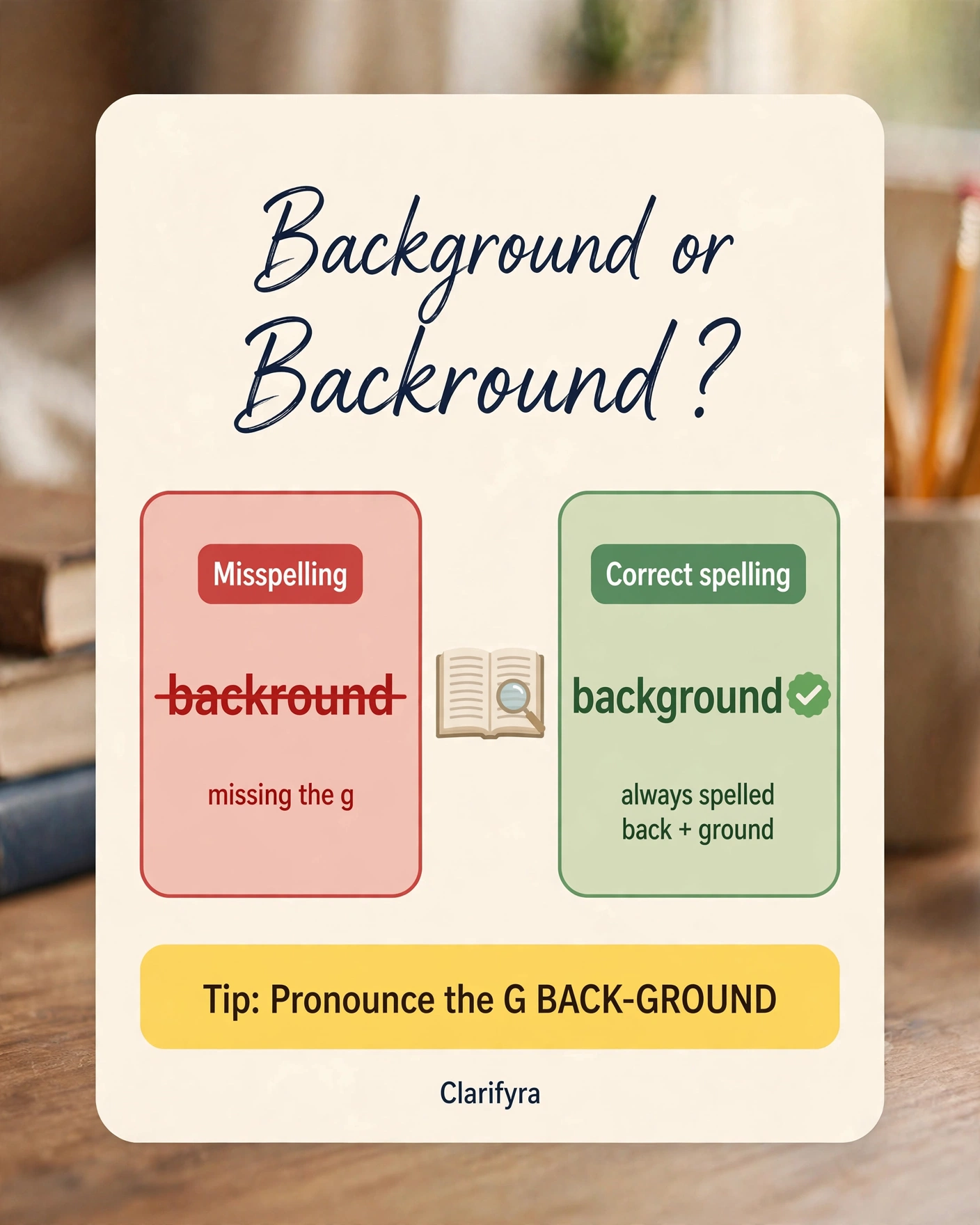
The correct spelling is background — back + ground, with the g pronounced and written. Backround is a misspelling: none of the major dictionaries — Cambridge, Oxford Learner’s, Merriam-Webster, or Collins — gives it an entry, and it survives only as a typo in forum posts, comments, and hasty drafts. The g is the whole story of this keyword: in fast speech, the k-g cluster in the middle collapses, and fingers follow ears.
Quick Answer
Background is the only correct spelling (the ground or setting behind something; a person’s history and experience; computer wallpaper). Backround is a misspelling with no dictionary entry in Cambridge, Oxford Learner’s, Merriam-Webster, or Collins. Pronunciation: /ˈbækɡraʊnd/ in both British and American English — the g is fully pronounced, so say “BACK-GROUND” as you type it.
Why “Backround” Feels Plausible (and Isn’t)
Say background at normal speed and listen to your mouth: “BAG-round.” The two sounds in the middle — /k/ and /ɡ/ — are both made at the back of the throat, and when they sit next to each other, the first one barely escapes before the second one swallows it. The spelling, though, has not swallowed anything: both halves of the compound are written in full, exactly as they are on their own.
This is a dropped-sound misspelling: the ear reports a simplified version of the word, and the fingers write that report. The fix is structural — spell the word by its construction, not by its sound.
What the Dictionaries Actually Say About “Backround”
We checked all four. Cambridge, Oxford Learner’s Dictionaries, Merriam-Webster, and Collins each carry a full entry for background — and none carries any entry for backround. Web searches for a dictionary definition of “backround” return no headword at all, only the typo itself turning up in message boards and user-generated text. That is the honest verdict: “backround” isn’t a variant, an Americanism, or an accepted alternative. It is a misspelling — a common and understandable one, but a misspelling all the same.
Meanwhile background has deep credentials. Merriam-Webster records its first known use as a noun in 1672 (“the scenery or ground behind something”), and records the verb form (to provide a background for) in use since 1768. Collins lists the verb too. This is a word spelled with both its letters intact for more than 350 years.
The Compound-Word Logic: Back + Ground
The spelling stops being a memory test the moment you see the structure. Background is a closed compound of back + ground — “the ground behind.” Neither half changes its spelling when the two are joined, and that is the whole rule:
- back keeps its k: background
- ground keeps its g: background
English is full of compounds that follow exactly the same pattern — foreground (fore + ground), playground, battleground, campground — and in every one of them, the letters survive the merger intact. Nobody writes “fore-round,” and nobody should write “backround.” The moment you think of the word as two ordinary words glued together, the phantom spelling disappears.
Pronunciation: UK and US
Unlike February, where the spelling and the pronunciation are at odds, background is honest on both sides of the Atlantic. The dictionaries agree: the g is fully pronounced in British (/ˈbækɡraʊnd/) and American (/ˈbækˌɡraʊnd/, Merriam-Webster ˈbak-ˌgrau̇nd) English.
In careful speech both consonants are articulated — “BACK-GROUND.” In rapid connected speech, speakers may under-articulate the /k/ so it sounds like “bag-round,” and that is precisely the trap: the sound in fast speech nudges toward the wrong spelling, while the standard spelling keeps the g it pronounces in careful speech. The memory hook is the pronunciation itself — if you say the g, you’ll write it.
What “Background” Means: The Main Senses
The dictionaries record a family of related meanings, all growing out of “what lies behind.” Here are the ones you’ll actually use:
1. What lies behind the main subject. The scenery or ground behind something — the original 1672 sense. ✗ “There’s a strange car in the backround of the photo.” → ✓ “There’s a strange car in the background of the photo.”
2. Someone’s history and experience. The total of a person’s family, education, and experience (Collins, Oxford Learner’s, Merriam-Webster all list this). “She comes from a working-class background.” “He has the right background for the job.” This is the sense in “background check” — looking into what came before.
3. The circumstances behind an event. The facts or conditions that explain a situation (Cambridge: “background on the situation”; Collins: “the background to the current troubles”). “The deal was struck against a background of rising prices.” So is “background information” — the preparatory facts that come before the main thing.
4. Sounds or activity that stay out of focus. Music or noise you hear without listening to: “background music,” “background noise.” And the related sense of an inconspicuous position: “shy people who try to stay in the background.”
5. Computing. Two senses: the image displayed on your screen behind the icons and windows (“use a photo as your computer background“), and background processing — tasks a computer runs while you work on something else.
Correct vs Incorrect: The Spellings Compared
| Spelling | Verdict | What’s wrong |
|---|---|---|
| background | ✓ Correct | Back + ground — the only standard form, noun and verb |
| backround | ✗ Misspelling | The g of “ground” has been dropped to match fast speech |
| back ground | ✗ Error (usually) | Two words break the closed compound; only defensible in a literal, rare sense like “the ground at the back of the house” |
| back-ground | ✗ Error | Hyphenated forms are not standard for this compound — it is written solid |
| bakcground | ✗ Typo | Simple transposition of the k and c; a keyboard error, not a spelling debate |
Common Mistakes
1. Dropping the g: “backround.” ✗ “Check his backround before hiring.” → ✓ “Check his background before hiring.” This is the mistake behind the whole article, and it turns up everywhere from CVs to software menus. Say “BACK-GROUND” as you type, and the g stays.
2. Splitting it in two: “back ground.” ✗ “The details are in the back ground of the report.” → ✓ “The details are in the background of the report.” “Back ground” as two words is only defensible when “back” literally describes physical ground — “the back ground of the garden was waterlogged” — which is a different phrase, not this word.
3. Hyphenating it: “back-ground.” Compound nouns move from open to hyphenated to closed over time, and “background” completed that journey centuries ago — Merriam-Webster’s earliest citation, from 1672, already treats it as one word. No hyphen.
4. Typing “bakcground.” The k-g-c neighborhood in the middle is a known finger-tangle. Slow down there: the letters are b-a-c-k-g-r-o-u-n-d, in that order.
5. Thinking of it as a “round” word. The ending is -ground, not -round — the everyday noun “ground,” the earth you stand on. Picture standing on it, and the g survives.
6. Confusing it with “backdrop.” A backdrop is the painted curtain hung at the back of a stage (or, figuratively, an event’s setting). The background is broader — everything that lies behind or before: setting, history, context. A backdrop is one possible piece of a background.
Background Isn’t Alone: The Dropped-Letter Club
The g in “backround” has company. The same ear-first instinct that erases it also produces the dropped n in collum vs column — a word where the second letter of a consonant pair disappears because the sound of it is swallowed — and the missing n in anual vs annual, where a doubled letter gets written singly. In each case the repair is the same: when sound and spelling disagree, spell the word by its structure, not by your ears.
How to Remember the Spelling
1. Say the g. Pronounce the word as two clean beats — “BACK-GROUND” — while you type. If your mouth forms the g, your fingers will write it. This is the single most effective trick for this word.
2. Split the compound. See back + ground. Both halves are words you can already spell. Glued together, neither changes: the k stays, the g stays.
3. Borrow from “foreground.” The twin compound keeps the same g: foreground. If the g belongs in the front, it belongs in the back.
4. Think of the ground. The ending is the noun ground — the earth under your feet. You stand on the ground, not on the “round.” Picture it, and the g survives.
Frequently Asked Questions
Is “backround” ever correct?
No. None of the four major dictionaries — Cambridge, Oxford Learner’s, Merriam-Webster, Collins — has an entry for it; searches for a dictionary definition of “backround” return no headword, only the typo itself in forums and unedited text. It is not a variant, an Americanism, or an accepted alternative. Always write background.
Do you pronounce the g in background?
Yes. Both British (/ˈbækɡraʊnd/) and American (/ˈbækˌɡraʊnd/) pronunciations include the g — Oxford Learner’s and Merriam-Webster both transcribe it. In rapid casual speech the k-g cluster can be under-articulated, but careful pronunciation keeps both consonants.
Is it “background” or “back ground”?
Background, one word — the compound closed centuries ago (Merriam-Webster’s earliest citation is from 1672). “Back ground” as two words is only legitimate when “back” literally describes physical ground, e.g. “the back ground of the garden.”
Can “background” be a verb?
Yes. Collins (via Webster’s New World) lists it as a transitive verb meaning “to provide a background for,” and Merriam-Webster records the verb in use since 1768. You’ll see it in arts and media writing: “strings backgrounded by a soft synth.” The noun is far more common, but the verb is standard.
What is the difference between “background” and “backdrop”?
A backdrop is a specific thing: the painted cloth hung at the back of a stage, extended figuratively to “the setting of an event.” The background is broader — everything that lies behind or before: the setting, the history, the context. A backdrop is one possible piece of a background.
Is the spelling the same in British and American English?
Yes — background is spelled identically in both. The dictionaries also transcribe the pronunciation essentially the same in both (Oxford Learner’s gives /ˈbækɡraʊnd/ for BrE and NAmE alike).
Final Takeaway
Background — back + ground, ten letters, one word. The g is pronounced, the compound keeps both halves intact, and the dictionaries have spelled it this way since 1672. “Backround” is what fast speech sounds like, not what correct writing looks like. Say the g, split the compound, and you’ll never drop the letter again.