Dinner or Supper: What’s the Difference?
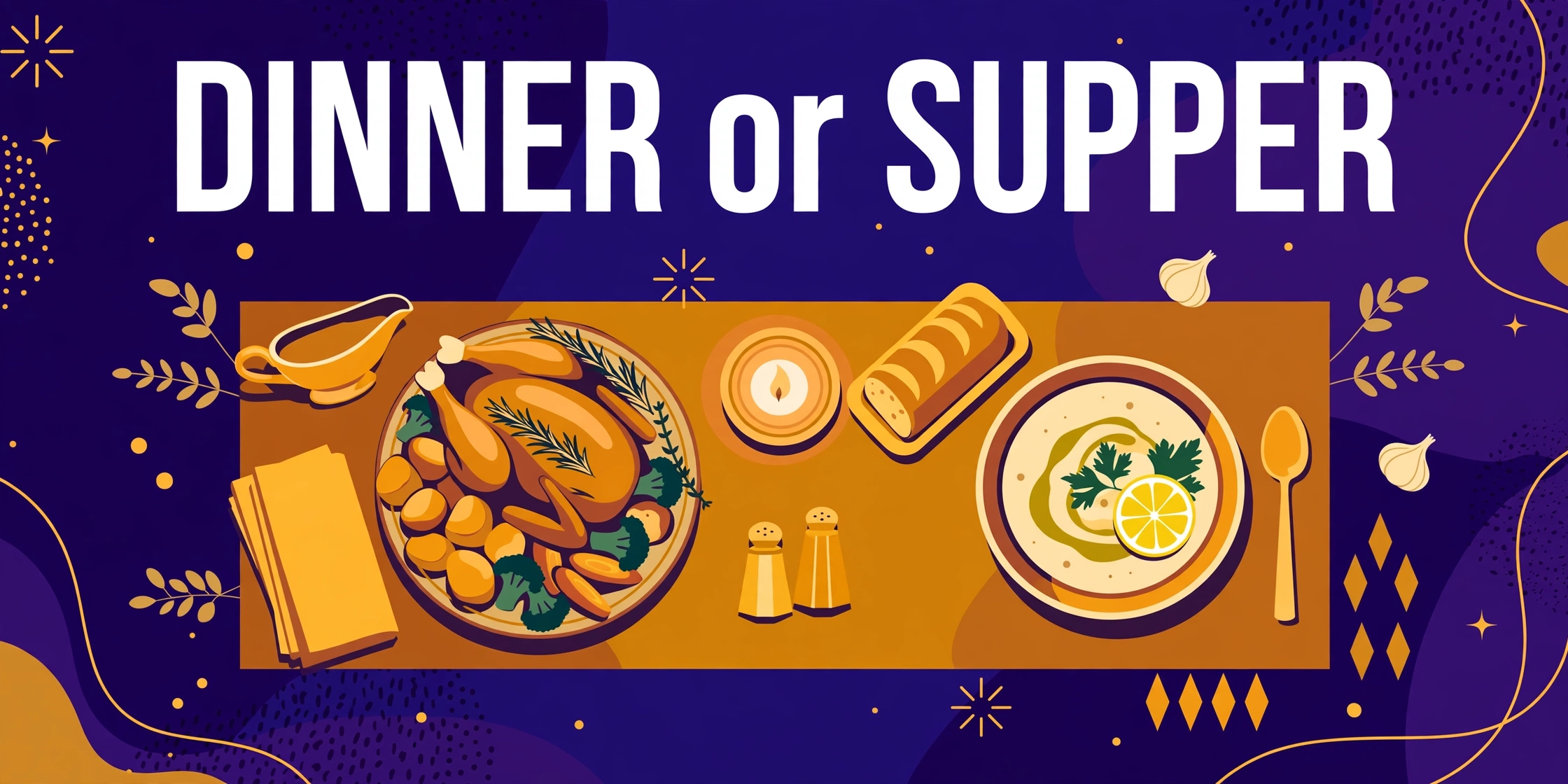
Dinner is the main meal of the day — the biggest, most substantial meal, usually eaten in the evening, though in some households and regions it is still the midday meal. Supper is an evening meal, and it is usually the lighter one: a bowl of soup after a long day, toast before bed, a modest plate eaten late. In modern use the two words often overlap, because for many families the evening meal is the main meal — so dinner and supper can name the same sitting. The difference is one of weight and formality, not of clock time alone: dinner sounds like the day’s centrepiece, supper like something smaller and more casual.
Quick Answer
Use dinner for the main meal of the day, whenever it falls: We are having roast chicken for dinner tonight; Christmas dinner is at one o’clock. Use supper for a lighter evening meal, especially a late or informal one: We had a light supper of soup and bread; she made herself some supper after the show. If the evening meal is the big meal of the day, either word can describe it — but dinner is the slightly more formal choice, and in writing it is the safer default.
What “dinner” means
Merriam-Webster defines dinner first of all as “the principal meal of the day,” and that single word — principal — does most of the work. Dinner is defined by importance, not by the clock. A dinner can be eaten at one in the afternoon or at eight in the evening; what makes it dinner is that it is the meal the day is built around. The same entry adds the second sense, “a formal feast or banquet” (“held a dinner in her honour”), and the third, simply “the food prepared for a dinner” (“eat your dinner”). All three senses carry the same implication: dinner is the serious meal.
That is why fixed phrases behave the way they do. Christmas dinner is eaten in the middle of the day in most British homes, yet nobody calls it Christmas lunch — it is dinner because it is the feast. Sunday dinner works the same way: Merriam-Webster notes that in the phrase “Sunday dinner,” dinner often refers to a main meal eaten earlier in the day. A dinner party is a formal evening gathering, a dinner jacket formal evening wear, and a TV dinner a packaged meal — the joke being that something so unceremonious borrows the word for the day’s grandest meal.
The word itself comes from the Anglo-French disner, meaning “to dine,” and has been in use since the 13th century. Originally it named the first substantial meal of the day, eaten around midday; as working hours shifted and the main meal moved later, the word moved with the meal rather than staying pinned to noon.
What “supper” means
Supper is always an evening meal — that much is fixed — but it is the evening meal in its lighter, later, less ceremonious form. Merriam-Webster gives three senses: “the evening meal especially when dinner is taken at midday,” “a social affair featuring a supper” (as in a church supper), and “a light meal served late in the evening.” The thread running through all three is modesty. Supper is what you eat when the day’s main eating is already done, or when the evening meal itself is deliberately simple.
Think of the scenes the word naturally summons: a family in the old pattern eating bread, cheese, and soup in the evening after a large dinner at noon; a child home late from a rehearsal eating toast standing up in the kitchen; a village hall fundraiser built around a shared hot meal, a church supper, where the point is the gathering as much as the food.
The etymology points the same way. Supper comes from Middle English soper, from Anglo-French super, from the verb super, to sup — to eat the evening meal, and in particular to eat something liquid or spoonable, which is why supper is related to soup. A supper was, at root, the meal you supped: sipped, spooned, taken lightly at the close of the day. That liquid, light origin still colours the word centuries later.
Why the two words get confused
The confusion is not a failure of logic; it is a record of social history. For centuries the pattern across much of the English-speaking world was dinner at midday and supper in the evening. Then, as work moved into towns and factories and offices, the main meal slid later in the day. When the main meal became an evening meal, it took the name dinner with it — and supper was left in an awkward position: for families whose big meal was now in the evening, supper either became a synonym for that meal or shrank to a late snack after it.
Merriam-Webster’s own FAQ puts the modern position plainly: “In modern use dinner and supper both usually refer to the main meal of the day eaten in the evening, with dinner being the slightly more formal word. Formerly, dinner typically referred to a main meal eaten in the middle of the day, while supper referred to a light meal eaten in the evening. That meaning of supper is still current in British English and among some speakers of American English.” So there are really two systems running side by side, and which one a speaker uses depends on family, region, and generation.
There is also a register layer: supper can sound old-fashioned, rural, or deliberately cosy — the word of farmhouses and church halls — while dinner is neutral from a school canteen to a state banquet. A novelist choosing between them is choosing atmosphere as much as menu.
Pronunciation
Dinner is pronounced /ˈdɪn.ər/ in British English and /ˈdɪn.ɚ/ in American English — the difference is only the rhotic r, the vowel staying the same short i. Supper is /ˈsʌp.ər/ in British English and /ˈsʌp.ɚ/ in American English, with the u of cup and sun. Note the spelling trap in supper: the double p does not make the vowel long — it is a short vowel, and the double consonant is there to protect it, just as in dinner the double n keeps the first vowel short. Neither word is ever pronounced with a long vowel in standard English.
Correct and incorrect, in sentences
| Sentence | Verdict | Why |
|---|---|---|
| We are having dinner at seven tonight. | ✓ Correct | The main evening meal — dinner is the natural, formal word. |
| Christmas dinner is at one o’clock this year. | ✓ Correct | Dinner follows importance, not the clock; the feast is dinner whenever it is eaten. |
| She had a light supper of soup and toast before bed. | ✓ Correct | A small, late evening meal — the classic use of supper. |
| In their house, dinner is at noon and supper is in the evening. | ✓ Correct | The traditional pattern, still current in many regions. |
| The church is holding a supper on Friday to raise funds. | ✓ Correct | Merriam-Webster’s social sense: an evening gathering built around a meal. |
| We had supper at the Ritz to celebrate the promotion. | ✗ Wrong tone | Not ungrammatical, but the wrong register: a grand formal meal is a dinner. |
| He ate a huge five-course supper and could barely move afterwards. | ✗ Misleading | A five-course feast contradicts supper’s lightness; call it dinner. |
| Supper is always eaten at six o’clock. | ✗ Wrong | Supper has no fixed hour; it is defined by being an evening meal, often a light or late one. |
| They invited us for dinner, so we arrived expecting a snack. | ✗ Wrong expectation | A dinner invitation promises the main meal, not a snack — that is the point of the word. |
Common mistakes
Treating the difference as purely about time. The most common misunderstanding is a timetable: dinner at six, supper at nine, as if the words were slots on a schedule. They are not. Dinner is the main meal whenever it happens; supper is the lighter evening meal. A family that eats its main meal at noon has dinner at noon, and a family that eats a sandwich at ten at night has supper at ten.
Using “supper” for a formal occasion. “A supper in her honour” sounds off because supper’s associations are domestic and informal. Formal occasions — banquets, celebrations, business meals — are dinners. If the invitation is engraved, the meal is dinner.
Assuming your family’s pattern is universal. A writer who grew up with dinner at noon can baffle readers who grew up with dinner at seven, and vice versa. In writing for strangers, spell out the pattern the first time it matters (“dinner, their big midday meal”) rather than assuming the reader shares it.
FAQs
Is supper the same as dinner?
Often, yes — in modern use both words frequently name the main evening meal, with dinner the slightly more formal choice. But they are not identical: dinner always means the main meal of the day, while supper traditionally means a lighter evening meal, and still does for many speakers. If the meal is big and formal, it is dinner; if it is small, late, and casual, supper fits better.
What time is supper?
There is no fixed hour. Supper is an evening meal, and in the traditional pattern it follows a midday dinner — so it tends to be later than dinner would be in the same household, often a light meal eaten in the later evening. But the defining feature is lightness and informality, not a time on the clock.
Which word should I use in formal writing?
Dinner. It is understood everywhere and unambiguously signals the main meal. Reserve supper for contexts where its lightness, lateness, or homely tone is part of the point.
Takeaway
Dinner is the main meal, supper the lighter evening meal — and the whole confusion comes from the fact that, for most people today, the main meal is an evening meal, so the two words now overlap. Hold on to the distinction that survives: dinner carries weight and formality, supper carries lightness and intimacy. Use dinner when the meal matters, when the occasion is formal, or when you are writing for readers whose regional pattern you do not know. Use supper when the meal is small, late, or homely.
Sources: Merriam-Webster defines dinner as “the principal meal of the day” and notes that in modern use dinner and supper both usually refer to the main meal eaten in the evening, “with dinner being the slightly more formal word,” while formerly dinner was the midday main meal and supper the light evening meal — a meaning still current in British English and among some speakers of American English; its entry for supper gives “the evening meal especially when dinner is taken at midday,” “a light meal served late in the evening,” and the social sense of an evening gathering featuring a supper. Further reading: Merriam-Webster — dinner.