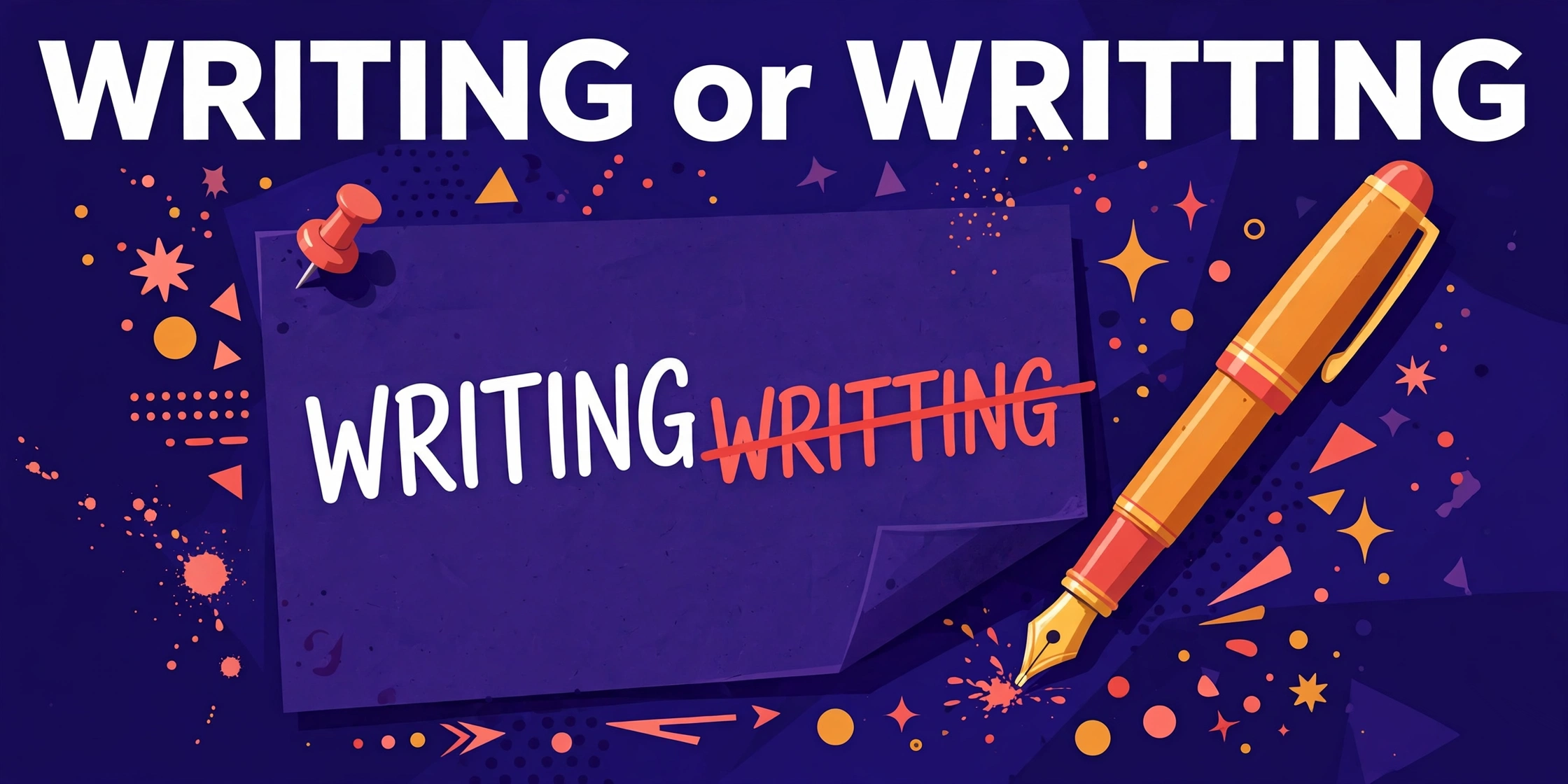
Writing or Writting: Which Spelling Is Correct?
Writing is the correct spelling. Writting, with two t’s, is a misspelling — one of the most common in English, and one that spellcheckers sometimes miss in names, headings, and handwritten notes. If you remember one thing from this guide, let it be this: write ends in a silent e, and verbs ending in a silent e drop the e before -ing without doubling the consonant. Write → writing. That is the whole rule, and it has no exceptions for this word.
That sounds simple, and it is — once you know why the double t feels so tempting. The past participle of write is written, spelled with two t’s. Your ear hears the double t in written, your hand has typed sitting, hitting, and fitting a thousand times, and writting slips out as if it belonged to the same family. It does not. This guide explains what writing means, the rule that settles the spelling, how to pronounce it, and how to use it correctly.
Quick Answer: Writing is correct; writting is a misspelling. Write ends in a silent e, so the e is dropped and -ing is added with no doubling: write → writing. Remember it this way: write has one t, and adding -ing never gives it a second one.
What Does “Writing” Mean?
Writing is the -ing form of the verb write, and it is also a noun in its own right. Cambridge Learner’s Dictionary defines the verb write as producing words, letters, or numbers on a surface using a pen or pencil, and as creating a book, story, article, or piece of music. Merriam-Webster gives the same core senses: to form characters or words by marking a surface, and to be the author of something. The verb forms are write — wrote — written.
As a noun, writing covers three related ideas: the activity itself, the work produced, and handwriting — as in “I can’t read your writing.” Context tells you which sense is meant.
- The activity: “She does her best writing early in the morning.”
- The work produced: “His writing on the history of the city won a prize.”
- Handwriting: “The note was in neat, careful writing.”
- The verb in progress: “I am writing to confirm our meeting.”
- A skill or subject: “The course covers academic writing and referencing.”
Note that last example: writing as a school subject or skill is a noun, not a verb form, but the spelling is the same. There is no context in standard English where the double-t spelling is the right choice for this word.
Why “Writting” Looks Right — and Isn’t
The misspelling has two causes, and both are understandable. The first is the doubling rule, which is real — it just does not apply here. The second is the word written, which really does have two t’s.
The doubling rule, and why it skips “write”
English doubles the final consonant before -ing when three conditions are all met: the verb has one syllable, it ends in a single vowel followed by a single consonant, and the stress falls on that syllable — the 1-1-1 rule, giving sit → sitting, run → running, and stop → stopping.
Write fails the second condition. It does not end in a vowel plus a consonant; it ends in a consonant (t) plus a silent e. Verbs ending in a silent e follow a different rule: drop the e, add -ing, and do not double anything. The pattern is consistent across the language:
| Verb | Ends in | -ing form | Doubled? |
|---|---|---|---|
| write | silent e | writing | No |
| make | silent e | making | No |
| take | silent e | taking | No |
| ride | silent e | riding | No |
| hope | silent e | hoping | No |
| sit | vowel + consonant | sitting | Yes |
| run | vowel + consonant | running | Yes |
| stop | vowel + consonant | stopping | Yes |
The silent e tells you the vowel before it is long: in write, the i is the long sound of right and kite. Dropping the e before -ing does not change that vowel, so nothing needs doubling to protect it — a logic that generalises to hundreds of verbs.
The “written” trap
The second cause of the error is the past participle written. It genuinely has two t’s, and it is a very frequent word — “I have written to them twice.” The double t in written exists because the vowel changed: the long i of write (/aɪ/) becomes the short i of written (/ɪ/, as in kit), and the doubled consonant marks that short vowel. No such vowel change happens in writing, where the i stays long, so no doubling is needed. The two forms look like they should match, and they do not — which is exactly why this pair catches so many writers.
How to Pronounce “Writing”
Writing is pronounced the same in British and American English: /ˈraɪtɪŋ/, with the stress on the first syllable — RY-ting. The w is pronounced, the i is the long vowel of right, and the t is a single, clear t sound. In American English the t between vowels is often softened towards a quick d-like sound in fast speech (“ry-ding”), but the spelling never changes to match that. The misspelling writting would, if pronounced by the rules, suggest a short vowel — WRIT-ting, rhyming with fitting — which is not how anyone says the word. Pronunciation is therefore a useful check: say the word slowly, hear the long i, and the single t follows.
“Writing” in Real Sentences
The word turns up in almost every kind of writing, from school essays to work emails. These examples show the main uses — the verb in progress, the noun for the activity, and the noun for the work itself:
- “She is writing her dissertation on the history of printing.”
- “I enjoy writing letters by hand, even though email is faster.”
- “His writing has improved a great deal this year.”
- “Creative writing classes meet on Tuesday evenings.”
- “Please put your request in writing so we have a record of it.”
Notice the fixed phrase “in writing”, meaning in written form rather than spoken: “I’d like that in writing.” It is a useful phrase for contracts, complaints, and any agreement you want recorded. It always uses writing, never the misspelling — and because it is a set phrase, getting it wrong there looks particularly careless.
Correct vs Incorrect
| Incorrect | Correct | Why |
|---|---|---|
| I enjoy writting stories. | I enjoy writing stories. | Silent-e verbs do not double the consonant. |
| Her writting is beautiful. | Her writing is beautiful. | Same rule; the noun is spelled the same way. |
| Creative writting class | Creative writing class | One t in write, one t in writing. |
| He is writting a novel. | He is writing a novel. | Drop the e, add -ing, nothing else. |
| Put it in writting, please. | Put it in writing, please. | The fixed phrase “in writing” keeps the same spelling. |
Common Mistakes to Avoid
1. Doubling the “t” because of “written”
This is the central error, and it comes from a real pattern misapplied. Written has two t’s because its vowel shortened; writing keeps the long vowel of write and needs only one. If you catch yourself typing the second t, ask which form you mean. If it is the -ing form, one t is right.
2. Writing “writeing” instead
A less common error keeps the e and adds -ing directly: writeing. This breaks the silent-e rule in the other direction. The e must go. Compare make → making and hope → hoping: the pattern is always drop the e first.
3. Confusing “writing” with “righting”
Righting is a real word — the -ing form of right, as in righting a capsized boat or righting a wrong. It sounds identical to writing in most accents, but it means putting something right, not putting words on paper. Spellcheckers will not flag it, because it is a correct word in its own right. Check the meaning, not just the sound: if no boat or wrong is being put right, you want writing.
4. Trusting spellcheck to catch “writting”
Most spellcheckers flag writting, but not in every context — headings in capitals and pasted text can slip through, and phone autocorrect sometimes learns a misspelling. The only reliable check is knowing the rule.
How to Remember the Spelling
Three memory aids, in order of usefulness. First, think of “write”: the word you start from has one t, and adding -ing adds no letters except -ing itself — the e drops out, so the letter count barely changes. Second, say it in syllables: writ-ing, two syllables, with the long i of right. If you hear right inside the word, you have the spelling right — and right has one t. Third, pair it with “written”: writing (one t, long vowel) versus written (two t’s, short vowel).
The same silent-e pattern explains other words that cause similar trouble. If you want to see the rule applied to a different word, Clarifyra’s guide to comprable or comparable shows how a root word keeps or loses its letters when a suffix is added.
FAQs
Is “writting” ever correct?
No, not as a form of the verb write. Cambridge and Merriam-Webster list writing as the -ing form of write, and neither lists writting as a standard form. You may occasionally see it as a surname or in unedited text online, but in standard written English it is always a misspelling.
Why does “written” have two t’s if “writing” has one?
Because the vowel changes. In write and writing the i is long (/aɪ/, as in right). In written it is short (/ɪ/, as in kit), and English doubles the following consonant to mark a short vowel before a suffix. The two spellings follow the same system; they just reflect different sounds.
What is the past tense of “write”?
Wrote is the past tense (“She wrote the letter yesterday”), and written is the past participle (“She has written three letters today”). Neither is spelled with the double t of writting in the wrong place — wrote has one t, written has two, and writing has one.
Is “writing” a verb or a noun?
Both. It is the present participle of the verb write (“She is writing”), and it is also a noun meaning the activity, the work produced, or handwriting (“Her writing is excellent”). The spelling is identical in every use.
The Takeaway
Writing is correct; writting is not. The rule is short enough to carry with you: verbs ending in a silent e drop the e and add -ing without doubling, so write becomes writing. The double t belongs to written, the past participle, where the vowel is short — and borrowing it into the -ing form is the mistake. Think of right inside write, hear the long vowel, and the spelling will look after itself. If you need to confirm the entry, see write in Cambridge Learner’s Dictionary or write in Merriam-Webster.



One Comment