Dilemna or Dilemma: Which Is Correct?
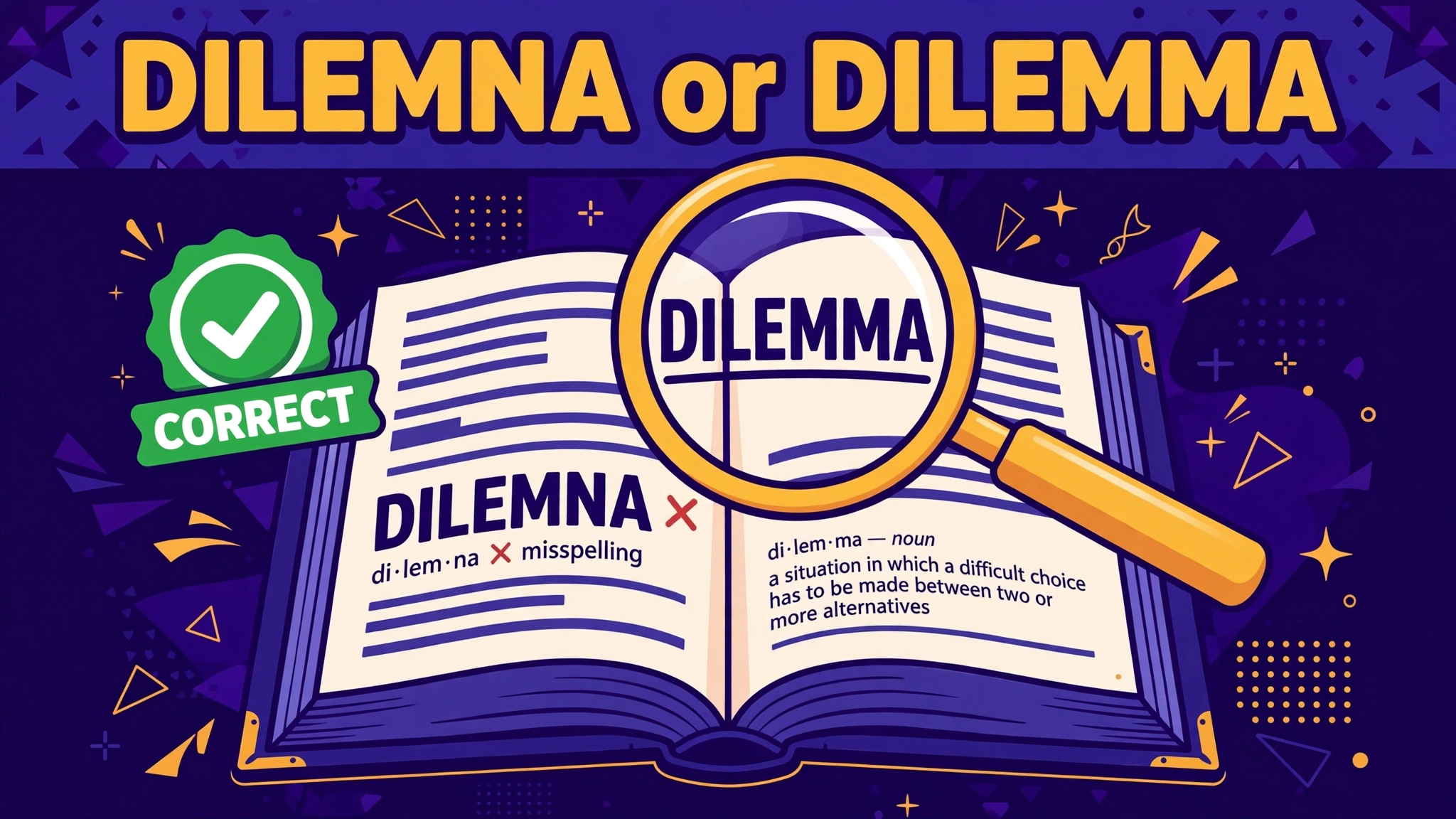
The correct spelling is dilemma, with a double m and no n. Dilemna — with the n slipped in before the m — does not appear as a headword in any of the major dictionaries checked for this article: Cambridge has no entry for it at all, and Oxford, Collins, and Merriam-Webster all file the word under dilemma. The phantom n is one of the commonest spelling slips in English, and it survives because it feels right — the word’s own Greek ancestor contains a double m, and English is full of silent-n words that train the hand to add one. This article sets out what dilemma means, why the n keeps appearing, and how to lock the correct spelling in.
Quick Answer
Write dilemma (d-i-l-e-m-m-a): a situation forcing a difficult choice between alternatives, as in a moral dilemma. Dilemna is a misspelling — no dictionary checked lists it as a word. Pronounce it /dɪˈlemə/ (also heard as /daɪˈlemə/ in both British and American English). The plural is dilemmas. Remember the double m from the word’s Greek root, di- (twice) + lēmma (premise): a choice built on two premises needs two m’s.
What dilemma actually means
Oxford Learner’s Dictionaries defines dilemma as “a situation that makes problems, often one in which you have to make a very difficult choice between things of equal importance,” giving moral dilemma and the perennial dilemma between work and family commitments as typical uses. Collins phrases it as “a difficult situation in which you have to choose between two or more alternatives.” Merriam-Webster lists it as “a usually undesirable or unpleasant choice” and, more broadly, “a situation involving such a choice” — and its usage note pushes back against purists who insist the two alternatives must be equally unpleasant, calling that concern “misplaced.” What is distressing about a dilemma, MW says, is simply “having to make a choice one does not want to make.”
That loosening matters for everyday writing. Strictly, the word began life as a term of logic — MW’s third sense is “an argument presenting two or more equally conclusive alternatives against an opponent,” and the first known English use (1523) was in that logical sense. But the dictionaries agree the broad sense is now fully established: any serious problem or difficult choice. Collins’s usage note does flag one boundary: some careful writers consider it incorrect to use dilemma for “a problem that seems incapable of a solution,” preferring predicament or quandary there. That is a style preference, not a rule every dictionary enforces — but it is worth knowing when you write for editors who care.
The word also carries one of English’s most durable idioms. Oxford records on the horns of a dilemma: “in a situation in which you have to make a choice between things that are equally unpleasant” — the dire economic situation had placed the prime minister on the horns of a dilemma. The image is of an animal caught on both points of a bull’s horns: whichever way you move, you are pierced.
Where the word comes from — and why the n feels plausible
The spelling dilemna is wrong, but it is not random. Oxford gives the word origin as early 16th century, “via Latin from Greek dilēmma, from di- ‘twice’ + lēmma ‘premise.'” Merriam-Webster traces the same path: Late Latin, from Late Greek dilēmmat-, dilēmma, a back-formation from dilēmmatos, “involving two assumptions.” The Greek original therefore has a double m (δίλημμα) and no n anywhere in it. So where does the n come from?
It comes from the rest of the English vocabulary. English is crowded with words where an n sits silently before another consonant: hymn, autumn, column, solemn, condemn, damn. A writer who has absorbed that pattern unconsciously — and who says dilemma quickly, with the stress on the second syllable — can easily “hear” a phantom n in the run-up to the double m. The slip is reinforced by genuine mn words such as mnemonic and amnesia, where the n is real. None of that makes dilemna legitimate; it makes it explicable, which is exactly why spellcheckers and proofreaders keep catching it in otherwise polished prose.
There is one more contributor: the ending. Words ending in -emma are rare in English (stemma, a term from textual criticism, is one of the few), so the eye has no familiar template for the ending and reaches for the more common -emna shape. But the correct ending is the Greek one: double m, then a.
Pronunciation: one spelling, one sound, two accepted vowels
Oxford gives dilemma as /dɪˈlemə/, with /daɪˈlemə/ also heard — the same pair in British and American English. Collins separates them slightly: British /dɪˈlɛmə/ (also /daɪ-/), American /dəˈlɛmə/ (also /daɪˈlɛmə/). In practice, three things hold everywhere:
- The stress falls on the second syllable: di-LEM-ma.
- The first vowel may be the short i of sit or the diphthong of my; both are standard, and neither changes the spelling.
- There is no n sound. If you pronounce an n — “di-LEM-na” — you are pronouncing the misspelling, and listeners will hear the error.
The pronunciation note matters because the misspelling often travels with a mispronunciation. Say it with the vowel of pen in the stressed syllable and no nasal before the m, and the spelling follows naturally: d-i-l, then the stressed e, then the double m you can feel in the prolonged nasal hum, then a.
Correct and incorrect, in sentences
- ✓ She faced a dilemma about whether to accept the offer or not. — Oxford’s own example; double m, no n.
- ✗ She faced a dilemna about whether to accept the offer. — no dictionary checked lists dilemna; the n is an intruder.
- ✓ The digital era brings new ethical dilemmas for journalists. — the plural adds a plain s: dilemmas.
- ✗ The digital era brings new ethical dilemna’s for journalists. — wrong on two counts: the n, and the apostrophe, which the plural never takes.
- ✓ He was faced with the dilemma of whether or not to return to his country. — Collins’s example; the classic “choice between alternatives” use.
- ✓ The minister is now in an impossible dilemma. — Oxford’s example; note an impossible dilemma, where an belongs to impossible, not to dilemma.
Common mistakes
Writing “dilemna” in formal prose. This is the signature error. Because dilemna is not in the dictionaries, spellcheckers set to “suggest” rather than “autocorrect” often wave it through or offer dilemma as a suggestion that a hurried writer ignores. Essays, cover letters, and published articles all show the slip; it reads as a spelling weakness out of proportion to its single letter.
Single m: “dilema.” The opposite slip — one m instead of two — is rarer but real. The Greek double m (δίλημμα) is the anchor: two premises, two m’s. Romance languages keep it too (French dilemme, Italian dilemma), which helps multilingual writers.
Forcing the “two equally bad options” rule. As Merriam-Webster’s usage note explains, some commentators insist dilemma should be restricted to choices between equally unsatisfactory alternatives — but “their concern is misplaced.” A dilemma between two good options (which university to attend, which job to take) is a perfectly standard use. Reserve your pedantry for the spelling.
Using “dilemma” where “predicament” fits better. Collins’s usage note flags this: if the situation is a problem with no good solution rather than a choice, predicament is the more precise word. Stuck in traffic with no way out is a predicament; choosing between the flight and the meeting is a dilemma.
A compact memory rule: dilemma contains di- (two) and a double m. Two m’s for two choices — and no room for an n between them.
FAQs
Is “dilemna” a word?
No — not in the dictionaries checked for this article. Cambridge has no entry for dilemna at all; Oxford, Collins, and Merriam-Webster file the word under dilemma only. Dilemna is a common misspelling, full stop.
Why do so many people spell it “dilemna”?
False analogy. English is full of silent-n words — hymn, autumn, column, solemn, condemn — and real mn words like mnemonic. The ear expects an n before the m, and the hand supplies one. The word’s own Greek root, di- + lēmma, has no n.
Is the spelling different in British and American English?
No. Dilemma is spelled identically in British and American English. The pronunciation varies slightly — /dɪˈlemə/ is commonest everywhere, with /daɪˈlemə/ also standard — but the spelling never changes.
What is the plural of “dilemma”?
Dilemmas — a plain -s, as Collins’s word forms confirm. Not dilemmae, and never with an apostrophe.
What does “on the horns of a dilemma” mean?
Oxford defines the idiom as being “in a situation in which you have to make a choice between things that are equally unpleasant” — impaled on both points, whichever way you turn.
Takeaway
There is only one word here, and it is dilemma: double m, no n, the difficult-choice noun that English took from Latin and Greek in the early 1500s. Dilemna survives purely on the momentum of silent-n words like hymn and column — a respectable explanation and an indefensible spelling. Hold the Greek in mind — di- (twice) plus lēmma (premise), two m’s for two premises — and the intruder n will never get past you again.