Emmaculate or Immaculate: Which Is Correct?
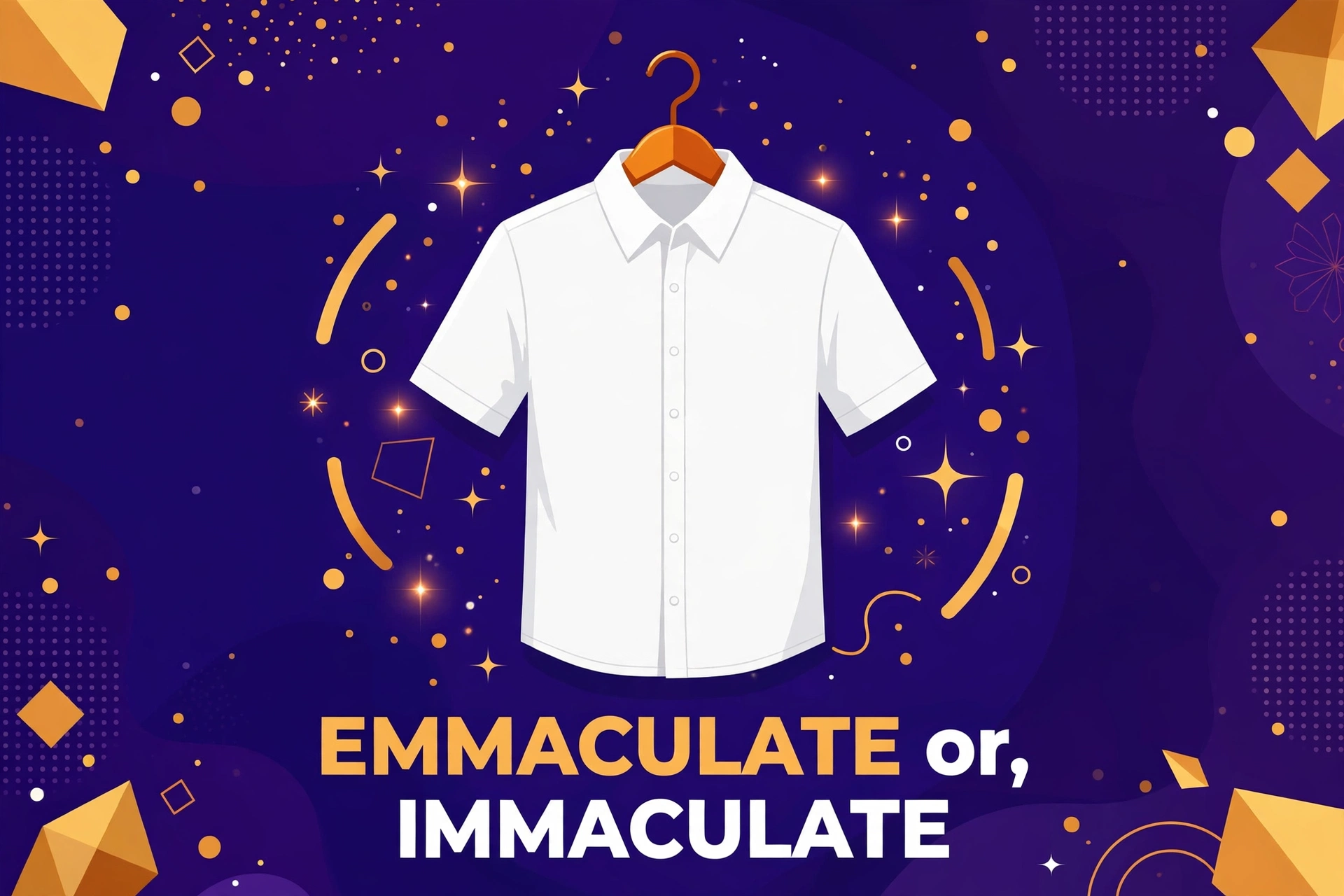
Immaculate is the correct spelling — the standard English word for perfectly clean, flawless, or pure. Emmaculate, spelled with emm- at the start, is not a standard word: it is a misspelling of immaculate, the kind that happens when a writer hears the word’s unstressed first syllable and guesses at its spelling. There is a genuine near-miss hiding behind the confusion — emaculate, with a single m, is an obsolete verb meaning to clear something of spots — but that is a different spelling, a different word, and not the word anyone means when they write emmaculate. If you mean spotless, flawless, or pure, the word is immaculate, with imm-.
Quick Answer
Always write immaculate (double m, i first): an immaculate kitchen; an immaculate record; immaculate timing. Do not write emmaculate (double m after e) — it has no dictionary entry and will be read as a typo. The single-m word emaculate is a real but obsolete verb (“to clear from spots”), not a spelling of immaculate, and it should not be used in modern writing except when discussing the word’s history.
What “immaculate” means
Merriam-Webster’s entry for immaculate gives four senses that show how far the word travels beyond cleaning. The first is “spotlessly clean” (“an immaculate kitchen, immaculate uniforms”). The second is “having or containing no flaw or error” (“an immaculate record of service,” “in immaculate detail”). The third is “having no stain or blemish: pure” (“an immaculate heart”). The fourth is a specialist sense used in botany and zoology: “having no colored spots or marks” (“petals immaculate”). The derived forms are immaculately (adverb) and immaculateness (noun).
What unites the senses is the idea of absence: no dirt, no flaw, no stain, no mark. That is also the key to the spelling, because immaculate is built from a negative prefix plus a root. It comes from Latin immaculatus, from in- (“not”) plus maculatus (“stained”), from macula, a spot. Merriam-Webster traces it to Middle English immaculat, first known use in the 15th century in the “pure” sense. The im- at the start is the negative prefix in its assimilated form: before a word beginning with m, Latin in- becomes im-, which is why the word has a double m — one from the prefix, one from the root macula. The double m is not decoration; it is the word’s construction showing.
The most famous fixed phrase is the Immaculate Conception, the Roman Catholic doctrine, decreed in 1854, that the Virgin Mary was conceived free from original sin — a theological use of “free from stain” that has nothing to do with housekeeping. In sport, an “immaculate inning” in baseball is one in which a pitcher strikes out all three batters on nine pitches — flawless in the second sense, no flaw or error.
Why “emmaculate” happens
Emmaculate is a listening error wearing a spelling error’s clothes. Say immaculate aloud: the first syllable is unstressed, the vowel reduces to a neutral uh sound, and the stress falls on the second syllable (im-MAK-yuh-lut). A writer spelling from sound alone hears something like “uh-MAK-yuh-lut” and has to guess the first vowel: i or e? English is full of words where that unstressed vowel is spelled e — embarrass, emigrate, embrace — and full of words where the em- prefix is genuine. So emmaculate feels plausible, and it even keeps the double m that the ear half-remembers from the real word. But plausibility is not correctness: the prefix in immaculate is the negative in-, assimilated to im- before m, and there is no em- version of this word.
It helps to compare the neighbours. Immense, immediate, immature, immobile — all follow the same pattern: in- plus a root beginning with m, giving a double m after i. Nobody writes “emmense” or “emmature,” because those words are learned early and seen often. Immaculate is rarer in everyday writing, so its spelling is less firmly fixed in memory, and the e guess gets its chance. The remedy is meaning-based: im- means “not” here — immaculate is literally “not spotted.”
One caution about how firmly to state this. Dictionaries record words, not every possible misspelling, so the evidence for “emmaculate is not a word” is the absence of an entry where one would expect it, combined with the positive evidence for immaculate as the headword in Merriam-Webster, Cambridge, and Collins. If a spelling were current, it would appear as a headword or a listed variant, as focussed appears beside focused. Emmaculate appears as neither, and spellcheckers flag it. For practical purposes, that settles it: emmaculate is a misspelling.
The near-miss: “emaculate” with one “m”
Here is the trap inside the trap. There is a real, historical word spelled emaculate — with one m, and an e at the start. It is an obsolete verb meaning “to clear from spots or stains, or from any imperfection,” recorded in older dictionaries (Webster’s 1913 edition gives exactly that definition) and built from Latin emaculare, from ex- (“out of”) plus maculare (“to spot”) — literally, to take the spots out of something. It is the active counterpart of immaculate‘s passive perfection: where immaculate describes a state (no spots), emaculate described an action (removing spots).
But three things disqualify it as a rescue for emmaculate. First, the spelling is different: emaculate has one m, emmaculate has two, and that single letter is the whole difference between a historical curiosity and a typo. Second, the word is obsolete: it has not been in live use for well over a century. Third, it is a verb, not an adjective — “to emaculate a text” cannot be swapped in for “an immaculate kitchen.”
And do not confuse either of them with emaciate, a third lookalike with a completely different meaning: to waste away, to become extremely thin, from Latin emaciare (to make lean). “The illness emaciated him” has nothing to do with spots, stains, or cleanliness. The cluster — immaculate, emaculate, emaciate — is a small minefield of similar spellings with unrelated meanings, and the only safe path through it is to spell each one exactly.
Pronunciation
Immaculate is pronounced UK /ɪˈmækjʊlət/ and US /ɪˈmæk.jʊ.lət/ (also /ᵻˈmæk.jə.lət/ in American English) — stress on the second syllable, the a of cat, the final vowel reduced. The i of the first syllable is the short, unstressed vowel that causes the whole emmaculate problem: in connected speech it is barely a vowel at all, which is why the ear cannot be trusted to spell it. The adjective has comparative and superlative forms with more and most (“more immaculate,” “most immaculate”) rather than suffixes — there is no “immaculater.” The adverb is immaculately: “she kept the house immaculately.”
Correct and incorrect, in sentences
| Sentence | Verdict | Why |
|---|---|---|
| Her kitchen was always immaculate. | ✓ Correct | Standard spelling, first sense: spotlessly clean. |
| He delivered an immaculate performance on stage. | ✓ Correct | Second sense: without flaw or error. |
| She kept an immaculate record of every payment. | ✓ Correct | Merriam-Webster’s own example sense: no flaw or error. |
| His reputation remained immaculate despite the scandal. | ✓ Correct | Third sense: pure, without blemish. |
| The hotel room was emmaculate when we arrived. | ✗ Wrong | Emmaculate (double m after e) is not a standard word; write immaculate. |
| She wore an imaculate white dress. | ✗ Wrong | Single m after i is also wrong: the prefix plus root gives double m — immaculate. |
| The editor tried to emaculate the manuscript. | ⚠ Obsolete only | Emaculate (one m) is a real historical verb, “to clear of spots,” but it is obsolete; do not use it in modern writing. |
| Months of illness had emaciated him. | ✓ Correct (different word) | Emaciate means to waste away — correct here, but unrelated to cleanliness. |
| Her emmaculate taste impressed everyone. | ✗ Wrong | Same error in a figurative use; the adjective is immaculate in every sense. |
Common mistakes
Writing “emmaculate” from sound. The signature error, and the reason this keyword exists. The unstressed first vowel invites an e, and the remembered double m survives the guess, producing a spelling that looks right and is not. The fix is meaning-based, not sound-based: im- = not, macula = spot, so immaculate = not-spotted. Remember the construction and the spelling follows.
Dropping a “m”: “imaculate.” The mirror error. Writers who know the word starts with i sometimes write it with a single m, by analogy with imagine or imitate. But those words have no m in their root; immaculate does, and the prefix adds another. Count the m‘s: two, always.
“Rescuing” the error with “emaculate.” Discovering the obsolete verb can tempt a writer into claiming emmaculate is “actually a word.” It is not — the historical word has one m, and even that form is obsolete. A near-miss in a dictionary is not a defence of a misspelling.
Confusing “emaciate” with the cluster. “Emaciated” describes wasting away, not cleanliness. The visual similarity of the words makes the slip easy in fast typing: immaculate (clean), emaculate (obsolete, remove spots), emaciate (waste away).
FAQs
Is “emmaculate” a word?
No, not in standard modern English. It has no entry as a headword or listed variant in the major dictionaries checked, and spellcheckers flag it. It is a misspelling of immaculate.
Why is “immaculate” spelled with two “m”s?
Because it is built from two parts that each contribute an m: the negative prefix in-, which becomes im- before a root beginning with m, plus maculatus (“stained”), from macula (a spot). Im- + maculate = immaculate, literally “not stained.”
What does “emaculate” mean?
With one m, emaculate is an obsolete verb meaning “to clear from spots or stains, or from any imperfection,” from Latin emaculare. It is recorded in older dictionaries such as Webster’s 1913 edition, but it is not in live modern use.
Is it “immaculate” or “Immaculate Conception”?
Both use the same word. The Immaculate Conception is the Catholic doctrine that Mary was conceived free from original sin — “immaculate” in its “pure, without stain” sense, capitalised as the name of the doctrine.
How do you pronounce “immaculate”?
UK /ɪˈmækjʊlət/, US /ɪˈmæk.jʊ.lət/ — im-MAK-yuh-lut, stress on the second syllable.
Takeaway
Immaculate is the word, in every sense and every register: spotlessly clean kitchens, flawless records, pure reputations, unspotted petals. Emmaculate is what happens when an unstressed vowel meets a guess — understandable, common, and wrong. The double m after i is not a quirk to memorise by rote; it is the word’s own history, the negative prefix im- meeting the root macula, a spot, to make “not spotted.” Remember that construction and the spelling takes care of itself.
Sources: Merriam-Webster defines immaculate as “spotlessly clean,” “having or containing no flaw or error,” “having no stain or blemish: pure,” and, in botany and zoology, “having no colored spots or marks,” tracing it to Latin immaculatus, from in- + maculatus (stained); the obsolete verb emaculate (“to clear from spots”) is recorded in Webster’s 1913 dictionary. Further reading: Merriam-Webster — immaculate.