Wack or Whack: What’s the Difference?
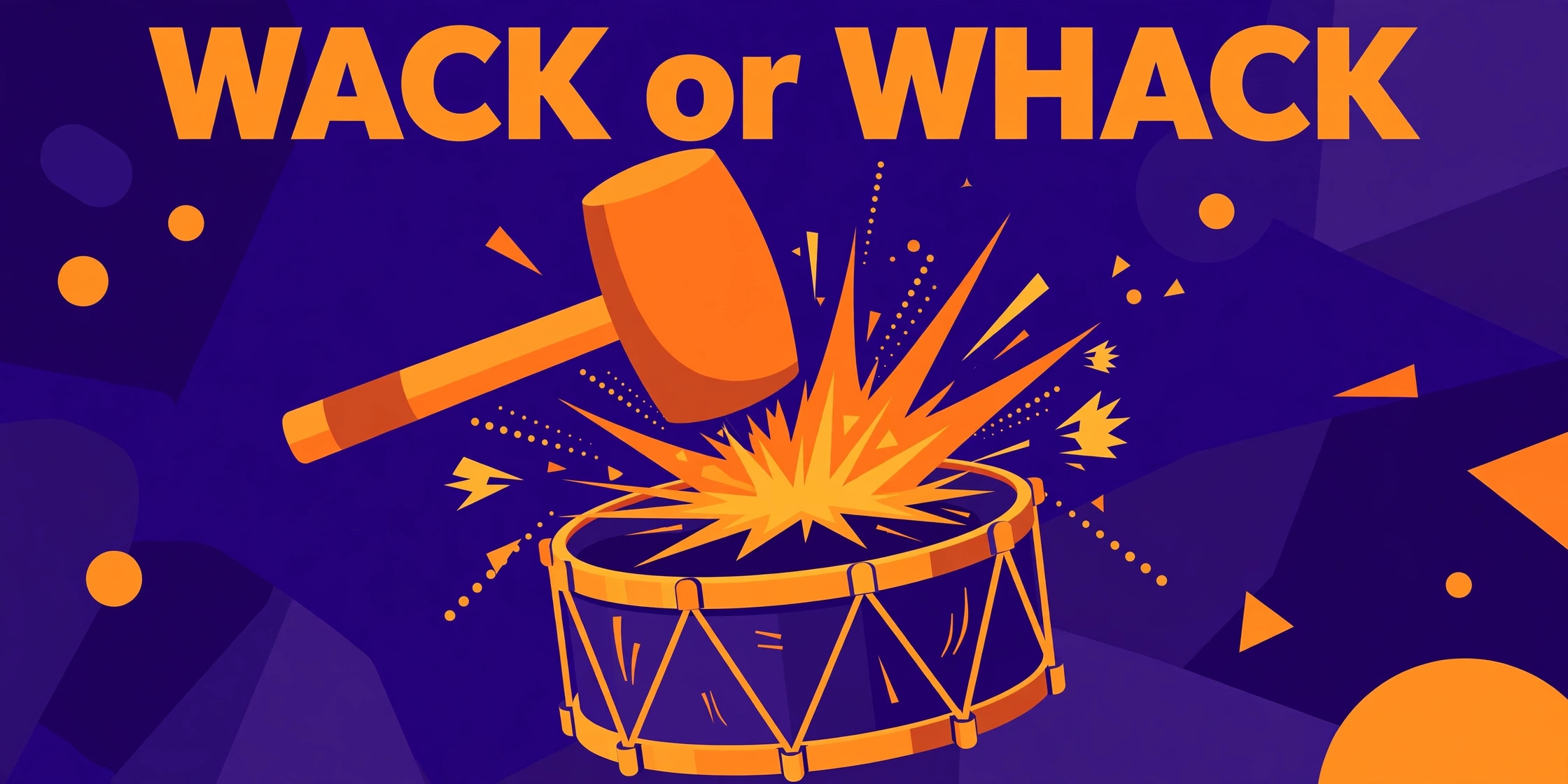
Wack or whack? The two words sound identical, but they are not two spellings of one word. They are different words entirely: whack, with an h, means to hit something hard, or the blow itself; wack, without the h, is slang for something bad, disappointing, or of poor quality. They differ in spelling, in meaning, and in part of speech — and swapping them changes what your sentence says.
Quick Answer
Use whack (with an h) when you mean a hit or the act of hitting: “She whacked the ball over the fence.” Use wack (no h) only as informal slang meaning bad or disappointing: “The film’s ending was wack.” Both are pronounced /wæk/. Whack is a standard verb and noun; wack is slang and does not belong in formal writing.
What Does Whack Mean?
Whack is a standard English word that works as both a verb and a noun. As a verb, Merriam-Webster defines it as “to strike with a smart or resounding blow” — to hit something hard and sharply. As a noun, it is the blow itself, or the sound the blow makes. It is an imitative word: it sounds like the noise it describes, and Merriam-Webster traces the verb to 1719 and the noun to 1737.
- Verb: “He whacked the nail with the hammer and bent it.”
- Verb: “She whacked the tennis ball across the net.”
- Noun: “The branch hit the roof with a loud whack.”
- Noun: “He gave the stuck drawer a whack and it finally opened.”
The ordinary verb forms are whacks, whacked, and whacking. The word also carries a chiefly British sense of defeating someone thoroughly (“we got whacked 5–0”), and in slang it can mean to murder someone (“the mob had him whacked”), though that sense belongs to crime fiction and film dialogue rather than everyday speech.
Phrases Built on Whack
Several common idioms depend on whack, and all of them use the h spelling:
- Take a whack at something — to have a try at it: “I’ve never fixed a tap before, but I’ll take a whack at it.” The phrase imagines having a swing at a problem, not hitting it literally.
- Out of whack — out of order, or not working properly: “The printer’s out of whack again.” Something that is out of whack is misaligned, like a machine that has been knocked off balance.
- Whack up — to divide something into shares, mostly in British informal use: “They whacked up the prize money between them.”
- Whac-a-Mole — the fairground game is a fixed name, spelled with one k; “wack-a-mole” and “whack-a-mole” are both common misspellings.
What Does Wack Mean?
Wack is a slang adjective meaning bad, stupid, unappealing, or not up to standard. It grew out of American hip-hop culture in the 1980s, probably as a shortened form of wacky, which means peculiar or odd. Merriam-Webster lists it, and Oxford records it too, so it is a real word — but it is labelled informal, and it belongs to casual speech and writing, not to formal English.
- “The new album is wack — every track sounds the same.”
- “That was a wack excuse, and nobody believed it.”
- “The party was wack, so we left early.”
Wack has an older sense as well: a wack can be a noun meaning an eccentric or crazy person, a sense that is older than the hip-hop adjective and is recorded as chiefly British. You will rarely meet it — “he’s a bit of a wack” is dated now — but it is worth knowing, because it shows the word did not appear from nowhere in the 1980s. What is new is the adjective sense, “bad or disappointing”, which is the sense almost everyone means today.
Note that wack is an adjective only in its slang sense. It is not a verb: you cannot “wack” something, and you cannot take “a wack” at a problem. Those belong to whack. And the spelling with an h is sometimes used for the slang sense too — “that’s whack” appears in print — but the dictionaries treat wack as the standard spelling for the slang adjective, and it is the clearer choice.
Wack vs Whack at a Glance
| Word | Part of speech | Meaning | Register | Example |
|---|---|---|---|---|
| wack | Adjective (also an older noun) | Bad, disappointing, of poor quality; or an eccentric person | Slang / informal | “The ending was wack.” |
| whack | Verb and noun | To hit hard; a hard blow; an attempt; a share | Standard English | “Whack the ball with the bat.” |
What the Dictionaries Say
Merriam-Webster’s entry for whack gives the verb as “to strike with a smart or resounding blow”, with the additional senses of cutting as if with a blow, defeating (chiefly British), and, in slang, murdering. The noun entry gives “a smart or resounding blow”, “the sound of or as if of such a blow”, and “an opportunity or attempt”, as in “take a whack at it”. Collins gives the same core senses for British and American English, with the pronunciation /wæk/ on both sides of the Atlantic.
Merriam-Webster also lists wack, as an adjective meaning not up to the mark, and notes that it is probably an alternate form of wacky. The spelling is worth a pause: some spellcheckers still flag wack, but that is the spellchecker lagging behind the dictionaries, not the word being wrong. The word has been in English for at least forty years in its slang sense, and longer in its older noun sense.
Pronunciation is the trap. Both words are pronounced /wæk/ in standard modern English. In most accents the wh in whack is pronounced exactly like the w in wack — the old distinction between /hw/ and /w/, still heard in parts of Scotland, Ireland, and the southern United States, has disappeared for most speakers. So the difference is entirely in the spelling, and it has to be learned by meaning, not by ear.
Why the Pair Causes Trouble
The confusion has three causes, and they stack. First, the words are homophones: they sound the same, so a writer working from sound alone has a fifty-fifty chance. Second, the spelling difference is a single silent letter, the kind of detail that is easy to miss and hard to remember. Third, the meanings are far apart — a hit and a judgement of quality have nothing in common — so a mix-up does not produce a sentence that is merely odd. It produces a sentence that says something else entirely.
“That’s whack” in a review of a restaurant means the food is bad. “That’s wack” means the same thing in slang, and the two spellings are sometimes used interchangeably for the slang sense — but “he wacked the ball” is simply wrong, and “the whack ending” is wrong too. The verb and the noun belong to whack; the slang adjective belongs to wack.
There is also a nearby word that adds to the muddle: thwack, a close cousin of whack meaning the same kind of sharp blow. If you mean a blow, either whack or thwack will do; wack never will.
How to Remember Which Is Which
The simplest hook is the letter h and the word hit. Whack contains an h, and it is a synonym of hit, which also begins with h. If your sentence is about hitting, the word you want has an h in it. Wack has no h, and it is the one that judges something as bad — think of it as the word that is missing something, just as the thing it describes is missing quality.
A second check is the part of speech. If the word in your sentence is a verb or a noun — something is being hit, or a blow is being described — it must be whack. If it is an adjective describing something as poor or disappointing, and you are writing casually, it is wack. If you are writing formally, neither slang sense belongs in the sentence at all: write “poor”, “disappointing”, or “unsatisfactory” instead.
Correct vs Incorrect
| Correct | Incorrect | Why |
|---|---|---|
| “He whacked the ball over the fence.” | “He wacked the ball over the fence.” | The verb “to hit” is always whack. |
| “The film was wack.” (informal) | “The film was whack.” | The slang adjective is spelled wack. |
| “Let me take a whack at it.” | “Let me take a wack at it.” | The idiom uses whack, a noun meaning an attempt. |
| “The whole system is out of whack.” | “The whole system is out of wack.” | The idiom is “out of whack”. |
| “The report was disappointing.” (formal) | “The report was wack.” (formal) | Slang does not belong in formal writing. |
Common Mistakes
The most frequent mistake is using wack as a verb. “He wacked me on the arm” is wrong in any register — the verb is whack, and the sentence needs its h. The reverse mistake, using whack for the slang adjective, is common online and usually understood, but it is not the dictionary spelling, and in edited writing it will be corrected.
Another mistake is trusting the spellchecker. Some spellcheckers flag wack and suggest whack, because the slang word entered the dictionaries later than the standard one. Accepting that suggestion silently turns a slang adjective into a verb, and the sentence stops making sense. If you mean “bad”, keep wack — or, in formal writing, replace it with a standard word.
Finally, watch the idioms. “Out of whack” and “take a whack at” are fixed phrases, and their spelling is fixed with them. Writing “out of wack” is the kind of error that looks small and reads as careless, because the phrase is so familiar that the wrong spelling stands out.
Frequently Asked Questions
Is it wack or whack?
It depends on the meaning. Whack (with an h) is the standard verb and noun for a hard hit or blow. Wack (no h) is slang for bad or disappointing. They are pronounced the same, /wæk/, but they are different words.
Is wack a real word?
Yes. Wack is listed in Merriam-Webster and Oxford as an informal adjective meaning bad or of poor quality, with an older noun sense meaning an eccentric person. It is slang, so it suits casual writing and speech, not formal writing.
What does “out of whack” mean?
It means out of order or not working properly — misaligned, broken, or malfunctioning. “The heating’s out of whack” means the heating is not working as it should. The phrase always uses whack, never wack.
What does “take a whack at it” mean?
It means to have a try at something: “I’ve never done this before, but I’ll take a whack at it.” It comes from the idea of taking a swing at something, and it always uses the whack spelling.
Is it whack-a-mole or wack-a-mole?
The game is called Whac-a-Mole, with one k and no c after the a. “Whack-a-mole” and “wack-a-mole” are both common misspellings of the trademarked name.
Takeaway
Whack and wack sound alike and look alike, but they do different jobs. Whack, with its h, is the standard word for hitting — a verb and a noun, at home in any register, and the word behind “out of whack” and “take a whack at it”. Wack, without the h, is slang for bad or disappointing, and it belongs only in casual writing. Remember the hook: whack has an h like hit, and if your sentence is about hitting, the h stays in.
Sources: Merriam-Webster, “whack” — merriam-webster.com/dictionary/whack.