Writing & Grammar
Syphon or Siphon: Which Spelling Is Correct?
Both syphon and siphon turn up in English writing, and they point at the same thing — the bent tube that…
Read MoreThe Writing & Grammar section of Clarifyra helps readers improve grammar, vocabulary, sentence structure, and word choice. Here, you can explore clearer alternatives to common phrases, useful transition words, academic expressions, and practical grammar guidance for essays, articles, reports, and everyday writing.
Our guides focus on more than just correctness. They explain differences in tone, formality, meaning, and context so you can choose wording that sounds natural and fits the situation. Whether you want to avoid repetition, strengthen a sentence, or understand a grammar point more clearly, this section is designed to make better writing easier.
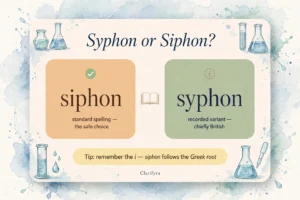
Both syphon and siphon turn up in English writing, and they point at the same thing — the bent tube that…
Read More →
If you’ve ever hesitated between cafe and café, here’s the short answer: both are correct. Every major dictionary checked for this…
Read More →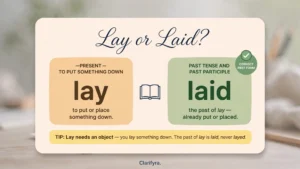
Here’s the short answer to “lay or laid”: laid is the past tense (and past participle) of the verb lay —…
Read More →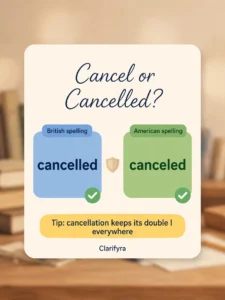
If you’re torn between cancel and cancelled, the reassurance is that both are real words — they’re just different forms of…
Read More →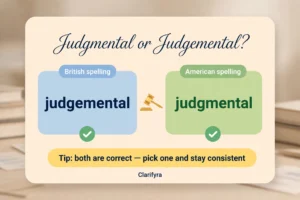
If you’ve typed “judgmental” and then stared at it, wondering whether the missing e is a mistake, you’re in good company…
Read More →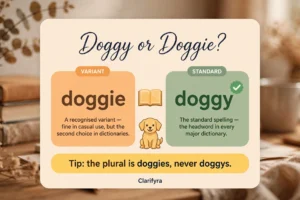
If you’ve ever typed the word for a small, cute dog and paused mid-keystroke — doggy or doggie? — you’re not…
Read More →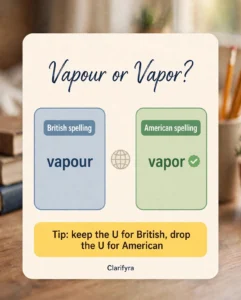
Both are correct — the difference is regional, not a matter of right and wrong. Vapour (with the u) is the…
Read More →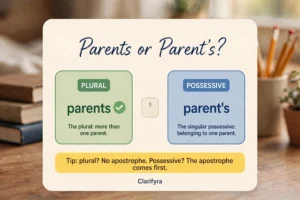
Parents is the plural of parent — more than one mother or father. Parent’s is the singular possessive — something belonging…
Read More →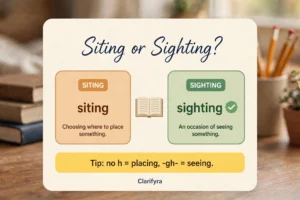
Siting is about placing things: choosing where something goes. Sighting is about seeing things: an occasion when something or someone is…
Read More →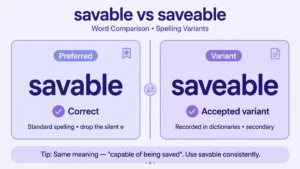
Savable is the standard spelling. It means “capable of being saved,” and it is the form Merriam-Webster uses as its headword…
Read More →