Another Way to Say “Sorry for Your Loss”: 40+ Thoughtful Alternatives
Finding the right words after someone dies can be difficult. “I’m sorry for your loss” is respectful and widely understood, but sometimes you may want something warmer, more personal, or more appropriate for a professional setting. If you’re looking for another way to say sorry for your loss, the best choice depends on your relationship with the grieving person and how well you knew the person who died.
Some condolences are simple and formal, while others express closeness, comfort, or practical support. The goal isn’t to find a clever replacement. It’s to say something sincere that acknowledges the person’s grief without trying to explain or minimize it.
Thoughtful Alternatives to “Sorry for Your Loss”
Not every condolence phrase communicates exactly the same thing. Some are appropriate for almost anyone, while others are better for close friends, relatives, colleagues, or formal messages.
| Alternative | Tone | Best Used For |
|---|---|---|
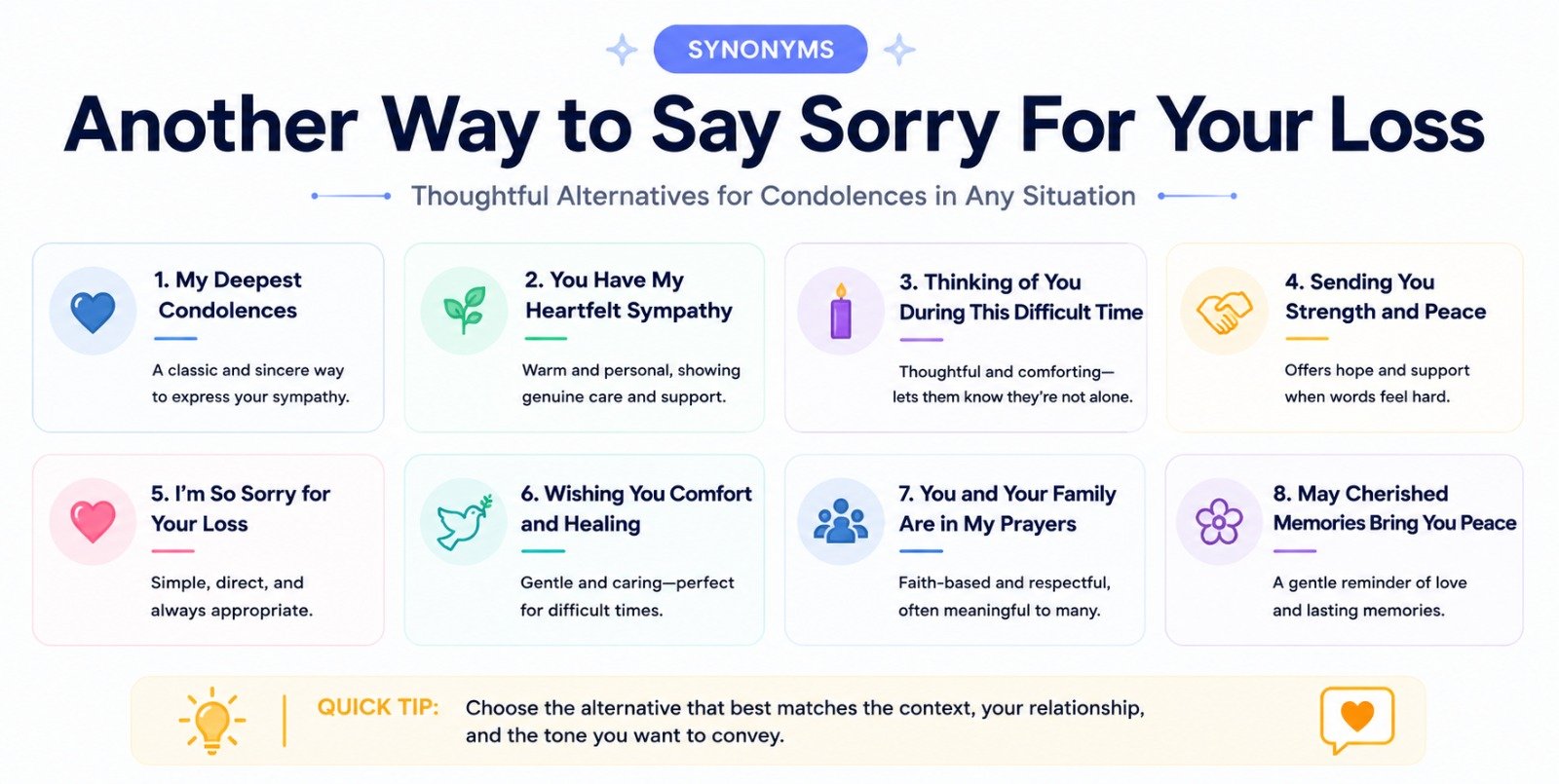
| My deepest condolences. | Formal, respectful | Coworkers, acquaintances, sympathy cards |
| Please accept my sincere condolences. | Very formal | Professional emails, clients, managers |
| My heart goes out to you. | Warm, compassionate | Friends and family |
| I’m thinking of you. | Gentle, simple | Texts, cards, personal messages |
| You and your family are in my thoughts. | Supportive | Family bereavement |
| Wishing you comfort and strength. | Caring | Cards, texts, workplace messages |
| Sending you love during this difficult time. | Personal | Close friends and relatives |
| I was deeply saddened to hear about your loss. | Sincere, formal | Professional or personal messages |
| I’m here for you. | Personal, supportive | Close relationships |
| Sending my heartfelt sympathy. | Formal, warm | Cards and written condolences |
| Wishing you peace in the days ahead. | Gentle | Sympathy cards |
| Holding you in my thoughts. | Warm | Friends and relatives |
| Thinking of you and remembering [Name]. | Personal | When you knew the deceased |
| [Name] will be deeply missed. | Personal, sincere | When you knew the person well |
| There are no words, but I’m thinking of you. | Emotional | Sudden or especially difficult losses |
The most natural choice is usually the one that sounds like something you would genuinely say. A formal expression can feel distant between close friends, while an intimate message such as “sending you love” may be too personal for a client or casual coworker.
Is “Sorry for Your Loss” Still Appropriate?
Yes. There is nothing inherently wrong with saying “I’m sorry for your loss.” In this context, “sorry” expresses sympathy rather than an admission that you caused something.
The phrase is especially useful when you don’t know what else to say, when you’re speaking to someone you don’t know closely, or when you need a short and respectful condolence.
The main limitation is that it can sound somewhat standard. If you know the grieving person well, adding a personal sentence can make it feel more meaningful.
For example:
Simple:
“I’m so sorry for your loss.”
More personal:
“I’m so sorry for your loss. Your dad was always so kind to me, and I’ll remember him fondly.”
The second message doesn’t replace the original phrase so much as make it personal.
Warm and Heartfelt Ways to Express Sympathy
When the grieving person is a friend, relative, or someone you know well, warmer wording often feels more natural.
Other Ways to Say “Sorry for Your Loss” to a Friend
With a close friend, you usually don’t need highly formal language. A simple acknowledgment of their pain combined with genuine support can be enough.
My heart goes out to you.
This is warm and compassionate without trying to explain what the person should feel.
Example:
“My heart goes out to you. I’m thinking about you and your family.”
I’m here for you.
This works best when you genuinely intend to remain available.
Example:
“I’m here for you, whether you want to talk or just need some company.”
Sending you so much love.
A natural choice for close friends and relatives.
Example:
“Sending you so much love during this incredibly difficult time.”
I’ve been thinking about you.
This can be particularly useful in the days or weeks after the funeral, when support often becomes quieter.
Example:
“I’ve been thinking about you today and wanted you to know I’m here.”
Other Ways to Say “Sorry for Your Loss” to Family
Messages to family members can usually be more intimate because the loss may affect both of you.
You could say:
- “We’ll miss him more than words can say.”
- “I’m holding you close in my thoughts.”
- “I’m so grateful for all the memories we shared with her.”
- “We’ll get through the difficult days together.”
- “I’m always here when you need me.”
- “Her love will always be part of our family.”
When you share the loss yourself, it can also be natural to acknowledge that shared grief.
Example:
“I still can’t believe she’s gone. I’m grateful we have so many wonderful memories of her.”
What’s a Nice Way to Say “Sorry for Your Loss”?
A nice way to express sympathy is usually gentle rather than elaborate. Grieving people rarely need perfect words. They need acknowledgment, kindness, and space to feel whatever they are feeling.
Other Ways to Say “Sorry for Your Loss” With Comfort
These phrases work when you want to express warmth without becoming overly personal:
- “Wishing you comfort during this difficult time.”
- “Keeping you close in my thoughts.”
- “Sending you strength for the days ahead.”
- “May you find comfort in the memories you shared.”
- “Thinking of you and your family.”
- “Wishing you peace and comfort.”
- “Holding you in my thoughts today.”
- “Sending my heartfelt sympathy.”
Be careful with phrases that assume how someone will cope. “May your memories bring you comfort” can be kind, but a person in very recent grief may not feel comforted by memories yet. It’s often better to offer the thought gently rather than present it as something they should feel.
Professional Ways to Say “Sorry for Your Loss”
Condolences at work should usually be sincere, respectful, and concise. You don’t need to sound emotionally distant, but highly intimate language may not be appropriate unless you have a close personal relationship.
Other Ways to Say “Sorry for Your Loss” Professionally
Please accept my sincere condolences.
A polished choice for clients, senior colleagues, managers, or formal correspondence.
Example:
“Please accept my sincere condolences to you and your family.”
I was saddened to hear of your loss.
This acknowledges the news directly while maintaining a professional tone.
Example:
“I was saddened to hear of your mother’s passing. My thoughts are with you and your family.”
My thoughts are with you during this difficult time.
Professional without sounding cold.
Example:
“My thoughts are with you and your family during this difficult time.”
Wishing you comfort and strength.
Short enough for a card, workplace chat, or email.
Example:
“Wishing you comfort and strength in the days ahead.”
Please know that we’re thinking of you.
Useful when writing on behalf of a team.
Example:
“Please know that everyone on the team is thinking of you and your family.”
For workplace condolences, avoid making the message unnecessarily long. A few sincere sentences usually communicate more than a lengthy attempt to find the perfect words.
How to Say It in a Condolence Text
Text messages are often more conversational than sympathy cards or emails. They can also be useful because they let the grieving person read and respond when they feel able.
Other Ways to Say “Sorry for Your Loss” in a Text Message
Try short messages such as:
- “Thinking of you today. No need to reply.”
- “Sending you love and strength.”
- “I’m so sorry. I’m here whenever you need me.”
- “Keeping you and your family in my thoughts.”
- “I heard about your dad. I’m thinking of you.”
- “Sending you a big hug and lots of love.”
- “I don’t have the right words, but I’m here.”
- “Thinking of you and remembering Sarah today.”
Adding “No need to reply” can be thoughtful because grieving people may receive many messages and feel pressure to answer them.
What to Write in a Sympathy Card
A sympathy card allows slightly more room than a text, but it still doesn’t need to become a long speech.
A simple structure works well:
- Acknowledge the loss.
- Express sympathy.
- Mention a positive memory if appropriate.
- Offer support or close warmly.
For example:
“Thinking of you and your family during this difficult time. David was such a kind and generous person, and I’ll always remember his wonderful sense of humor. Wishing you comfort and peace in the days ahead.”
Another option:
“I was deeply saddened to hear about your mother. She always made everyone around her feel welcome. Please know that you’re in my thoughts.”
Specific memories can make a sympathy message especially meaningful when you genuinely knew the person who died.
A Better Way to Say “Sorry for Your Loss” Is Often More Personal
Sometimes the best way to say sorry for your loss isn’t to find a different synonym. It’s to personalize the message.
Compare these:
Generic:
“My condolences.”
Personal:
“My condolences. I’ll always remember how your grandfather could make everyone laugh.”
Or:
Generic:
“I’m sorry for your loss.”
Personal:
“I’m so sorry about Emma. She was always incredibly kind to me, and I’ll never forget that.”
Mentioning the deceased by name can make the message feel more human. It acknowledges that a specific person mattered and is remembered.
You shouldn’t invent memories or force personal details, though. If you never met the person who died, a sincere general expression of sympathy is more appropriate.
Offer Support Without Making the Person Ask
Condolence messages often end with:
“Let me know if you need anything.”
There’s nothing wrong with that, but grieving people may not know what they need or may not feel comfortable asking.
If you’re close enough to help, a specific offer can be easier to accept.
For example:
- “I can bring dinner over on Thursday if that would help.”
- “I’m going to the grocery store tomorrow. Can I pick anything up for you?”
- “I can take the kids to school this week if you need some time.”
- “I’m free Saturday if you’d like some company.”
- “I can help with calls or errands if you’d like.”
Only offer something you can realistically do.
Condolence Phrases That Aren’t Interchangeable
A different way to say sorry for your loss isn’t automatically suitable in every situation.
For example:
“My deepest condolences” is respectful but can sound formal between very close friends.
“I’m here for you” communicates ongoing support, so it works best when you have a relationship where that support is realistic.
“Sending you love” sounds natural with friends and family but could feel too intimate in a formal business relationship.
“Thinking of you” is gentle and versatile, although on its own it doesn’t explicitly acknowledge the death.
“[Name] will be deeply missed” works when you knew the deceased or are speaking on behalf of people who did. It would sound less natural if you never met them.
The right condolence depends as much on your relationship as it does on the words themselves.
What Not to Say to Someone Who Is Grieving
Good intentions don’t always lead to helpful wording. Some statements can unintentionally minimize a loss or tell someone how they should feel.
It is usually safer to avoid phrases such as:
- “Everything happens for a reason.”
- “At least they lived a long life.”
- “They’re in a better place.”
- “You need to stay strong.”
- “I know exactly how you feel.”
- “At least they’re no longer suffering.”
- “You’ll get over it eventually.”
- “It was probably for the best.”
Some of these statements may be comforting within particular religious or personal beliefs, but don’t assume those beliefs unless you know the person shares them.
Likewise, avoid immediately turning the conversation toward your own experiences. Saying “I know exactly how you feel because I lost my…” can unintentionally shift attention away from the person you’re trying to support.
Simple acknowledgment is usually safer:
“I’m so sorry. I can only imagine how difficult this is.”
How to Choose the Right Condolence
Before sending your message, consider three things: relationship, tone, and timing.
For someone you barely know, keep it simple:
“My sincere condolences to you and your family.”
For a coworker:
“I’m very sorry to hear about your loss. Thinking of you during this difficult time.”
For a close friend:
“My heart goes out to you. I’m here whenever you need me.”
For someone whose loved one you knew:
“I was so saddened to hear about James. I’ll always remember his kindness.”
For a quick text:
“Thinking of you today. No need to reply.”
For a sympathy card:
“Wishing you comfort, strength, and peace in the days ahead.”
There is no single perfect condolence. The most meaningful messages tend to be sincere, uncomplicated, and appropriate for the relationship.
Frequently Asked Questions
What’s another way to say “sorry for your loss”?
You can say “My deepest condolences,” “My heart goes out to you,” “I’m thinking of you during this difficult time,” “Wishing you comfort and strength,” or “Sending my heartfelt sympathy.” Choose wording that matches how well you know the person.
What is the best way to say “sorry for your loss”?
The best wording is usually simple and sincere. “I’m so sorry for your loss. I’m thinking of you” works in many situations. If you knew the person who died, adding their name or a genuine memory can make your message more personal.
What is a professional way to say “sorry for your loss”?
For a colleague, manager, employee, or client, try: “Please accept my sincere condolences,” “I was saddened to hear of your loss,” or “My thoughts are with you and your family during this difficult time.”
What is a nice way to say “sorry for your loss”?
A warm option is “My heart goes out to you and your family.” You could also say “Wishing you comfort and strength” or “Keeping you close in my thoughts.”
Is saying “sorry for your loss” appropriate?
Yes. “I’m sorry for your loss” is a respectful and commonly understood expression of sympathy. You don’t need to avoid it. Adding a personal thought can make it warmer when you know the grieving person well.
What can I say when “sorry for your loss” doesn’t feel like enough?
You don’t necessarily need a more elaborate phrase. Add something genuine, such as “I’m here for you,” “I’ll always remember her kindness,” or a specific offer of help. Personal sincerity is usually more meaningful than complicated wording.
How do you comfort someone who has lost a loved one over text?
Keep the message brief and pressure-free. For example: “I’m thinking of you and your family. No need to reply. I’m here if you need anything.” If you’re close to them, you can also offer specific practical help.
Final Thoughts
There are many thoughtful alternatives when you want another way to say sorry for your loss, but the most polished phrase isn’t always the most comforting one. A professional contact may appreciate “Please accept my sincere condolences,” while a close friend may find “I’m here for you” or “My heart goes out to you” more natural.
Focus on acknowledging the loss, matching your words to the relationship, and avoiding language that minimizes grief or tells someone how they should feel. When emotions are difficult to put into words, Clarifyra can help you understand the small differences in tone so you can choose an expression that feels respectful, sincere, and right for the moment.
You May Also Read | 45+ Other Ways to Say “Sorry” for Every Situation