Another Way to Say “As a Result”: 25 Natural Alternatives for Better Writing
“As a result” is a useful phrase when you want to show that one event caused another. It works well in essays, reports, emails, and everyday writing, but repeating it too often can make your sentences sound predictable.
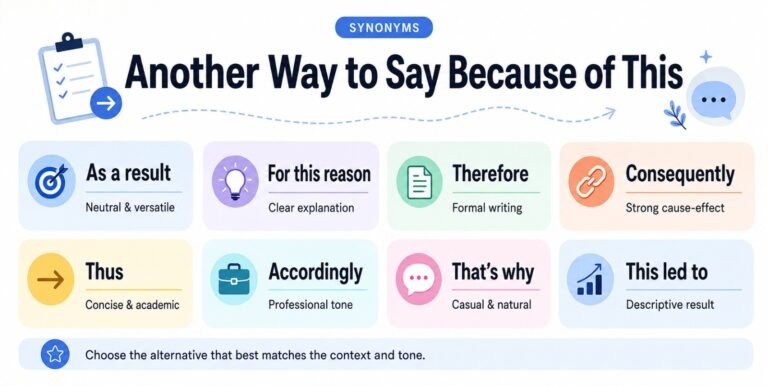
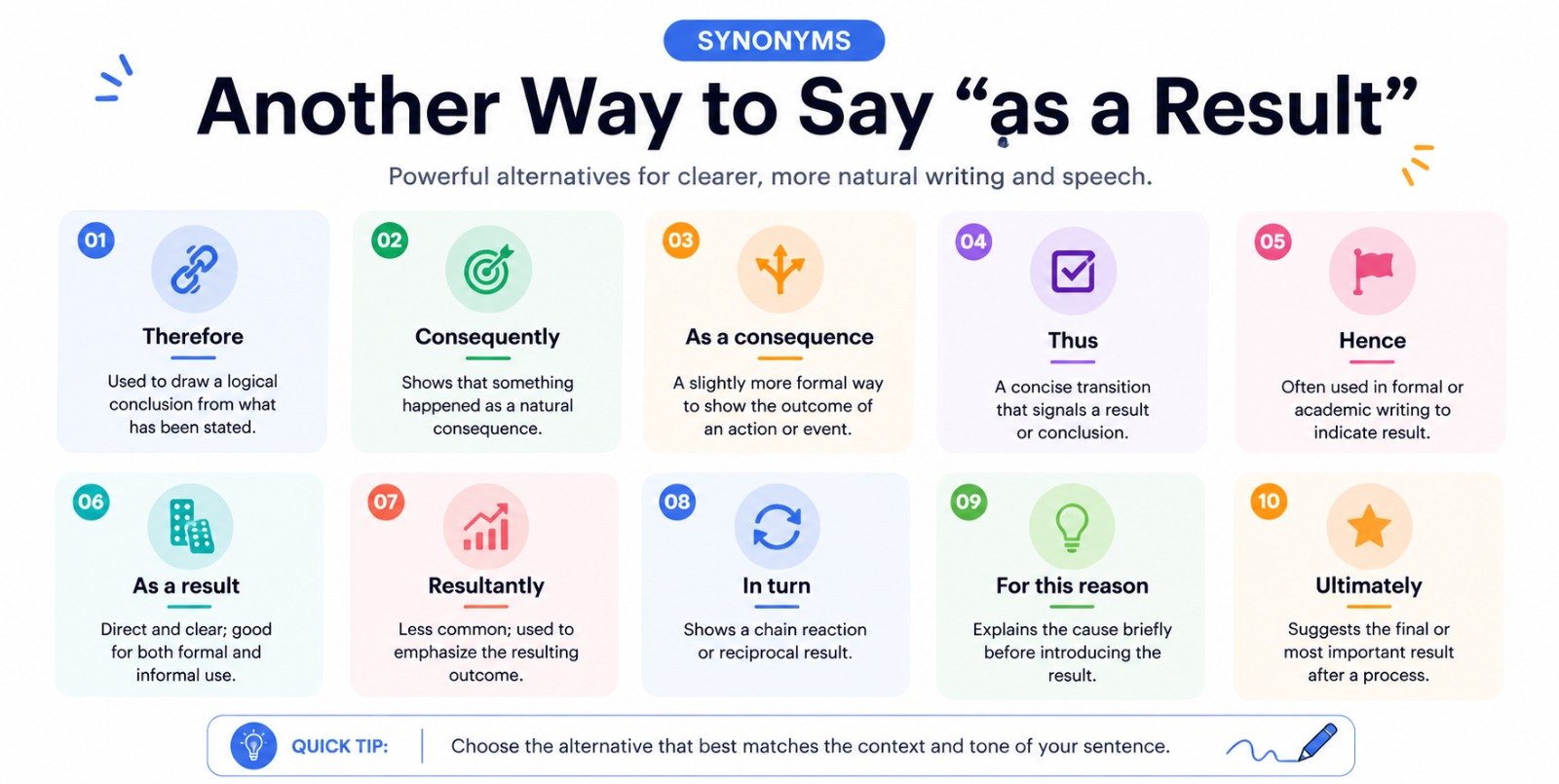
If you need another way to say “as a result,” strong choices include therefore, consequently, thus, for this reason, because of this, accordingly, as a consequence, so, and this led to. The best option depends on whether you’re writing formally, academically, professionally, or conversationally.
What Does “As a Result” Mean?
“As a result” introduces an effect or consequence caused by something mentioned earlier.
For example:
The roads were covered in ice. As a result, several schools closed.
The icy roads are the cause, while the school closures are the result.
The phrase is especially useful when you want to make the relationship between two ideas clear. Dictionaries define a result as something caused or produced by something else, which explains why “as a result” naturally connects a cause with its consequence.
“As a result of” works a little differently:
Several schools closed as a result of the icy roads.
Here, “as a result of” introduces the cause rather than starting a separate statement about the effect. Cambridge similarly defines “as a result of something” as meaning “because of something.”
That grammatical difference matters when choosing an alternative.
Best Alternatives to “As a Result” at a Glance
| Alternative | Tone | Best Used For | What It Emphasizes |
|---|---|---|---|
| Therefore | Formal/neutral | Essays, reports, arguments | Logical conclusion |
| Consequently | Formal | Academic and professional writing | Consequence |
| Thus | Formal | Essays and concise explanations | Logical result |
| Hence | Formal | Analytical writing | Reason or conclusion |
| Accordingly | Formal | Business and professional writing | Appropriate response |
| For this reason | Neutral/formal | Essays and explanations | Clear reason |
| Because of this | Neutral | General writing | Direct cause |
| As a consequence | Formal | Reports and essays | Resulting consequence |
| In turn | Neutral | Chains of cause and effect | Secondary result |
| So | Casual/neutral | Conversation and informal writing | Simple result |
| That’s why | Casual | Speech and messages | Everyday explanation |
| This led to | Neutral | Reports, essays, storytelling | Development over time |
| This resulted in | Neutral/formal | Reports and analysis | Direct outcome |
| Thereby | Formal | Academic and technical writing | Result created by an action |
| In response | Neutral/formal | Business and reporting | Reaction to an event |
These expressions overlap, but they aren’t interchangeable in every sentence. Some introduce a conclusion, some describe a consequence, and others work only when a particular action produces a result.
Formal and Professional Ways to Say “As a Result”
When you’re writing a report, formal email, business document, or analysis, it helps to choose wording that clearly shows cause and effect without sounding conversational.
Other Ways to Say “As a Result” Formally
The strongest formal alternatives are:
- Therefore
- Consequently
- Thus
- Hence
- Accordingly
- As a consequence
- For this reason
- In consequence
- Thereby
- It follows that
Here are the distinctions that matter most.
1. Therefore
Therefore is one of the safest alternatives when the second statement follows logically from the first.
Example:
“The equipment failed the safety inspection. Therefore, it was removed from service.”
It works particularly well in arguments, reports, and explanatory writing.
However, “therefore” can sound more logical or deductive than “as a result.”
Compare:
The evidence is unreliable. Therefore, we cannot accept the conclusion.
Here, the writer is drawing a conclusion rather than simply reporting what happened next.
2. Consequently
Consequently strongly emphasizes that something happened because of an earlier event.
Example:
“The supplier missed several deadlines. Consequently, production was delayed.”
It’s one of the closest formal alternatives to “as a result” and sounds natural in academic, professional, and analytical writing.
3. Thus
Thus is concise and formal.
Example:
“Several responses were incomplete. Thus, they were excluded from the final analysis.”
It works well when space and clarity matter, although it can sound more formal in ordinary conversation.
4. Hence
Hence can introduce a conclusion or consequence.
Example:
“Operating costs have risen sharply, hence the need for a revised budget.”
It is useful in academic and analytical writing, but it’s less common in casual speech.
5. Accordingly
Accordingly often means that someone acted in a way that was appropriate given the earlier information.
Example:
“Customer demand shifted toward online services. Accordingly, the company increased its digital investment.”
This makes it especially useful in business writing.
It isn’t always a perfect replacement for “as a result.” If you’re simply describing an accidental consequence, “consequently” may be more accurate.
6. As a Consequence
As a consequence is very close to “as a result” and emphasizes the outcome of an earlier situation.
Example:
“The area experienced months of low rainfall. As a consequence, water restrictions were introduced.”
Because the wording is already close to “as a result,” this alternative is useful when you want variety without changing the sentence’s meaning significantly.
7. For This Reason
For this reason explicitly connects a decision or consequence to what was just explained.
Example:
“The available evidence is limited. For this reason, the findings should be interpreted cautiously.”
It is clear enough for general readers while still fitting formal writing.
8. Thereby
Thereby works differently from most alternatives because it is usually incorporated into the same sentence.
Example:
“The company simplified the checkout process, thereby reducing the time required to place an order.”
It means roughly “by doing that” and works best when an action directly produces an outcome.
Don’t simply replace:
“As a result, sales increased.”
with:
“Thereby, sales increased.”
That would sound unnatural.
Another Way to Say “As a Result” in an Essay
In an essay, variety can make transitions smoother, but clarity matters more than using complicated vocabulary.
The best choice depends on whether you’re describing an observed consequence or drawing a logical conclusion.
Other Ways to Say “As a Result” in an Essay
Useful academic alternatives include:
- Consequently
- Therefore
- Thus
- Hence
- For this reason
- As a consequence
- Accordingly
- Thereby
- It follows that
- This resulted in
- This contributed to
- This led to
Consider this repetitive paragraph:
The population grew rapidly. As a result, demand for housing increased. As a result, property prices rose.
A smoother version would be:
The population grew rapidly. Consequently, demand for housing increased, which in turn contributed to higher property prices.
The second version doesn’t merely replace words. It improves the relationship between the ideas.
Use “Consequently” for a Clear Consequence
Example:
“The policy increased the cost of imported goods. Consequently, consumers began seeking cheaper alternatives.”
This works when the second development is presented as a consequence of the first.
Use “Therefore” for a Logical Conclusion
Example:
“The two samples produced nearly identical results. Therefore, the difference cannot reasonably be attributed to the tested variable alone.”
“Therefore” is especially useful when you’re making an argument based on evidence.
Use “Thus” for Concise Academic Writing
Example:
“The study included only a small sample. Thus, the findings cannot be generalized to the entire population.”
“Thus” keeps the connection compact and formal.
Use “This Led to” When Explaining a Process
Example:
“Factories attracted workers from surrounding areas. This led to rapid growth in the city’s population.”
This wording is useful in history, sociology, business, and other subjects where one development leads to another.
Use “Contributed to” When the Cause Isn’t the Only Cause
Sometimes “as a result” sounds too definite.
For example:
“Changing consumer habits contributed to the decline in store visits.”
This wording is more precise than saying consumer habits caused the decline if several factors were involved.
That’s particularly important in academic writing, where you shouldn’t claim a stronger causal relationship than the evidence supports.
Everyday and Conversational Alternatives
Formal transitions aren’t always the most natural choice.
If you’re texting a friend, telling a story, or writing casually, simpler expressions usually sound better.
Other Ways to Say “As a Result” in Everyday English
Try:
- So
- That’s why
- Because of that
- Because of this
- This is why
- Which meant that
- That led to
- So then
- In turn
9. So
So is the most natural casual alternative in many sentences.
Formal:
“The bus was delayed. As a result, I arrived late.”
Conversational:
“The bus was delayed, so I arrived late.”
There is usually no advantage to using “consequently” when “so” sounds more natural.
10. That’s Why
That’s why works when you’re explaining the reason behind a situation.
Example:
“I had to finish a report this morning. That’s why I didn’t answer your message earlier.”
It sounds natural in conversation, texts, and informal emails, but it may be too conversational for an academic paper.
11. Because of This
Because of this clearly identifies the preceding situation as the cause.
Example:
“The software kept crashing. Because of this, we weren’t able to finish the work on time.”
It’s less formal than “consequently” but is perfectly natural in general writing.
12. Which Meant That
This expression works well when explaining the practical consequence of a situation.
Example:
“The last train had already left, which meant that we had to take a taxi.”
It’s particularly useful in storytelling because it creates a natural flow between events.
Better Ways to Describe a Direct Result
Sometimes replacing a transition word isn’t enough. Rewriting the sentence with a verb can make the cause-and-effect relationship stronger and clearer.
Other Ways to Say “As a Result” When Something Directly Caused an Outcome
Consider these structures:
- This resulted in
- This caused
- This led to
- This produced
- This created
- This triggered
- This prompted
- This contributed to
13. This Resulted In
Example:
“The manufacturer changed its production process. This resulted in fewer defective products.”
“This resulted in” directly connects an event to its outcome.
14. This Caused
Use “this caused” only when you mean that the first event actually produced the second.
Example:
“A damaged cable interrupted the power supply. This caused the system to shut down.”
Because “caused” is strong wording, avoid it when the relationship is uncertain.
15. This Led To
This led to is slightly less rigid and works well when describing developments.
Example:
“The business received several large orders. This led to the hiring of additional staff.”
It’s a useful alternative in essays, reports, and narrative writing.
16. This Prompted
Prompted is appropriate when an event causes someone to take action.
Example:
“Customers complained about long waiting times. This prompted the company to introduce an appointment system.”
It would be less appropriate for an automatic physical consequence.
17. This Contributed To
Contributed to suggests that something was one factor among several.
Example:
“Higher fuel prices contributed to an increase in delivery costs.”
That distinction can make your writing more accurate.
Another Way to Say “As a Result Of”
“As a result of” requires a different group of alternatives because it usually comes before a noun, pronoun, or noun phrase.
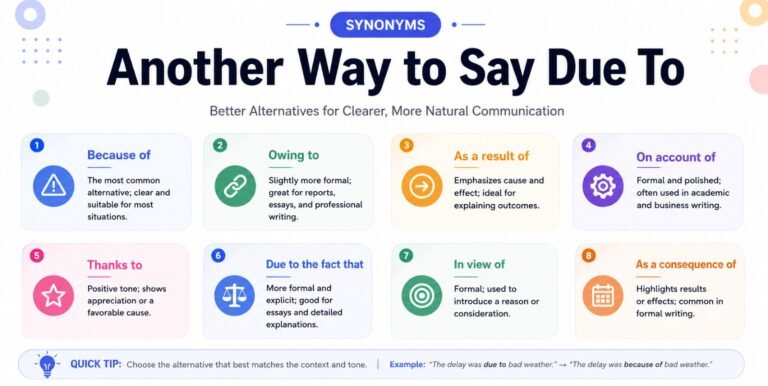
Cambridge gives the phrase the meaning “because of something,” while dictionaries and thesauruses also connect it with expressions such as “due to” and “owing to.”
For example:
The match was canceled as a result of heavy rain.
Possible alternatives include:
The match was canceled because of heavy rain.
The match was canceled due to heavy rain.
The match was canceled owing to heavy rain.
These structures are different from transitions such as “therefore.”
You wouldn’t write:
“The match was canceled therefore heavy rain.”
Other Ways to Say “As a Result Of”
Natural alternatives include:
- Because of
- Due to
- Owing to
- As a consequence of
- On account of
- Resulting from
- Stemming from
- Caused by
- Attributable to
- Thanks to
The right choice depends heavily on meaning and tone.
18. Because Of
Because of is usually the simplest and most natural alternative.
Original:
“The event was postponed as a result of bad weather.”
Alternative:
“The event was postponed because of bad weather.”
It works in both spoken and written English.
19. Due To
Due to is common in formal and everyday writing and can mean “because of” or “as a result of.” Merriam-Webster treats this prepositional use as standard English.
Example:
“Several flights were delayed due to fog.”
It’s concise and especially common in notices, reports, and professional communication.
20. Owing To
Owing to is another established way to introduce a cause.
Example:
“Owing to severe weather, the outdoor event was postponed.”
It can sound slightly more formal than “because of,” particularly in American English.
21. As a Consequence Of
As a consequence of is close in meaning to “as a result of.”
Example:
“Production declined as a consequence of the supply shortage.”
It’s grammatically useful, but because it’s fairly long, “because of” or “due to” may read more smoothly when no extra formality is needed.
22. Stemming From
Stemming from is useful for describing the origin of a problem, situation, or effect.
Example:
“The company is addressing several complaints stemming from the recent software update.”
It doesn’t fit every “as a result of” sentence, but it can be more precise when discussing where something originated.
23. Resulting From
Resulting from directly identifies the source of an outcome.
Example:
“The researchers examined damage resulting from prolonged exposure to moisture.”
This construction works particularly well when the effect is mentioned before its cause.
24. Attributable To
Attributable to means that an outcome can be explained by or connected to a particular cause.
Example:
“The increase in operating costs was partly attributable to higher energy prices.”
It’s useful in analytical and professional writing, especially when making a measured causal claim.
25. Thanks To
Thanks to can mean “because of,” but it often carries a positive or appreciative tone.
Example:
“Thanks to everyone’s hard work, the project was completed ahead of schedule.”
Compare that with:
“The road was closed thanks to a serious accident.”
That sentence can sound sarcastic because the cause is negative.
For neutral or negative situations, because of or due to is usually safer.
“As a Result” and “As a Result Of” Are Not the Same Structure
This distinction is one of the easiest ways to avoid awkward replacements.
Other Ways to Say “As a Result” vs. “As a Result Of”
As a result introduces an outcome:
The server failed. As a result, customers couldn’t access the website.
You could say:
The server failed. Consequently, customers couldn’t access the website.
But as a result of introduces the cause:
Customers couldn’t access the website as a result of a server failure.
You could say:
Customers couldn’t access the website because of a server failure.
A simple way to remember the difference:
As a result → the effect usually follows
As a result of + noun → the cause follows
Not Every Alternative Is Interchangeable
A long synonym list can be misleading if it suggests that every expression works in every sentence.
Here are several important differences.
“Therefore” Doesn’t Always Mean Exactly “As a Result”
“Therefore” often presents a logical conclusion.
The contract has expired. Therefore, a new agreement is required.
The second statement follows logically from the first.
“As a result” can also describe an actual event:
The river overflowed. As a result, several homes were flooded.
Here, “consequently” may be closer than “therefore.”
“Subsequently” Shows Time, Not Necessarily Cause
Consider:
“He graduated in June and subsequently moved to London.”
“Subsequently” tells us the move happened later. It doesn’t necessarily mean graduating caused the move.
So don’t automatically use subsequently as another word for “as a result.”
“Following This” May Only Show Sequence
“The presentation ended. Following this, everyone went to lunch.”
The lunch occurred afterward, but the presentation didn’t necessarily cause it.
Use this phrase when chronological sequence matters more than causation.
“In Turn” Usually Describes a Chain Reaction
“Higher costs increased prices, which in turn reduced demand.”
“In turn” works especially well when one consequence becomes the cause of another.
“Accordingly” Often Suggests a Deliberate Response
“The forecast predicted heavy snow. Accordingly, the organizers canceled the event.”
This suggests the organizers acted in response to the forecast.
That nuance makes “accordingly” different from a purely accidental consequence.
“Thanks To” Can Add Positive Meaning
“Thanks to” isn’t completely neutral.
“Thanks to your advice, we solved the problem.”
It naturally expresses appreciation.
Use because of or due to when you don’t want that positive implication.
How to Choose the Best Alternative
Instead of asking only, “What’s a different way to say ‘as a result’?” consider what relationship your sentence actually needs to express.
Choose consequently when you want to emphasize a consequence.
Choose therefore when you’re drawing a logical conclusion.
Choose thus when you need a concise formal transition.
Choose for this reason when you want the connection to be especially clear.
Choose so for natural everyday conversation.
Choose this led to when explaining a chain or development.
Choose contributed to when the first factor isn’t necessarily the only cause.
Choose because of when replacing “as a result of + noun.”
Choose due to when you want a concise cause phrase.
Choose in turn when one result produces another result.
The most sophisticated choice isn’t necessarily the longest one. Good writing uses the expression that makes the relationship between ideas easiest to understand.
Punctuation With “As a Result” and Its Alternatives
When “as a result” starts a sentence, it is normally followed by a comma:
“The deadline was extended. As a result, the team had more time to test the product.”
Several alternatives follow the same pattern:
“The deadline was extended. Consequently, the team had more time.”
“The deadline was extended. Therefore, the team had more time.”
“The deadline was extended. For this reason, the launch was rescheduled.”
When using because of, due to, or as a result of inside the sentence, the structure changes:
“The launch was delayed because of technical problems.”
“The launch was delayed due to technical problems.”
Don’t assume you can exchange these phrases without changing the grammar of the sentence.
Examples of Different Ways to Say “As a Result”
Here are a few natural rewrites showing how context changes the best choice.
Original:
“The temperature dropped overnight. As a result, the roads became icy.”
Natural alternative:
“The temperature dropped overnight. Consequently, the roads became icy.”
Original:
“The evidence doesn’t support the claim. As a result, we should reject the hypothesis.”
Better for logical reasoning:
“The evidence doesn’t support the claim. Therefore, we should reject the hypothesis.”
Original:
“I missed my alarm. As a result, I was late for work.”
More conversational:
“I missed my alarm, so I was late for work.”
Original:
“The company simplified its application process. As a result, more people completed their applications.”
More direct:
“The company simplified its application process, which led to more completed applications.”
Original:
“The game was postponed as a result of heavy rain.”
Simpler:
“The game was postponed because of heavy rain.”
The most natural rewrite often involves changing the sentence structure rather than replacing one phrase word for word.
Frequently Asked Questions
What Is Another Way to Say “As a Result”?
Common alternatives include therefore, consequently, thus, for this reason, because of this, as a consequence, accordingly, in turn, and so. “Consequently” is especially close when you want to emphasize an effect caused by something previously mentioned.
What Is a Better Way to Say “As a Result” in an Essay?
For an essay, good choices include consequently, therefore, thus, hence, for this reason, as a consequence, and this led to. Choose “therefore” for logical conclusions and “consequently” when describing a consequence.
What Is Another Way to Say “As a Result Of”?
Natural alternatives include because of, due to, owing to, as a consequence of, resulting from, stemming from, and on account of. The simplest replacement in many sentences is “because of.”
Can I Use “Therefore” Instead of “As a Result”?
Often, but not always. Therefore tends to emphasize a conclusion that logically follows from previous information, while as a result can simply describe an effect that occurred because of an earlier event.
What Is a More Formal Way to Say “As a Result”?
Consequently, therefore, thus, accordingly, hence, and as a consequence are useful formal options. The best one depends on whether you’re describing an actual consequence, a logical conclusion, or a deliberate response.
What Is a Casual Way to Say “As a Result”?
In casual English, so, that’s why, because of that, and which meant that often sound more natural.
For example:
“Traffic was terrible, so I got home late.”
sounds more conversational than:
“Traffic was terrible. Consequently, I arrived home late.”
Can “Because” Replace “As a Result”?
It can express the same cause-and-effect relationship, but the sentence normally needs to be restructured.
As a result:
“The roads were flooded. As a result, the event was canceled.”
Because:
“The event was canceled because the roads were flooded.”
Is “As a Result” Appropriate for Academic Writing?
Yes. “As a result” is clear and appropriate in academic writing. You don’t need to avoid it entirely. Alternatives become useful when repetition makes a paragraph sound monotonous or when a different phrase expresses the relationship more precisely.
Is “Subsequently” Another Way to Say “As a Result”?
Not necessarily. Subsequently primarily means that something happened later. It doesn’t by itself prove that the earlier event caused the later one. Use “consequently” when you specifically mean “as a consequence.”
Final Thoughts
The best another way to say “as a result” depends on what your sentence is actually doing. Consequently works well for consequences, therefore for logical conclusions, so for everyday conversation, and because of or due to when you’re replacing “as a result of.”
Rather than swapping one transition for another mechanically, pay attention to how strongly you want to express cause, what level of formality suits your audience, and whether the sentence needs restructuring. That’s the kind of wording distinction Clarifyra aims to make clearer, so you can choose an expression that says exactly what you mean.
You May Also Read | Another Way to Say “Due To”: Better Alternatives for Every Context