Writing & Grammar
Aisle vs Isle: What’s the Difference and Which Word Is Correct?
Aisle and isle are both correct English words, but they mean very different things. The confusion comes from their almost identical…
Read MoreThe Writing & Grammar section of Clarifyra helps readers improve grammar, vocabulary, sentence structure, and word choice. Here, you can explore clearer alternatives to common phrases, useful transition words, academic expressions, and practical grammar guidance for essays, articles, reports, and everyday writing.
Our guides focus on more than just correctness. They explain differences in tone, formality, meaning, and context so you can choose wording that sounds natural and fits the situation. Whether you want to avoid repetition, strengthen a sentence, or understand a grammar point more clearly, this section is designed to make better writing easier.
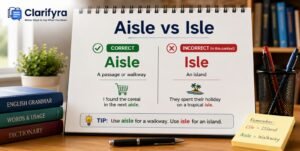
Aisle and isle are both correct English words, but they mean very different things. The confusion comes from their almost identical…
Read More →
If you are deciding between synch and sync, the good news is that both spellings are valid. They are shortened forms…
Read More →
Tear and tare are both real English words, but they are used for very different things. The confusion comes from pronunciation:…
Read More →
The difference between upon and apon is mainly a matter of correct modern spelling. The two forms can look and sound…
Read More →
Columbia vs Colombia can be confusing because the two names differ by only one vowel and can sound similar when spoken.…
Read More →
“Wiff” and “whiff” sound almost identical, so it is easy to understand why they get mixed up. The important difference is…
Read More →
The words patients and patience are easy to confuse because they look similar and are pronounced almost the same in everyday…
Read More →
The words bussed and bused can look like one of them must be a spelling mistake, but both forms are correct.…
Read More →
If you are learning Spanish, por and para can be surprisingly difficult because both are often translated as “for” in English.…
Read More →
If you have seen both honey and hunny in messages, captions, or romantic conversations, you may wonder whether they are two…
Read More →