25 Other Ways to Say “On the Other Hand” in Essays, Formal Writing and Conversation
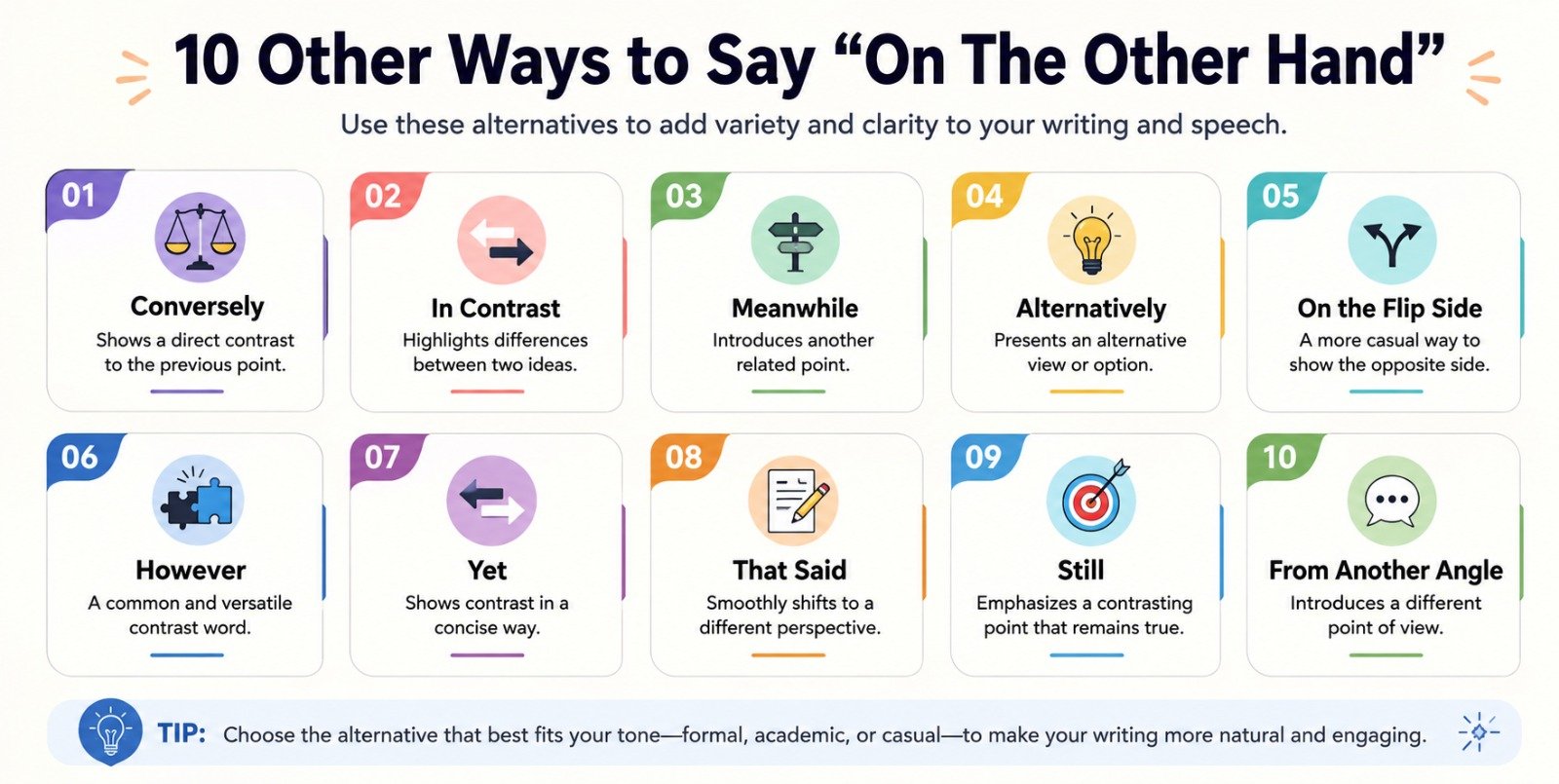
“On the other hand” is a useful transition when you want to introduce a contrasting idea, another side of an argument, or a different perspective. But when it appears repeatedly in an essay, report, email, or conversation, the wording can start to feel predictable. Fortunately, there are many other ways to say “on the other hand,” from formal choices such as “conversely” and “by contrast” to conversational expressions such as “then again” and “on the flip side.”
What Does “On the Other Hand” Mean?
“On the other hand” introduces an idea that differs from something mentioned previously. It is particularly useful when both points can be true but represent different sides of a situation.
For example:
“Working from home saves commuting time. On the other hand, some people miss the social side of an office.”
The second statement does not prove the first one wrong. It simply introduces another consideration.
Cambridge describes the expression as introducing something different from the first thing mentioned and also recognizes the familiar “on the one hand … on the other hand” structure for presenting two sides of an issue.
That distinction matters because not every contrast word works in exactly the same way.
Quick Comparison of Alternatives
| Alternative | Tone | Best Used For | Type of Contrast |
|---|---|---|---|
| However | Neutral/Formal | Essays, reports, emails | General contrast |
| Conversely | Formal | Academic and analytical writing | Opposite or reversed relationship |
| By contrast | Formal | Essays, reports, comparisons | Clear difference |
| In contrast | Formal | Academic comparisons | Clear difference |
| Alternatively | Neutral/Professional | Options and suggestions | Different possibility |
| Nevertheless | Formal | Essays and arguments | Contrast despite a difficulty |
| Nonetheless | Formal | Academic and professional writing | Contrast despite a fact |
| Whereas | Formal/Neutral | Comparing two subjects | Direct comparison |
| While | Neutral | Balanced comparisons | Softer contrast |
| Yet | Neutral | Concise writing | Unexpected contrast |
| Still | Neutral/Conversational | Qualifications and counterpoints | Softer counterpoint |
| Then again | Casual | Conversation and informal writing | Reconsideration |
| On the flip side | Informal | Blogs and conversation | Another side of an issue |
| That said | Neutral/Professional | Emails and commentary | Qualification |
| On the contrary | Formal | Correcting a claim | Direct contradiction |
You May Also Read | 25 Other Ways to Say “Thank You for the Clarification” Professionally
25 Better Ways to Say “On the Other Hand”
The best replacement depends on what your second point is doing. Some alternatives simply introduce a difference, while others show an opposite result, acknowledge a difficulty, or present another option.
1. However
“However” is one of the most versatile alternatives. It introduces a contrast without suggesting that the two ideas are complete opposites.
Example:
“The apartment is conveniently located. However, the monthly rent is quite high.”
It works especially well in essays, reports, emails, and other professional writing.
2. Conversely
Use “conversely” when the second situation represents an opposite or reversed relationship.
Example:
“Higher temperatures increased demand for cold drinks. Conversely, demand for hot beverages declined.”
Because it signals a fairly precise relationship, “conversely” is particularly useful in academic and analytical writing.
3. By Contrast
“By contrast” draws attention to a noticeable difference between two people, situations, results, or ideas.
Example:
“The first campaign focused on short-term sales. By contrast, the second focused on building customer loyalty.”
4. In Contrast
“In contrast” performs a similar job to “by contrast” and works naturally in essays, research papers, and reports.
Example:
“The city center is busy throughout the evening. In contrast, the surrounding villages become quiet after sunset.”
5. Alternatively
“Alternatively” introduces another possibility rather than necessarily an opposing fact.
Example:
“We could launch the product in September. Alternatively, we could wait until the holiday season.”
This is why “alternatively” cannot replace “on the other hand” in every sentence.
6. Nevertheless
“Nevertheless” means that the following point remains true despite what has just been mentioned.
Example:
“The journey was long and tiring. Nevertheless, everyone agreed that the destination was worth visiting.”
7. Nonetheless
“Nonetheless” is close in meaning to “nevertheless” and tends to suit formal and academic writing.
Example:
“The evidence is limited. Nonetheless, the findings raise several important questions.”
8. Whereas
“Whereas” is useful when directly comparing two subjects or situations in the same sentence.
Example:
“Daniel prefers working early in the morning, whereas Mia is more productive at night.”
Its grammatical role is different from a sentence-opening transition such as “however.”
9. While
“While” can introduce a softer comparison between two ideas.
Example:
“While the cheaper model has fewer features, it may be sufficient for casual users.”
Be aware that “while” can also refer to time, so the surrounding sentence should make its intended meaning clear.
10. Yet
“Yet” is concise and useful when the second idea seems surprising in light of the first.
Example:
“The design looks simple, yet it took months to develop.”
11. Still
“Still” introduces a reservation or counterpoint without creating a strong opposition.
Example:
“The salary isn’t particularly high. Still, the job offers excellent flexibility.”
12. That Said
“That said” acknowledges the previous point before adding a qualification.
Example:
“The software is easy to learn. That said, advanced users may find its features limited.”
It sounds natural in professional communication, articles, reviews, and thoughtful conversation.
13. Then Again
“Then again” introduces a second thought or reconsideration.
Example:
“I could drive to the event. Then again, taking the train would be less stressful.”
Its conversational feel makes it less suitable for highly formal academic work.
14. On the Flip Side
“On the flip side” is an informal expression for looking at the other side of a situation.
Example:
“Freelancing gives you more freedom. On the flip side, your income may be less predictable.”
Save it for casual writing, blogs, presentations, and conversation rather than formal research papers.
15. But
Sometimes the simplest replacement is simply “but.”
Example:
“The hotel is expensive, but its location is excellent.”
There is no need to use a longer transitional phrase when a straightforward conjunction communicates the contrast clearly.
16. Although
“Although” introduces a concession and usually joins two ideas within the same sentence.
Example:
“Although the course is demanding, it provides excellent practical experience.”
It is useful when you want a more tightly connected sentence rather than two separate contrasting statements.
17. Even So
“Even so” acknowledges the previous fact while showing that another point remains valid.
Example:
“The weather forecast wasn’t promising. Even so, we decided to continue with the trip.”
18. Even Though
“Even though” introduces a stronger concession than “although.”
Example:
“Even though sales declined, the company continued investing in new products.”
19. Despite This
“Despite this” is useful when the second statement happens or remains true in spite of what came before.
Example:
“The initial test produced disappointing results. Despite this, the researchers continued the experiment.”
20. In Comparison
“In comparison” helps compare one subject with another, often emphasizing differences.
Example:
“The older device has limited storage. In comparison, the newer model offers considerably more space.”
21. By Comparison
“By comparison” is another useful analytical transition.
Example:
“The first department reduced costs by 3%. By comparison, the second achieved a 12% reduction.”
22. From Another Perspective
This phrase works when you deliberately want to introduce a different viewpoint rather than a strict opposite.
Example:
“The change may inconvenience current employees. From another perspective, it could create better opportunities for future growth.”
23. Viewed Differently
“Viewed differently” encourages the reader to consider another interpretation.
Example:
“The delay may seem like a setback. Viewed differently, it gives the team more time to improve the product.”
24. At the Same Time
“At the same time” can introduce a competing consideration when two apparently conflicting facts are both true.
Example:
“The policy could reduce costs. At the same time, it may place additional pressure on employees.”
25. Rather
“Rather” can correct or replace an earlier interpretation, although it is not a general-purpose synonym for “on the other hand.”
Example:
“The change wasn’t intended to reduce staffing. Rather, it was designed to reorganize existing roles.”
Other Ways to Say “On the Other Hand” in an Essay
Essay writing often requires transitions that show exactly how one argument relates to another. Instead of repeatedly using the same expression, choose a connector based on the relationship between your ideas.
Other Ways to Say “On the Other Hand” for General Essay Contrast
For a straightforward contrast, useful choices include:
- However
- By contrast
- In contrast
- Whereas
- While
- Yet
Example:
“Online courses give students greater flexibility. However, face-to-face classes can provide more immediate interaction.”
If you are comparing two clearly different groups:
“Urban residents generally have easier access to public transport. By contrast, people in rural communities may depend heavily on private vehicles.”
Other Ways to Say “On the Other Hand” for a Counterargument
When you want to acknowledge a point but then introduce a competing consideration, try:
- Nevertheless
- Nonetheless
- Even so
- Despite this
- That said
Example:
“The policy has been criticized for its cost. Nevertheless, supporters argue that its long-term benefits justify the investment.”
These phrases are especially useful when the second sentence remains true despite the information in the first.
Academic Ways to Say “On the Other Hand”
Academic writing benefits from precise transitions rather than simply more sophisticated vocabulary.
Strong choices include:
Conversely
Best for an actual opposite or reversed relationship.
“Participants with extensive training completed the task more quickly. Conversely, inexperienced participants required considerably more time.”
By contrast / In contrast
Best for comparing clearly different findings, groups, methods, or conditions.
“The qualitative study focused on individual experiences. In contrast, the quantitative study examined patterns across the entire population.”
However
Best for broad contrast, limitations, exceptions, and qualifications.
“The results indicate a positive association. However, the relatively small sample limits their generalizability.”
Nevertheless / Nonetheless
Best when evidence, conclusions, or actions remain valid despite a limitation.
“The dataset contains several gaps. Nonetheless, it provides useful evidence of the broader trend.”
In academic writing, a precise transition is generally more useful than an impressive-sounding one. “Conversely,” for example, should not be inserted simply because it sounds scholarly; it works best when there is a genuine reversal or opposing relationship.
Formal Ways to Say “On the Other Hand”
In reports, proposals, workplace emails, presentations, and formal discussions, these alternatives tend to fit comfortably:
- However
- By contrast
- Conversely
- Alternatively
- Nevertheless
- Nonetheless
- Whereas
- In comparison
- That said
- At the same time
Consider what you actually want to communicate.
If you are suggesting a second option:
“We can extend the current contract. Alternatively, we could begin a new supplier review.”
If you are identifying a drawback:
“The proposal could reduce operating costs. However, implementation would require significant initial investment.”
If two valid considerations need to be balanced:
“The new process may improve efficiency. At the same time, staff will require additional training.”
Other Ways to Say “On the Other Hand” in Casual Conversation
Formal transitions can sound unnecessarily stiff in everyday conversation. More natural conversational options include:
- But
- Then again
- Still
- Yet
- On the flip side
- At the same time
- That said
Examples:
“I’d love to go out tonight. Then again, I’ve got an early start tomorrow.”
“The place is pretty far away. Still, I’ve heard the food is amazing.”
“Working for yourself is exciting. On the flip side, you never completely switch off from work.”
The original phrase “on the other hand” is also perfectly natural in everyday English, so there is no need to avoid it completely.
Not Every Alternative Is Interchangeable
One of the biggest mistakes with transition words is assuming that anything labeled a synonym can be substituted into the same sentence.
It can’t.
“On the Other Hand” vs. “On the Contrary”
These expressions perform different jobs.
On the other hand introduces another side or contrasting consideration:
“Living downtown is convenient. On the other hand, it can be expensive.”
Both statements can be true.
On the contrary rejects or corrects an earlier idea:
“Some people assume the new system is easier. On the contrary, many users have found it more complicated.”
Cambridge specifically distinguishes these uses: “on the contrary” expresses the opposite of a claim, while “by contrast” or “in contrast” is appropriate when comparing two different things.
“On the Other Hand” vs. “Conversely”
“Conversely” usually suggests a more direct opposite or reversed relationship.
Natural:
“Higher interest rates can reduce borrowing. Conversely, lower rates may encourage it.”
Less natural would be using “conversely” simply to introduce an unrelated disadvantage.
“On the Other Hand” vs. “Alternatively”
“Alternatively” normally means another option is available.
“We can leave tonight. Alternatively, we can travel tomorrow morning.”
It does not necessarily mean that the second statement contrasts with the first.
“On the Other Hand” vs. “Nevertheless”
“Nevertheless” means something remains true despite an obstacle or contrary fact.
“The evidence was incomplete. Nevertheless, the committee decided to proceed.”
That relationship is more specific than simply looking at another side of an issue.
Do You Need “On the One Hand” First?
A common pattern is:
“On the one hand … on the other hand …”
For example:
“On the one hand, buying a house gives you greater control over your living space. On the other hand, renting usually offers more flexibility.”
This structure is particularly useful when deliberately presenting two sides of an argument.
However, English also commonly uses “on the other hand” on its own when the contrast is already obvious from the surrounding context. Cambridge’s grammar guidance includes this standalone use.
So you do not have to write “on the one hand” every time before using “on the other hand.”
Punctuation With “On the Other Hand”
When the expression begins a sentence, a comma normally follows it:
“The first option is cheaper. On the other hand, the second may last longer.”
It can also appear within a sentence:
“The first option is inexpensive; the second, on the other hand, offers better performance.”
The exact sentence structure may change when you replace the phrase with a conjunction such as but, whereas, although, or while. Do not replace the words mechanically while leaving the grammar untouched.
How to Choose the Right Alternative
Instead of choosing the longest or most formal expression, identify the relationship between your two ideas.
Use however for a flexible general contrast.
Use conversely when there is a genuine opposite or reversal.
Use by contrast or in contrast when comparing clear differences.
Use alternatively when presenting another option.
Use nevertheless or nonetheless when something remains true despite the previous point.
Use whereas or while when contrasting two subjects within one sentence.
Use then again or on the flip side when a conversational tone fits.
Use on the contrary only when correcting or directly contradicting an earlier statement.
Sometimes, the strongest choice is not another transition at all. If the contrast is already obvious, a simple “but” or a well-structured sentence may be clearer than adding a formal connector.
Frequently Asked Questions
What is another way to say “on the other hand”?
“However” is one of the closest general alternatives. Depending on context, you can also use “conversely,” “by contrast,” “in contrast,” “nevertheless,” “alternatively,” “then again,” or “on the flip side.”
What can I use instead of “on the other hand” in an essay?
Good essay alternatives include however, by contrast, in contrast, conversely, nevertheless, nonetheless, whereas, and while. Choose according to the relationship between the two points rather than varying words simply for variety.
What is an academic way to say “on the other hand”?
“Conversely,” “by contrast,” and “in contrast” are strong academic choices when comparing differences. “However” is useful for broader contrast, while “nevertheless” and “nonetheless” work when a point remains valid despite a limitation.
Is “on the other hand” formal?
It is acceptable in many formal and professional contexts, including essays and reports. More precise alternatives such as “by contrast,” “conversely,” or “however” may sometimes fit academic writing better, depending on the relationship between the ideas.
Can I start a sentence with “on the other hand”?
Yes. It can naturally begin a sentence that introduces a contrasting consideration:
“Public transport is inexpensive. On the other hand, it may take longer than driving.”
A comma normally follows the introductory phrase.
Can I use “on the other hand” without saying “on the one hand”?
Yes. Although “on the one hand … on the other hand” is a common paired construction, “on the other hand” is also commonly used by itself when the preceding context already establishes the first side of the contrast.
Is “on the contrary” another way to say “on the other hand”?
Not in most situations. “On the contrary” rejects or corrects a previous claim, while “on the other hand” generally presents another side or consideration. For ordinary comparison, “by contrast” or “in contrast” is usually more appropriate than “on the contrary.”
Is “on the flip side” suitable for academic writing?
Usually not. “On the flip side” has a conversational tone and works better in informal speech, blogs, or relaxed presentations. In an academic paper, “by contrast,” “however,” or “conversely” will generally sound more appropriate.
Conclusion
There is no single perfect replacement for “on the other hand.” The right expression depends on the relationship between your ideas, your audience, and the level of formality you need. “However” handles general contrast well, “conversely” suits genuine opposites, “alternatively” introduces another choice, and “then again” brings a more conversational feel.
Choosing transitions by meaning rather than simply swapping synonyms makes your writing clearer and more natural. That is the kind of distinction Clarifyra aims to make easier, helping you find wording that truly fits what you mean rather than merely sounding different.
You May Also Read | 35 Other Ways to Say “However” in Essays, Emails and Everyday English