Kindergartner or Kindergartener: Which Spelling Is Correct?
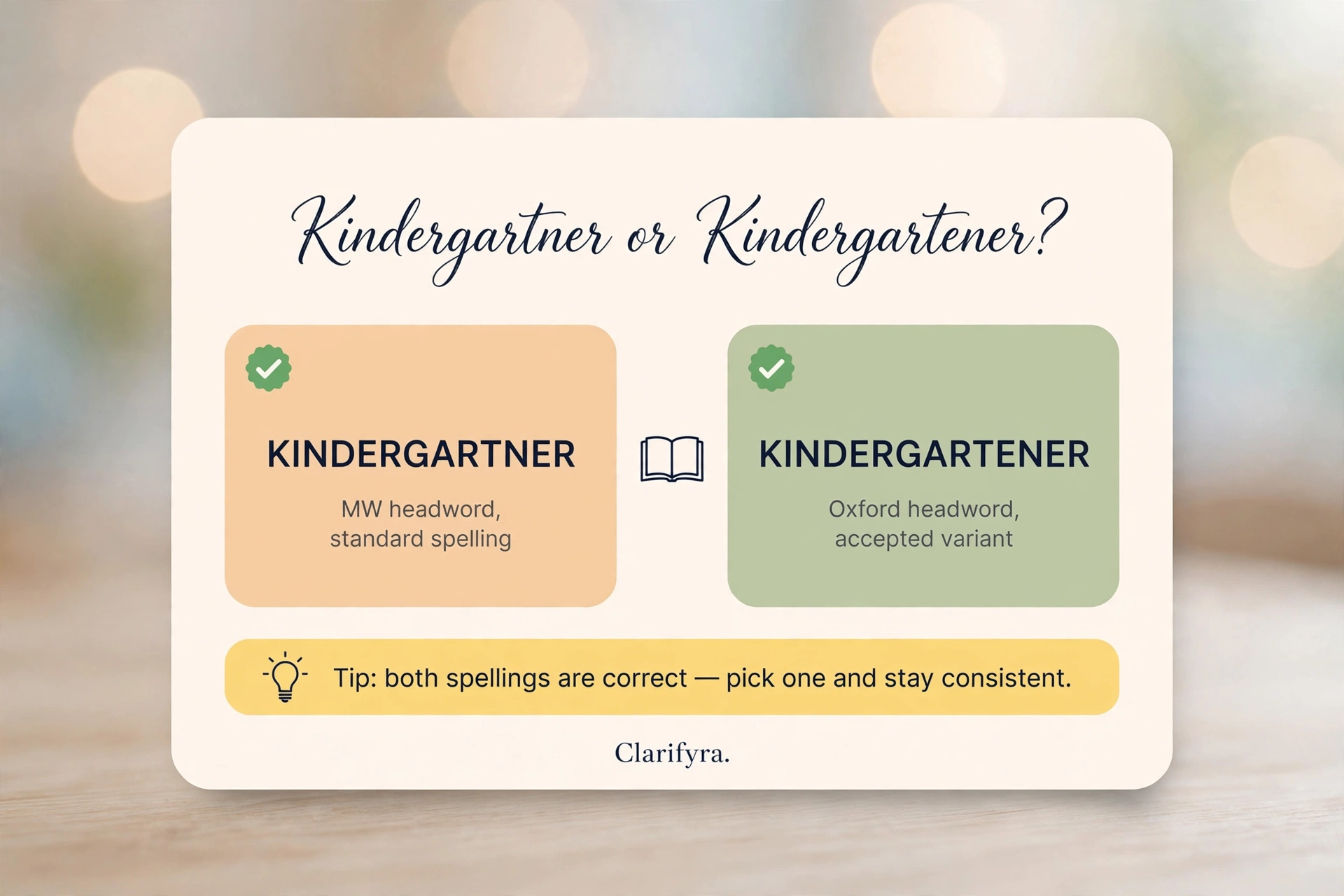
If you’ve ever typed kindergartner and watched your spellchecker shrug, or written kindergartener and had a colleague “fix” it — here’s the short answer: both spellings are correct. Kindergartner is the more common spelling in the United States and the headword in Merriam-Webster and Collins; kindergartener is a fully recognized variant and the headword in Oxford’s learner dictionaries. Neither is a misspelling. The one you want is mostly a question of house style and consistency — but the story of why two spellings exist is genuinely interesting, and it goes back to German.
Quick Answer
Kindergartner and kindergartener both mean a child who attends kindergarten, and both are recorded in major dictionaries. Merriam-Webster and Collins use kindergartner as the headword; Oxford uses kindergartener as the headword with kindergartner as the alternate. In the US usage samples checked for this article, kindergartner is the more common form. Pick one and use it consistently.
What the Dictionaries Actually Say
This is one of those cases where the reference books split — and the split itself is the answer. Here is what I found, checked against each dictionary:
| Dictionary | Headword | How it treats the other spelling | Definition given |
|---|---|---|---|
| Merriam-Webster (American) | kindergartner | Searching for “kindergartener” resolves to the same entry — the dictionary’s own citation cites “Kindergartner” at the kindergartner URL. | The entry is numbered with two senses — the pupil sense, which appears in every one of the dictionary’s live example sentences (“kindergartners” in vaccine-coverage news from NPR, USA Today, ProPublica, and the CDC), alongside a teacher sense, “a teacher at a kindergarten.” First known use: 1868. |
| Collins (American English) | kindergartner | Listed plainly: “Also: kindergartener.” | Noun, from German Kindergärtner (dated by Collins to 1870–75). Pronunciation given as (ˈkɪndərˌɡɑːrtnər, -ˌɡɑːrd-). |
| Oxford Advanced Learner’s Dictionary and Oxford Advanced American Dictionary | kindergartener | “(also kindergartner).” | “A child who is in kindergarten.” Marked North American English — Oxford’s label for the whole word, not for one spelling. |
| Cambridge | — | Cambridge does not appear to give either form a headword entry. But its own usage in example sentences (e.g. the entry for redshirting) is kindergartner: “the only kindergartner who actually started school on time.” | — |
| Wiktionary (supplementary) | kindergartner | “kindergartener (less common).” | Main sense: “a child who attends a kindergarten”; a separate, (rare) sense: “a person who teaches at a kindergarten.” |
So the scorecard is real: two of the big three American-facing references lead with kindergartner; Oxford leads with kindergartener. Nobody calls either form wrong. When someone tells you flatly that one of them is a mistake, they are describing their dictionary’s house preference, not the language.
Why Both Spellings Exist: A German Garden and an English Habit
The doubled spelling isn’t random — it’s a collision between the word’s German ancestry and English’s own suffix habits.
Kindergarten is a German loanword: Kinder (“children”) + Garten (“garden”), coined by the educator Friedrich Fröbel, who started the first kindergarten in 1840 as a “garden of children.” In German, the word for the gardener-of-children was Kindergärtner — Gärtner being “gardener,” with the umlaut. When English borrowed the family of words in the late 19th century, the umlaut was dropped, and kindergartner — kindergarten minus its final en, plus -er — came along with the shape of the German stem intact. This is the route the -ner spelling takes: it is the German form minus the umlaut, which is why one usage source puts it neatly: the spelling kindergartner follows the German noun Kindergärtner.
Kindergartener, meanwhile, follows the ordinary English habit: take the whole base word and add -er. Kindergarten + er → kindergartener, exactly the pattern that gives us gardener (from garden) or teacher (from teach). Nothing was clipped; the linking e is just how English agent nouns are usually built. So the two spellings aren’t really fighting: one preserves the borrowed German skeleton, the other applies the standard English suffix rule. Both paths are legitimate, which is why both spellings ended up in the dictionaries.
It also explains why the confusion runs one way and not the other. The root word kindergarten itself is spelled with -ten in every variety of English — there is no “kindergarden” in standard usage (“kindergarden” is a common misspelling, not a variant). Because the root keeps its full -ten ending, writers naturally extend it into kindergarten-er, while writers who think of the German stem reach for kindergart-ner. Both instincts are reasonable; the dictionaries confirm both.
An Interesting Wrinkle: It Once Meant the Teacher
Here is a detail most short grammar posts miss. The pupil sense — “a child who is in kindergarten,” as Oxford defines it — is what the word means today, and it is what appears in every example sentence I checked across Merriam-Webster (vaccination coverage), Wiktionary (Octavia Butler, CNN), and Cambridge. But the older German Kindergärtner could mean the kindergarten teacher, the gardener-of-children, and 19th-century English used it that way too.
Wiktionary marks “a person who teaches at a kindergarten” as a (rare) sense and cites an 1887 usage from education writer Elizabeth Palmer Peabody: “a dear, devout old German kindergartner.” Merriam-Webster’s entry similarly retains the teacher sense, and Collins dates the word’s arrival to 1870–75 from German Kindergärtner. A 2026 JSTOR Daily piece even quoted “German women who had trained as kindergartners” — the teacher meaning, alive in historical writing.
So the word has drifted: teacher first (from the German), child later (the dominant modern sense). If you ever meet the teacher meaning in an old text, it isn’t an error — it’s the word as it arrived.
The American Angle: Why -ner Wins in the US
The word itself is a North American word — that’s Oxford’s label — and in the usage samples checked for this article the -ner spelling is the clear leader. Merriam-Webster’s, Wiktionary’s, and Cambridge’s current-usage example sentences (quoting NPR, USA Today, ProPublica, the CDC, CNN, and others) all use kindergartners. If you write for an American audience — a school newsletter, an education-policy piece, a news article — kindergartner is the safe, standard, invisible choice.
Kindergartener is the form you’ll more often see defended by Oxford’s learner dictionaries and by Wiktionary’s “less common” label, and it remains perfectly defensible anywhere. In practice, mixing the two within one document looks sloppy, so the real rule is: pick one, and be consistent.
Pronunciation
The two spellings are pronounced the way they look — and the -er form carries an extra syllable in careful speech:
| Form | British (Oxford / Wiktionary) | American (Oxford / Collins) |
|---|---|---|
| kindergartner | /ˈkɪndəˌɡɑːtnə/ — KIN-duh-gah-tnuh | /ˈkɪndərˌɡɑːrtnər/ — KIN-der-gart-ner |
| kindergartener | /ˈkɪndəɡɑːtənə(r)/ — KIN-duh-gah-tuh-nuh | /ˈkɪndərɡɑːrtənər/ — KIN-der-gah-tuh-ner |
Oxford’s international edition gives both forms in both varieties; the Advanced American Dictionary lists the NAmE pronunciations /ˈkɪndərˌɡɑrdnər/ and /ˈkɪndərˌɡɑrtnər/ for the headword kindergartener and its kindergartner variant. In everyday speech the distinction is faint — most Americans glide through the unstressed middle syllables of either form.
Correct vs. Incorrect
| Spelling | Verdict | Note |
|---|---|---|
| kindergardener | kindergartner / kindergartener | The mixed form kindergardener (garden + -er) isn’t recorded in any dictionary — pick one of the two real spellings. |
| kindergarden | kindergarten | The root word keeps its t: “children’s garden,” not “children’s gard.” |
| A Kindergartner walked in. (capitalized mid-sentence) | A kindergartner walked in. | It’s a common noun — no capital unless it starts the sentence. |
| Mixing both in one article: “our kindergartners… these kindergarteners…” | Pick one and stay with it. | Both are right; inconsistency is the only real error. |
✓ Her son is a kindergartner this year.
✓ Her son is a kindergartener this year.
✗ Her son is a kindergardener this year. (Not a standard word — a blend of garden and kindergarten.)
✓ Kindergartners in the district must show proof of vaccination. (Standard US news usage.)
✗ Kindergardeners should be able to count to ten. (Two errors in one: wrong root spelling.)
Common Mistakes
- “Correcting” kindergartener to kindergartner (or the reverse). The most common real-world error around this word isn’t misspelling it — it’s over-correcting it. An editor trained on Merriam-Webster will red-pen kindergartener; an editor trained on Oxford will do the opposite. Both corrections are wrong unless the publication’s style guide picks a side. Unless you’re following a house style, leave the other spelling alone.
- The blended “kindergardener.” Writers who half-remember the word splice its two halves: the garden of gardener plus the kinder- of kindergarten. No dictionary records this form.
- Misspelling the root as “kindergarden.” The loanword keeps German spelling: kindergarten, with a t. “Kindergarden” is always an error.
- Capitalizing it. Kindergartner is a common noun — “the kindergartner,” not “the Kindergartner.” Capitalize only at the start of a sentence or in a proper name (e.g. the film Kindergarten Cop, where the title gets the capital).
- Assuming the plural changes the spelling. The plurals are regular: kindergartners and kindergarteners. Match the plural to whichever singular you chose.
- Stumbling on the rare teacher sense. If you read “a trained kindergartner” in a 19th-century education text, it likely means a kindergarten teacher — the word’s original German meaning. In modern writing, the pupil sense is near-universal.
FAQs
Which is correct: “kindergartner” or “kindergartener”?
Both. Merriam-Webster and Collins head the entry at kindergartner and treat kindergartener as a variant; Oxford does the reverse, heading kindergartener with kindergartner as the alternate. In the US usage samples checked for this article, kindergartner is the more common form.
Is “kindergartener” just a misspelling of “kindergartner”?
No. It is Oxford’s headword spelling and a recorded variant in Collins (“Also: kindergartener”). It is the form you get when you apply the ordinary English -er suffix to the full word kindergarten — the same pattern as gardener.
Why do the dictionaries disagree?
They are describing two legitimate histories. Kindergartner preserves the German stem (Kindergärtner, minus the umlaut), reflecting the word’s 1870s arrival in English; kindergartener applies the regular English rule of adding -er to the whole base word. Dictionary headwords are editorial choices, not verdicts, and the major references simply made different ones.
How do you pronounce “kindergartner” vs “kindergartener”?
American: kindergartner /ˈkɪndərˌɡɑːrtnər/ (KIN-der-gart-ner); kindergartener /ˈkɪndərɡɑːrtənər/ (KIN-der-gah-tuh-ner). British: /ˈkɪndəˌɡɑːtnə/ and /ˈkɪndəɡɑːtənə(r)/ respectively. In practice the unstressed middle syllables blur together.
What’s the plural?
Regular: kindergartners or kindergarteners — whichever matches the singular spelling you chose.
Can “kindergartner” mean a teacher?
Historically, yes — that’s the original German sense (Kindergärtner, the gardener-of-children), and Wiktionary still marks it a (rare) sense with an 1887 citation. Today, in ordinary usage, it means the pupil. If you mean the teacher, write “kindergarten teacher.”
Do British English speakers use this word?
Rarely. Oxford marks the whole word as North American English, and the UK preschool stage is handled by other vocabulary. The word — in either spelling — is essentially American.
The Takeaway
Kindergartner and kindergartener are two correct spellings of the same word — a child who attends kindergarten. Merriam-Webster and Collins lead with kindergartner; Oxford leads with kindergartener. The -ner form is the more common American choice in the dictionary example sentences checked here; the -er form is the regular English -er formation on the full stem. The backstory is the charm: one spelling is German engineering, the other is English habit — and neither is wrong. Choose one, use it consistently, and don’t let anyone “correct” the other into your copy.