Spicket or Spigot: Which Is Correct?
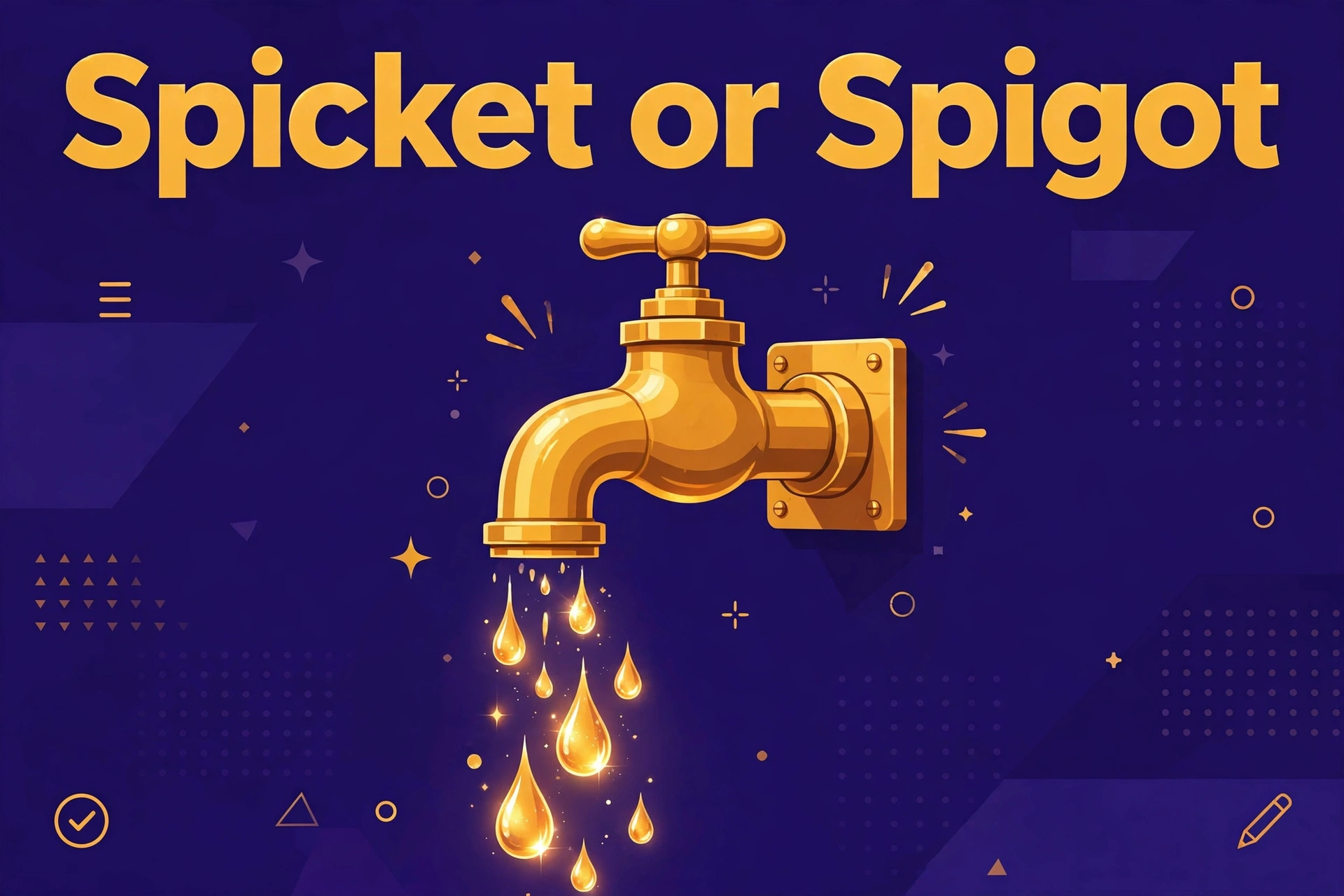
Spicket or Spigot: Which Is Correct?
Spigot is the standard spelling — the one every major dictionary headlines, the one to use in any formal or edited writing. But this is not a simple misspelling story. Spicket has a genuine dictionary footprint: Merriam-Webster lists it as a regional form (“chiefly South & Midland” US), one major dictionary records the “spicket” pronunciation outright, and the -k- spelling goes back to Middle English. So the honest answer is two-tiered: spigot everywhere in standard writing; spicket as a recognized regional variant you should understand but not use in formal prose.
What the Dictionaries Say
This is where the story gets interesting, because the dictionaries do not simply delete spicket — they document it:
- Merriam-Webster (spigot): noun — 1. “the plug of a faucet or cock”; 2. “something resembling a spigot especially in regulating availability or flow (as of money)” (as in “the money spigot”). Etymology: Middle English; first known use in the 14th century. Pronunciation: /ˈspi-gət/. MW also carries a spicket headword that redirects to spigot, labeled as chiefly South & Midland US usage. (MW’s full entry: spigot at Merriam-Webster.)
- Collins / Webster’s New World: spigot (spɪgət), countable noun — “A spigot is a faucet” [US]; “a device that controls the flow of liquid from a container, especially a cask or barrel.” Notably, Webster’s New World gives the pronunciation as (ˈspɪɡət; also ˈspɪkət) — the “spicket” pronunciation, recorded in a major dictionary without apology.
- Wiktionary: spigot — IPA /ˈspɪ.ɡət/, /ˈspɪ.kət/; lists spicket as a dialectal form and even as an occasional homophone. Senses include “a pin or peg used to stop the vent in a cask,” “the plug of a faucet, tap or cock,” and “(US, especially Appalachia) a water tap: a faucet or sillcock.”
So the reference works agree on the hierarchy: spigot is the headword, the standard, the form to teach and to print. Spicket is real the way regional speech is real — documented, labeled, and geographically bounded — but it is not the standard spelling. Writing “spicket” in a report, an essay, or a product manual will be read as an error by most readers, whatever the dictionaries’ regional labels say.
Why “Spicket” Exists: Pronunciation and 600 Years of History
Two forces keep spicket alive, and both are respectable.
First, pronunciation. In Southern American English, spigot is widely pronounced /ˈspɪkət/ — “spicket.” The encyclopedia entry on Southern American English states it plainly: “Spigot (a water tap) is often pronounced /ˈspɪkət/, as if spelled spicket.” When a word is said as “spicket” across whole regions, it is only natural that people write it that way. The spelling is phonetic; the standard spelling is historical. That mismatch is the entire engine of the confusion.
Second, history. The -k- spelling is not a modern corruption. Etymologists record the Middle English forms as spigot, spegot, spikket — “a wooden plug used to stop the hole of a cask” — going back to the late 1300s, probably via Old French from Latin spica (“ear of grain”). The “valve controlling liquid flow” sense dates to the 1520s. So a writer in 1390 spelling it with a k was not making a mistake; the spelling only became nonstandard centuries later, when spigot won the standardization lottery. That doesn’t make “spicket” correct today — but it does mean the form has deeper roots than most misspellings can claim.
Pronunciation: UK and US
The standard pronunciation is /ˈspɪɡət/ — “SPIG-ut,” stress on the first syllable, hard g — in both British and American English (MW, Collins). The regional variant /ˈspɪkət/ (“SPICK-ut”) is documented in Southern and Midland US speech and even appears as an “also” pronunciation in Webster’s New World. The two pronunciations are the reason the two spellings coexist: say it the standard way and spigot looks obvious; say it the Southern way and spicket looks obvious. In formal contexts, pair the standard spelling with the standard pronunciation.
Spigot vs. Faucet vs. Tap: The Regional Map
Part of the confusion is that English has three common words for the same object, divided by geography and by indoor/outdoor:
- Spigot (US): the outdoor faucet — the fixture on the side of the house you attach a garden hose to. Also the plug/valve of any faucet, and historically the wooden plug of a cask.
- Faucet (US): the indoor fixture — kitchen sink, bathroom sink. Americans rarely say “spigot” for the kitchen tap.
- Tap (UK): the universal word — kitchen tap, bathroom tap, garden tap. British English has little everyday use for “spigot” at all; where it appears, it usually means the plug or valve mechanism rather than the whole fixture.
Plumbers add their own terms: the outdoor fixture is technically a hose bibb (or hose bib) — the version with a threaded outlet for a garden hose — and the frost-proof long-stem version is a sillcock. You don’t need these words unless you’re buying plumbing parts, but knowing them explains why a hardware store might label the same object three different ways.
MW’s second sense is worth a mention for readers who meet spigot in news and finance writing: “something resembling a spigot especially in regulating availability or flow (as of money)” — the metaphorical spigot of funding, spending, or oil (“the money spigot turned on”). Same spelling, same standard form.
Correct vs. Incorrect
- ✓ “Hook the hose up to the spigot behind the house.” (Merriam-Webster’s example)
- ✓ “The spigot on the beer keg was leaking.”
- ✓ “She turned off the spigot before winter.”
- ✓ “Congress opened the spending spigot.” (metaphorical sense)
- ✗ (formal writing) “Turn on the spicket.” → ✓ “Turn on the spigot.”
- ✗ “The spicket needs a new washer.” → ✓ “The spigot needs a new washer.”
- ✓ (regional speech, informal) “Y’all turn off that spicket.” — documented Southern/Midland US usage; fine in dialogue and dialect writing, not in formal prose.
Common Mistakes
1. Writing “spicket” in formal or professional contexts. The regional label in the dictionary does not make it standard. In edited writing — reports, essays, manuals, product listings — spigot is the only spelling that won’t be flagged. Save “spicket” for dialogue, dialect writing, and informal regional contexts.
2. Assuming “spicket” is just ignorance. It isn’t. The pronunciation /ˈspɪkət/ is documented across the American South and Midland, a major dictionary lists the pronunciation, and the -k- spelling is Middle English. Correcting someone’s “spicket” as though no such form existed would itself be an error — the kind this article is written to prevent. The correction is about register, not intelligence: “standard spelling is spigot.”
3. Using “spigot” for an indoor kitchen tap (US). Technically defensible (MW’s “plug of a faucet”), but idiomatically odd. Americans say faucet indoors and spigot outdoors. “The kitchen spigot is dripping” will be understood, but “the kitchen faucet is dripping” is what a native speaker writes.
4. Using “spigot” with a British audience. In the UK, tap is the everyday word for the whole fixture; “spigot” reads as technical or American. “Turn off the garden tap” is the British sentence; “turn off the garden spigot” marks the writer as American or as writing for Americans.
Frequently Asked Questions
Is “spicket” a real word?
It is a real regional form, not a standard word. Merriam-Webster lists spicket as a headword redirecting to spigot, labeled chiefly South & Midland US; Wiktionary marks it dialectal; one major dictionary records the /ˈspɪkət/ pronunciation. But no dictionary makes it the standard spelling, and in formal writing it will be read as a misspelling. Real, regional, nonstandard.
Where is “spicket” used?
Primarily the American South and Midland states, in speech and informal writing. Surveys of regional usage (including a well-known 1940s classroom survey in North Carolina) have found “spicket” the dominant local form. It is not used outside the US.
What is the difference between a spigot, a faucet, and a tap?
In American usage: a spigot is the outdoor fixture (hose connection); a faucet is the indoor fixture (sink). In British usage, tap covers both. Technically, a spigot is the valve or plug mechanism itself (MW’s first sense), but everyday US speech uses it for the whole outdoor fixture.
Why do people spell it “spicket”?
Because millions of people pronounce it “spicket” (/ˈspɪkət/) — and because the -k- spelling is genuinely old (Middle English spikket, late 1300s). The standard spelling spigot won out in print, but the pronunciation kept the k alive in speech, and speech keeps regenerating the spelling.
Which should I use in writing?
Spigot — always, in any formal, professional, or edited writing, and in any writing for an international audience. Reserve spicket for dialogue, dialect representation, and informal regional contexts where the local color is the point.
The Takeaway
Spigot is the standard spelling — the dictionary headword, the 14th-century survivor, the form that works in every register and every country. Spicket is its regional shadow: genuinely spoken across the American South and Midland, documented in dictionaries as a regional form, and carrying a -k- that is older than Modern English itself. Respect the shadow, but write the standard: in anything formal, it’s spigot, pronounced “SPIG-ut,” every time.