Program or Programme: Which Is Correct?
Program or Programme: Which Is Correct?
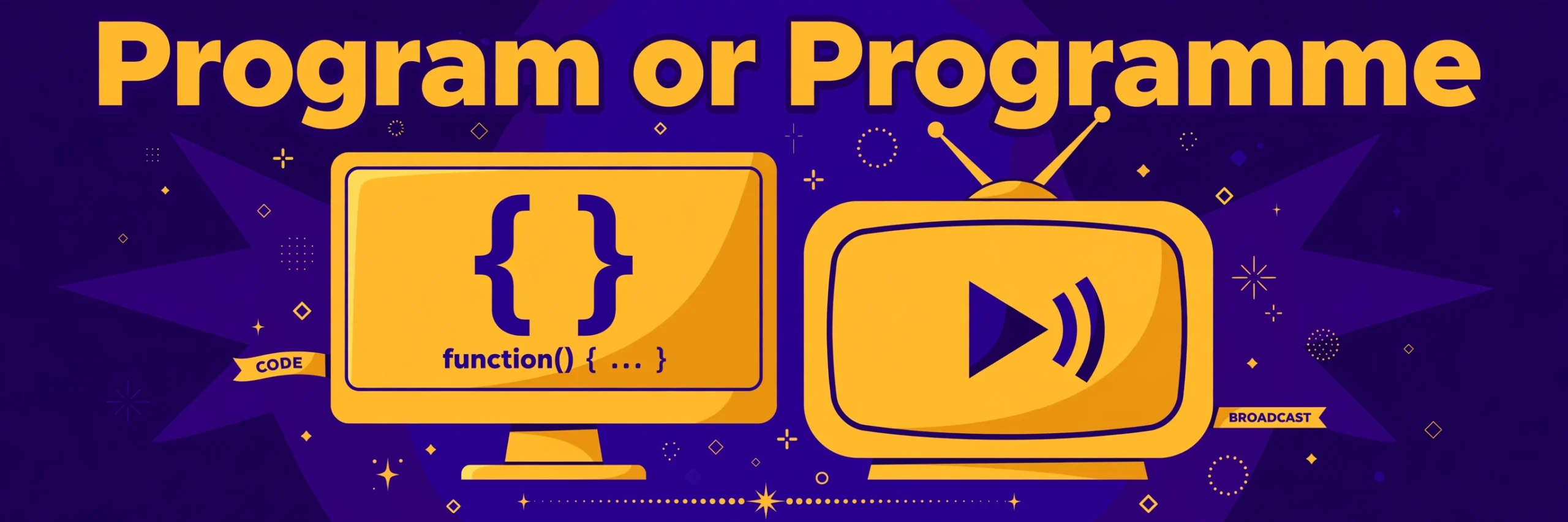
Both — but never interchangeably. Program is the American spelling for everything, and the universal spelling for computers in both varieties of English. Programme is the British spelling for everything else: the TV schedule, the concert plan, the printed running order. The single rule that prevents nearly every error is this: if it runs on a computer, it is always “program” — in London exactly as in Los Angeles. Everything else follows your audience’s dialect.
What the Dictionaries Say
The dictionaries present this as a dialect split with one hard exception — computing:
- Cambridge (programme): noun, UK (US program), /ˈprəʊɡræm/. Three senses: TELEVISION/RADIO (“a TV programme”), PLAN (“a plan of things to be done” — “a programme of reforms”), and THIN BOOK (“a printed sheet telling people about a play, concert, etc.” — “According to the programme, the show begins at 8.00”). Then the crucial carve-out: “(*British and American usually* program) a set of data, instructions etc put into a computer.”
- Merriam-Webster (program): noun — “a public notice” (from Late Latin programma, from Greek); “a brief usually printed outline of the order to be followed” (the concert program); “the performance of a program, especially a performance broadcast on radio or television”; “a plan or system under which action may be taken toward a goal”; “a sequence of coded instructions that can be inserted into a mechanism (such as a computer).” MW’s programmes entry reads simply: “chiefly British spelling of program.” (Full entry: program at Merriam-Webster.)
- Dictionary.com: American /ˈproʊgræm/, “especially British, programme” — noun senses spanning “a plan of action,” “a broadcasted television or radio production,” “a precise sequence of instructions enabling a computer to perform a task; a piece of software,” and “a list of items, pieces, performers, etc., in a musical, theatrical, or other entertainment.”
No dictionary marks either spelling wrong. They are parallel standards — the choice is geographic and contextual, not qualitative. The errors come from applying the wrong standard to the wrong context.
The Decision Table: Which Spelling, Where
This is the whole system in one table. Find your meaning, find your audience, read off the spelling:
| Meaning | American English | British English |
|---|---|---|
| TV or radio show | program (“a TV program”) | programme (“a TV programme”) |
| Plan of events / schedule | program (“a program of reforms”) | programme (“a programme of reforms”) |
| Printed running order (concert, play) | program | programme |
| Computer software | program | program — always |
| Verb: to schedule / arrange | program | programme (or program) |
| Verb: to write code | program | program — always |
The table’s most important row is the computer one. British English borrows the American spelling for computing across the board — “computer program,” “software program,” “to program the thermostat” — and this is not a modern sloppiness but the settled convention recorded in every dictionary. Writing “computer programme” is wrong in both dialects: Americans never write it, and the British convention explicitly excludes computing.
The Verb Forms: Programmed and Programming
The verb deserves its own section because the spelling of the -ed and -ing forms trips up even confident writers:
- Programmed and programming — double m — are the standard forms in both American and British English, for both the computing and the scheduling senses. (“She programmed the thermostat.” “They’re programming the festival.”)
- Programed and programing — single m — are recognized as American variants but are far less common; the Oxford English Dictionary recommends the double m, and most style guides agree.
- When the British verb is programme (to schedule or design), its forms are still programmed / programming — the final e drops before the suffix, exactly as with any -e verb. There is no “programmeed” or “programmeing.”
The practical rule: whatever the base spelling, the inflected forms always double the m. Memorize “programmed, programming” as a fixed pair and the verb stops being a problem.
A Short History: Why Two Spellings Exist
“Program” was the predominant spelling in Britain until the 19th century, when “programme” took over — largely under French influence (French has the same word, programme). American English, following the simplifying instinct associated with Noah Webster’s spelling reforms, kept the shorter form for everything. Then computers arrived in the 20th century, and British English — which had spent a century writing “programme” — adopted the American “program” for the new technology, creating the split system we have today.
This history explains the pattern’s odd shape: it is not really “British vs. American” but “19th-century French-influenced British spelling for traditional senses, American spelling for the 20th-century technology.” The same logic governs a small family of computing spellings where British English uses the American form: disk (not “disc”) for computer storage, and dialog box (not “dialogue box”) in software — both noted in usage guides as the same phenomenon.
Pronunciation: UK and US
The spelling changes; the sound doesn’t. Cambridge gives UK /ˈprəʊɡræm/ and US /ˈproʊɡræm/ (“PROH-gram”) for both program and programme — stress on the first syllable, identical whichever spelling is on the page. Plurals are regular: programs (US), programmes (UK non-computing). A writer who “corrects” a colleague’s programme aloud is correcting ink, not sound — a cousin of the same point made for analogue/analog (see below).
Correct vs. Incorrect
- ✓ (US) “The school started a morning breakfast program.” (Grammarly’s example)
- ✓ (UK) “Did you see that TV programme last night?”
- ✓ (UK) “We’re still drawing up the programme for the concert.”
- ✓ (UK and US) “This computer program won’t run on my PC.” (computing — always “program”)
- ✓ (UK and US) “She programmed her computer to wake him up.” (verb — double m, both varieties)
- ✗ (UK) “I missed my favourite television program.” → ✓ “…television programme.”
- ✗ (anywhere) “Install the latest version of this computer programme.” → ✓ “…computer program.”
- ✗ “He programed the thermostat.” → ✓ “He programmed the thermostat.” (double m preferred)
- ✗ (one document) “The programme begins at 8; the program notes are inside.” → pick one dialect per document.
Common Mistakes
1. Writing “computer programme.” The single most important error to avoid, because it is wrong in both dialects. Computing takes program everywhere — software, code, apps, programming. British writers who apply “programme” by habit to technology are making the one mistake the convention explicitly forbids.
2. Using “programme” in American writing. American English never uses programme — not for TV, not for concerts, not for plans. A “TV programme” in a US publication reads as a Britishism at best and a typo at worst. Match the house dialect.
3. Single-m verb forms: “programed,” “programing.” Recognized as American variants, but the double-m forms (programmed, programming) are overwhelmingly preferred and recommended by the OED. In British writing, the single-m forms look simply wrong. Use the double m everywhere.
4. Mixing spellings within one document. “Programme” in the introduction, “program” in the conclusion — neither is wrong, but the alternation signals unedited writing. One document, one dialect, one spelling (with the computing exception applied consistently).
5. Extending the pattern to relatives. The -amme/-am split belongs to this word only. There is no “programmeing,” no “programmatic/programmeatic” split (it’s programmatic everywhere), and the adjective programmable keeps the double m in all varieties.
If this Atlantic spelling split interests you, Clarifyra’s Analog or Analogue: Which Spelling Is Correct? covers the closest cousin of this pattern — the -ogue/-og family — including the same “technology keeps the American spelling” wrinkle.
Frequently Asked Questions
Is it “computer program” or “computer programme”?
Always “computer program” — in British and American English alike. Cambridge’s entry makes the carve-out explicit: “British and American usually program” for “a set of data, instructions etc put into a computer.” “Computer programme” is incorrect in both dialects.
Do Americans ever use “programme”?
Essentially never in standard writing. American English uses program for all senses — TV shows, plans, printed orders, software. “Programme” in a US text will be read as a Britishism or an error.
What are the correct verb forms?
Programmed and programming — double m — in both varieties and for both the computing and scheduling senses. The single-m forms (“programed,” “programing”) exist as less-common American variants but are best avoided.
Is “programme” just the British spelling of “program”?
For most senses, yes — Merriam-Webster defines it as “chiefly British spelling of program.” The refinement: British English keeps programme for broadcasts, plans, and printed orders, but uses program for computing — the one context where the British spelling does not apply.
How do you pronounce “programme”?
Exactly like “program”: UK /ˈprəʊɡræm/, US /ˈproʊɡræm/ — “PROH-gram,” stress on the first syllable. The extra -me is silent, like the -ue in “analogue.”
The Takeaway
Program is American for everything and universal for computers; programme is British for everything except computers. The verb is programmed / programming — double m, both varieties, no exceptions. Hold the one hard rule — computers always take “program” — and match the rest to your audience’s dialect, consistently, and this pair will never trouble you again.





2 Comments