Another Word for Meaning: Synonyms and How to Use Them
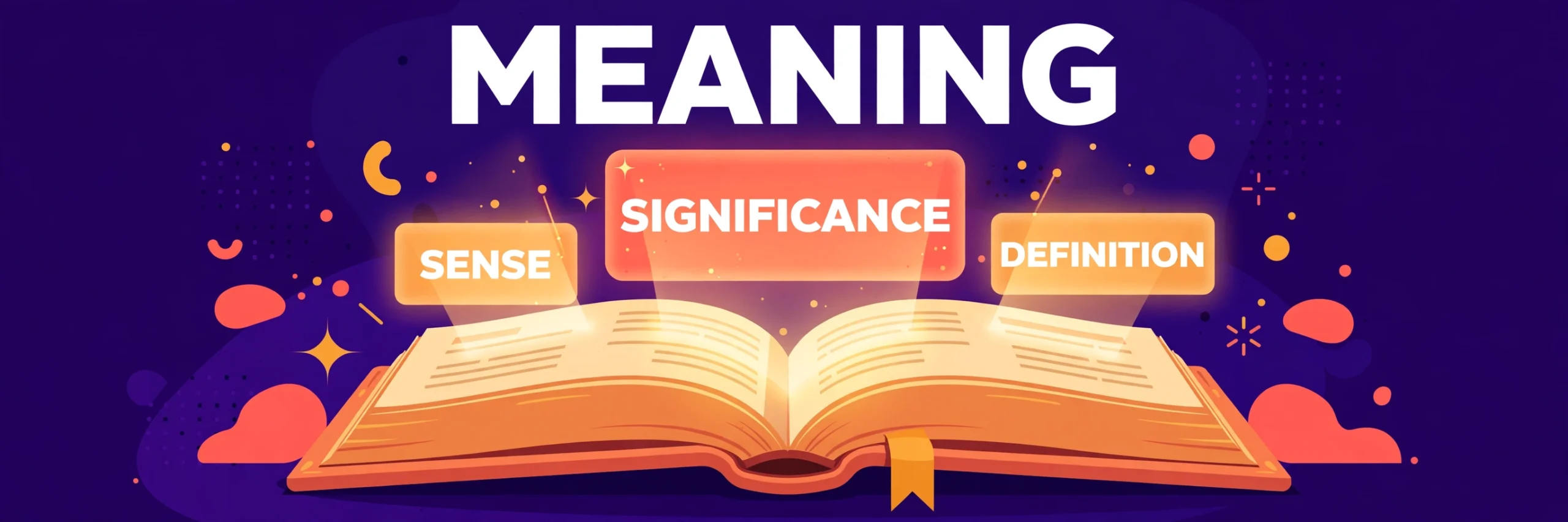
If you have ever written the word meaning three times in one paragraph, you know the problem: it is a useful word, but it is vague, and repeating it makes your writing feel flat. The good news is that English has a large stock of alternatives — sense, significance, definition, implication, gist, purpose — and each one fits a slightly different situation. The trick is not to collect synonyms, but to match the synonym to the exact shade of meaning you intend.
That is because meaning itself does several jobs. It can name what a word denotes, what a speaker intends, what matters about an event, or why a life feels worthwhile. No single synonym covers all of those. This guide sorts the best alternatives by the job they do, so you can pick the right word in seconds, with examples for each.
Quick Answer: The best synonym for meaning depends on context: use sense or definition for what a word means, significance or import for what something matters or implies, gist or essence for the main point, and purpose or point when you mean why something exists or matters. There is no single perfect replacement — match the word to the sense.
What Does “Meaning” Mean?
Before choosing a synonym, it helps to pin down what meaning is doing in your sentence. Oxford’s academic dictionary gives four main senses for the noun: (1) the thing or idea that something such as a word, sign, action or fact represents; (2) the ideas somebody wishes to communicate through a book, film or painting; (3) the quality or sense of purpose that makes something, especially a life, feel valuable; and (4) the real importance and nature of an experience or situation. Cambridge Learner’s Dictionary splits it more simply into two: what a word or symbol expresses, and purpose — as in “her life had no meaning”.
Those senses fall into three groups, and the synonyms group the same way. First, meaning as definition: what a word or symbol stands for. Second, meaning as message or implication: what is being communicated, openly or indirectly. Third, meaning as significance or purpose: why something matters, or why it exists. A synonym from the wrong group will sound off, even if a thesaurus lists it. “The significance of the word bank” is possible but stiff; “the definition of his sacrifice” is simply wrong.
| Sense of meaning | What you are really saying | Best synonyms |
|---|---|---|
| Definition (of a word or symbol) | What this word stands for | sense, definition, denotation |
| Message (of a text, speech, look) | What is being communicated | message, gist, substance, purport |
| Implication (what is suggested) | What is hinted, not stated | implication, connotation, suggestion |
| Significance (of an event) | Why this matters | significance, import, consequence |
| Purpose (of a life, a project) | Why this exists or is worth doing | purpose, point, value |
The Best Synonyms for “Meaning”, by Situation
1. Sense — the safest all-round replacement
Sense is the closest general synonym for meaning when you are talking about words. Collins lists sense among the first synonyms for meaning in the definition sense, with the example “a noun which has two senses”. It works because it carries the same idea of one meaning among several: “the word light has several senses”, “in this sense, fair means just”. It also works for intelligibility: “That sentence makes no sense” is far more natural than “That sentence has no meaning”.
Use sense when you are discussing words, phrases or statements, and when the point is understanding rather than importance. Avoid it when you mean purpose or value — “the sense of life” is possible, but “the meaning of life” is the idiomatic phrase, and purpose is the clearer synonym there.
2. Definition — for the dictionary meaning
When meaning refers to the formal, stated explanation of a word, definition is the precise word. Collins lists definition as a synonym for meaning in the sense “what is meant by a word or text”, with the example “There is no general agreement on a standard definition of sanity.” Say “the definition of photosynthesis” rather than “the meaning of photosynthesis” in academic or technical writing — it signals that you want the exact, agreed explanation, not a loose paraphrase.
Definition does not work for implied or emotional meaning. “The definition of her smile” sounds wrong because a smile has no dictionary entry; “the meaning of her smile” or “the significance of her smile” is what you want.
3. Significance — for importance and weight
Significance is the right word when meaning is about importance rather than definition. “The significance of the discovery” says the discovery matters and has consequences; “the meaning of the discovery” is vaguer and could be read as asking what the discovery was. Collins and Oxford both list significance as a core synonym, and it is the natural choice in history, science and news writing: “the historical significance of the treaty”, “the clinical significance of the result”.
Be careful with register. Significance is formal. In casual speech it can sound stiff, and in statistics it has a technical sense (statistical significance) that you should not confuse with the everyday one.
4. Implication — for what is suggested, not said
When the meaning is indirect — hinted at, suggested, or left to be inferred — implication is the precise word. Merriam-Webster defines implication as “an idea that is conveyed often indirectly”, and lists meaning itself among its near-synonyms. “The implication of his remark was clear: he did not trust us.” You could write “the meaning of his remark”, but implication tells the reader the meaning was unstated, which is exactly the point.
Implication also covers consequences: “the implications of the new law” means what will follow from it. That second use is so common that in policy and business writing, implications has almost become the default word.
5. Gist — for the main point, briefly
Gist means the general sense or main point of something, without the detail. Collins lists it as a synonym for meaning, with the example “He related the gist of his conversation to us.” Use it when you are summarising: “Give me the gist of the meeting”, “the gist of her argument is that taxes should rise”. It is informal and friendly, and it signals that you want the essentials only. Do not use gist when you need precision. “The gist of the contract” is a warning sign, not a summary — contracts need their exact terms, not their gist.
6. Purpose and point — for why something exists
When meaning is about purpose — “What is the meaning of this exercise?”, “She found meaning in her work” — the honest synonyms are purpose and point. Collins lists purpose, point, end, goal and idea for this sense. “What is the point of this exercise?” is more natural than “What is the meaning of this exercise?” in everyday speech, and “a sense of purpose” is the standard phrase for feeling that your life or work matters.
Point is casual and direct; purpose is steadier and more formal. “What is the purpose of the meeting?” suits a work email; “What is the point of this meeting?” suits a frustrated colleague. Both are correct, but they carry different tones.
More Synonyms, with Their Exact Shade
The words above cover most situations. The table below adds the second tier: words that are excellent in their niche but misleading outside it.
| Synonym | Best for | Watch out for |
|---|---|---|
| import | Formal writing; the weight of a speech or message | Sounds old-fashioned in casual speech |
| purport | The stated or apparent meaning of a formal document or speech | Implies the real meaning may differ from the stated one |
| substance | The real content of a discussion or argument | Also means physical matter; can confuse |
| connotation | The feelings or ideas a word suggests beyond its literal sense | Not a synonym for the literal meaning — it is the opposite pole |
| denotation | The literal, dictionary sense of a word | Technical; use only when contrasting with connotation |
| interpretation | One person’s reading of a text, event or figure | Implies a personal view, not a fixed meaning |
| drift | Informal; the general direction of what someone is saying | Very informal; “I get your drift” is idiomatic |
Two of these deserve a closer look, because they are often confused with each other. Denotation is the literal, dictionary meaning of a word — what it refers to. Connotation is everything the word suggests on top of that: the feelings, associations and social signals it carries. “Home” denotes a place where someone lives; it connotes warmth, safety and belonging. If you need that contrast, those two words are a pair, and neither is a straight replacement for meaning on its own.
Common Mistakes When Replacing “Meaning”
| Mistake | Why it fails | Better version |
|---|---|---|
| “The definition of the protest” | A protest has no dictionary definition | “The significance of the protest” |
| “The purpose of the word serendipity“ | Words do not have purposes; they have senses | “The sense of the word serendipity“ |
| Swapping in a synonym just to avoid repetition | A slightly wrong word is worse than a repeated right one | Repeat meaning once, or restructure the sentence |
The last row is the most important. Repetition is a real problem, but a thesaurus is not a cure-all. If no synonym fits exactly, repeat meaning or rewrite the sentence so the word is not needed: “What does this mean?” can become “What is she trying to say?” — no synonym required.
Frequently Asked Questions
What is the best synonym for “meaning”?
There is no single best synonym. Sense is the best general replacement for word meanings, significance is best for importance, gist is best for summaries, and purpose is best when you mean why something matters. Match the word to the sense you intend.
Is “significance” a synonym for “meaning”?
Yes, in the sense of importance. Collins lists significance as a synonym for meaning, and it is the standard choice when you are discussing why an event, discovery or decision matters. It is not a good synonym when you mean a word’s definition.
What is the difference between meaning and significance?
Meaning is the general word: what something expresses, denotes or intends. Significance is narrower: it refers to importance, especially importance that is implied rather than stated, or that may not be obvious at first. “The significance of her glance” means the glance mattered in a way that was not obvious; “the meaning of her glance” is vaguer.
What is another word for “meaning of life”?
Purpose is the usual replacement: “a sense of purpose”, “the purpose of life”. Value also works in some contexts (“what gives life value”), as does point in casual speech (“what is the point of it all?”). Avoid definition here — a life is not a dictionary entry.
The Takeaway
Meaning is a general word that does at least three jobs — definition, message and purpose — and its synonyms split along the same lines. For a word’s meaning, use sense or definition. For what a message conveys, use gist, message or substance. For what is hinted, use implication. For why something matters, use significance. For why it exists, use purpose or point. Choose by sense, test the swap by reading the sentence aloud, and when no synonym fits exactly, keep meaning — a repeated right word beats a wrong elegant one.
Sources: synonym senses checked against Collins English Thesaurus (meaning), Oxford Learner’s Dictionary of Academic English (meaning), Cambridge Learner’s Dictionary (meaning) and Merriam-Webster Thesaurus (implication); the denotation/connotation contrast follows the standard dictionary distinction recorded by Collins.