Pita Meaning: Definition, Uses, and Examples
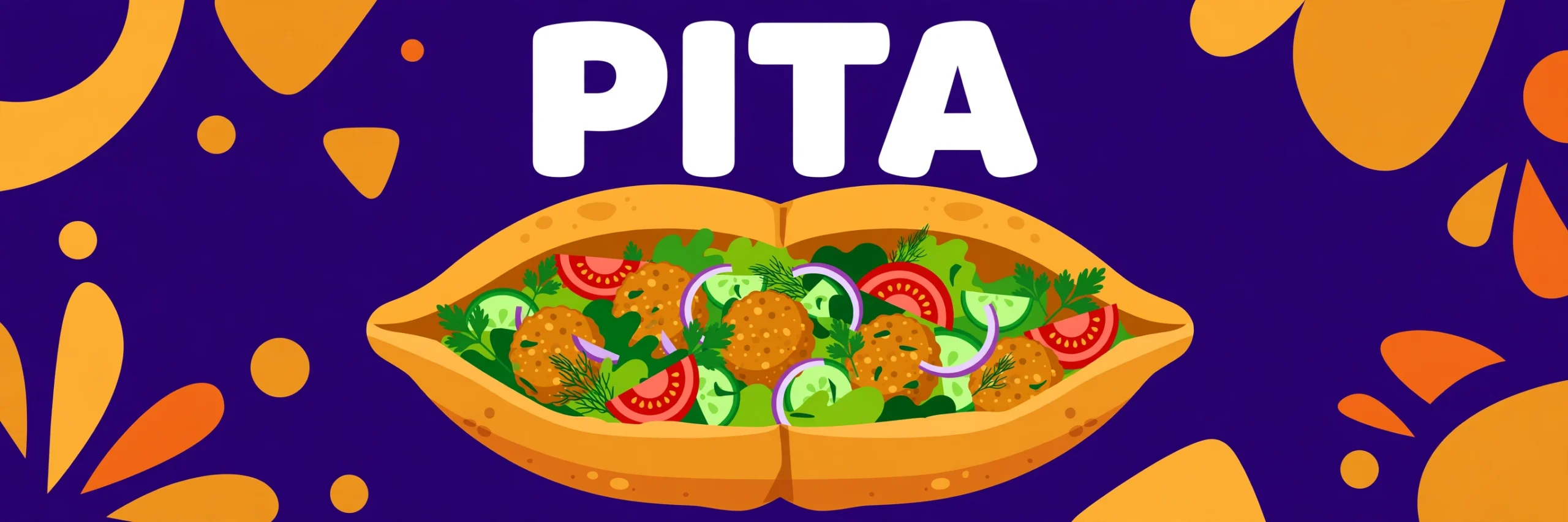
A pita is a round, soft flatbread that puffs up in a hot oven and can be split open to form a pocket. If you have ever torn a piece of warm bread to scoop up hummus, or eaten a falafel sandwich wrapped in a soft, pillowy round, you have almost certainly eaten pita. It is one of the most familiar breads in Middle Eastern and Mediterranean cooking, and it has become an everyday food far beyond the region where it began.
Most people meet the word pita on a menu or in a supermarket, where it usually means the bread itself. But the word has more than one meaning, and its spelling changes between British and American English. This guide covers the bread, the less common fibre sense, the slang abbreviation PITA, and the pita/pitta spelling question, with examples you can use straight away.
Quick Answer: Pita is a noun meaning a round, soft Middle Eastern flatbread, usually made from wheat flour, water, yeast and salt, that puffs up during baking so it can be split open and filled. In British English it is usually spelled pitta. As an abbreviation, PITA is informal slang for “a pain in the ass” — an annoying person or thing.
What Does Pita Mean?
The main meaning of pita is a type of flatbread. Oxford Learner’s Dictionaries defines it as “a type of flat bread in the shape of an oval that can be split open and filled”, and Merriam-Webster describes it as “a thin flat bread that can be separated easily into two layers to form a pocket”. Both definitions point to the same two features that make pita different from other breads: it is flat, and it opens up.
Pita is made from a simple dough — wheat flour, water, yeast and salt — rolled into thin rounds and baked at a very high temperature. The heat turns the moisture in the dough into steam, which inflates the round like a balloon. As it cools, the bread settles back down, but the two layers stay separate, leaving the pocket inside. That pocket is the whole point: it turns a flat piece of bread into a container for food.
In everyday use, pita can refer to the whole round, to one half of a split round, or to the bread in general. You can say “a pita”, “two pitas”, or “some pita” depending on whether you are counting rounds or talking about the food as a substance. Oxford lists it as both countable and uncountable for exactly this reason.
| Form | What it means | Example |
|---|---|---|
| pita (noun) | A round, soft flatbread that can be split and filled | “She stuffed the pita with grilled chicken.” |
| pita bread | The same bread, named in full | “Serve the soup with warm pita bread.” |
| pita pocket | A pita opened up and used as a pouch | “Falafel in a pita pocket is a classic lunch.” |
| PITA (abbreviation) | Informal slang: “a pain in the ass” | “That printer is a real PITA.” |
How to Pronounce Pita
Pita is pronounced with two syllables, PEE-tuh, with the stress on the first syllable. Oxford Learner’s Dictionaries gives the British pronunciation as /ˈpiːtə/ and also records /ˈpɪtə/, while the American pronunciation is /ˈpiːtə/. In practice, most American speakers say PEE-tuh and most British speakers say either PEE-tuh or PIH-tuh. None of these is wrong; they are regional variants of the same word.
The spelling is where the regions really differ. In American English the bread is pita. In British English it is usually pitta, with a double t — although pita is also used and understood in Britain. Oxford lists the British form as pitta (North American English pita) and the American form as pita (British English pitta). If you are writing for an American audience, use pita; for a British audience, pitta is the safer choice. Do not mix the two spellings in one piece of writing.
One pronunciation to avoid: pita is not pronounced “pie-tah” with a long i as in pie. The first vowel is the long ee sound (or, in some British speech, a short i), and the second syllable is a soft, unstressed tuh.
The Main Meaning: Pita as a Flatbread
Pita comes from the eastern Mediterranean and the Middle East, where flatbreads baked in very hot ovens have been made for centuries. The word itself comes from modern Greek píta, meaning “pie” or “cake”, and is related to Turkish pide and, more distantly, to pizza. That shared history is a useful reminder that many of the world’s best-known breads are cousins.
What sets pita apart from other flatbreads is the pocket. A tortilla wraps around food; a naan is torn and used for scooping; a pita opens into a pouch that holds the filling inside. That makes it practical as well as tasty: a filled pita is a sandwich you can eat while walking, with far less mess than an open wrap.
How pita is eaten
The most familiar way to eat pita is filled. Falafel, shawarma, souvlaki, grilled halloumi and salad are all commonly served in a pita pocket. The bread is cut in half, each half is opened into a pocket, and the filling goes inside. In restaurants the pita is often warmed first, which makes it softer and easier to open without tearing.
The second common use is as a scoop. Torn into pieces, warm pita is the natural partner for dips: hummus, baba ghanoush, tzatziki, labneh and muhammara. The bread is sturdy enough to carry a thick dip without breaking, which is exactly why it works where a cracker might snap.
Pita, naan and tortilla: how they differ
People often group all flatbreads together, but they are not interchangeable. The table below shows the practical differences that matter in the kitchen.
| Bread | Texture | Pocket? | Typical use |
|---|---|---|---|
| Pita | Soft, thin, chewy | Yes — it splits into two layers | Filled sandwiches, scooping dips |
| Naan | Soft, thick, pillowy, often buttery | No | Torn and scooped with curries |
| Tortilla | Thin and flexible | No | Rolled or folded around a filling |
| Lavash | Very thin and soft, or crisp when dried | No | Wraps, crackers, scooping |
That said, in a home kitchen the lines blur: a soft tortilla can stand in for a pita wrap in a pinch, and a piece of naan works fine for scooping hummus. The differences matter most when the recipe depends on the pocket, as a falafel sandwich does.
Other Meanings of Pita
The bread is by far the most common meaning, but it is not the only one. Knowing the others prevents confusion when you meet the word in an unexpected context.
Pita as a plant fibre
Pita is also the name of a strong fibre obtained from agave plants and related species, used for cordage, mats and paper. Merriam-Webster lists this sense first in its entry, defining pita as “any of several fiber-yielding plants (such as an agave)” and “the fiber of a pita”. Dictionary.com gives the same sense. This meaning comes from a different source — Latin American Spanish, from Quechua pita — and is unrelated to the Greek bread word. You will rarely meet it outside botanical or historical writing, but it explains why some older dictionaries treat the fibre sense as the primary one.
PITA as slang
In informal writing, especially online and in text messages, PITA is an abbreviation of “pain in the ass” (in British English, “pain in the arse”). Cambridge’s English–Spanish dictionary records it as the abbreviated form of “pain in the arse”, with the example “Deeply held beliefs are no excuse for being a PITA.” It describes an annoying person, task or thing: a fiddly form, a printer that keeps jamming, a neighbour who complains about everything.
This is slang, and the full phrase is mildly rude. Use the abbreviation only in casual contexts where that tone is acceptable, and never in formal writing. The capital letters are part of the point: written in capitals, PITA reads as an abbreviation; written in lower case, pita reads as the bread.
Pita in Real Sentences
Seeing a word in use is the fastest way to learn it. These examples show each sense in a natural sentence.
- “The waiter brought a basket of warm pita with olive oil for dipping.”
- “Cut the pita in half and fill each pocket with falafel and salad.”
- “She tore off a piece of pita and scooped up the hummus.”
- “Filling in this tax form is a real PITA — it asks for the same information three times.”
Notice how the countable and uncountable uses sit side by side: “two pitas” counts the rounds, while “some pita” or “warm pita” treats the bread as a substance. Both are correct; choose the one that matches what you mean.
Common Mistakes with Pita
Most errors with pita are small, but they are easy to avoid once you know them.
| Mistake | Why it is wrong | Correct version |
|---|---|---|
| “A piece of pita breads” | Bread is uncountable; it has no plural in this sense | “A piece of pita bread” |
| “Pita’s are on sale” | The apostrophe is wrong; the plural is pitas | “Pitas are on sale” |
| Mixing pita and pitta in one text | Pick one regional spelling and stay with it | Pita (US) or pitta (UK) throughout |
| Calling any flatbread a pita | Naan and tortillas are different breads | Use pita only for the pocket flatbread |
| Using PITA in formal writing | It is slang for a rude phrase | Use “a nuisance” or “a hassle” instead |
| “Pitta” in an American recipe | American readers expect pita | Match the spelling to your audience |
Frequently Asked Questions
Is pita the same as pitta?
Yes. Pita and pitta are the same bread. Pita is the American spelling and pitta is the usual British spelling. The pronunciation is the same in most cases, and the bread is identical.
Is pita bread healthy?
Pita is a bread, so its health value depends on the type. Whole-wheat pita contains more fibre than white pita, and either is a reasonable choice as part of a balanced meal, especially when filled with vegetables, lean protein and dips like hummus. It is the filling, more than the bread, that usually decides how healthy the meal is.
Can you eat pita cold?
Yes, but it is much better warm. Cold pita can be stiff and hard to split without tearing. Warming it for a minute in a dry pan, a toaster or a microwave makes it soft and pliable again.
What is the plural of pita?
The plural is pitas (or pittas in British spelling). Some dictionaries also record pites, but pitas is the form you will see almost everywhere.
What does PITA mean in slang?
PITA is an abbreviation of “pain in the ass” (British: “pain in the arse”). It means an annoying person or thing. It is informal slang and should not be used in formal writing.
The Takeaway
Pita is a round, soft flatbread that puffs into a pocket in a hot oven — the bread of falafel sandwiches, shawarma wraps and hummus scooping. Spell it pita for American readers and pitta for British ones, pronounce it PEE-tuh, and keep the capital-letter slang PITA for casual contexts only. Once you know the pocket, the spelling split and the slang sense, there is very little left to get wrong.
Sources: definitions and pronunciations checked against Oxford Advanced Learner’s Dictionary (pita, pitta, pita bread), Merriam-Webster (pita, PITA) and Cambridge Dictionary (pita, PITA); the fibre sense and etymology checked against Merriam-Webster and Dictionary.com.