Grinded or Ground: Which Is Correct?
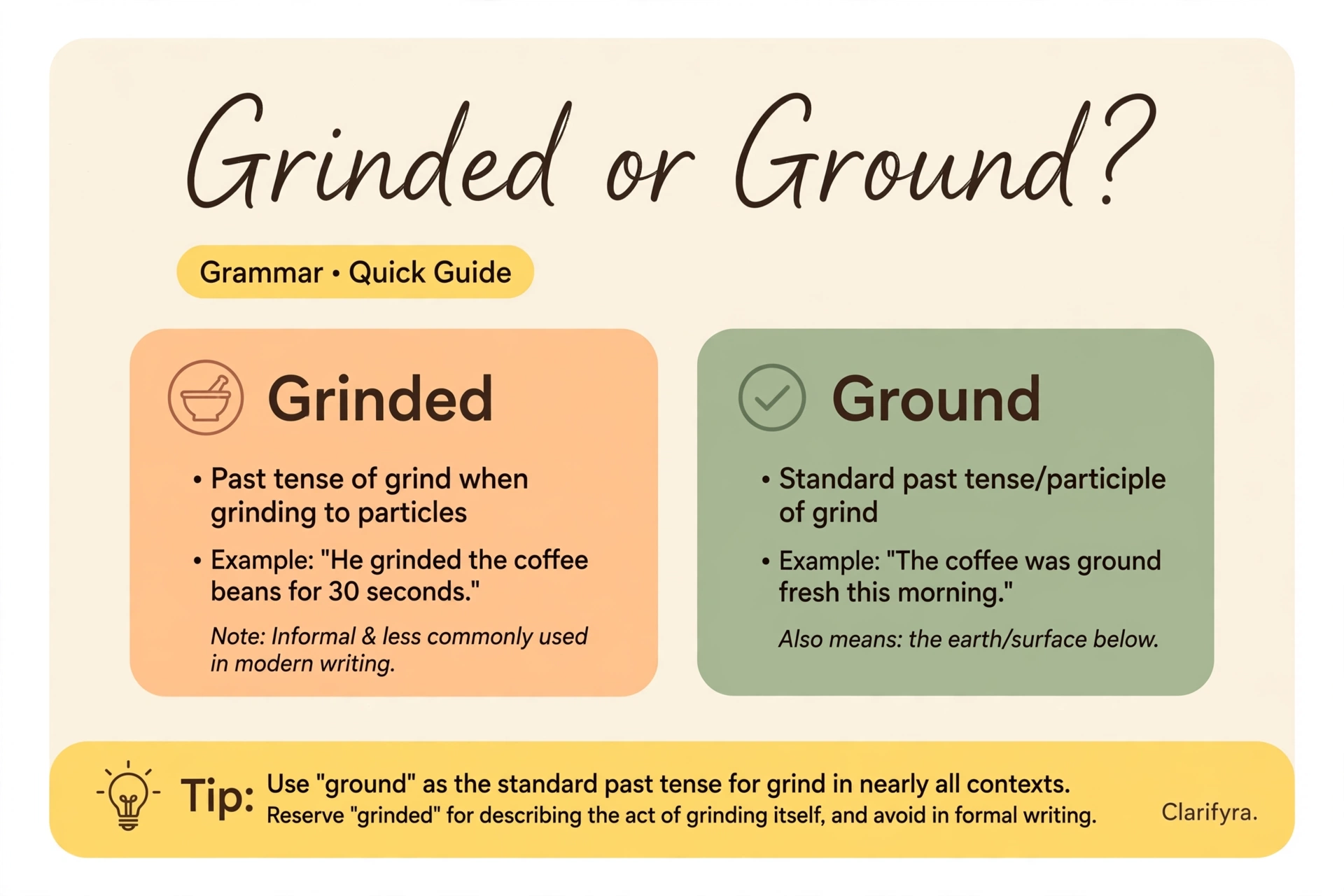
“Grinded” looks logical — most English verbs just add -ed — but ground is the standard past tense and past participle of grind: “she ground the coffee,” “freshly ground pepper,” “the gears ground to a halt.” Grind belongs to the old irregular family of English verbs that change their vowel instead of adding -ed, like find/found and bind/bound. Grinded does appear in dictionaries as a rare variant, and you will hear it in speech, but in edited writing it is treated as non-standard. If you are choosing for anything formal — an essay, a report, a published recipe — ground is the answer.
Quick Answer
The past tense and past participle of grind is ground: “I ground the beans this morning,” “have you ground the spices?” Every major dictionary checked — Oxford Learner’s, Collins, Merriam-Webster, Cambridge — gives the verb forms as grinds, grinding, ground, ground, with no -ed form in the standard paradigm. Grinded is recorded in some dictionaries as a rare variant and turns up in informal speech and writing, but it is not the standard form and will be marked wrong in most edited English. Pronunciation: grind is /ɡraɪnd/; ground is /ɡraʊnd/ — the same sound as the noun ground (the earth).
The Verb “Grind” and Its Irregular Past
Oxford Learner’s lays out the paradigm in full. The verb grind /ɡraɪnd/ runs: present simple grind/grinds, past simple ground /ɡraʊnd/, past participle ground, -ing form grinding. Collins’ verb table agrees line for line — past “I ground, you ground,” past perfect “I had ground” — and its pronunciation entry gives the word forms as “3rd person singular present tense grinds, present participle grinding, past tense, past participle ground.” Merriam-Webster’s examples show the same usage in the wild: “The corn is ground into meal,” “ground dirt into the carpet.” No -ed form appears in any of these standard paradigms.
This vowel-change pattern is ancient. Grind descends from Old English grindan, and it keeps company with a small, stubborn set of verbs that form their past by shifting the vowel: find → found, bind → bound, wind → wound, grind → ground. These verbs are frequent enough in daily speech that their irregular forms never levelled out the way rarer verbs did. When a new or occasional user of the verb reaches for the regular pattern — grinded, by analogy with wanted or needed — the result is understandable but non-standard, rather like teached for taught.
The meanings that take ground cover everything grind does. Oxford groups them as: crushing food or grain into small pieces (grind coffee/corn; “freshly ground black pepper”), making something sharp or smooth by friction (grinding knives), pressing something into a surface (he ground his cigarette into the ashtray), rubbing hard objects together (she grinds her teeth), moving noisily and slowly (the trucks ground up the mountain track), and turning a mill’s handle. Merriam-Webster adds the figurative and slang layers — oppressing (“ground down by poverty”), studying hard (“grinding away at the task”), and the dance sense. In every one of those senses, past reference takes ground.
So Where Does “Grinded” Come From?
Grinded is best described honestly: it exists, it is rare, and standard references treat it as a variant rather than the norm. The Random House dictionary tradition, quoted in Collins’ American entries and WordReference, gives the verb as “ground or (Rare) grinded” — that parenthetical “Rare” is the crucial detail. Historical dictionaries record grinded from earlier centuries, when the verb’s conjugation was less fixed; an oft-quoted 17th-century line has “the tooth of usury be grinded.” Modern corpus evidence shows grinded surviving at the margins: in unedited journalism from parts of the English-speaking world (“Pakistan grinded the New Zealand top order”), in sports and music slang where grind has specialised new senses (a skateboarder who “grinded the rail”), and in the speech of children and learners applying the regular -ed rule.
That slang corner deserves a fair hearing. When a verb develops a genuinely new meaning, speakers sometimes regularise it — the same process that gives baseball’s “he flied out” alongside flew. Some younger speakers feel grinded belongs to the dance-floor and skate-park senses of grind in a way ground does not. Dictionaries have not adopted that distinction: Merriam-Webster includes the dance sense (“to rotate the hips in an erotic manner”) within the main grind entry whose past is ground, and Oxford does the same. The safe summary for learners is simple — in standard written English, grinded will be read as an error regardless of which sense you intend. You may describe it, quote it, or use it deliberately in dialogue; you should not rely on it in formal prose.
One more confusion to clear away: ground the verb form is a homonym of ground the noun (earth, floor, basis) and ground the electrical and aviation verb. Those are separate dictionary entries with their own past forms — planes are grounded, arguments are grounded in fact, children are grounded by their parents. The existence of regular grounded (from the noun ground) is probably one reason grinded feels plausible: the sound pattern “base + -ed” is right there in the same spelling neighbourhood. But the entries are distinct, and grind‘s past remains ground, never grounded and not standardly grinded.
The Forms at a Glance
| Form | Standard spelling | Pronunciation | Example |
|---|---|---|---|
| Base / infinitive | grind | /ɡraɪnd/ | “Grind the pepper fresh.” |
| Third person present | grinds | /ɡraɪndz/ | “She grinds her teeth at night.” |
| Present participle | grinding | /ˈɡraɪndɪŋ/ | “The gears are grinding.” |
| Past simple | ground | /ɡraʊnd/ | “He ground the beans at dawn.” |
| Past participle | ground | /ɡraʊnd/ | “Freshly ground coffee.” |
| Rare variant (avoid in formal writing) | grinded | /ˈɡraɪndɪd/ | Recorded as rare; treated as non-standard |
Note the pronunciation relationship: grind /ɡraɪnd/ and ground /ɡraʊnd/ differ only in the vowel — “gr-eye-nd” versus “gr-ow-nd.” If you say the sentence aloud and hear the -ow- sound, you want the spelling ground. The -ed pronunciation (“GRINE-ded”) is the tell-tale sign of the non-standard form.
Correct vs. Incorrect
- ✓ “I ground the coffee this morning.” (past simple)
- ✗ “I grinded the coffee this morning.” → ✓ “I ground the coffee this morning.”
- ✓ “Freshly ground black pepper.” (past participle as adjective)
- ✗ “Freshly grinded black pepper.” → ✓ “Freshly ground black pepper.”
- ✓ “The mill ground to a halt during the strike.” (idiom: grind to a halt — Oxford records “Production ground to a halt”)
- ✗ “The mill grinded to a halt.” → ✓ “The mill ground to a halt.”
- ✓ “She has ground that axe for years.” (have an axe to grind — past participle ground)
- ✓ “The plane was grounded for repairs.” (different verb: ground = keep on the ground; grounded is correct here)
- ✗ “He grounded his teeth all night.” → ✓ “He ground his teeth all night.” (grind, not ground, is the base verb)
The last pair is the subtlest. Ground is the past of grind; grounded is the past of the separate verb ground (“to keep on the ground, to base, to connect electrically”). Keeping the two verbs apart in your mind makes both choices easy.
Common Mistakes
1. Regularising the irregular: “grinded.” The root error. English speakers meet far more regular verbs than irregular ones, so grinded feels like the default. But Oxford, Collins, Merriam-Webster, and Cambridge all record ground as the past and past participle, full stop. In exams, edited articles, and professional writing, grinded will be corrected to ground.
2. Treating “grinded” as the safe formal option. Some writers, sensing that ground sounds too much like “the ground” (soil), reach for grinded to sound precise. The instinct backfires: ground meaning “reduced by grinding” is fully established — ground coffee, ground beef (North American English for minced beef), ground glass, ground almonds. These fixed phrases never take -ed.
3. Confusing “ground” with “grounded.” “The flight was grinded” and “he grounded his teeth” are mirror-image errors. Aviation, discipline, electricity, and reasoning take the verb ground → grounded. Crushing, sharpening, and teeth take the verb grind → ground. Match the base verb first; the past form follows automatically.
4. Hypercorrecting the slang senses. Writing about dance or skateboarding, authors sometimes insist on grinded as though it were the “correct slang conjugation.” Current dictionaries do not support a separate past for those senses; they sit inside the main grind entry. In reported speech or quotation, keep a speaker’s grinded as spoken; in your own narration, ground remains the defensible choice.
5. Misspelling the participle in set phrases. Recipe and menu English is full of ground: freshly ground pepper, finely ground almonds, coarsely ground pork (Collins’ example). “Freshly grinded” on a menu signals an unedited text to many readers. When in doubt in the kitchen, it’s ground.
Frequently Asked Questions
Is “grinded” a real word?
It is a recorded word, but a rare and non-standard one. The Random House tradition carried in Collins and WordReference lists “ground or (Rare) grinded,” and historical usage exists. That is different from being acceptable in standard modern writing. For Clarifyra’s purposes the answer is: grinded exists at the margins; ground is the form to use.
Why doesn’t “grind” just add “-ed” like most verbs?
Because it is one of the Old English strong verbs that change their vowel to mark the past — the family of find/found, bind/bound, wind/wound. High-frequency verbs resist regularisation because speakers hear the irregular form constantly. Grindan was already irregular in Old English, and ground has held its ground ever since.
What is the difference between “ground” and “grounded”?
They are past forms of two different verbs. Ground (no -ed) is the past of grind: “she ground the spices.” Grounded is the past of ground: “the pilot was grounded,” “an argument grounded in evidence,” “grounded wiring,” “you’re grounded for a week.” Same letters, different base verbs — context always tells you which one is meant.
Is it “ground beef” or “grinded beef”?
Ground beef — always. Oxford notes the North American usage: grind means “to cut food, especially meat, into very small pieces using a special machine,” and the resulting product adjective is ground (ground beef, ground turkey, ground pork). British English usually calls the same product minced beef or mince, but the American term is ground, never grinded.
The Takeaway
Ground is the past tense and past participle of grind — “I ground the beans,” “freshly ground pepper,” “the talks ground to a halt.” Grinded survives as a rare, historically attested variant and a common learner’s regularisation, but Oxford, Collins, Merriam-Webster, and Cambridge all give ground as the standard form, and edited English expects it. Keep it beside its irregular cousins — find/found, bind/bound, grind/ground — and keep it separate from grounded, which belongs to the different verb ground (planes, punishments, and electrical earths). When the vowel changes to /aʊ/, the spelling is ground.