Anywho or Anyhoo: Which Is Correct?
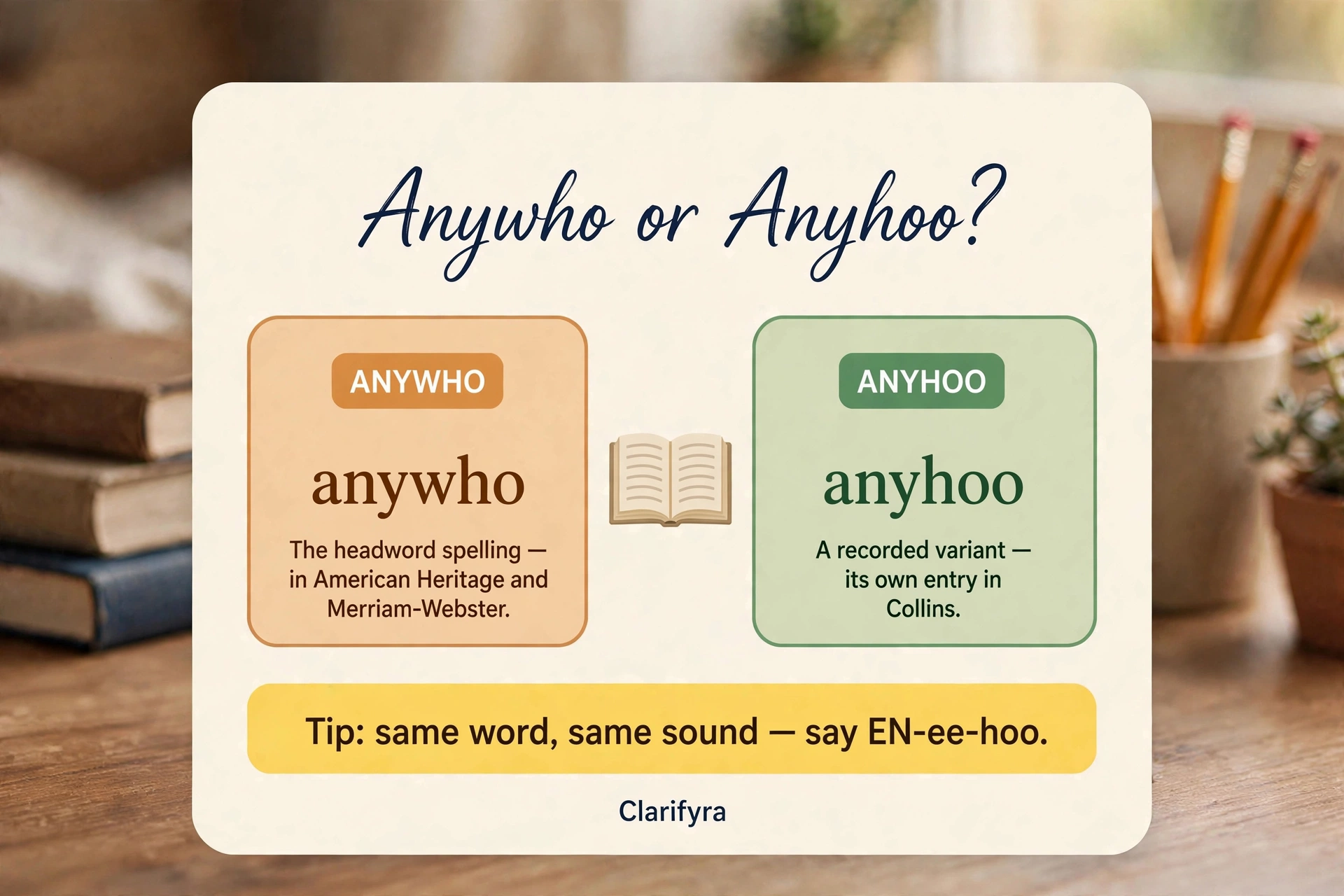
If you’re torn between anywho and anyhoo, neither spelling is wrong. They are two accepted written forms of the same informal word — a humorous, deliberately casual variant of anyhow/anyway used to change the subject, brush past a tangent, or dismiss what was just said. American Heritage lists the headword as anywho with anyhoo as its variant spelling, Merriam-Webster’s entry sits under anywho, and Collins gives anyhoo its own entry. Pick one and use it consistently; just don’t use either in formal writing.
Quick Answer
Anywho and anyhoo are both dictionary-recorded spellings of the same word, pronounced EN-ee-hoo, meaning “anyhow/anyway.” American Heritage’s headword is anywho (“also anyhoo“), marking it Slang; Merriam-Webster’s entry is under anywho (“chiefly US, informal + humorous”); Collins lists anyhoo as an adverb in its own right. Anywho is the slightly safer pick — the headword in two of the three dictionaries that record the word. Both are informal: fine in texts and casual emails, wrong in reports and essays.
What “Anywho” / “Anyhoo” Means
At heart it’s a sentence adverb — a little word that sits at the start of a sentence and steers the conversation. American Heritage defines it as “in spite of that; nevertheless; however” and “in any case; at least; anyway.” In practice it does three conversational jobs:
1. Changing the subject. “We could argue about the seating chart all night. Anywho, who’s driving tomorrow?” The word closes one topic and opens another, usually with a wink.
2. Resuming after a tangent. “Anyhoo, back to that killer finale …” — Lynette Rice, yahoo.com (2021), as cited by Merriam-Webster.
3. Brushing something aside. “I can only feel half my face thanks to the wonders of modern dentistry. There may or may not be drool. Anyhoo, on with the show!” — Tory Shepherd, The Guardian (2022), via Merriam-Webster. The signal: we’re done with that, moving on.
The tone is the point: this is a joking, self-aware word, and the “who” spelling makes it look and sound like a punchline — which is exactly what the etymology says it is.
Where It Comes From
Both Merriam-Webster and American Heritage trace the word to a humorous alteration of “anyhow.” Merriam-Webster goes one step further, suggesting it was “probably originally jocular appropriation of Scots and Ulster onie-hoo” — the Scots rendering of “anyhow.” So the joke is old: take the flat, everyday “anyhow” and inflate its ending into something cartoonish.
It’s also older than it sounds. Merriam-Webster’s first known use is 1850. A Newsday citation from 1991 shows it thriving in American dialogue long before the internet: “…snapping such lines as ‘Say, what’s the big idea, anyhoo?'” So while the word feels like internet-era slang, the dictionaries date the joke to the mid-19th century — which contradicts the common claim that it’s not a real word, just a modern corruption.
How the Dictionaries Treat Each Spelling
This is where the “which is correct?” question gets its real answer — and the dictionaries don’t all say it the same way, which is precisely the point.
American Heritage (5th edition) puts the headword at anywho and prints “also anyhoo” directly beneath it, with one shared pronunciation, (ĕn′ē-ho͞o′), and the label Slang. In dictionary convention, the headword spelling is the one the editors consider primary; the “also” form is fully accepted but secondary.
Merriam-Webster enters the word under ANYWHO, glossed “chiefly US, informal + humorous: anyhow, anyway.” Here’s the telling detail: all four of Merriam-Webster’s own usage citations spell it “Anyhoo.” The dictionary’s entry spelling and its real-world evidence point in different directions — a quiet admission that usage is split and both forms are in circulation.
Collins goes the other way: it publishes anyhoo as its own entry — an adverb pronounced (ˈɛnɪˌhuː), added via Collins’s new-word process with the note “an informal and humorous spelling of anyhow.” Collins COBUILD’s learner’s dictionary even uses it in example sentences: “Anyhoo, that is not the most pressing matter here.”
Cambridge is the honest gap in this survey. I found no standalone entry for either spelling on dictionary.cambridge.org — though Cambridge’s “anyhow” entry does list anyhoo among its related forms, which shows the word is on the editors’ radar even if it hasn’t earned its own entry. I likewise found no Oxford Learner’s entry for either form. That absence isn’t proof the word is wrong — Merriam-Webster, Collins, and American Heritage record it — but it does mark the word as outside the core vocabulary learners’ dictionaries cover.
Pronunciation: UK and US
Here’s the pleasant part: the two spellings are pronounced identically, so the spelling choice changes nothing about how the word sounds.
United States: EN-ee-hoo — American Heritage gives (ĕn′ē-ho͞o′) for both anywho and anyhoo alike.
United Kingdom: Collins transcribes its anyhoo entry as (ˈɛnɪˌhuː) — the same EN-ee-hoo, with the shorter “i” of British-influenced transcription. No distinct British pronunciation: same word, same sound.
For reference, the word it derives from — anyhow — is /ˈen.i.haʊ/ in both Cambridge’s UK and US transcriptions (“EN-ee-how”). The joke spelling keeps the first two syllables and swaps the blunt “how” for a long, breezy “hoo.” That swap is the entire point of the word: it sounds like “anyhow” said by someone being deliberately silly.
UK vs US: Who Actually Says It?
Merriam-Webster labels the word “chiefly US,” which matches the bulk of the citation evidence (NBC News, Newsday, yahoo.com). But “chiefly” isn’t “only.” Collins — a British publisher — carries anyhoo in its English dictionary, and Merriam-Webster’s most recent citation is from The Guardian (London, 2022). So the word crosses the Atlantic; it just reads as American-flavored wherever it’s used.
The register is consistent everywhere: informal, humorous, slang. American Heritage’s Slang label and Merriam-Webster’s “informal + humorous” agree. That’s the one claim all three dictionaries make in unison, and it’s the most practically important one: whatever spelling you choose, the word belongs in speech, texts, social media, and deliberately casual writing — not in essays, reports, cover letters, or anything where you want to sound authoritative.
Correct vs Incorrect
- ✓ “We could debate the menu forever. Anywho, are we still on for Friday?”
- ✓ “We could debate the menu forever. Anyhoo, are we still on for Friday?”
- ✓ “Anyhoo, back to that killer finale.” (Merriam-Webster’s citation)
- ✓ “Sorry about the rant — anywho, how did the interview go?”
- ✗ “Anywho, the quarterly figures demonstrate a 4% decline.” → In a report, use anyway or in any case.
- ✗ “Any who are interested should sign up — anywho, moving on.” → The two-word any who (“anyone who”) is a different construction entirely; don’t split the interjection.
- ✗ “The defendant stated that, anyhoo, the contract was binding.” → Formal or legal writing; the word’s slang label disqualifies it.
Common Mistakes
1. Using it in formal writing. This is the mistake that actually costs people. ✗ “Anywho, our findings indicate…” in an essay or work report. The dictionaries’ register labels — Slang (American Heritage), “informal + humorous” (Merriam-Webster) — are instructions, not decorations. In formal contexts, write anyway, in any case, or nevertheless.
2. Writing “any who” as two words. ✗ “Any who, moving on.” The interjection is one word. Two-word any who means “anyone who” (“any who wish to attend…”) and reads as a different sentence entirely.
3. Treating “anyhoo” as a typo for “anywho” (or vice versa). A spellchecker set to a formal style may flag one or both, but the dictionaries record both forms. Correcting someone’s “anyhoo” to “anywho” isn’t fixing an error; it’s imposing a preference.
4. Using it where “anyhow” the adverb is needed. “Anyhow” also means “in a careless, haphazard way” (“he dressed anyhow”). Anywho/anyhoo carries only the conversational “anyway” sense — ✗ “she packed anywho” doesn’t mean she packed carelessly; it means nothing at all.
5. Overusing it as a crutch. As a topic-shifter it’s charming once; as a verbal tic every three sentences it becomes the thing people complain about. If every paragraph of your message starts with it, you’re leaning on a joke past its punchline.
6. Assuming it’s brand-new slang. It’s tempting to treat the word as a recent internet invention and therefore not “real.” Merriam-Webster’s 1850 first known use says otherwise. Old slang is still slang, but it’s established slang.
How to Remember It
One word, one joke, either spelling. “Anywho” and “anyhoo” are the same word — a playful, stretched-out “anyhow” — recorded in the dictionaries under both spellings. If you want the form with the most dictionary headword support, write anywho; if you prefer the look of anyhoo, Collins backs you. Either way, pronounce it EN-ee-hoo, keep it to one word, and keep it out of anything formal.
Frequently Asked Questions
Is “anywho” a real word?
Yes. It’s recorded in Merriam-Webster (“chiefly US, informal + humorous: anyhow, anyway”), American Heritage (5th edition, marked Slang), and Collins — with a first known use in 1850. “Real” doesn’t mean “formal,” though: it’s an established slang word, not a standard-English one.
Is “anyhoo” wrong?
No. Collins lists anyhoo as its own dictionary entry (“an informal and humorous spelling of anyhow”), American Heritage prints it as a variant of anywho, and Merriam-Webster’s own example citations spell it “Anyhoo.” It’s a recorded spelling, not a mistake.
Which spelling should I use?
Either — they’re the same word with the same pronunciation and meaning. If you want the form with the broadest headword support, anywho is the headword in American Heritage and Merriam-Webster; anyhoo is the form Collins entries and Merriam-Webster’s citations use. Consistency matters more than the choice: don’t switch spellings mid-document.
Is it “anywho” or “any who”?
The interjection is one word: anywho. Two-word any who is a different construction meaning “anyone who” — “any who disagree may leave.” Splitting the interjection into two words is the one spelling error in this neighborhood.
Can I use “anywho” in a work email?
Only in a genuinely casual one — to a colleague you joke with, in a chatty team message. In anything formal, client-facing, or documented, use anyway or in any case. The slang label in the dictionaries is the whole answer here.
What’s the difference between “anywho” and “anyhow”?
They overlap in the “anyway / in any case” sense, but they’re not interchangeable. Anyhow is standard English with an extra meaning — “in a careless or haphazard way” — that anywho doesn’t share. Anywho is slang, always jokey, and used almost entirely as a sentence-opening topic-shifter. In neutral prose, “anyhow” is the safe word; in playful prose, “anywho” is the deliberate one.
Do British people say “anywho”?
It’s chiefly American (Merriam-Webster’s label), but it’s understood and occasionally used in British English — Collins, a British publisher, carries anyhoo, and The Guardian has printed it. Everywhere, though, it reads as American-flavored informality.
Why do some people hate the word?
Because it’s a cutesy deformation of a perfectly good word, and deliberate cutesiness divides people — the same way “anyways” or “welp” do. Dictionaries record usage; they don’t require you to enjoy it. Knowing it’s established slang lets you use it (or avoid it) with your eyes open, rather than on the false claim that “it’s not a word.”
Final Takeaway
Anywho and anyhoo are two spellings of one word: an informal, humorous variant of “anyhow”/”anyway,” pronounced EN-ee-hoo, used to change the subject or wave a tangent aside. American Heritage and Merriam-Webster headword it as anywho; Collins enters anyhoo; all label it slang or informal-humorous, and Merriam-Webster dates it to 1850. Choose whichever spelling you like — anywho has the edge in headword support — keep it one word, keep it casual, and leave it out of formal writing.