Febuary or February: Which Is Correct?
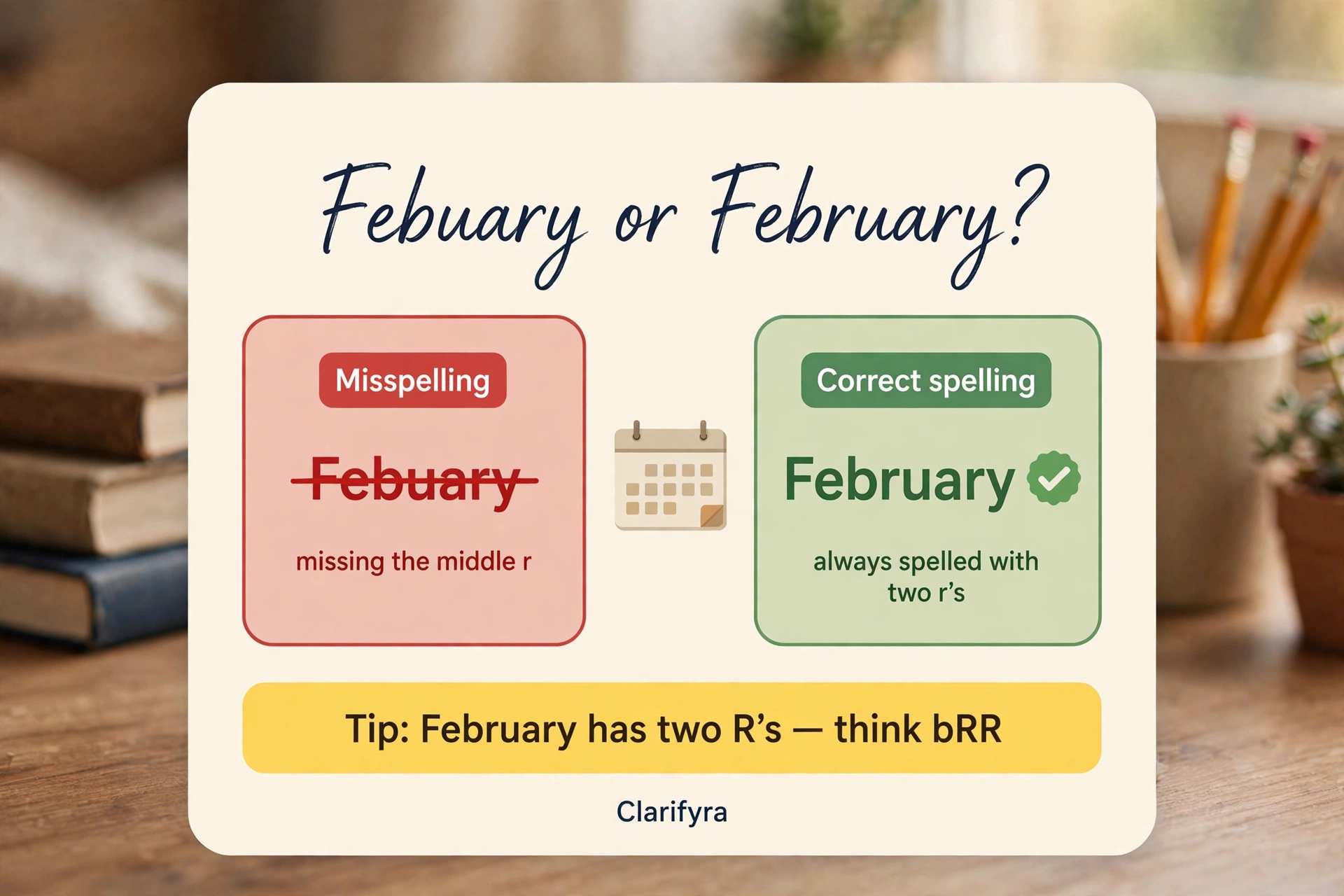
The correct spelling is February — with two r’s: Feb-r-u-a-r-y. Febuary (one r) is a misspelling. None of the major dictionaries — Cambridge, Oxford Learner’s, Merriam-Webster, or Collins — gives “febuary” an entry, while all four list February as the second month of the year. The misspelling is so widespread that it has its own pronunciation: many people say “FEB-yoo-air-ee,” dropping the first r exactly the way the misspelling does.
Quick Answer
February is the only correct spelling — F-e-b-r-u-a-r-y, with an r after the b and an r before the y. Febuary is a misspelling with no dictionary entry in Cambridge, Oxford Learner’s, Merriam-Webster, or Collins. Careful pronunciation keeps both r’s: UK /ˈfeb.ru.er.i/, US /ˈfeb.ju.er.i/ — but in rapid speech the first r often disappears (“FEB-yoo-air-ee”), which is exactly why the misspelling is so common. Say “FEB-roo-air-ee” as you type it.
Why the First “r” Disappears
The misspelling is phonetic: it records what the word sounds like in casual speech rather than how it’s spelled. The sequence /bru/ — b followed immediately by r — is slightly awkward to articulate, so in rapid speech speakers simplify it. The result, “FEB-yoo-air-ee,” drops the first r entirely, and fingers obediently write what ears report: febuary.
The same simplification swallows sounds in other familiar words — the first r in “library” (“lie-berry”), the “t” in “often,” the middle of “chocolate” — but in those cases the spelling usually survives because we learn the words visually early. February’s problem is that the simplified pronunciation is so dominant that many people never encounter the careful version, and the misspelling gets reinforced every time they hear it.
What the Dictionaries Actually Say
- Cambridge: February — “the second month of the year, after January and before March.” UK pronunciation /ˈfeb.ru.er.i/, US /ˈfeb.ju.er.i/.
- Oxford Learner’s: February — noun, “the 2nd month of the year.” British /ˈfebrʊəri/, American /ˈfebrʊəri/ and /ˈfebjuːeri/ — Oxford records both the careful and the simplified American pronunciations, which is honest lexicography: the simplified version is real speech, just not the spelling.
- Merriam-Webster: February — “the second month of the Gregorian calendar.” Its pronunciation note is famously candid: many Americans say “FEB-yoo-air-ee,” and Merriam-Webster lists \ˈfe-b(y)ə-ˌwer-ē\ as an accepted spoken variant — while the spelling stays firmly February.
- Collins: February — “February is the second month of the year in the Western calendar.” Collins adds the etymology: from Latin Februarius (mensis), “month of expiation,” from februa, the Roman festival of purification held in mid-February.
And “febuary”? No entry anywhere — not as a variant, not as an archaism, not in any register. It is a pure misspelling: the most common one-word spelling error for any month name in English.
The Etymology: Why the “r” Is Really There
The first r isn’t decorative — it’s the oldest letter in the word. The month is named for Februa, the Roman festival of ritual purification held on February 15th, via Latin Februarius (mensis), “the month of Februa.” The r after the b has been there since Rome; dropping it doesn’t simplify the word, it amputates its history.
English month names are unusually conservative spellings — September, October, November, December all keep their Latin bones intact — and February is no exception. The r survived two thousand years of transmission from Latin Februarius through Old French into Middle English. It can survive your keyboard too.
Pronunciation: Careful vs Casual
Here’s the honest picture, because the dictionaries themselves split on it:
- Careful pronunciation (both varieties): /ˈfeb.ru.er.i/ (UK), /ˈfeb.ju.er.i/ (US) — both r’s articulated: “FEB-roo-air-ee.”
- Casual American speech: “FEB-yoo-air-ee” — the first r dropped. Merriam-Webster and Oxford both record this as an accepted spoken variant.
- What this means for spelling: nothing. Pronunciation variants don’t change spellings — “often” keeps its t, “chocolate” keeps its middle syllable, and February keeps both r’s. Say the careful version when you type; say whatever your accent says the rest of the time.
The memory trick is the pronunciation itself: say “FEB-roo-air-ee” as you type it — four beats, both r’s audible. If your mouth forms the first r, your fingers will write it.
February in Dates and Formal Writing
Two style points that come up constantly with month names:
1. Capitalization. Month names are proper nouns — always capitalized: ✗ “we met in february” → ✓ “we met in February.” This applies in every variety of English and every register.
2. Abbreviations. The standard abbreviation is Feb. (with a period in American style; “Feb” without one is common in British style). Either way, the abbreviation keeps the b but drops everything after it — there’s no “Febr.” in standard use.
Common Mistakes
1. Dropping the first r: “febuary.” ✗ “The conference is in febuary.” → ✓ “The conference is in February.” The most common month-name misspelling in English. Say “FEB-roo-air-ee” while typing.
2. Lowercasing the month. ✗ “see you in february” → ✓ “see you in February.” Months are proper nouns — always capitalized.
3. Adding a stray “r”: “februrary.” ✗ → ✓ February. Some writers, warned about the missing r, overcorrect and insert a third one. The word has exactly two: Feb-r-u-a-r-y.
4. “Februarys” for the plural. ✗ “The februarys of recent years have been mild.” → ✓ “The Februaries of recent years have been mild.” Month names pluralize with -ies like any -y noun — and keep the capital.
5. Wrong preposition. ✗ “I’ll see you on February.” → ✓ “I’ll see you in February.” Use in for months (“in February”), on for specific dates (“on February 14th”).
February Isn’t Alone: The Dropped-Letter Club
The missing r in “febuary” has company. The same ear-first instinct produces the dropped n in collum vs column — where a letter vanishes because the sound of it is swallowed in speech — and the missing n in anual vs annual, where a doubled letter gets written singly. In each case the repair is the same: when sound and spelling disagree, spell the word by its structure, not by your ears.
Frequently Asked Questions
Is “febuary” a word?
No. None of the four major dictionaries — Cambridge, Oxford Learner’s, Merriam-Webster, Collins — gives “febuary” an entry in any sense. It is a misspelling of February, however common.
How do you spell February?
F-e-b-r-u-a-r-y — February, with an r after the b and an r before the y. Two r’s, in that order.
How do you pronounce February?
Carefully: UK /ˈfeb.ru.er.i/, US /ˈfeb.ju.er.i/ — “FEB-roo-air-ee,” both r’s pronounced. Casually, many Americans say “FEB-yoo-air-ee,” dropping the first r — Merriam-Webster and Oxford both record this spoken variant. The spelling keeps both r’s regardless.
Why is February spelled with two r’s?
Because of its Latin origin: the month is named for Februa, the Roman festival of purification, via Latin Februarius. The r after the b is the oldest letter in the word — it’s been there since Rome.
Is it “in February” or “on February”?
“In February” — use in for months. Reserve on for specific dates: “on February 14th.”
What’s the abbreviation for February?
Feb. — with a period in American style (“Feb” without one is common in British style). Either way it keeps the b and drops the rest.
Can February ever have 29 days?
Yes — in leap years. February has 29 days every four years (with century exceptions), which is why it’s the only month whose length varies. Nothing to do with the spelling, but the question comes up constantly.
Final Takeaway
February — two r’s, capital F, always. The misspelling “febuary” is what the word sounds like in rapid speech, not what it looks like on the page; the dictionaries have no entry for it in any register. Say “FEB-roo-air-ee” as you type, remember the Roman festival Februa that put the first r there, and the month will never lose a letter again.