Enrol or Enroll: Which Is Correct?
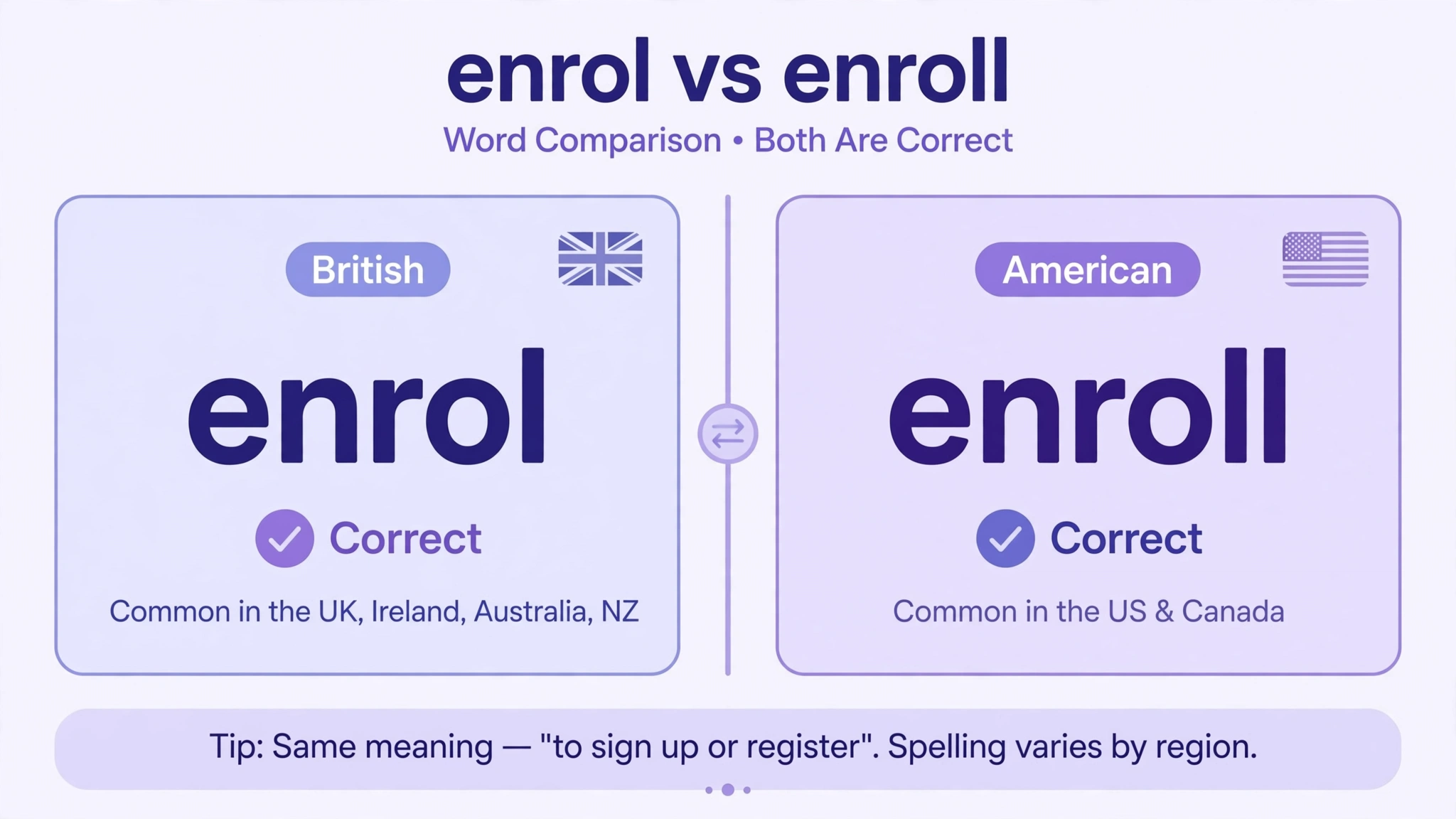
If you’re choosing between enrol and enroll, here’s the liberating news: both are correct. This isn’t a right/wrong question at all — it’s a regional one. Enrol, with one l, is the standard British spelling; enroll, with two l’s, is the standard American spelling. They mean exactly the same thing — to register officially, as for a course, a school, or a program — and they’re pronounced identically. Pick the one your audience expects, and use it consistently.
Quick Answer
Enrol and enroll are regional variants of the same verb, meaning “to register officially.” Collins lists enrol as the headword with the note “in AM, use enroll”; Merriam-Webster defines enroll as “to insert, register, or enter in a list, catalog, or roll.” British English: enrol, enrols, enrolment. American English: enroll, enrolls, enrollment. The -ing and -ed forms — enrolling, enrolled — are spelled identically in both.
What the Dictionaries Actually Say
The references divide neatly along regional lines, which is exactly what you’d expect:
- Collins COBUILD (the learner’s dictionary): headword enrol, with the explicit regional note “in AM, use enroll.” Its listed word forms are enrols, enrolling, enrolled.
- Collins English Dictionary: “enrol in British English or US enroll” — treating them as equal regional partners.
- Merriam-Webster (American): headword enroll — “to insert, register, or enter in a list, catalog, or roll” — with examples like “enrolled in drama school.”
- Cambridge Dictionary: headword enrol (marked B1 level), defined around officially joining a course, school, or organization.
Notice what’s not here: no dictionary calls either spelling an error, a variant of lesser standing, or informal. They’re parallel standards. The only thing every reference agrees you must not do is mix them within a single document.
The Full Set of Forms
This is where the pair gets interesting — and where most of the real errors happen. The two spellings don’t differ everywhere; they differ only in the base form, the third-person singular, and the -ment noun:
| Form | British English | American English | Example |
|---|---|---|---|
| Base verb | enrol | enroll | “You must enrol/enroll by Friday.” |
| 3rd-person singular | enrols | enrolls | “She enrols/enrolls in September.” |
| Present participle | enrolling | enrolling | “They are enrolling now.” (same!) |
| Past tense / participle | enrolled | enrolled | “He enrolled last year.” (same!) |
| Noun | enrolment | enrollment | “Enrolment/Enrollment is open.” |
The takeaway from that table: enrolling and enrolled are the same on both sides of the Atlantic. The double l appears in the inflected forms in both varieties — British English doubles the l when adding the vowel-initial endings, just as it does in “travelling” and “cancelled.” So if you remember nothing else, remember this: the past tense is always enrolled, never “enroled.”
Why English Has Two Spellings
The split belongs to a small, well-documented family of BrE/AmE -l/-ll pairs. Noah Webster’s American spelling reforms regularized the doubling of final l, and a handful of verbs ended up with a single l in the British base form and a double l in the American one. The family includes:
- enrol (BrE) / enroll (AmE)
- fulfil (BrE) / fulfill (AmE)
- instil (BrE) / instill (AmE)
- distil (BrE) / distill (AmE)
It’s the mirror image of the better-known doubling pattern in words like fuelled/fueled and travelling/traveling — where British English doubles the l before vowel endings and American English doesn’t. The two patterns together explain nearly every transatlantic l-doubling puzzle; the guide to fuelled vs fueled walks through the other half of the family.
Pronunciation, for the record, is identical everywhere: /ɪnˈrəʊl/ (“in-ROHL”), with the stress on the second syllable. No accent pronounces the extra l separately — it’s purely a spelling convention.
Practical Guidance: Which to Use
- Match your audience. Writing for a British, Irish, or (usually) Australian readership? Use enrol. Writing for an American readership? Use enroll. For international or online audiences, either is acceptable — but pick one.
- Be consistent within a document. This is the one real rule. Don’t write “enrol” in the introduction and “enrollment” in the conclusion. If your base form is “enrol,” your noun is “enrolment”; if it’s “enroll,” your noun is “enrollment.”
- Follow the house style if one exists. Universities, publishers, and employers usually specify British or American English outright — that choice settles “enrol/enroll” automatically.
- Check the -ing and -ed forms anyway. Even careful writers who get the base form right sometimes write “enroled” by over-applying the single-l pattern. The inflected forms double the l in both varieties: enrolling, enrolled.
- In quoted or proper names, don’t “correct.” If an American university’s program is called “Open Enrollment,” keep their spelling even in a British document — proper names keep their own forms.
Common Mistakes
1. Writing “enrole.” ✗ “Please enrole online.” → ✓ “Please enrol/enroll online.” The -e ending is never correct in any variety — it’s the single most common misspelling of this word.
2. Writing “enroled” with one l. ✗ “She enroled in May.” → ✓ “She enrolled in May.” Wrong in both British and American English — the past tense doubles the l everywhere.
3. Mixing the families in one document. ✗ “Please enrol early; enrollment closes Friday.” → ✓ “Please enrol early; enrolment closes Friday.” (Or go full American: “enroll … enrollment.”) The base form and the noun must match.
4. “Correcting” the other variety’s spelling. Changing a British colleague’s “enrol” to “enroll” (or vice versa) isn’t a fix — it’s introducing an inconsistency with their audience’s expectations. Regional spellings aren’t errors.
5. Writing “enrolls” in a British document. ✗ (BrE) “He enrolls next term.” → ✓ “He enrols next term.” The third-person singular follows the base form: single l in British English.
6. Assuming the pattern applies to all -l verbs. “Enrol/enroll” is a special small family. Don’t generalize it: “control” → “controlled” doubles in both varieties, and “travel” → “travelled/travelled” follows the opposite pattern. When in doubt, check the dictionary rather than the analogy.
How to Remember It
Americans double the L — enroLL. The United States doubled down on the letter, just as it did with “fulfiLL” and “instaLL.” The British kept it lean: enrol, one l, like “fulfil” and “instil.” And for the forms that trip everyone up, remember the rhyme: the -ing and -ed always bring the double-l — enrolling, enrolled, in every country.
Frequently Asked Questions
Is “enrol” a misspelling of “enroll”?
No. Enrol is the standard British spelling, listed as the headword in Collins and Cambridge with “enroll” noted as the American form. Neither is a misspelling of the other.
Which spelling should I use?
Match your audience: enrol for British (and usually Australian and New Zealand) readers, enroll for American readers. For international audiences, either is fine — the requirement is consistency, not a particular choice.
Is it “enrolled” or “enroled”?
Enrolled — in both varieties. The past tense and past participle double the l everywhere; “enroled” with one l is wrong in British and American English alike.
Is it “enrolment” or “enrollment”?
British English: enrolment. American English: enrollment. Match the noun to whichever base form you’re using.
Do “enrol” and “enroll” mean different things?
No — the meaning is identical: to register officially, to put someone’s name on a list or roll. The difference is purely orthographic and regional.
How do you pronounce “enrol/enroll”?
/ɪnˈrəʊl/ — “in-ROHL,” stress on the second syllable. Identical in British and American English; the extra l is never pronounced separately.
What about Canada?
Canadian English generally accepts both, with enrol often preferred but enroll widely seen thanks to American influence. When writing for Canadians, pick one and stay consistent.
Is “enrole” ever correct?
No. “Enrole” is a misspelling in every variety of English — the word is enrol or enroll, never with a final -e.
Final Takeaway
Enrol or enroll? Both — the first is British, the second American, and neither is wrong. What is wrong is mixing them: keep the base form, the -s form, and the -ment noun in the same family, and remember that enrolling and enrolled double the l in every country. Match your audience, stay consistent, and never write “enrole.”