Other Ways to Say “For Example”: 40+ Better Alternatives for Writing and Essays
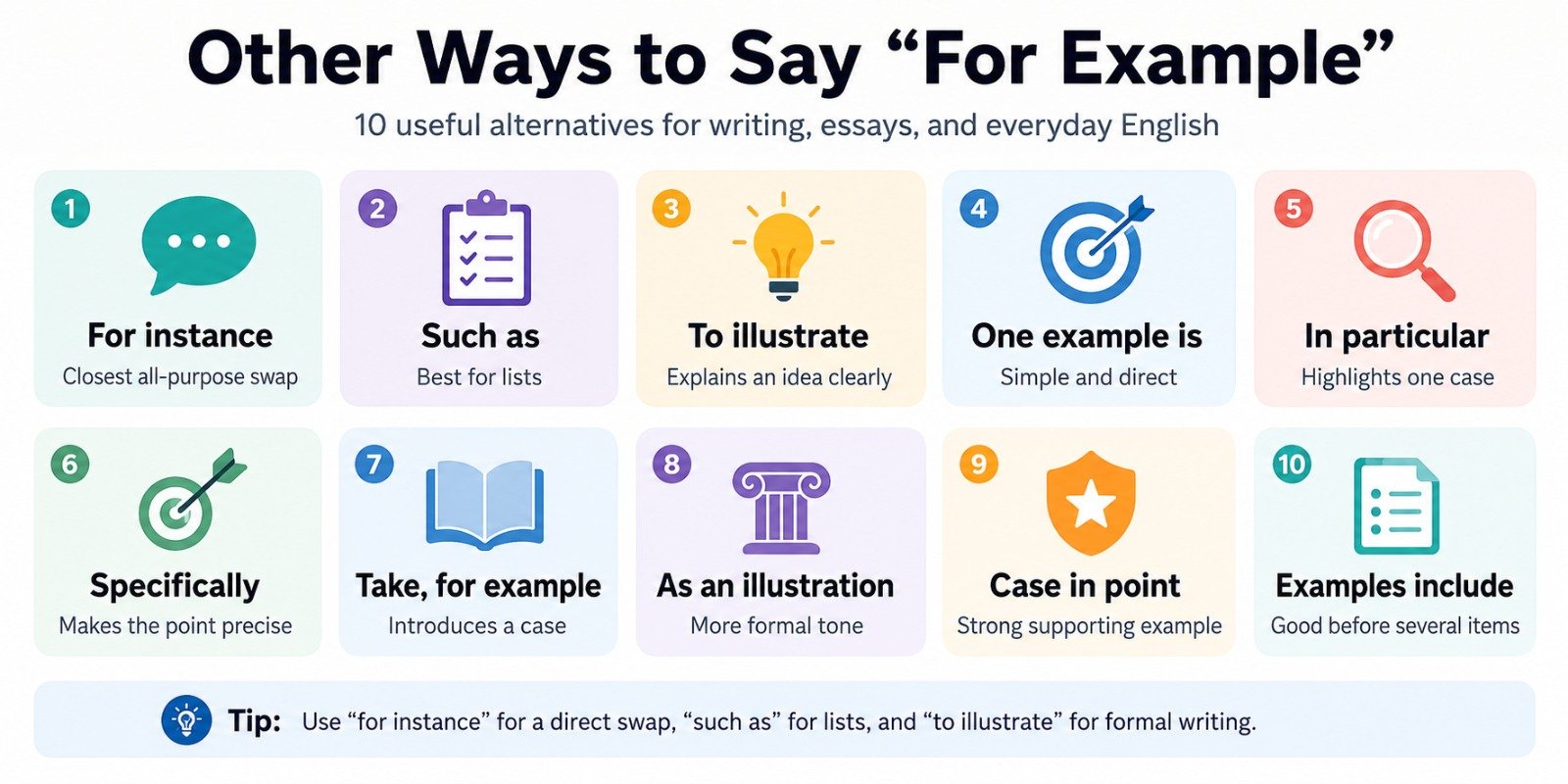
“For example” is clear, natural, and useful, but repeating it too often can make an essay, report, email, or explanation feel monotonous. There are many other ways to say “for example”, including simple alternatives such as “for instance,” more formal choices such as “to illustrate,” and list-friendly options such as “such as.”
The important part is choosing a phrase that fits the sentence. Some alternatives introduce a complete example, while others work better for lists, evidence, emphasis, or hypothetical situations.
Useful Alternatives to “For Example” at a Glance
| Alternative | Tone | Best Used For |
|---|---|---|
| For instance | Neutral/Formal | Essays, reports, general writing |
| Such as | Neutral | Introducing examples in a list |
| To illustrate | Formal | Essays and explanations |
| As an illustration | Formal | Academic and professional writing |
| One example is | Neutral | Clear explanations |
| A good example is | Neutral | General writing and speech |
| Take, for example | Neutral | Explanatory writing |
| Take, for instance | Neutral | Essays and presentations |
| In particular | Neutral/Formal | Highlighting one specific case |
| Specifically | Neutral/Formal | Narrowing a general point |
| Case in point | Neutral/Formal | Arguments and commentary |
| By way of example | Formal | Professional or academic writing |
| Consider | Formal | Arguments and analysis |
| Consider the case of | Formal | Academic discussion |
| As shown by | Formal | Evidence-based writing |
| As demonstrated by | Formal | Research and analysis |
| As evidenced by | Formal | Essays and reports |
| Examples include | Neutral | Lists and explanations |
| Including | Neutral | Adding examples within a sentence |
| Like | Casual | Conversation and informal writing |
| Let’s say | Casual | Hypothetical examples |
| Suppose | Neutral | Hypothetical situations |
| Imagine | Conversational | Teaching and persuasive writing |
| To give you an idea | Conversational | Blogs, presentations, speech |
Also Check | 75 Cute Ways to Say “I Love You”: Sweet, Romantic, Poetic and Funny Ideas
The Most Natural Ways to Say “For Example”
If you simply want another way to say “for example”, these are the most useful options to know.
1. For Instance
“For instance” is one of the closest substitutes and works in essays, articles, professional writing, and conversation.
Example:
“Some plants can survive in very dry environments. For instance, cacti store water in their stems.”
2. To Illustrate
“To illustrate” works well when the example is meant to make an idea clearer.
Example:
“Small pricing changes can affect customer behavior. To illustrate, a limited-time discount may encourage buyers to act sooner.”
It sounds slightly more formal and deliberate than “for example.”
3. One Example Is
This is a straightforward option when clarity matters most.
Example:
“There are several ways to reduce household energy use. One example is replacing traditional bulbs with LEDs.”
4. Take, for Example
This phrase draws attention to one particular person, place, or situation.
Example:
“Some cities have transformed unused industrial areas. Take, for example, London, where former docklands have been extensively redeveloped.”
5. As an Illustration
This is a more formal option suited to analytical or professional writing.
Example:
“Unexpected delays can increase project costs. As an illustration, a shipping delay may force a manufacturer to halt production.”
6. Case in Point
“Case in point” introduces a strong example that supports a claim.
Example:
“Good customer service can turn a bad experience into a positive one. Case in point: the company refunded the order and sent a replacement the same day.”
7. Consider
“Consider” invites the reader to think about a particular example.
Example:
“Remote work can reduce commuting costs. Consider an employee who previously spent two hours a day traveling to and from the office.”
8. By Way of Example
This is formal and somewhat traditional.
Example:
“Different industries face different compliance requirements. By way of example, financial institutions must follow strict rules regarding customer data.”
It is appropriate in formal documents, but can sound stiff in everyday writing.
Other Ways to Say “For Example” in an Essay or Formal Writing
When you’re looking for other ways to say “for example” in an essay, the strongest choices are usually phrases that sound clear without becoming unnecessarily elaborate.
Useful options include:
- For instance
- To illustrate
- As an illustration
- Consider the case of
- As demonstrated by
- As evidenced by
- As shown by
- In particular
- Specifically
- One example of this is
- A clear example is
- This can be seen in
- To demonstrate this
- Take, for instance
- As a case in point
- By way of illustration
For Instance
This is one of the safest choices in essays.
Example:
“Regular exercise can improve mental well-being. For instance, moderate physical activity may help reduce stress.”
This Can Be Seen In
This phrase connects an argument to a specific case or observation.
Example:
“The effects of urbanization are visible in changing housing patterns. This can be seen in the growth of high-density apartment developments.”
As Demonstrated By
Use this when the example acts as supporting evidence.
Example:
“Public transport investment can change commuting habits, as demonstrated by increased rail use after new services are introduced.”
Consider the Case Of
This works well when you want to examine an example in greater detail.
Example:
“Strong brand loyalty can protect companies during periods of competition. Consider the case of customers who continue buying from the same manufacturer even when cheaper alternatives are available.”
To Demonstrate This
Use this when the example directly proves or clarifies the point before it.
Example:
“Digital tools can reduce repetitive administrative work. To demonstrate this, automated invoicing can eliminate several manual data-entry steps.”
Formal wording should still sound natural. A phrase such as “by way of illustration” may be suitable in academic prose, but it can sound unnecessarily stiff in a routine email or blog post.
Compare:
More formal:
“The policy may affect smaller businesses disproportionately. By way of illustration, companies with limited administrative staff may find compliance more demanding.”
More natural:
“The policy may affect smaller businesses disproportionately. For instance, companies with limited administrative staff may find compliance more demanding.”
Alternatives for Lists and Groups of Examples
Sometimes “for example” isn’t the best grammatical choice at all. If you’re naming several members of a category, phrases such as “such as,” “including,” and “examples include” are often smoother.
Such As
Use “such as” to introduce examples directly after a noun or category.
Example:
“Soft skills such as communication, teamwork, and adaptability are valuable in many jobs.”
You usually can’t replace “such as” with “for example” without restructuring the sentence.
Including
“Including” shows that the listed items form part of a wider group.
Example:
“The package contains several useful tools, including a calculator, calendar, and note-taking app.”
Examples Include
This works well for direct, readable lists.
Example:
“Several renewable energy sources are widely used. Examples include solar, wind, and hydroelectric power.”
Among Them
“Among them” refers back to a group that has already been mentioned.
Example:
“Several countries have introduced digital identity systems. Among them are Estonia and Singapore.”
Casual and Conversational Alternatives
In conversation, blog posts, presentations, and informal explanations, simpler phrases often sound more natural.
Like
“Like” is common for informal examples.
Example:
“I enjoy quiet weekend activities like reading, cooking, and walking.”
In formal academic writing, “such as” is often the better choice.
Let’s Say
“Let’s say” introduces a hypothetical example.
Example:
“Let’s say you want to save $100 a month. You could begin by reviewing subscriptions you rarely use.”
Suppose
“Suppose” introduces an imagined situation and can work in both educational and reasonably formal contexts.
Example:
“Suppose a customer places an order after the shipping deadline. The business may need to adjust the expected delivery date.”
Imagine
“Imagine” helps make an example vivid.
Example:
“Imagine you’re giving a presentation and your laptop suddenly stops working. Having a backup copy could save the situation.”
To Give You an Idea
This sounds natural in speech and informal explanatory writing.
Example:
“The renovation was expensive. To give you an idea, replacing the windows alone cost several thousand dollars.”
Say
“Say” can introduce a quick hypothetical example.
Example:
“Choose a manageable target, say, 20 minutes of exercise three times a week.”
It is concise, but more conversational than academic.
Not Every Alternative Is Interchangeable
A useful synonym list should also explain where substitutions stop working. Several phrases related to examples have different grammatical or semantic functions.
“For Example” vs. “For Instance”
These are usually very close in meaning.
For example:
“Some vegetables can be grown indoors. For example, lettuce grows well in small containers.”
For instance:
“Some vegetables can be grown indoors. For instance, lettuce grows well in small containers.”
In most situations, either works.
“For Example” vs. “Such As”
“Such as” usually introduces examples inside the sentence.
For example:
“Some fruits contain large amounts of vitamin C. For example, oranges are a common source.”
Such as:
“Fruits such as oranges and strawberries contain vitamin C.”
The meaning is similar, but the sentence structure changes.
“For Example” vs. “Specifically”
“For example” offers an illustration. “Specifically” narrows a broad statement to something more precise.
For example:
“The company wants to expand into new markets. For example, it may begin selling in several European countries.”
Specifically:
“The company plans to expand into two markets, specifically France and Spain.”
The second sentence identifies exactly which markets are meant.
“For Example” vs. “In Particular”
“In particular” gives special emphasis to one member of a group.
For example:
“I enjoy several winter sports. For example, I go skiing whenever I can.”
In particular:
“I enjoy several winter sports, in particular skiing.”
The second version highlights skiing as especially important.
“For Example” vs. “Namely”
“Namely” is not a direct substitute for “for example.”
Compare:
“Several employees volunteered, for example, Daniel.”
This means Daniel is one example from a potentially larger group.
“Two employees volunteered, namely Daniel and Priya.”
Here, “namely” identifies exactly who the two employees were.
Use “namely” when you are specifying something precisely, not merely offering one possible example.
E.g. and I.e. Are Not the Same Thing
Another common mistake is confusing e.g. with i.e.
E.g.
“E.g.” means for example.
Example:
“Bring something waterproof, e.g., a rain jacket or poncho.”
You are offering possible examples.
I.e.
“I.e.” means that is or in other words.
Example:
“The meeting has been moved to our largest conference room, i.e., Room 301.”
Here, you are clarifying exactly which room is meant.
A simple reminder:
- e.g. = example
- i.e. = clarification
Different Ways to Say “For Example” Depending on Sentence Position
Sentence position can help you choose the right wording.
At the Beginning of a Sentence
Natural choices include:
- For instance,
- To illustrate,
- As an example,
- In particular,
- Specifically,
- As a case in point,
Example:
“To illustrate, a customer who receives a quick response may be more willing to buy from the company again.”
In the Middle of a Sentence
Useful options include:
- for instance
- for example
- in particular
- specifically
- including
Example:
“Some industries, for instance healthcare, require especially careful handling of personal information.”
Before a List
Use:
- such as
- including
- examples include
- among them
Example:
“Common productivity tools include calendars, task managers, and note-taking apps.”
Trying to force every alternative into the same sentence position can make otherwise correct writing sound unnatural.
Quick Cheat Sheet: Which Alternative Should You Choose?
Use this as a simple rule of thumb:
| If You Want To… | Best Choices |
| Give a normal example | For instance, for example |
| Introduce a list | Such as, including, examples include |
| Explain an idea more clearly | To illustrate, as an illustration |
| Present supporting evidence | As demonstrated by, as evidenced by |
| Highlight one case | In particular |
| Narrow a statement | Specifically |
| Introduce a strong supporting case | Case in point |
| Discuss a detailed example | Consider the case of |
| Create a hypothetical situation | Let’s say, suppose, imagine |
| Keep the tone conversational | Like, say, to give you an idea |
A more elaborate phrase isn’t automatically a better one. In many sentences, “for example” or “for instance” remains the clearest choice.
Other Ways to Say “For Example” in Spanish
The standard Spanish equivalent of “for example” is:
Por ejemplo — “for example” or “for instance”
Example:
“Me gustan muchas frutas, por ejemplo, las naranjas y las fresas.”
Meaning:
“I like many fruits, for example, oranges and strawberries.”
Depending on the structure, you may also encounter:
- Por poner un ejemplo — to give an example
- En particular — in particular
- Como — like/such as, depending on context
These are not direct substitutes in every sentence. As in English, the natural choice depends on grammar and meaning.
Common Mistakes to Avoid
Replacing Every “For Example”
Variation can improve writing, but replacing every occurrence can make prose feel forced. There is nothing wrong with using “for example” more than once when it is the clearest wording.
Choosing an Overly Formal Phrase
Compare:
“By way of illustration, I bought milk on the way home.”
with:
“For example, I bought milk on the way home.”
The first version is technically possible but far too formal for an ordinary situation.
Treating “Such As” as a Direct Swap
This is awkward:
“Many outdoor activities are inexpensive. Such as, walking requires very little equipment.”
Better:
“Many outdoor activities are inexpensive. For instance, walking requires very little equipment.”
Or:
“Inexpensive outdoor activities such as walking require very little equipment.”
Using “Namely” for a Random Example
“Namely” is best when you are identifying exactly who or what you mean, not when you are simply naming one possible example.
Confusing E.g. With I.e.
Use e.g. to introduce examples and i.e. to clarify or restate something precisely.
Frequently Asked Questions
What is another way to say “for example”?
“For instance” is one of the closest and most natural alternatives. Depending on the sentence, you can also use “to illustrate,” “such as,” “one example is,” or “take, for example.”
What are some better ways to say “for example” in an essay?
Useful essay alternatives include “for instance,” “to illustrate,” “as demonstrated by,” “as evidenced by,” “consider the case of,” and “this can be seen in.” Choose based on whether you’re simply illustrating an idea or providing evidence.
What is a formal way to say “for example”?
“To illustrate,” “as an illustration,” “by way of example,” and “consider the case of” are suitable formal choices. “For instance” also works well in many formal contexts.
Can I use “such as” instead of “for example”?
Sometimes, but the sentence often needs to be restructured. “Such as” usually introduces examples inside a phrase, while “for example” can introduce a separate clause or sentence.
Is “for instance” the same as “for example”?
In most contexts, yes. They are very close in meaning and are often interchangeable.
Does e.g. mean “for example”?
Yes. “E.g.” is used to introduce examples. It should not be confused with “i.e.,” which means “that is” or “in other words.”
Choosing the Right Expression
The best alternative depends on what the example is doing in your sentence. Use “for instance” for a simple substitution, “such as” for lists, “to illustrate” for explanation, and evidence-focused phrases such as “as demonstrated by” when you’re supporting an argument.
Clear writing matters more than avoiding repetition at all costs. Clarifyra focuses on those small differences in wording so you can choose an expression that sounds natural and fits the exact context.
Also Read | Different Ways to Say Good Morning: 75+ Creative and Natural Greetings