Either or Ither: Which Is Correct and Why?
The words either and ither can be confusing because they look similar and may even sound similar in some accents. In standard English, however, they are not normally interchangeable. Either is the familiar word used when talking about two choices or possibilities, while ither is mainly a dialectal form found in Scots and some British dialects. There is also more than one accepted way to pronounce either, which can make the spelling seem less obvious than it really is.
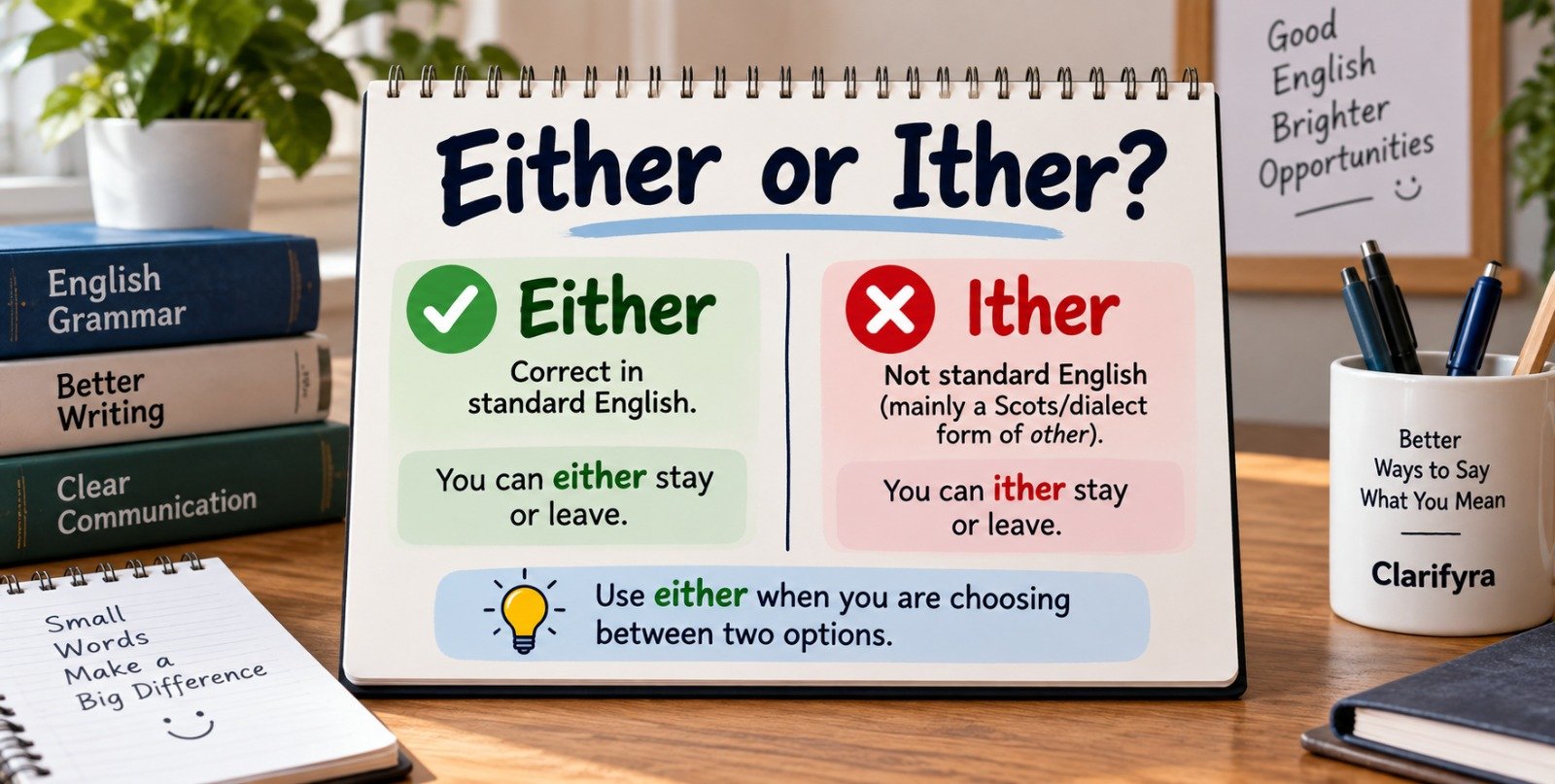
Either is the correct word in standard English when referring to one of two choices or using the structure either…or. Ither is a real dialectal word, especially in Scots, where it usually corresponds to other; it should not normally replace either in standard writing.
Either or Ither: What’s the Difference?
The most important difference is that either belongs to standard English, while ither is mainly dialectal.
| Feature | Either | Ither |
|---|---|---|
| Standard English? | Yes | Usually no |
| Main meaning | One or the other of two choices | Mainly a Scots/dialect form of “other” |
| Common in formal writing? | Yes | No |
| Used in “either…or”? | Yes | Not in standard English |
| Example | Either option is fine. | Found mainly in dialect writing |
Cambridge describes either as a determiner, pronoun, adverb, or conjunction. It is commonly used to refer to two possibilities or to connect alternatives with or.
Merriam-Webster records ither as a dialectal British variant of both other and, in some dialect use, either. The Dictionaries of the Scots Language primarily identifies it as a Scots form of other.
Many English learners mix up similar-looking words such as Savor or Savour: Which Spelling Is Correct?
What Is Either?
Either is a standard English word used when there are two possibilities, choices, people, or things.
It can function in several ways.
As a determiner
It can appear before a singular countable noun:
- Either route will take us there.
- You can choose either seat.
- Either answer is acceptable.
In this use, the speaker is saying that one of the two options is acceptable.
As a pronoun
Either can stand alone:
- “Which jacket do you want?” “Either is fine.”
- I don’t particularly like either.
In the structure “either…or”
The phrase either…or connects two alternatives:
- We can either walk or take the bus.
- Either Emma or Daniel will lead the meeting.
- You must either finish today or return tomorrow.
Cambridge notes that either…or can connect words, phrases, and clauses, provided the alternatives are grammatically parallel.
As an adverb
Either can also appear after a negative statement and mean something similar to too:
- I don’t enjoy horror films either.
- She wasn’t tired, and I wasn’t either.
So the meaning of either depends partly on its grammatical role.
What Is Ither?
Ither is a real word, but it is not normally used in standard modern English.
In Scots, ither is commonly a form of other. The Dictionaries of the Scots Language lists it among Scottish forms and usages of other, while Collins also describes it as a Scots word for other.
For example, dialect writing might contain an expression corresponding to:
- the ither day
- some ither person
- the ither side
In standard English, these would usually be written:
- the other day
- some other person
- the other side
Merriam-Webster also records a dialectal British use of ither as a variant of either, so it would be inaccurate to say that ither is simply a nonexistent spelling. However, it is not the form you would normally use in standard English writing.
Which Is Correct: Either or Ither?
If you are writing normal standard English, either is the correct choice when you mean one of two alternatives.
Correct: Either answer could be right.
Not standard: Ither answer could be right.
Correct: You can either call me or send a message.
Not standard: You can ither call me or send a message.
The exception is when ither is being used deliberately as part of a Scots or regional dialect.
This means the question “is it either or ither?” has a simple practical answer: use either in ordinary English.
When to Use Either
Use either when you are choosing between two possibilities or referring to one of two people or things.
One of two options
- You can use either entrance.
- Either solution will work.
- I would be happy with either.
Presenting alternatives
- You can either stay here or come with us.
- Either Mia or George has the key.
- We’ll travel either Friday or Saturday.
In negative sentences
- I don’t want dessert either.
- He hasn’t seen the film, and I haven’t either.
Meaning both sides
In some constructions, either can refer to both of two sides:
- There were trees on either side of the road.
- A lamp stood on either side of the bed.
Cambridge specifically records this use of either meaning both of two corresponding sides.
Is It Pronounced Either or Ither?
One major source of confusion is pronunciation.
The word either has two widely accepted pronunciations:
- roughly EYE-thur
- roughly EE-thur
Cambridge lists both pronunciations in British and American English.
The consonant sound in the middle is the voiced th sound heard in words such as this and those.
Because the EE-thur pronunciation begins with a long “ee” sound, someone may hear it and assume that the spelling should be something like ither. That is not the case.
Both of these pronunciations are still spelled:
either
So if you are wondering how to pronounce either or ither, remember that pronunciation variation does not change the standard spelling.
Either or Ither in a Sentence
Seeing the words in context makes the difference clearer.
Standard use of “either”
- Either restaurant would be a good choice.
- You may sit on either side of me.
- Either Liam or Noah will collect the package.
- I don’t know the answer either.
- We can either leave now or wait until noon.
- “Would you like tea or coffee?” “Either is fine.”
Dialectal use of “ither”
In Scots or dialect writing, ither may appear where standard English would normally use other.
For example, a dialect sentence containing the ither one would correspond to the other one in standard English.
That distinction matters because ither should not be treated simply as an alternative modern spelling of either.
Why Are Either and Ither Confused?
There are two main reasons.
First, the spellings are visually similar.
Second, either has more than one accepted pronunciation. Someone hearing the “EE-thur” pronunciation may try to spell the word according to sound and arrive at ither.
There is also a genuine dialect word spelled ither, which makes the issue slightly more complicated than a simple spelling mistake.
For everyday English, though, the practical rule remains straightforward: use either for choices and alternatives.
Common Mistakes to Avoid
One common mistake is writing ither simply because either was pronounced “EE-thur.”
Incorrect in standard English: Ither option is fine.
Correct: Either option is fine.
Another mistake is using a plural noun directly after either when it functions as a determiner.
Incorrect: Either books will help.
Correct: Either book will help.
When referring to two plural items with of, use:
Correct: Either of the books will help.
Cambridge notes that a singular countable noun normally follows either directly, while constructions such as either of the books use of before a plural noun.
A third mistake is confusing either…or with neither…nor.
- Either A or B means one of the alternatives.
- Neither A nor B means not A and not B.
An Easy Way to Remember the Difference
Associate either with two alternatives.
Think:
Either = one of two.
For example:
- either left or right
- either today or tomorrow
- either you or me
If you are writing about a choice between two possibilities, the word you almost certainly need is either.
Think of ither separately as a regional or Scots form, most often corresponding to other.
Final Verdict: Either or Ither?
For standard English, use either when referring to one of two choices, connecting alternatives, or using expressions such as either…or. Ither does exist, but it is mainly dialectal and is especially associated with Scots, where it commonly corresponds to other.
The pronunciation of either may be roughly “EYE-thur” or “EE-thur,” and both are accepted. Whichever pronunciation you use, the standard spelling remains either. That clear distinction is exactly the kind of usage Clarifyra aims to make easier to understand.
FAQs
Is “ither” a real word?
Yes. Ither is a real dialectal word. It is especially associated with Scots and commonly corresponds to standard English other. Some dictionaries also record a dialectal British use as a variant of either.
Do you say either or ither?
In standard English, the word is either. It can be pronounced approximately “EYE-thur” or “EE-thur.” The spelling ither is normally reserved for dialectal usage rather than ordinary standard English.
Is either pronounced “EE-thur” or “EYE-thur”?
Both pronunciations are accepted. British and American English both use forms corresponding to “EE-thur” and “EYE-thur,” although individual speakers may strongly prefer one.
Can I use “ither” in formal writing?
Not as a substitute for either in normal formal English. Use ither only when the dialect itself is relevant, such as when writing Scots, discussing regional language, or reproducing dialect speech.
What part of speech is “either”?
Depending on the sentence, either can function as a determiner, pronoun, adverb, or conjunction. For example, it is a determiner in “either route,” a pronoun in “either will do,” and part of a conjunction structure in “either…or.”
Does “either” always mean only one of two?
Usually it refers to one or the other of two options, but in expressions such as on either side, it can effectively mean on both sides.
You May Also Read | Palette or Pallet: What’s the Difference?