Agree or Agreed: Which Is Correct and When Should You Use Each?
Choosing between agree and agreed can be confusing because both are correct English words and both express the idea of sharing an opinion or accepting something. The difference is mainly grammatical: agree is normally used for the present, while agreed is used for the past or as the past participle. In some contexts, agreed can also describe something that has already been accepted, such as an agreed price or agreed date. The correct choice depends on what you are trying to say.
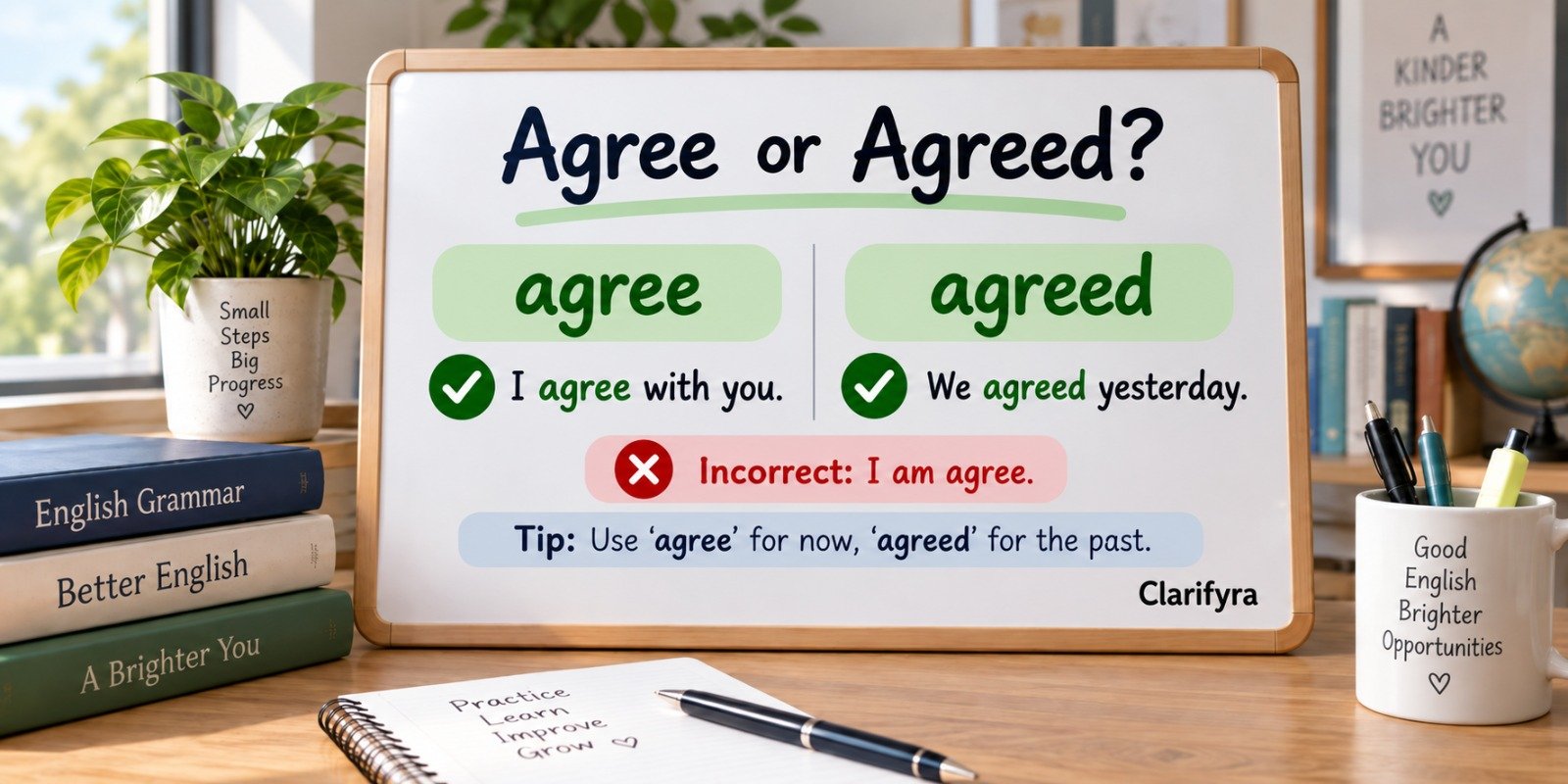
Both agree and agreed are correct. Use agree for a present opinion or decision, as in “I agree with you.” Use agreed for something accepted or decided in the past, as in “We agreed yesterday.”
Agree or Agreed: What’s the Difference?
The simplest difference is tense.
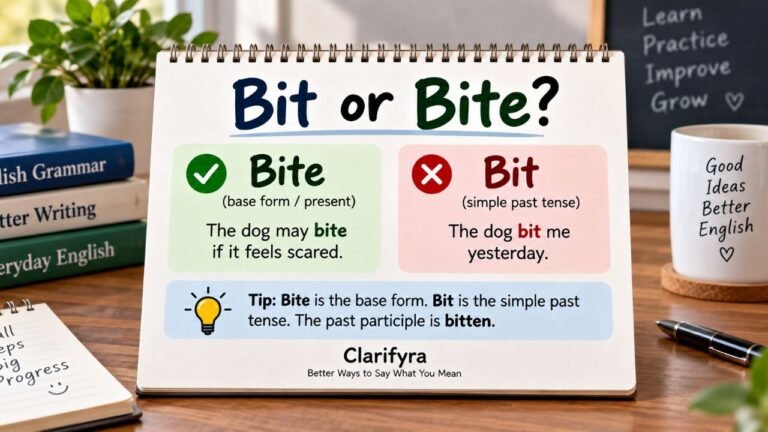
Agree is the base form and present-tense form of the verb. It is used when someone currently shares an opinion, accepts a proposal, or reaches the same conclusion as another person.
Agreed is the simple past tense and past participle of agree. It refers to an agreement that happened earlier.
Compare:
- I agree with your suggestion.
- I agreed with your suggestion yesterday.
The first sentence describes what the speaker thinks now. The second describes what the speaker thought or accepted at an earlier time.
You May Also Read | Lie or Lye: What’s the Difference and Which Is Correct?
Quick Comparison
| Feature | Agree | Agreed |
|---|---|---|
| Correct English? | Yes | Yes |
| Main role | Present/base verb | Past tense/past participle |
| Typical time | Present | Past |
| Example | I agree with you. | I agreed with you yesterday. |
| Other use | Expressing consent | Can describe something already accepted |
What Does “Agree” Mean?
Agree is a verb meaning to share the same opinion, accept a suggestion, give consent, or reach the same decision as another person.
For example:
- I agree with your point.
- We agree that the plan needs improvement.
- Do you agree with her decision?
- They agree on most important issues.
You can also use agree to when accepting a proposal, arrangement, or action:
- She agreed to help us.
- I agree to the terms.
- They agree to meet again next week.
Another common structure is agree on, which is used when people reach the same decision about a particular matter:
- We agree on the price.
- The team cannot agree on a date.
What Does “Agreed” Mean?
Agreed is most commonly the past tense or past participle of agree.
Examples:
- She agreed with me yesterday.
- We agreed to meet at 10 a.m.
- They agreed on a final price.
- Everyone agreed that the idea was practical.
It can also appear after have, has, or had:
- We have agreed on the main points.
- She has agreed to join the project.
- They had agreed before the meeting started.
In addition, agreed can work as an adjective when something has already been discussed and accepted.
For example:
- Please arrive at the agreed time.
- They paid the agreed price.
- We followed the agreed plan.
Agree or Agreed: Which Is Correct?
Both are grammatically correct, so the important question is not which word is universally right but which form fits the sentence.
Use agree when the statement refers to the present:
Correct: I agree with your opinion.
Use agreed when the action happened in the past:
Correct: I agreed with your opinion during yesterday’s meeting.
A time word often makes the choice obvious:
- Now: I agree.
- Usually: We agree.
- Yesterday: We agreed.
- Last week: They agreed.
- Already: We have agreed.
The verb form changes because the time changes.
Do You Say “I Agree” or “I Agreed”?
If you are responding to someone and expressing your opinion at that moment, say:
“I agree.”
For example:
“This design looks much cleaner.”
“I agree.”
Use “I agreed” when referring to a previous conversation or decision:
- I agreed with him during the meeting.
- I agreed to the proposal last Monday.
- At first, I agreed, but later I changed my mind.
A frequent learner error is “I am agree.” This is not standard English because agree is a verb, not an adjective in that construction.
Incorrect: I am agree with you.
Correct: I agree with you.
Totally Agree or Agreed?
Use totally agree when talking about your current opinion.
- I totally agree with you.
- We totally agree that the change is necessary.
- I totally agree with her explanation.
Use totally agreed when referring to a past opinion or reaction:
- I totally agreed with him at the time.
- We totally agreed with the decision last year.
The tense rule stays the same:
Present: I totally agree.
Past: I totally agreed.
In more formal writing, completely agree or fully agree may sometimes sound more neutral than totally agree.
Absolutely Agree or Agreed?
The same principle applies to absolutely agree or agreed.
For a present opinion:
- I absolutely agree.
- I absolutely agree with your recommendation.
- We absolutely agree that safety comes first.
For a past situation:
- I absolutely agreed with her when she raised the issue.
- At the time, they absolutely agreed with the proposal.
If someone has just made a point and you want to show strong agreement, “I absolutely agree” is the natural choice.
Is “100 Agree” or “100% Agree” Correct?
The natural informal expression is 100% agree, with the percent sign or the word percent.
Examples:
- I 100% agree with you.
- We agree 100% on this issue.
- I one hundred percent agree with that statement.
Simply writing “100 agree” is generally not standard.
You may occasionally see “100% agreed” as an informal online response:
- “This rule needs to change.”
- “100% agreed.”
That construction is understandable, but “I 100% agree” is usually clearer when you are stating your present opinion.
In formal writing, consider using:
- I completely agree.
- I fully agree.
- I strongly agree.
Agree and Agreed Grammar
Because agree is a regular verb, its basic forms are straightforward.
| Verb Form | Form |
|---|---|
| Base form | agree |
| Third-person singular | agrees |
| Present participle | agreeing |
| Simple past | agreed |
| Past participle | agreed |
Present Simple
Use agree with I, you, we, and they:
- I agree.
- You agree.
- We agree.
- They agree.
Use agrees with he, she, and it:
- She agrees with me.
- He agrees that the plan is fair.
Past Simple
Use agreed with every subject:
- I agreed.
- She agreed.
- We agreed.
- They agreed.
Perfect Tenses
Use the past participle agreed after have, has, or had:
- I have agreed to the terms.
- She has agreed to help.
- They had agreed before we arrived.
How “Agreed” Can Be a Complete Reply
Agreed can also stand alone as a brief reply.
For example:
“We should finish this before Friday.”
“Agreed.”
In this use, agreed means something close to:
- I agree.
- Yes, that sounds right.
- We have an agreement.
- That is settled.
It is especially natural when confirming a plan, decision, or suggestion.
Compare:
“This movie is the best one in the series.”
“I agree.”
Here, I agree sounds natural because the speaker is expressing an opinion.
“Let’s meet at nine tomorrow.”
“Agreed.”
Here, agreed works especially well because the speakers are settling an arrangement.
Agree or Agreed Examples
Seeing the two forms side by side makes the distinction easier.
Present
- I agree with your argument.
- We agree about the main problem.
- They agree to follow the rules.
- I absolutely agree with that.
- I totally agree with her.
Past
- I agreed with your argument yesterday.
- We agreed about the main problem during the meeting.
- They agreed to follow the rules.
- I absolutely agreed with that at the time.
- I totally agreed with her explanation.
Correct and Incorrect Examples
Correct: She agrees with me.
Incorrect: She agree with me.
Correct: I agree with you.
Incorrect: I am agree with you.
Correct: We agreed yesterday.
Incorrect: We agree yesterday.
Correct: They have agreed to the new schedule.
Incorrect: They have agree to the new schedule.
Common Mistakes to Avoid
1. Using “agreed” for a current opinion
If you are saying what you think right now, agree is normally required.
Incorrect: I agreed with you.
Correct: I agree with you.
The first sentence is only correct if the agreement happened earlier.
2. Saying “I am agree”
English speakers sometimes learn adjectives such as happy or ready with am, but agree is a verb.
Incorrect: I am agree.
Correct: I agree.
3. Forgetting “agrees” with he or she
In the present simple, third-person singular subjects require agrees.
Incorrect: He agree with me.
Correct: He agrees with me.
4. Using the base form after “have”
After have, has, or had, use the past participle.
Incorrect: We have agree on a solution.
Correct: We have agreed on a solution.
Agree or Agreed Synonyms
The best synonym depends on the meaning of agree in a particular sentence.
For sharing the same opinion, possible alternatives include:
- concur
- be in agreement
- see eye to eye
- be of the same opinion
- be of the same mind
For accepting a proposal or request, you may use:
- accept
- consent
- approve
- assent
Examples:
I agree with her conclusion.
→ I concur with her conclusion.
We agree about the issue.
→ We see eye to eye on the issue.
She agreed to the proposal.
→ She accepted the proposal.
These alternatives are not interchangeable in every sentence, so choose one that matches the intended meaning.
An Easy Way to Remember the Difference
Look for the -ed ending.
In regular English verbs, -ed commonly marks the past. Since agree is a regular verb:
agree → agreed
Think:
I agree now.
I agreed before.
If the sentence includes words such as yesterday, last night, earlier, last year, or another clear past-time reference, agreed will often be the correct form.
Final Verdict: Agree or Agreed?
Use agree when expressing a present opinion, consent, or shared understanding: “I agree with you.” Use agreed when the agreement happened in the past or when something has already been accepted: “We agreed yesterday” or “the agreed price.” Both forms are correct; tense and sentence structure determine which one you need.
Frequently Asked Questions
Is it agree or agreed when replying to someone?
Use “I agree” when you are directly expressing your current opinion. You can also reply with “Agreed” when confirming a suggestion, decision, or arrangement.
Is “agreed” a past-tense word?
Yes. Agreed is both the simple past tense and past participle of agree. For example, “We agreed yesterday” uses the simple past, while “We have agreed” uses the past participle.
Can I say “totally agreed”?
Yes, but it normally refers to the past, as in “I totally agreed with him at the time.” For a current opinion, “I totally agree” is more appropriate.
Which is correct: “absolutely agree” or “absolutely agreed”?
Both can be correct. Absolutely agree expresses strong agreement in the present, while absolutely agreed refers to strong agreement in a past situation.
Is “100% agree” grammatically acceptable?
Yes, “I 100% agree” is common in informal English and means that you completely agree. In more formal writing, “I completely agree” or “I fully agree” may be a better choice.
Is “I am agree” correct English?
No. Say “I agree.” Because agree is a verb, it does not normally follow am in this construction.
Understanding the tense makes the choice straightforward: use agree for what is true or accepted now and agreed for what was accepted earlier. That simple distinction fits Clarifyra’s goal of helping readers find better, clearer ways to say what they mean.
You May Also Read | Witch vs Which: Meaning, Difference, Pronunciation & Examples