Levelling or Leveling: Which Spelling Is Correct?
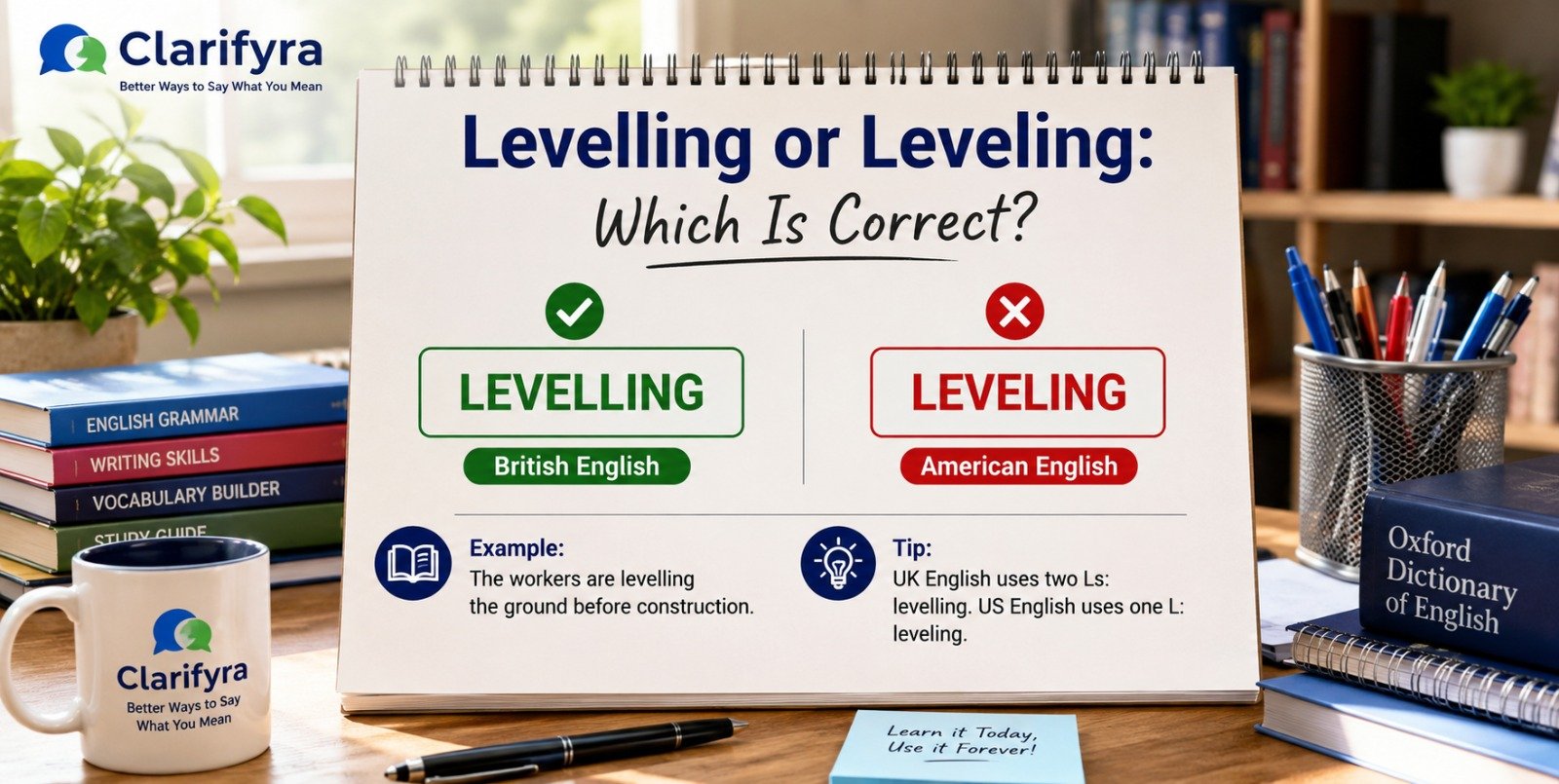
If you are unsure whether to write levelling or leveling, the answer depends mainly on which variety of English you are using. Both forms are correct, and both come from the verb level. The spelling with two Ls is standard in British English, while the spelling with one L is standard in American English. You may see the word used when discussing flat surfaces, equal scores, surveying, gaming, or even making conditions more equal. The meaning stays the same; only the regional spelling changes.
Both levelling and leveling are correct. Levelling is the usual British English spelling, while leveling is standard in American English. Use the form that matches your audience and stay consistent throughout your writing.
Levelling or Leveling: What’s the Difference?
There is no difference in basic meaning between the two spellings.
The distinction is regional:
| Feature | Levelling | Leveling |
|---|---|---|
| Correct spelling? | Yes | Yes |
| Main variety | British English | American English |
| Common in Canada? | Usually preferred | Sometimes seen |
| Meaning | Making something level, equal, or even | Making something level, equal, or even |
| Example | They are levelling the ground. | They are leveling the ground. |
In most cases, choosing between them is similar to choosing between British travelling and American traveling.
If you are writing for readers in the United States, leveling is normally the best choice. For readers in the United Kingdom, levelling is standard.
You May Also Read | Aisle vs Isle: What’s the Difference and Which Word Is Correct?
What Is Levelling?
Levelling is the British English present participle and gerund form of the verb level.
The verb can describe several related actions, including:
- making a surface flat or even
- making two things equal
- bringing something to the same height
- reducing differences between people, places, or conditions
- destroying or flattening a structure in some contexts
Examples:
- The workers are levelling the soil before laying the patio.
- A late goal succeeded in levelling the score.
- The carpenter spent an hour levelling the floor.
- The new scheme is intended to help with levelling regional opportunities.
In all of these sentences, the two-L spelling is appropriate when British spelling conventions are being followed.
What Is Leveling?
Leveling is the standard American English form of exactly the same verb.
It can be used in the same situations as levelling.
Examples:
- The crew is leveling the land for a new building.
- She scored in the final minute, leveling the game.
- We need to finish leveling the concrete.
- He spent the evening leveling his character in the game.
The spelling changes, but the grammatical function and meaning do not.
This means that neither form should be treated as a misspelling simply because it looks unfamiliar to readers from another region.
Levelling or Leveling Meaning in Different Contexts
The meaning of the word depends on what is being made “level.”
Making a Surface Flat
This is one of the most literal meanings.
The contractor is leveling the ground before construction begins.
Here, the action involves making the surface flatter or bringing it to a consistent height.
Making Things Equal
The verb can also refer to reducing a difference.
For example:
The equalizer leveled the score at 2–2.
In British spelling, this could be written with levelled instead.
Creating More Equal Conditions
The word may be used figuratively when talking about fairness or opportunity.
For example:
The funding is intended to help level the playing field for smaller businesses.
The phrase level the playing field means making conditions fairer so that one side does not have an unreasonable advantage.
Knocking Something Down
In another sense, to level can mean destroying or flattening a building or structure.
For example:
The abandoned building was leveled to make room for the new development.
Again, British English would normally use levelled.
Is It Levelling or Leveling in the UK?
In the UK, levelling is the standard spelling.
British English commonly doubles the final l when adding endings such as -ed or -ing to certain words.
Examples include:
- level → levelling
- level → levelled
- travel → travelling
- cancel → cancelled
So a British writer would normally write:
Correct in UK English:
The builders are levelling the site.
The form leveling may still be understood by British readers, but it looks American.
If the rest of your writing follows British conventions, such as colour, centre, and travelling, using levelling keeps the style consistent.
Levelling or Leveling in Canada
Canadian English often combines features of British and American spelling, so some words can vary.
For this particular word, levelling is commonly preferred in standard Canadian usage.
A Canadian writer is therefore likely to use:
- levelling
- levelled
rather than:
- leveling
- leveled
However, American influence means you may still encounter the one-L forms, especially in digital content or writing aimed at a North American audience.
The safest approach is to follow the spelling guide or house style used by the publication, school, company, or organization you are writing for.
Levelling or Leveling Up
The phrase level up originally became especially familiar through games, where a character reaches a higher rank, stage, or ability level.
Both regional forms are correct:
British English:
She is levelling up her character.
American English:
She is leveling up her character.
Today, the expression is also used informally outside gaming.
For example:
- He is leveling up his design skills.
- She wants to level up her career.
- The company is trying to level up its customer service.
In these cases, level up generally means improve, advance, or move to a higher stage.
The spelling rule remains the same: two Ls for typical British usage and one L for American usage.
Levelling or Leveling Synonyms
There is no single synonym that works in every context because level can express several meanings.
Possible alternatives include:
| Context | Possible Synonyms |
|---|---|
| Making land flat | flattening, grading, smoothing |
| Making heights equal | evening, aligning |
| Making conditions fairer | equalizing, balancing |
| Making a score equal | equalizing, tying |
| Improving a game character | advancing, upgrading |
| Destroying a structure | flattening, demolishing |
For example:
Original:
They are leveling the ground.
Alternative:
They are flattening the ground.
But in this sentence:
The striker scored, leveling the match.
Equalizing is a better substitute than flattening.
This is why the best synonym depends on the meaning intended.
Leveling in Surveying
Leveling surveying refers to determining or establishing the elevations of points relative to a known reference level or datum.
The process is important in civil engineering, construction, road design, drainage work, and land development.
A surveyor may use leveling to answer questions such as:
- How much higher is one point than another?
- Is a foundation at the correct elevation?
- What slope is needed for a road or drainage channel?
- Where should earth be removed or added?
In British technical writing, the process is normally called levelling. In American technical writing, leveling is standard.
The underlying surveying method is the same regardless of spelling.
Types of Levelling in Surveying
Several techniques may be used depending on the project and required accuracy.
Simple Levelling
Simple levelling is used when the difference in height between two relatively close points can be measured from one instrument position.
It is one of the most straightforward forms of the process.
Differential Levelling
Differential levelling is used when points are farther apart or when several instrument positions are required.
Measurements are taken in stages to determine the elevation difference between the starting and ending points.
Fly Levelling
Fly levelling is often used to transfer a known elevation or benchmark to another location.
It can help establish temporary benchmarks for a project.
Profile Levelling
Profile levelling records elevations along a particular line.
It is useful for projects such as:
- roads
- railways
- canals
- pipelines
- drainage systems
The measurements help engineers understand how the ground rises and falls along the proposed route.
Reciprocal Levelling
Reciprocal levelling can be useful when two points are separated by an obstacle such as a river, valley, or other feature that makes placing the instrument midway difficult.
Trigonometric Levelling
This method uses measured angles and distances to calculate differences in elevation.
It can be especially useful when direct conventional levelling is inconvenient.
What About Levels of Organization in Ecology?
The phrase levels of organization in ecology is unrelated to the spelling choice between levelling and leveling.
In ecology, levels is the plural noun form of level.
A commonly taught sequence is:
Organism → Population → Community → Ecosystem → Biome → Biosphere
Here is the basic distinction:
- An organism is an individual living thing.
- A population is a group of organisms of the same species in an area.
- A community includes different populations interacting with one another.
- An ecosystem includes living organisms and their physical environment.
- A biome is a large ecological region defined by broad climate and biological characteristics.
- The biosphere includes all parts of Earth where life exists.
So, when discussing ecology, the correct phrase is levels of organization, not levelling of organization or leveling of organization.
Correct Usage Examples
Seeing the two regional forms side by side makes the distinction easier.
British English
- The gardener is levelling the soil.
- Engineers are levelling the construction site.
- He spent two hours levelling up his character.
- The team scored just before halftime, levelling the match.
- Accurate levelling is important during surveying work.
American English
- The gardener is leveling the soil.
- Engineers are leveling the construction site.
- He spent two hours leveling up his character.
- The team scored just before halftime, leveling the game.
- Accurate leveling is important during surveying work.
Both sets are grammatically correct. The difference is simply the spelling convention being followed.
Easy Way to Remember the Difference
A practical way to remember the distinction is to connect the extra L with British spelling.
Think:
British English keeps two Ls: levelling.
American English uses one L: leveling.
You can associate the same pattern with:
- travelling / traveling
- cancelled / canceled
- labelled / labeled
These patterns are not identical for every word in English, but they can help you remember the spelling of levelling.
Common Mistakes to Avoid
One frequent mistake is treating one regional form as universally incorrect. Both are accepted spellings.
Another mistake is mixing conventions within the same piece of writing.
For example:
The company is levelling the ground after it finished leveling the entrance.
Although readers will understand this sentence, the switch between British and American spelling looks inconsistent.
Choose one style:
British:
The company is levelling the ground after it finished levelling the entrance.
American:
The company is leveling the ground after it finished leveling the entrance.
Also avoid confusing leveling with the noun levels. They are different grammatical forms.
Final Verdict: Levelling or Leveling?
Both spellings are correct. Choose levelling for standard British English and usually Canadian English, and choose leveling for standard American English. Their meanings are identical, whether you are talking about flattening land, equalizing a score, advancing in a game, or carrying out surveying work.
Frequently Asked Questions
Is levelling or leveling correct?
Both are correct. Levelling is the standard British English spelling, while leveling is the standard American English spelling.
Is levelling a British spelling?
Yes. British English normally doubles the final l in this form, producing levelling and levelled.
Is leveling correct in American English?
Yes. Leveling with one L is standard in American English, along with the past-tense form leveled.
Is it levelling or leveling in Canada?
Levelling is commonly preferred in Canadian English, although the American spelling leveling may also appear. Follow the style required by your publication or organization.
What does leveling up mean?
Leveling up means advancing to a higher level. It is especially common in gaming, but it can also informally mean improving a skill, career, business, or ability.
What is leveling in surveying?
In surveying, leveling or levelling is the process of determining or establishing the relative elevations of different points using a reference level or datum.
The simplest rule is to match your spelling to your audience and remain consistent: levelling for British-style English and leveling for American English. That distinction is all you need to use the word confidently, and it fits Clarifyra’s goal of making English choices clearer and easier to understand.
You May Also Read | Synch vs Sync: What’s the Difference and Which Is Correct