Tear vs Tare: What’s the Difference and Which Is Correct?
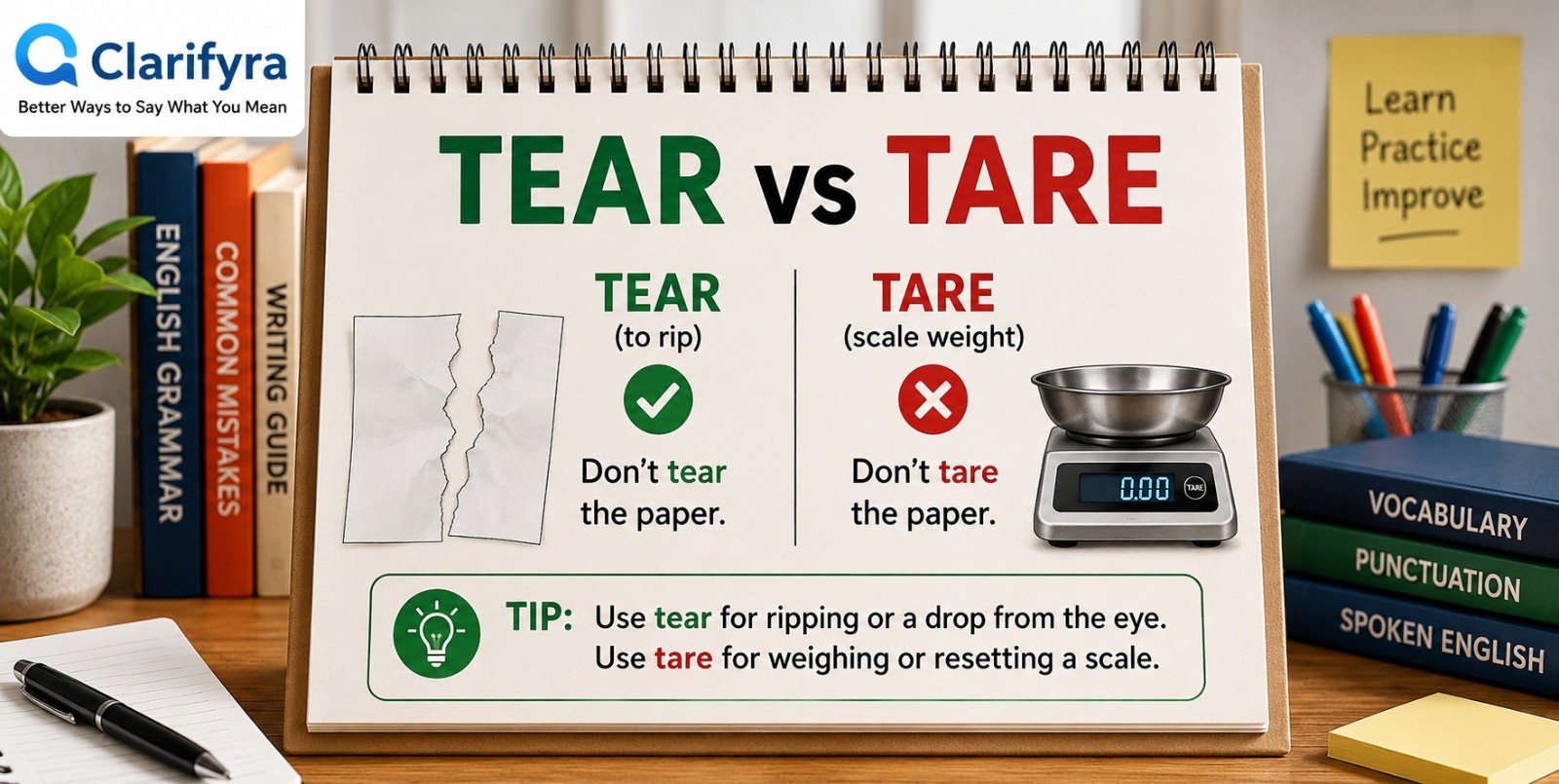
Tear and tare are both real English words, but they are used for very different things. The confusion comes from pronunciation: tear, when it means “to rip,” sounds the same as tare. However, you tear a piece of paper, while you tare a scale to remove the weight of an empty container. There is also another tear, pronounced differently, that refers to a drop of liquid from the eye. Understanding these meanings makes the choice much easier.
Both tear and tare are correct words, but they are not interchangeable. Use tear for ripping something or for a drop from the eye. Use tare when referring to the weight of an empty container or resetting a scale to zero.
Tear vs Tare: What’s the Difference?
The main tear vs tare difference is meaning.
Tear can mean to rip or pull something apart. It can also refer to a drop of liquid produced by the eye.
Tare is mainly a weighing term. It refers to the weight of an empty container or the process of resetting a scale so that the container’s weight is excluded.
Here is a quick comparison:
| Feature | Tear | Tare |
|---|---|---|
| Correct word? | Yes | Yes |
| Main meaning | To rip; a rip; a drop from the eye | Container weight or resetting a scale |
| Word type | Noun or verb | Noun or verb |
| Pronunciation | “Tair” for rip; “teer” for eye liquid | “Tair” |
| Example | Don’t tear the page. | Tare the scale first. |
The words may sound alike in certain contexts, but choosing the correct one depends entirely on what you mean.
You May Also Read | Columbia vs Colombia: Which Spelling Is Correct?
What Is Tear?
The tear definition changes depending on pronunciation and context.
When tear is pronounced like “tair,” it usually means to pull, rip, or split something apart.
Examples:
- Be careful not to tear the envelope.
- The sharp branch could tear your jacket.
- She tried to tear the label off the box.
- Don’t tear the page out of the book.
As a noun, tear can also describe damage caused by ripping:
- There is a small tear in my shirt.
- I noticed a tear in the curtain.
The past tense of this verb is tore, and its past participle is torn.
For example:
- He tore the paper in half.
- My sleeve has been torn.
Tear Meaning a Drop From the Eye
The same spelling has another meaning.
When tear is pronounced like “teer,” it means a drop of liquid that comes from the eye, often because of emotion, irritation, pain, or normal eye moisture.
Examples:
- A tear rolled down her cheek.
- His eyes filled with tears.
- The ending brought a tear to my eye.
This creates an unusual situation where one spelling has two common pronunciations and two clearly different meanings.
What Is Tare?
Tare is a real word, but it does not mean “rip.”
In everyday modern usage, tare is most often connected with weighing. As a noun, it refers to the weight of an empty container, wrapper, vessel, or package.
For example, suppose an empty bowl weighs 250 grams. If you want to weigh only the flour inside it, the bowl’s weight needs to be excluded. That empty-container weight is the tare weight.
As a verb, tare means to adjust a scale so that it reads zero with the empty container already on it.
Examples:
- Put the bowl on the scale and tare it.
- Remember to tare the kitchen scale before adding flour.
- The shipping label lists both gross and tare weight.
- I tared the scale before weighing the ingredients.
This usage is common with kitchen scales, laboratory equipment, shipping, packaging, and commercial weighing.
Tear vs Tear vs Tare Explained
The phrase tear vs tear vs tare becomes much easier to understand when the three meanings are placed side by side.
Tear — “tair”
Means to rip or pull apart.
She might tear the paper.
Tear — “teer”
Means a drop from the eye.
A tear appeared in his eye.
Tare — “tair”
Relates to weighing or container weight.
Tare the scale before adding the ingredients.
The first tear and tare sound alike, which is why they can be confused in writing. The second tear, referring to the eye, has a different pronunciation.
Tear vs Tare Pronunciation
Pronunciation is one of the main reasons these words cause problems.
When tear means “rip,” it is pronounced approximately:
Tear → “tair”
It rhymes with words such as:
- air
- care
- fair
- pair
Tare has the same basic pronunciation:
Tare → “tair”
So these two are homophones in this context: they sound the same but have different spellings and meanings.
However, tear meaning a drop from the eye sounds like:
Tear → “teer”
It rhymes with:
- ear
- fear
- near
- clear
Compare:
- tear the paper → “tair”
- a tear in her eye → “teer”
- tare the scale → “tair”
The sentence context usually makes the intended meaning clear in spoken English.
Is “Tare” Correct When You Mean Rip?
No. Tare as in rip is not correct in standard English.
When you mean to pull something apart, damage material, or split it by force, use tear.
Correct: Don’t tear the paper.
Incorrect: Don’t tare the paper.
Correct: He tore his shirt.
Incorrect: He tared his shirt.
Correct: She accidentally tore the package open.
Incorrect: She accidentally tared the package open.
Use tare only when its actual meaning fits the sentence, such as when discussing a scale or container weight.
Tear vs Tear Up
Tear and tear up are related, but tear up can express a more complete or forceful action.
To tear something simply means to rip it.
I accidentally tore the paper.
To tear something up usually means to rip it into pieces or badly damage it.
He tore up the old letter.
She tore up the receipt and threw it away.
The phrasal verb can also be used figuratively.
For example:
They decided to tear up the old agreement.
Here, tear up can suggest rejecting or abandoning the agreement rather than literally ripping the paper.
There is also tear up in the sense of becoming emotional:
She began to tear up during the speech.
In this sentence, the phrase means that tears began forming in her eyes.
Context and pronunciation tell you which meaning is intended.
Is “Tare Something Up” Correct?
If you mean rip something into pieces, the phrase tare something up is incorrect.
Use:
tear something up
Examples:
Correct: He tore up the letter.
Incorrect: He tared up the letter.
Correct: Don’t tear up the document yet.
Incorrect: Don’t tare up the document yet.
The mistake is understandable because tear meaning “rip” and tare sound the same. Their spelling and meanings, however, are different.
You can tare a scale, but you tear up a letter.
Correct Usage Examples
Looking at the words in complete sentences makes the distinction easier.
Using Tear for Ripping
- Don’t tear the wrapping paper.
- A nail caused a tear in the fabric.
- She tore the envelope open.
- His backpack was torn near the zipper.
- The child began to tear up the old newspaper.
Using Tear for the Eye
- A tear rolled down his cheek.
- Her eyes filled with tears.
- The touching scene brought her to tears.
- He wiped a tear from his eye.
Using Tare
- Tare the scale before adding the rice.
- The container has a tare weight of 200 grams.
- She placed the empty bowl on the scale and tared it.
- Always tare your kitchen scale before measuring ingredients in a container.
Common Mistakes to Avoid
One common error is writing tare when the intended meaning is “rip.”
Incorrect:
Be careful not to tare your shirt.
Correct:
Be careful not to tear your shirt.
Another mistake is forgetting that tear has two pronunciations. A tear in a shirt uses the “tair” pronunciation, while a tear in your eye uses the “teer” pronunciation.
It is also incorrect to write tare up when you mean to rip something apart. The correct phrasal verb is tear up.
Finally, remember that tared is a valid word when talking about scales:
I tared the scale before adding the ingredients.
It would not be correct for describing something that was ripped. For that meaning, use tore or torn.
Easy Way to Remember the Difference
A simple association can help:
Tare = scale.
If the sentence involves a scale, empty container, package weight, or measurement, tare is likely the word you need.
For everything involving ripping, use tear:
- tear paper
- tear fabric
- tear a package
- tear something up
And if liquid is coming from someone’s eye, that is also a tear, although it is pronounced differently.
Final Verdict: Tear or Tare?
Both words are correct, but they serve different purposes. Use tear when you mean to rip something, describe a rip, or refer to a drop from the eye. Use tare when talking about the weight of an empty container or resetting a scale before weighing something. If you mean “rip,” “rip apart,” or “rip up,” tear is the spelling you want.
For Tear vs Tare: What’s the Difference and Which Is Correct?
Tear and tare are both real English words, but they are used for very different things. The confusion comes from pronunciation: tear, when it means “to rip,” sounds the same as tare. However, you tear a piece of paper, while you tare a scale to remove the weight of an empty container. There is also another tear, pronounced differently, that refers to a drop of liquid from the eye. Understanding these meanings makes the choice much easier.
<div style=”background:#F2F4FF; border-left:5px solid #4C60DC; padding:16px 18px; margin:20px 0; border-radius:8px;”> <strong style=”color:#4C60DC; font-size:18px;”>Quick Answer</strong> <p style=”margin:8px 0 0;”>Both <strong>tear</strong> and <strong>tare</strong> are correct words, but they are not interchangeable. Use <strong>tear</strong> for ripping something or for a drop from the eye. Use <strong>tare</strong> when referring to the weight of an empty container or resetting a scale to zero.</p> </div>
Tear vs Tare: What’s the Difference?
The main tear vs tare difference is meaning.
Tear can mean to rip or pull something apart. It can also refer to a drop of liquid produced by the eye.
Tare is mainly a weighing term. It refers to the weight of an empty container or the process of resetting a scale so that the container’s weight is excluded.
Here is a quick comparison:
| Feature | Tear | Tare |
|---|---|---|
| Correct word? | Yes | Yes |
| Main meaning | To rip; a rip; a drop from the eye | Container weight or resetting a scale |
| Word type | Noun or verb | Noun or verb |
| Pronunciation | “Tair” for rip; “teer” for eye liquid | “Tair” |
| Example | Don’t tear the page. | Tare the scale first. |
The words may sound alike in certain contexts, but choosing the correct one depends entirely on what you mean.
What Is Tear?
The tear definition changes depending on pronunciation and context.
When tear is pronounced like “tair,” it usually means to pull, rip, or split something apart.
Examples:
- Be careful not to tear the envelope.
- The sharp branch could tear your jacket.
- She tried to tear the label off the box.
- Don’t tear the page out of the book.
As a noun, tear can also describe damage caused by ripping:
- There is a small tear in my shirt.
- I noticed a tear in the curtain.
The past tense of this verb is tore, and its past participle is torn.
For example:
- He tore the paper in half.
- My sleeve has been torn.
Tear Meaning a Drop From the Eye
The same spelling has another meaning.
When tear is pronounced like “teer,” it means a drop of liquid that comes from the eye, often because of emotion, irritation, pain, or normal eye moisture.
Examples:
- A tear rolled down her cheek.
- His eyes filled with tears.
- The ending brought a tear to my eye.
This creates an unusual situation where one spelling has two common pronunciations and two clearly different meanings.
What Is Tare?
Tare is a real word, but it does not mean “rip.”
In everyday modern usage, tare is most often connected with weighing. As a noun, it refers to the weight of an empty container, wrapper, vessel, or package.
For example, suppose an empty bowl weighs 250 grams. If you want to weigh only the flour inside it, the bowl’s weight needs to be excluded. That empty-container weight is the tare weight.
As a verb, tare means to adjust a scale so that it reads zero with the empty container already on it.
Examples:
- Put the bowl on the scale and tare it.
- Remember to tare the kitchen scale before adding flour.
- The shipping label lists both gross and tare weight.
- I tared the scale before weighing the ingredients.
This usage is common with kitchen scales, laboratory equipment, shipping, packaging, and commercial weighing.
Tear vs Tear vs Tare Explained
The phrase tear vs tear vs tare becomes much easier to understand when the three meanings are placed side by side.
Tear — “tair”
Means to rip or pull apart.
She might tear the paper.
Tear — “teer”
Means a drop from the eye.
A tear appeared in his eye.
Tare — “tair”
Relates to weighing or container weight.
Tare the scale before adding the ingredients.
The first tear and tare sound alike, which is why they can be confused in writing. The second tear, referring to the eye, has a different pronunciation.
Tear vs Tare Pronunciation
Pronunciation is one of the main reasons these words cause problems.
When tear means “rip,” it is pronounced approximately:
Tear → “tair”
It rhymes with words such as:
- air
- care
- fair
- pair
Tare has the same basic pronunciation:
Tare → “tair”
So these two are homophones in this context: they sound the same but have different spellings and meanings.
However, tear meaning a drop from the eye sounds like:
Tear → “teer”
It rhymes with:
- ear
- fear
- near
- clear
Compare:
- tear the paper → “tair”
- a tear in her eye → “teer”
- tare the scale → “tair”
The sentence context usually makes the intended meaning clear in spoken English.
Is “Tare” Correct When You Mean Rip?
No. Tare as in rip is not correct in standard English.
When you mean to pull something apart, damage material, or split it by force, use tear.
Correct: Don’t tear the paper.
Incorrect: Don’t tare the paper.
Correct: He tore his shirt.
Incorrect: He tared his shirt.
Correct: She accidentally tore the package open.
Incorrect: She accidentally tared the package open.
Use tare only when its actual meaning fits the sentence, such as when discussing a scale or container weight.
Tear vs Tear Up
Tear and tear up are related, but tear up can express a more complete or forceful action.
To tear something simply means to rip it.
I accidentally tore the paper.
To tear something up usually means to rip it into pieces or badly damage it.
He tore up the old letter.
She tore up the receipt and threw it away.
The phrasal verb can also be used figuratively.
For example:
They decided to tear up the old agreement.
Here, tear up can suggest rejecting or abandoning the agreement rather than literally ripping the paper.
There is also tear up in the sense of becoming emotional:
She began to tear up during the speech.
In this sentence, the phrase means that tears began forming in her eyes.
Context and pronunciation tell you which meaning is intended.
Is “Tare Something Up” Correct?
If you mean rip something into pieces, the phrase tare something up is incorrect.
Use:
tear something up
Examples:
Correct: He tore up the letter.
Incorrect: He tared up the letter.
Correct: Don’t tear up the document yet.
Incorrect: Don’t tare up the document yet.
The mistake is understandable because tear meaning “rip” and tare sound the same. Their spelling and meanings, however, are different.
You can tare a scale, but you tear up a letter.
Correct Usage Examples
Looking at the words in complete sentences makes the distinction easier.
Using Tear for Ripping
- Don’t tear the wrapping paper.
- A nail caused a tear in the fabric.
- She tore the envelope open.
- His backpack was torn near the zipper.
- The child began to tear up the old newspaper.
Using Tear for the Eye
- A tear rolled down his cheek.
- Her eyes filled with tears.
- The touching scene brought her to tears.
- He wiped a tear from his eye.
Using Tare
- Tare the scale before adding the rice.
- The container has a tare weight of 200 grams.
- She placed the empty bowl on the scale and tared it.
- Always tare your kitchen scale before measuring ingredients in a container.
Common Mistakes to Avoid
One common error is writing tare when the intended meaning is “rip.”
Incorrect:
Be careful not to tare your shirt.
Correct:
Be careful not to tear your shirt.
Another mistake is forgetting that tear has two pronunciations. A tear in a shirt uses the “tair” pronunciation, while a tear in your eye uses the “teer” pronunciation.
It is also incorrect to write tare up when you mean to rip something apart. The correct phrasal verb is tear up.
Finally, remember that tared is a valid word when talking about scales:
I tared the scale before adding the ingredients.
It would not be correct for describing something that was ripped. For that meaning, use tore or torn.
Easy Way to Remember the Difference
A simple association can help:
Tare = scale.
If the sentence involves a scale, empty container, package weight, or measurement, tare is likely the word you need.
For everything involving ripping, use tear:
- tear paper
- tear fabric
- tear a package
- tear something up
And if liquid is coming from someone’s eye, that is also a tear, although it is pronounced differently.
Final Verdict: Tear or Tare?
Both words are correct, but they serve different purposes. Use tear when you mean to rip something, describe a rip, or refer to a drop from the eye. Use tare when talking about the weight of an empty container or resetting a scale before weighing something. If you mean “rip,” “rip apart,” or “rip up,” tear is the spelling you want.
For Clarifyra readers, the simplest rule is worth remembering: tear is for ripping or crying; tare is for weighing.
Frequently Asked Questions
Is it tear or tare when you mean rip?
Use tear when you mean “rip.” For example, “Don’t tear the paper.” Tare is not an alternative spelling for this meaning; it is mainly associated with weighing and container weight.
Are tear and tare pronounced the same?
Sometimes. Tear meaning “rip” and tare are both pronounced roughly like “tair.” However, tear meaning a drop from the eye is pronounced “teer.”
What is the past tense of tear?
The past tense of tear meaning “rip” is tore. Its past participle is torn. For example, “She tore the paper” and “The paper has been torn.”
Can you say “tare up”?
Not when you mean to rip something apart. The correct phrase is tear up, as in “He tore up the letter.” Tare can be used as a verb when resetting or adjusting a scale.
Is tare a real English word?
Yes. Tare is a real English word. In its most relevant everyday use, it refers to the weight of an empty container or the act of adjusting a scale so that the container’s weight is excluded.
What is the difference between a tear in fabric and a tear in your eye?
They use the same spelling but have different meanings and pronunciations. A tear in fabric is a rip and sounds like “tair.” A tear from the eye is liquid produced by the eye and sounds like “teer.” readers, the simplest rule is worth remembering: tear is for ripping or crying; tare is for weighing.
Frequently Asked Questions
Is it tear or tare when you mean rip?
Use tear when you mean “rip.” For example, “Don’t tear the paper.” Tare is not an alternative spelling for this meaning; it is mainly associated with weighing and container weight.
Are tear and tare pronounced the same?
Sometimes. Tear meaning “rip” and tare are both pronounced roughly like “tair.” However, tear meaning a drop from the eye is pronounced “teer.”
What is the past tense of tear?
The past tense of tear meaning “rip” is tore. Its past participle is torn. For example, “She tore the paper” and “The paper has been torn.”
Can you say “tare up”?
Not when you mean to rip something apart. The correct phrase is tear up, as in “He tore up the letter.” Tare can be used as a verb when resetting or adjusting a scale.
Is tare a real English word?
Yes. Tare is a real English word. In its most relevant everyday use, it refers to the weight of an empty container or the act of adjusting a scale so that the container’s weight is excluded.
What is the difference between a tear in fabric and a tear in your eye?
They use the same spelling but have different meanings and pronunciations. A tear in fabric is a rip and sounds like “tair.” A tear from the eye is liquid produced by the eye and sounds like “teer.”
You May Also Read | Upon vs Apon: Which Spelling Is Correct?