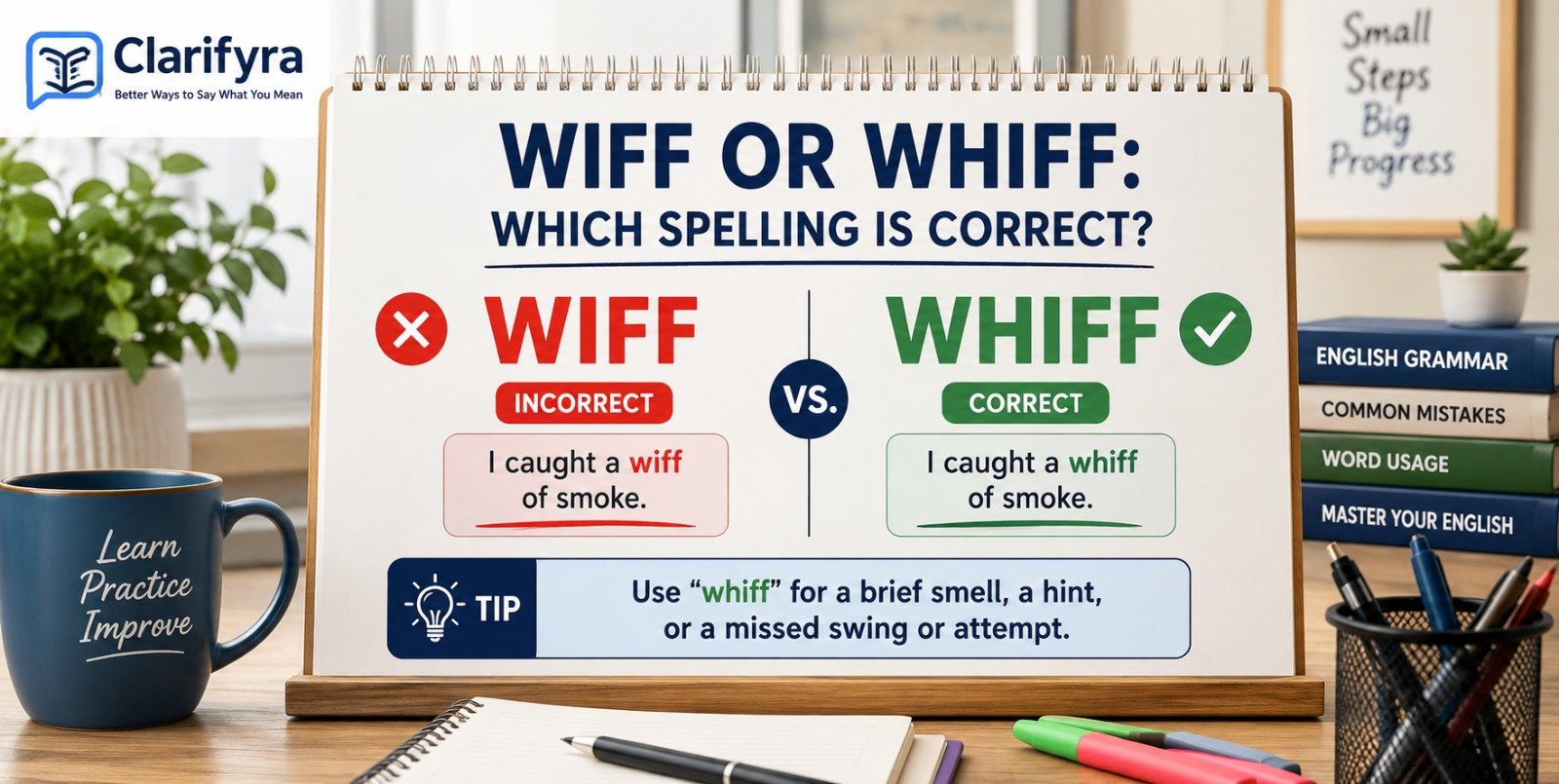
Is It Wiff or Whiff? Meaning and Spelling Explained
“Wiff” and “whiff” sound almost identical, so it is easy to understand why they get mixed up. The important difference is that whiff is the standard English spelling when you mean a brief smell, a faint trace of something, or a complete miss in sports or gaming. Wiff may appear informally, in names, or as a phonetic spelling, but it is not normally the correct form for these everyday meanings.
Whiff is the correct standard spelling when referring to a brief smell, a slight hint, a missed swing, or a failed attempt. Wiff is usually a misspelling or informal phonetic form in these contexts, although it can appear in proper names and specialized uses.
Wiff or Whiff: What’s the Difference?
The simplest difference is that whiff is an established English word with several related meanings, while wiff is generally not used as its standard alternative.
| Feature | Whiff | Wiff |
|---|---|---|
| Standard English word? | Yes | Usually not for these meanings |
| Smell meaning | Yes | Nonstandard |
| Baseball meaning | Yes | Usually a misspelling |
| Gaming meaning | Yes | Informal/nonstandard |
| Figurative “hint” meaning | Yes | Not standard |
| Example | I caught a whiff of smoke. | I caught a wiff of smoke. ✗ |
If you are writing professionally, academically, or simply want to use standard English, whiff is almost always the form you need.
You May Also Read | Is It Colab or Collab? Learn the Correct Usage
What Is Whiff?
Whiff can function as both a noun and a verb.
As a noun, it often describes a brief or faint smell.
For example:
- I caught a whiff of coffee from the kitchen.
- There was a whiff of smoke in the hallway.
- She noticed a faint whiff of perfume.
It can also describe a small trace, suggestion, or hint of something that is not literally a smell.
For example:
- There was a whiff of suspicion around the deal.
- His explanation had a whiff of dishonesty.
- The story carries a whiff of mystery.
As a verb, whiff can mean to swing at something and miss it completely.
For example:
- The batter whiffed at the fastball.
- I whiffed the shot completely.
- She tried to hit the ball but whiffed.
What Is Wiff?
When people ask, “What is wiff?”, the answer depends on the context.
In ordinary English sentences involving smell, sports, gaming, or a failed attempt, wiff is usually a nonstandard spelling of whiff.
For example:
Incorrect in standard English:
I caught a wiff of fresh bread.
Correct:
I caught a whiff of fresh bread.
However, this does not mean the sequence of letters “wiff” can never be correct. It may appear in:
- proper names;
- usernames;
- acronyms;
- business or organization names;
- informal slang;
- specialized terms.
Those uses do not make wiff interchangeable with whiff in normal writing.
Why Are Wiff and Whiff Confused?
The confusion mainly comes from pronunciation.
Whiff is pronounced roughly like “wif.” Because the “h” is not strongly heard, people sometimes spell the word exactly as it sounds.
That produces forms such as:
- wiff of smoke;
- wiffed the ball;
- wiffed my shot.
These spellings may be understandable, especially in informal messages, but whiff remains the conventional spelling.
The easiest rule is:
If you mean a brief smell, a slight hint, or a complete miss, spell it “whiff.”
Wiff or Whiff for a Smell?
For smell, the correct word is whiff.
A whiff is a brief or small amount of a smell that reaches your nose.
Correct Examples
- I caught a whiff of garlic.
- We noticed a whiff of gas near the door.
- A whiff of perfume remained in the room.
- He smelled a whiff of fresh bread.
- There was a strange whiff of smoke outside.
Incorrect Examples
- I caught a wiff of garlic.
- There was a wiff of smoke.
- She noticed a wiff of perfume.
The reader may understand these sentences, but the spelling should normally be whiff.
What Does “Whiff” Mean When Talking About Smell?
The whiff smell meaning is fairly specific: it usually refers to a smell that is noticed briefly rather than continuously.
For example:
I caught a whiff of roses as I walked past the garden.
This suggests that the speaker noticed the scent for a short moment.
A whiff can describe both pleasant and unpleasant smells.
Pleasant smells
- a whiff of vanilla;
- a whiff of coffee;
- a whiff of flowers;
- a whiff of fresh bread.
Unpleasant smells
- a whiff of garbage;
- a whiff of smoke;
- a whiff of chemicals;
- a whiff of rotten food.
So, whiff does not automatically mean a bad smell. The surrounding context tells you whether the scent is pleasant or unpleasant.
Wiff or Whiff in Baseball
In baseball, the correct spelling is also whiff.
To whiff means to swing at a pitch and miss the ball.
Examples:
- The batter whiffed at a fastball.
- He swung hard but completely whiffed.
- The pitcher made the hitter whiff on the breaking ball.
- That pitch produced another whiff.
The word can be used as either a noun or a verb.
Noun: That swing was a complete whiff.
Verb: He whiffed on the pitch.
If you see wiff in casual baseball discussions, it is usually an informal or mistaken spelling rather than the standard sports term.
Whiff Meaning in Gaming
In gaming, whiff commonly means attempting an attack, shot, ability, or other move and failing to connect.
Examples include:
- I completely whiffed my shot.
- He whiffed the attack and lost the round.
- She whiffed her ability.
- I cannot believe I whiffed that easy shot.
The meaning comes naturally from the sports sense of swinging and missing.
Gamers may also use the word more broadly when someone performs an action poorly.
For example:
I totally whiffed that play.
Here, the player means that the attempt failed badly.
You may sometimes see wiff in gaming chats because the spelling matches the pronunciation, but whiff is still the standard form.
Wiff or Whiff Slang Meaning
In informal speech, whiff can mean more than physically missing a ball.
It is often used to describe a failure, mistake, or missed opportunity.
For example:
- The team whiffed on a great opportunity.
- I completely whiffed that interview question.
- The company whiffed on its prediction.
- He whiffed his chance to score.
In these examples, nobody is literally swinging at anything. The idea of “swinging and missing” has become figurative.
Other Ways to Say “Whiff” When You Mean Fail
Depending on the sentence, you could use:
- miss;
- fail;
- mess up;
- botch;
- misjudge;
- fall short;
- get it wrong;
- miss the mark.
For example:
They whiffed on the decision.
Could become:
They misjudged the decision.
or:
They got the decision wrong.
What Does “A Whiff Of” Mean?
The expression “a whiff of” can describe either a literal smell or a figurative hint.
Literal Meaning
There was a whiff of cinnamon in the room.
This means a faint cinnamon smell was noticeable.
Figurative Meaning
There was a whiff of scandal around the situation.
This means there was a slight suggestion or indication of scandal.
Other figurative examples include:
- a whiff of danger;
- a whiff of suspicion;
- a whiff of corruption;
- a whiff of controversy;
- a whiff of nostalgia.
In these cases, whiff is similar to hint, trace, or suggestion.
Wiff or Whiff Synonyms
The best synonym depends on the meaning.
Other Ways to Say “Whiff” for a Smell
- scent;
- smell;
- odor;
- aroma;
- waft;
- trace.
Example:
A whiff of perfume
→ A faint scent of perfume
Other Ways to Say “Whiff” for a Hint
- hint;
- trace;
- suggestion;
- touch;
- indication.
Example:
A whiff of suspicion
→ A hint of suspicion
Other Ways to Say “Whiff” for a Miss
- miss;
- failed attempt;
- unsuccessful swing;
- mistake;
- failure.
Example:
He whiffed the shot.
→ He missed the shot.
Because whiff has several meanings, there is no single synonym that works in every sentence.
Wiff or Whiff on Urban Dictionary and Slang Sites
The phrase wiff or whiff urban dictionary can lead to several informal definitions because user-generated slang sites often contain meanings created by individual contributors.
On those platforms, wiff may appear as a slang spelling, nickname, joke term, or community-specific expression.
That does not necessarily make it standard English.
Slang dictionaries are useful for understanding how people use words informally, but their entries are not the same as conventional dictionary guidance.
For formal or general-purpose writing, use whiff when you mean:
- a brief smell;
- a slight hint;
- a missed swing;
- a missed gaming attack;
- an unsuccessful attempt.
Correct Usage Examples
Here are some side-by-side examples.
Talking About Smell
Correct: I caught a whiff of smoke.
Incorrect: I caught a wiff of smoke.
Talking About Baseball
Correct: The batter whiffed at the pitch.
Incorrect: The batter wiffed at the pitch.
Talking About Gaming
Correct: I whiffed my final shot.
Nonstandard: I wiffed my final shot.
Talking About a Hint
Correct: His answer had a whiff of sarcasm.
Incorrect: His answer had a wiff of sarcasm.
Talking About Failure
Correct: The company whiffed on that opportunity.
Nonstandard: The company wiffed on that opportunity.
Common Mistakes to Avoid
1. Spelling It the Way It Sounds
Because whiff sounds similar to “wif,” people may omit the “h.”
Remember that pronunciation does not always tell you the exact spelling in English.
2. Assuming “Whiff” Only Refers to Smell
The word also appears naturally in sports, gaming, and figurative language.
You can:
- catch a whiff of perfume;
- whiff at a baseball;
- whiff a shot in a game;
- whiff an important opportunity.
3. Assuming Every Use of “Wiff” Is Automatically Wrong
“Wiff” can appear legitimately in proper names, acronyms, and specialized contexts.
The issue is that it is normally not the correct replacement for whiff in everyday English.
4. Confusing “Whiff” With “Wiffle”
Wiffle Ball is a proper name associated with the lightweight perforated plastic ball and game.
However:
We played Wiffle Ball.
But:
I swung at the ball and whiffed.
The similarity between Wiffle and whiff does not change the normal spelling of the verb.
Easy Way to Remember the Correct Spelling
Use this simple rule:
If you smell it or miss it, use WHIFF.
Think of:
- a whiff of perfume;
- a whiff of smoke;
- a batter who whiffs;
- a gamer who whiffs a shot.
The same spelling covers all these common meanings.
Final Verdict: Wiff or Whiff?
For normal English writing, whiff is the correct form when you mean a faint smell, a small hint, a missed swing, or a failed attempt. Wiff may appear informally or in specialized names, but it should not normally replace whiff.
If you remember that you can catch a whiff of a smell and whiff when you miss, the spelling becomes much easier. Understanding small distinctions like this is also what makes resources such as Clarifyra useful when comparing words that sound alike but behave differently in real sentences.
Frequently Asked Questions
Is it wiff or whiff for a smell?
The correct spelling is whiff. For example, “I caught a whiff of smoke” is standard English. “Wiff of smoke” is usually considered a misspelling.
Is wiff a real word?
It can appear in proper names, acronyms, slang, and specialized contexts. However, when referring to a smell, missed swing, or failed attempt, whiff is the standard spelling.
What does whiff mean in baseball?
In baseball, whiff means to swing at a pitch and fail to make contact with the ball. A missed swing can also be called a whiff.
What does whiff mean in gaming?
In gaming, whiff usually means missing an attack, shot, ability, or other action. It can also describe executing a play badly or failing at an important moment.
Does whiff mean a bad smell?
No. A whiff simply means a brief or faint smell. It can refer to something pleasant, such as perfume or coffee, or something unpleasant, such as smoke or garbage.
What are some synonyms for whiff?
For smells, useful alternatives include scent, smell, aroma, odor, and waft. For figurative uses, hint, trace, and suggestion work well. When whiff means “miss,” the closest alternative is usually miss.
You May Also Read | Is It Hidding or Hiding? Correct Spelling Explained