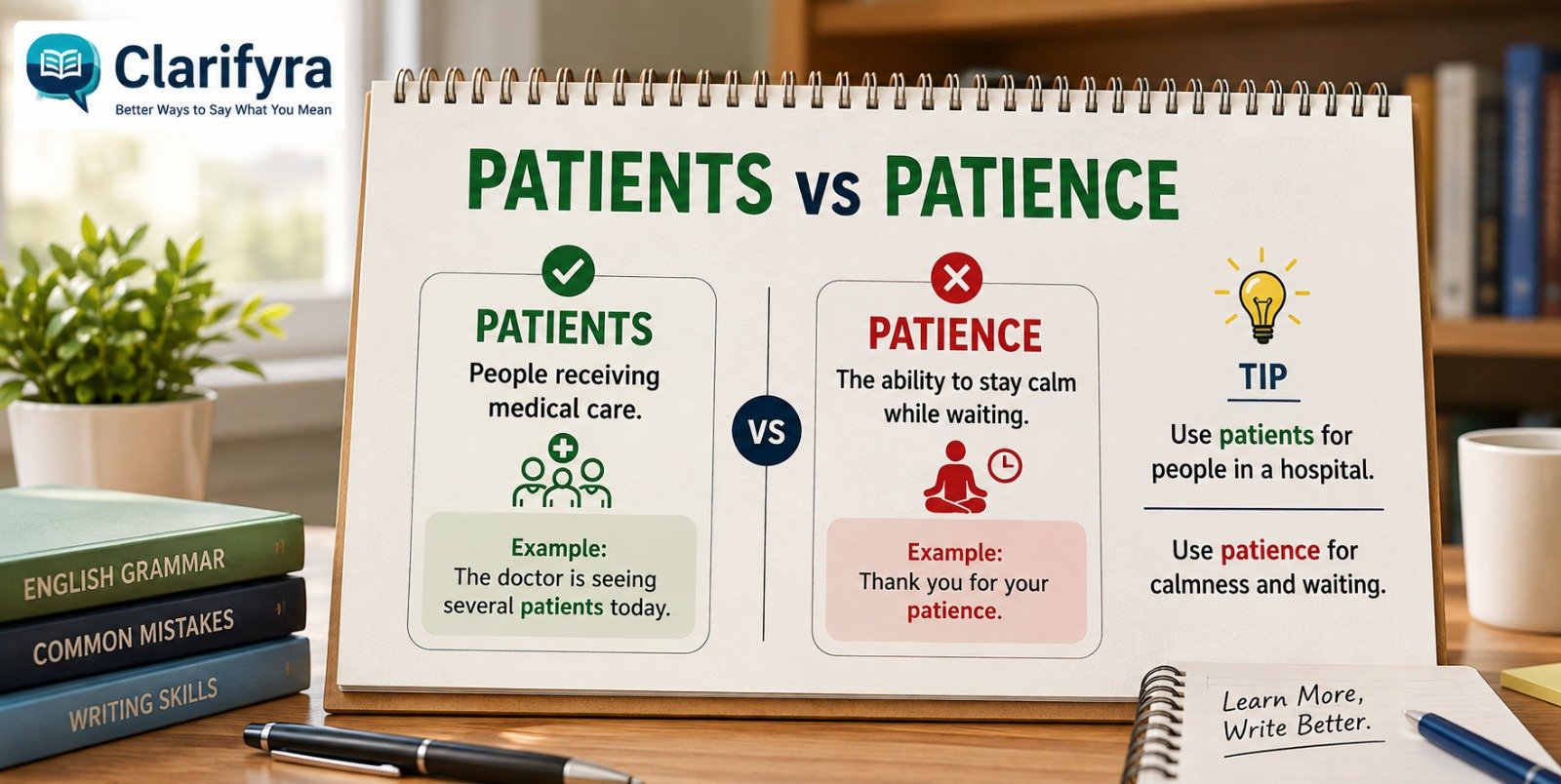
Patients vs Patience: Meaning, Difference, and Examples
The words patients and patience are easy to confuse because they look similar and are pronounced almost the same in everyday speech. However, they have completely different grammatical roles and meanings. Patients refers to people receiving medical care, while patience describes the ability to stay calm while waiting or dealing with difficulty. There is also the singular word patient, which can refer to one person receiving treatment or describe someone who is calm and willing to wait.
Patients means two or more people receiving medical care, while patience means the ability to wait calmly or deal with difficulty without becoming frustrated. Use patient when describing a calm person or referring to one person receiving medical treatment.
Patients vs Patience: What’s the Difference?
Both words are correct, but they are used in different situations.
Patients is the plural form of the noun patient when it refers to people receiving medical treatment.
Patience is an abstract noun referring to calmness, tolerance, or the ability to wait without becoming annoyed.
For example:
- The doctor is seeing several patients today.
- Thank you for your patience while we process your request.
The first sentence refers to people. The second refers to a personal quality.
Quick Comparison
| Feature | Patients | Patience |
|---|---|---|
| Correct word? | Yes | Yes |
| Part of speech | Plural noun | Noun |
| Meaning | People receiving medical care | Ability to remain calm |
| Related form | Patient | Patient |
| Typical use | Hospitals, clinics, doctors | Waiting, tolerance, self-control |
| Example | The nurse checked her patients. | Learning takes patience. |
The related adjective patient is important because it connects closely with patience.
You can say:
- She is patient.
- She has patience.
Both sentences express a similar idea, but the grammar is different.
You May Also Read | Bussed or Bused: Which Spelling Is Correct?
What Is “Patients”?
Patients is the plural form of patient when the word refers to someone receiving medical treatment, examination, or care.
One person is a patient.
Two or more people are patients.
Examples:
- The doctor spoke with three patients this morning.
- All patients must check in at reception.
- The nurse carefully monitored her patients.
- Several patients were waiting outside the clinic.
The word is commonly associated with hospitals, doctors, dentists, therapists, clinics, and other healthcare settings.
Hospital Patient vs Patience
In a medical context, use patient for one person and patients for more than one.
Correct: The hospital admitted a new patient.
Correct: The hospital admitted several patients.
Incorrect: The hospital admitted several patience.
The word patience never means a person receiving healthcare.
What Is “Patience”?
Patience is a noun meaning the ability to stay calm while waiting, dealing with delays, facing difficulties, or handling frustrating situations.
Examples:
- Learning a new language requires patience.
- Please have patience while we investigate the issue.
- She showed great patience with the children.
- His patience was beginning to run out.
Unlike patients, patience does not refer to people.
It refers to a quality, behavior, or state of mind.
A useful grammar pattern is:
Someone has patience.
But:
Someone is patient.
“Thanks for Being Patient” or “Patience”?
The correct phrase is:
Thanks for being patient.
Here, patient is an adjective describing the person.
For example:
- Thanks for being patient while I checked the details.
- Thank you for being so patient with us.
- We appreciate you being patient during the delay.
You can also say:
Thank you for your patience.
In this sentence, patience is a noun.
Both of these are correct:
Thanks for being patient.
Thank you for your patience.
However, this is incorrect:
Thanks for being patience.
The easiest rule is:
Use patient after forms of the verb be.
Use patience after words such as your, my, his, her, show, or have.
“She Is Patient” or “Patience”?
The correct sentence is:
She is patient.
Here, patient is an adjective describing her personality or behavior.
Examples:
- She is very patient with beginners.
- My teacher is patient when explaining difficult topics.
- He remained patient even after a long delay.
You would not normally say:
She is patience.
Instead, if you want to use the noun, say:
She has patience.
or:
She has a lot of patience.
This creates a useful pattern:
She is patient.
She has patience.
Patients vs Patience Spelling Difference
The words are spelled differently near the end.
Patients: p-a-t-i-e-n-t-s
Patience: p-a-t-i-e-n-c-e
The spelling of patients is easy to understand when you break it into two parts:
patient + s = patients
The final s makes the medical noun plural.
By contrast, patience ends in -ence and represents an abstract quality rather than a group of people.
A simple memory trick is:
Patients need Treatment.
The T in patients can remind you of treatment.
Patience helps you stay Calm.
The C in patience can remind you of calm.
Do Patients and Patience Have the Same Pronunciation?
Patients and patience are pronounced very similarly, and in normal conversation they may sound almost identical.
That similarity is one reason the words are frequently confused in writing.
Instead of relying on pronunciation, look at the meaning of the sentence.
Ask yourself:
Am I talking about people receiving medical care?
Use patients.
Am I talking about calmness, tolerance, or waiting?
Use patience.
Am I describing someone who stays calm?
Use patient.
Meaning and grammar are much more reliable than sound when choosing the correct spelling.
Patients, Patient, and Patience Examples
Seeing all three words together makes the distinction clearer.
Patient as a Medical Noun
- The patient is waiting for the doctor.
- The dentist called the next patient.
- Each patient received clear instructions.
Patients as a Plural Noun
- The doctor treated six patients.
- Several patients arrived early.
- Nurses spoke with their patients before the procedure.
Patient as an Adjective
- Please be patient.
- She is incredibly patient with children.
- Try to remain patient while you wait.
Patience as a Noun
- Success often requires patience.
- Thank you for your patience.
- He quickly lost his patience.
- Teaching young children takes patience.
Common Mistakes to Avoid
Most errors happen because writers confuse the adjective patient, the plural noun patients, and the noun patience.
“Please Have Patients”
This can technically be correct if you are talking about a doctor having people to treat.
For example:
The dentist has five patients today.
But if you mean “wait calmly,” the correct sentence is:
Please have patience.
“She Is Patience”
This is incorrect because patience is a noun.
Write:
She is patient.
Or:
She has patience.
“Thank You for Your Patient”
If you are thanking someone for waiting calmly, use:
Thank you for your patience.
The word patient would only make sense if you were literally referring to a person receiving medical care.
“The Hospital Has Many Patience”
This is incorrect.
Write:
The hospital has many patients.
The sentence refers to people, not the quality of waiting calmly.
An Easy Way to Remember the Difference
Use this three-part rule:
Patient = one person or a calm adjective
Patients = several people receiving medical care
Patience = the quality of staying calm
A useful example is:
The patient doctor showed great patience while speaking with her patients.
In this sentence:
- patient describes the doctor.
- patience names her calm quality.
- patients refers to the people receiving care.
If you can understand that sentence, you can usually choose the correct word easily.
Patients vs Patience Meme: A Simple Funny Reminder
The similarity between the words makes them useful for simple wordplay.
A good memory line is:
Doctors need patience for their patients.
The first word refers to calmness.
The second refers to people receiving medical care.
Another simple version is:
A patient doctor has patience with patients.
These sentences may sound repetitive, but they make the grammatical difference easier to remember.
Final Verdict: Patients or Patience?
Use patients when referring to two or more people receiving medical care. Use patience when referring to calmness, tolerance, or the ability to wait without becoming frustrated. Use patient for one person receiving treatment or as an adjective meaning calm and willing to wait.
Frequently Asked Questions
What is the patients vs patience definition?
Patients means multiple people receiving medical treatment or care. Patience means the ability to stay calm while waiting or dealing with difficulties.
Can “patient” mean two different things?
Yes. As a noun, patient means a person receiving medical care. As an adjective, it describes someone who can wait calmly without becoming annoyed.
Is “thank you for your patience” correct?
Yes. Thank you for your patience is correct because patience is a noun referring to calmness or willingness to wait.
Is it “please be patient” or “please be patience”?
Use please be patient. The verb be is followed by the adjective patient, not the noun patience.
Can I say “the doctor has patients”?
Yes. In this context, patients refers to the people the doctor treats. For example: “The doctor has four patients waiting.”
How can I quickly remember the difference?
Think of patients as people receiving treatment and patience as staying calm. You can also remember the sentence: “A good doctor needs patience with patients.”
Choosing between these words becomes much easier once you identify whether the sentence is talking about people, a calm personality, or the quality of calmness itself. Similar word comparisons are also useful for readers of Clarifyra who want to understand small spelling changes that create very different meanings.
You May Also Read | Para vs Por: What’s the Difference and When Should You Use Each?