Sees or See’s: Which One Is Correct?
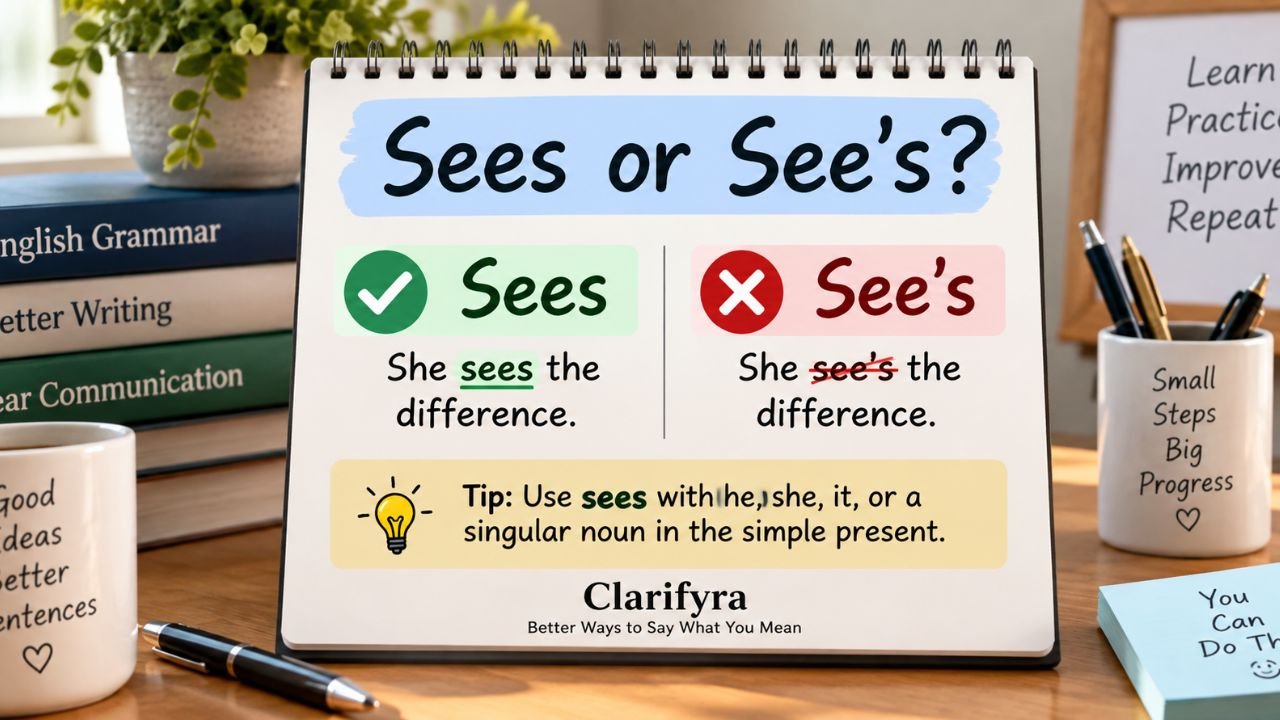
If you are unsure whether to write sees or see’s, the answer is usually straightforward. The correct form of the verb is sees, without an apostrophe. It is the third-person singular present-tense form of see, as in “She sees the problem.” The form see’s is not the standard spelling when you mean the verb sees. Understanding why the apostrophe is unnecessary also makes it easier to avoid similar mistakes with other verbs such as runs, works, and needs.
Sees is the correct form when you need the third-person singular present tense of see: “She sees the difference.” See’s is not the standard verb form and should not be used in this context. The apostrophe in see’s is unnecessary.
Sees vs. See’s: The Basic Difference
Sees is a correctly spelled English word. It is the present-tense form of see used with a singular third-person subject such as he, she, it, or a singular noun.
Examples:
- She sees the mountains from her window.
- He sees his doctor regularly.
- The child sees a bird in the garden.
- Everyone sees the difference.
By contrast, see’s is not the standard way to form this verb. The apostrophe should not be inserted before the s.
| Feature | Sees | See’s |
|---|---|---|
| Standard English form? | Yes | No, when intended as the verb |
| Base word | See | See |
| Function | Third-person singular verb | Not the standard verb form |
| Example | She sees the answer. | ❌ She see’s the answer. |
| Apostrophe needed? | No | No |
So, if your sentence means that he, she, or it sees something, use sees.
What Does “Sees” Mean?
Sees is the third-person singular present form of the verb see.
The verb see has several related meanings depending on context. It can describe physically noticing something, understanding something, meeting someone, or experiencing something.
Seeing something visually
Maya sees a rainbow after the storm.
Here, sees means visually notices or observes something.
Understanding something
He sees why the decision was necessary.
In this sentence, sees means understands or recognizes.
Meeting or visiting someone
She sees her dentist twice a year.
Here, sees means visits or has an appointment with the dentist.
Experiencing something
The town sees thousands of visitors each summer.
Here, sees means experiences or receives.
The meaning changes with the context, but the spelling remains sees.
When Do You Use “Sees”?
Use sees when the subject is third-person singular and the sentence uses the simple present tense.
The pattern is:
He/She/It + sees
For example:
- He sees the problem.
- She sees an opportunity.
- It sees the object.
- Daniel sees his friends on Fridays.
- The dog sees the ball.
- Everyone sees what happened.
Other subjects use see, rather than sees:
- I see the problem.
- You see the problem.
- We see the problem.
- They see the problem.
This is an important distinction because the -s ending is determined by the subject.
See and sees at a glance
| Subject | Correct form | Example |
|---|---|---|
| I | see | I see the problem. |
| You | see | You see the problem. |
| We | see | We see the problem. |
| They | see | They see the problem. |
| He | sees | He sees the problem. |
| She | sees | She sees the problem. |
| It | sees | It sees the object. |
| Emma | sees | Emma sees the problem. |
Why Is “See’s” Incorrect?
The main reason is that an apostrophe is not used to create the ordinary third-person singular form of a verb.
English normally adds -s or -es to a verb when it follows a third-person singular subject in the simple present:
- walk → walks
- run → runs
- work → works
- need → needs
- see → sees
Notice that none of these forms needs an apostrophe.
Therefore:
- She walks to work.
- He runs every morning.
- It works well.
- She needs help.
- He sees the answer.
Writing see’s follows the wrong pattern:
❌ He see’s the answer.
The correct sentence is:
✅ He sees the answer.
The apostrophe is not part of the verb ending.
When Is an Apostrophe Used?
Understanding common uses of apostrophes can explain why see’s sometimes looks tempting.
Apostrophes are commonly used for contractions and possession.
Apostrophes in contractions
For example:
She’s ready.
She’s is a contraction of she is.
Similarly:
He’s finished.
Depending on the context, he’s can represent he is or he has.
Apostrophes for possession
An apostrophe can also indicate possession:
Sarah’s notebook is on the table.
Here, Sarah’s means that the notebook belongs to Sarah.
Neither situation applies to the ordinary verb sees.
Compare:
She sees a bird.
There is no contraction or possessive construction, so no apostrophe is needed.
Correct and Incorrect Examples
The easiest way to understand the rule is to compare sentences directly.
Correct
- She sees a strange light outside.
- He sees the value of the idea.
- The teacher sees a mistake in the sentence.
- My brother sees his friends every weekend.
- Everyone sees the same result.
- The cat sees something moving.
- The manager sees an opportunity for improvement.
Incorrect
- ❌ She see’s a strange light outside.
- ❌ He see’s the value of the idea.
- ❌ The teacher see’s a mistake.
- ❌ My brother see’s his friends.
- ❌ Everyone see’s the same result.
In each case, removing the apostrophe gives you the correct verb: sees.
Is “See’s” Ever Correct?
For the ordinary verb meaning “sees,” no. You should not use see’s as an alternative spelling.
However, it is important not to confuse the specific sequence of letters see’s with every possible use of an apostrophe involving the word see. Apostrophes can have grammatical functions in English, particularly with contractions and possession, but that does not make see’s an accepted replacement for sees.
For normal writing, if you mean:
“She observes something.”
write:
She sees something.
Not:
❌ She see’s something.
This is especially important in formal, academic, professional, and edited writing.
Why Do People Write “See’s”?
The error is easy to understand because English contains many common ’s forms:
- he’s
- she’s
- it’s
- John’s
- Mary’s
Someone may therefore assume that a third-person singular verb should also take ’s.
But ordinary verbs do not work that way.
Compare:
- He runs, not run’s.
- She works, not work’s.
- It needs, not need’s.
- He sees, not see’s.
The important principle is simple: the third-person singular verb ending is normally written with an s, not an apostrophe followed by s.
See, Sees, Saw, and Seen
It can also help to place sees alongside other forms of see.
| Verb form | Use | Example |
|---|---|---|
| see | Base form / present with I, you, we, they | I see the house. |
| sees | Third-person singular present | She sees the house. |
| saw | Simple past | She saw the house yesterday. |
| seen | Past participle | She has seen the house. |
| seeing | Present participle/gerund | She is seeing the house. |
This shows why sees is a genuine grammatical form rather than simply a spelling variation.
A Simple Rule to Remember
Here is an easy rule:
If the subject is he, she, it, or another singular third-person noun, use “sees” in the simple present.
Think:
She → sees
He → sees
It → sees
And remember:
No apostrophe in the verb.
You can also compare it with other regular verbs:
She walks.
He works.
It runs.
She sees.
If you would not write walk’s or run’s in these sentences, you should not write see’s either.
Common Mistakes to Avoid
1. Adding an apostrophe before the verb ending
❌ He see’s the problem.
✅ He sees the problem.
2. Using “see” with a third-person singular subject
❌ She see the difference.
✅ She sees the difference.
3. Using “sees” with a plural subject
❌ They sees the problem.
✅ They see the problem.
4. Confusing “she’s” with “sees”
These are completely different forms.
She’s = she is / she has
sees = third-person singular form of see
For example:
She’s happy because she sees the solution.
Both forms are correct, but they perform different grammatical jobs.
“She Sees” or “She See”?
The correct expression is “she sees.”
Because she is a third-person singular subject, the present-tense verb see changes to sees.
✅ She sees the moon.
❌ She see the moon.
However, there are situations where see remains in its base form after certain auxiliary verbs.
For example:
Does she see the problem?
Not:
❌ Does she sees the problem?
The auxiliary does already carries the grammatical marking, so the main verb returns to its base form.
Similarly:
She does see the problem.
This distinction is useful when learning how the verb behaves in questions and negative sentences.
“He Sees” or “He See”?
The same rule applies to he.
✅ He sees the car.
❌ He see the car.
But after does, use the base form:
✅ Does he see the car?
❌ Does he sees the car?
And after can, use the base form:
He can see the car.
Not:
❌ He can sees the car.
The form sees is specifically the simple present form used directly with a third-person singular subject.
FAQ
Is “sees” a correct word?
Yes. Sees is the standard third-person singular present-tense form of the verb see. For example, “She sees the mountains” is grammatically correct.
Is “see’s” grammatically correct?
Not when you are trying to write the verb sees. The apostrophe is unnecessary, so “She see’s the answer” should be written “She sees the answer.”
What is the meaning of “sees”?
Sees can mean visually notices something, understands something, meets or visits someone, or experiences something, depending on the sentence. It is the third-person singular form of see.
When should I use “sees” instead of “see”?
Use sees with a third-person singular subject in the simple present, such as he, she, it, or a singular noun: “The child sees the bird.” Use see with I, you, we, and they.
Is “sees” singular or plural?
Sees is the third-person singular present form of the verb see. The subject can be singular, such as she, he, the dog, or everyone. It is not the plural form.
How can I remember the correct spelling?
Remember the pattern she sees, he sees, it sees. The ending is simply -s, without an apostrophe. If you are using the verb see in this grammatical position, write sees.
The Bottom Line
Sees is the correct form when see follows a third-person singular subject in the simple present: “She sees the problem.” See’s should not be used as an alternative spelling because the verb ending does not require an apostrophe. Once you remember the pattern he sees, she sees, it sees, the distinction becomes easy. For more clear explanations of confusing English forms, Clarifyra helps you choose better ways to say what you mean.